



















Blood Moon Lunar Eclipse Visible Across Canada Tonight: Viewing Guide, Best Locations, and Astronomical Significance
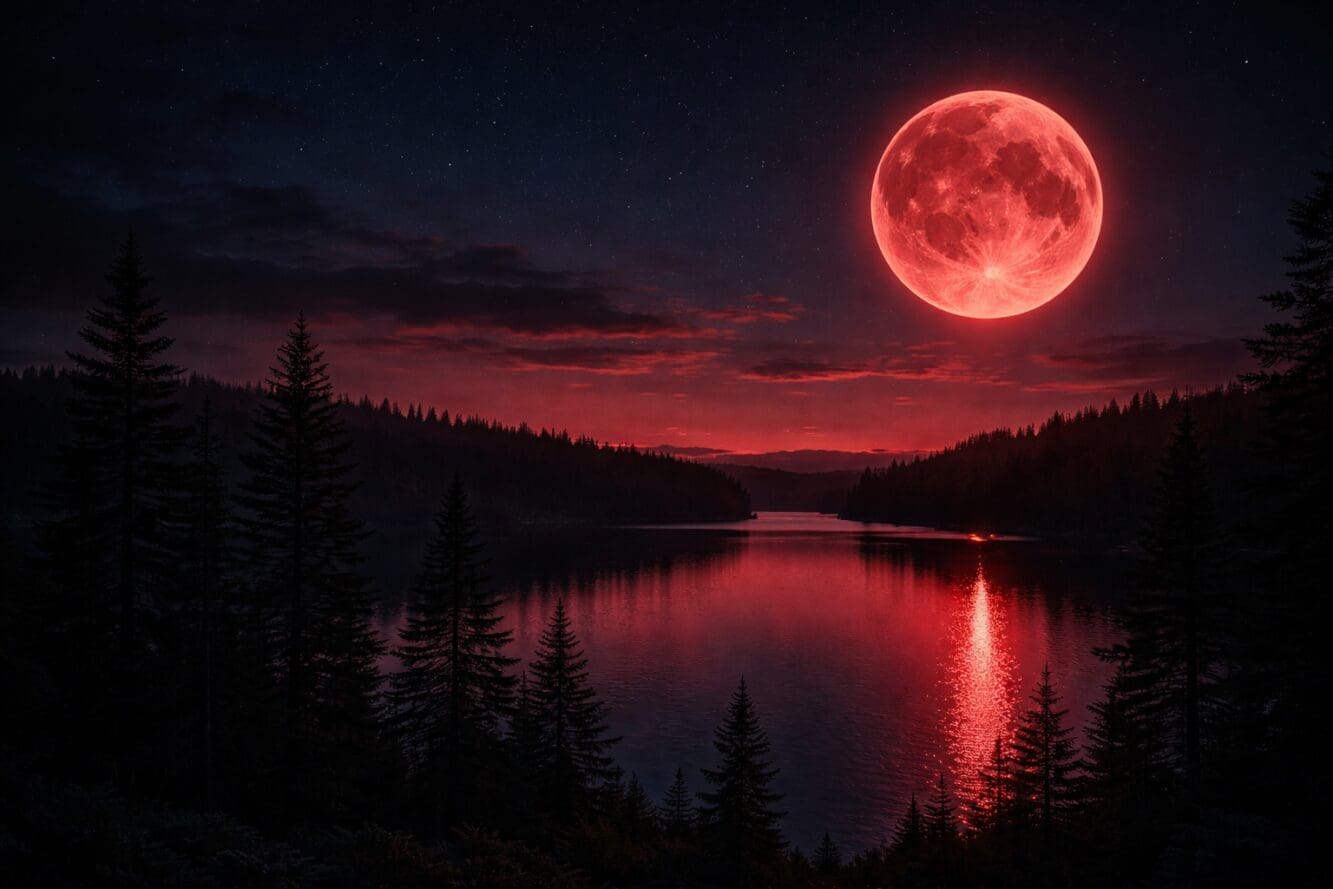
A rare celestial spectacle is about to unfold over Canadian skies. NASA has confirmed that a total lunar eclipse — commonly known as a Blood Moon — will turn the full moon a striking shade of red in the early morning hours of March 3, 2026. The Blood Moon lunar eclipse visible across Canada tonight offers a viewing guide, best locations, and astronomical significance that every skywatcher should know. From coast to coast, Canadians have a front-row seat to one of nature’s most breathtaking shows, and the best part? No special equipment is needed.
This event is accessible to anyone willing to set an early alarm. Whether watching from a backyard in British Columbia or a rooftop in Toronto, the eclipse promises a memorable experience for millions.
Key Takeaways 🌑
- The total lunar eclipse begins at 6:04 a.m. ET on March 3, 2026, with totality lasting approximately 58 minutes and maximum eclipse at 6:33 a.m. ET.
- The entire event spans about 5 hours and 39 minutes, starting with the penumbral phase at 3:44 a.m. ET and concluding at 9:23 a.m. ET.
- No special glasses or telescopes are required — unlike solar eclipses, lunar eclipses are completely safe to view with the naked eye.
- Western Canada has the best viewing conditions, as the moon will be higher in the sky and sunrise occurs later.
- Over 3.3 billion people worldwide can see at least part of the total phase, making this a truly global event.
What Is a Blood Moon and Why Does It Turn Red?
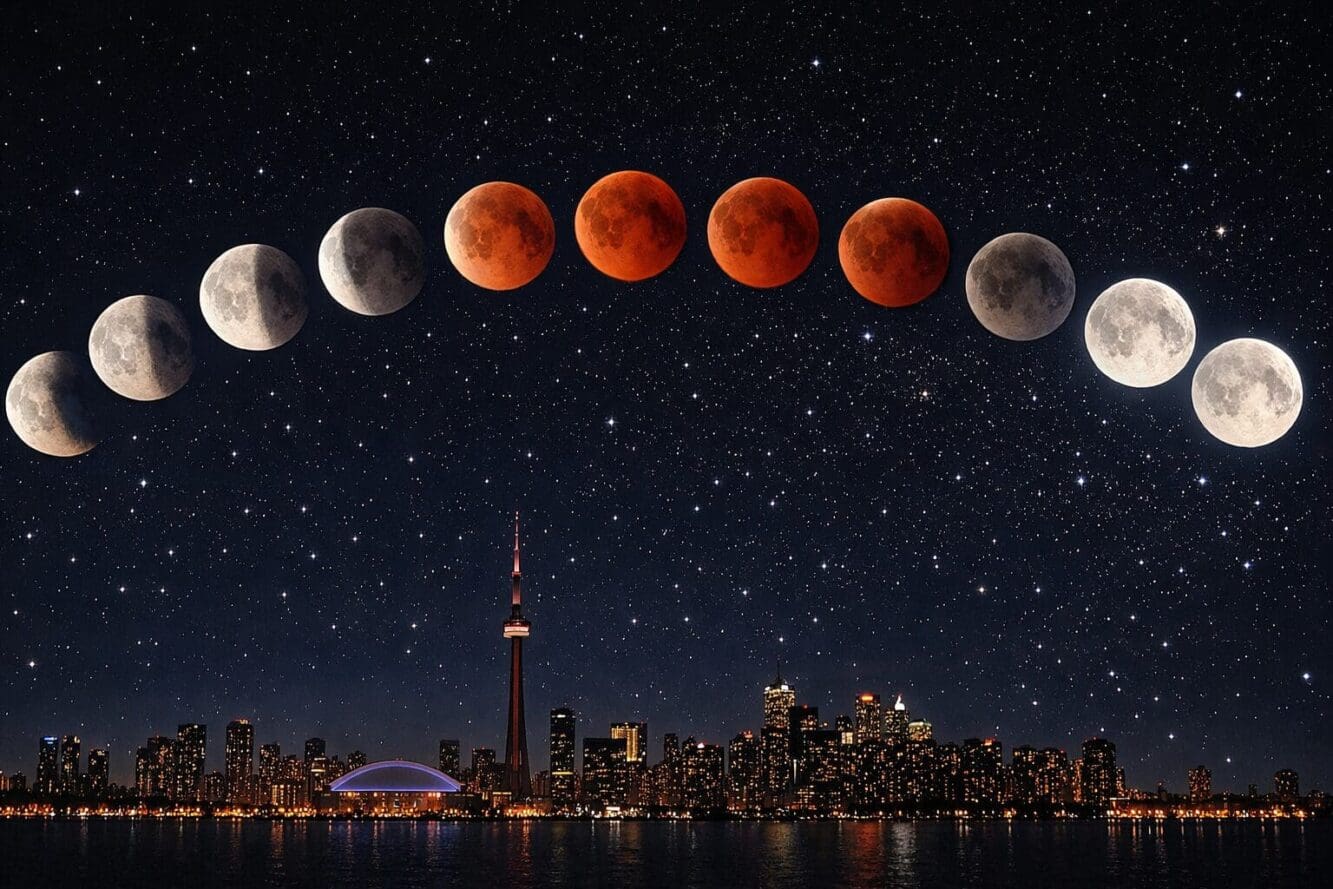
A Blood Moon occurs during a total lunar eclipse when Earth passes directly between the sun and the moon. Earth’s shadow — called the umbra — completely covers the lunar surface. But instead of disappearing entirely, the moon takes on a deep reddish-copper hue.
This dramatic color comes from a phenomenon called Rayleigh scattering. As sunlight passes through Earth’s atmosphere, shorter blue wavelengths scatter away while longer red wavelengths bend around the planet and reach the moon. It is essentially the light from every sunrise and sunset on Earth projected onto the lunar surface simultaneously.
🔴 “The Blood Moon is like watching Earth’s atmosphere paint the moon red — it’s the combined glow of every sunrise and sunset happening at that moment.”
The eclipse magnitude for this event is 1.150, meaning Earth’s shadow will more than fully cover the moon’s diameter. The obscuration reaches 100% of the lunar surface during totality, producing a vivid and deeply saturated red color.
This kind of natural spectacle reminds communities to look up and share experiences that connect people across vast distances.
Complete Viewing Timeline for Canadian Observers
Timing is everything for eclipse watching. Here is the full schedule converted to Eastern Time (ET). Adjust accordingly for your time zone.
| Eclipse Phase | Eastern Time | Pacific Time |
|---|---|---|
| Penumbral phase begins | 3:44 a.m. | 12:44 a.m. |
| Partial eclipse begins | 4:50 a.m. | 1:50 a.m. |
| Totality begins | 6:04 a.m. | 3:04 a.m. |
| Maximum eclipse | 6:33 a.m. | 3:33 a.m. |
| Totality ends | ~7:02 a.m. | ~4:02 a.m. |
| Eclipse concludes | 9:23 a.m. | 6:23 a.m. |
⏱️ Total duration: 5 hours, 39 minutes from start to finish.
What Each Phase Looks Like
- Penumbral phase: A subtle darkening on one side of the moon. Difficult to notice at first.
- Partial eclipse: Earth’s dark umbral shadow begins creeping across the lunar surface — this is when the show really starts.
- Totality: The moon turns fully red or copper-colored for approximately 58 minutes.
- Post-totality: The process reverses as the moon gradually returns to its normal brightness.
For viewers in Eastern Canada, the challenge is that sunrise begins competing with the eclipse during totality. The moon will be low on the western horizon, making an unobstructed view essential.
Best Locations Across Canada for Blood Moon Lunar Eclipse Viewing
The Blood Moon lunar eclipse visible across Canada tonight demands a viewing guide highlighting best locations and astronomical significance for each region. Geography and weather play crucial roles in the quality of the experience.
🏔️ Western Canada (Best Viewing)
British Columbia, Alberta, and Saskatchewan offer the most favorable conditions. The moon will be higher in the sky during totality, and sunrise occurs later, giving viewers the full duration of the red phase against a dark sky.
Top spots include:
- Jasper National Park, Alberta — A designated Dark Sky Preserve with minimal light pollution
- Okanagan Valley, BC — Clear interior skies and wide-open horizons
- Grasslands National Park, Saskatchewan — One of the darkest places in Canada
🌲 Central Canada (Good Viewing)
Manitoba and Ontario viewers can catch totality, but the moon will be lower on the western horizon. Finding an elevated location with a clear westward view is critical.
Communities along Georgian Bay and the Escarpment offer excellent elevated vantage points. Local parks and waterfront areas provide unobstructed western horizons perfect for this event.
🌊 Atlantic Canada (Challenging but Possible)
Quebec, New Brunswick, Nova Scotia, PEI, and Newfoundland face the toughest conditions. Sunrise arrives earliest here, meaning the sky will already be brightening during totality. The moon will sit very low on the western horizon.
Pro tip: Head to the highest elevation available with a completely clear western view. Even partial views of the Blood Moon near the horizon can produce stunning photographs.
Viewing Guide: Tips for the Best Blood Moon Experience
Whether a seasoned astronomer or a first-time skywatcher, these tips will maximize the experience.
Essential Viewing Tips ✅
- No special equipment needed — Lunar eclipses are 100% safe to watch with bare eyes, unlike solar eclipses
- Binoculars or a small telescope enhance the experience by revealing surface details and color variations
- Find a dark location away from streetlights, headlights, and building lights
- Check the weather forecast the evening before — clouds are the number one obstacle
- Look west-southwest as the moon will be setting toward the western horizon during totality
- Arrive early to let eyes adjust to darkness (at least 15-20 minutes)
- Dress warmly — March mornings in Canada are cold, and standing still makes it worse
For Urban Viewers 🏙️
City dwellers face extra light pollution challenges. Here are specific strategies:
- Rooftops and parking garages offer elevated, unobstructed views
- Waterfront areas facing west provide open sky lines
- Turn off nearby lights if possible, and avoid looking at phone screens
- Use red-filtered flashlights to preserve night vision
Residents in communities like Collingwood and surrounding areas can take advantage of nearby trails and parks that offer darker skies just minutes from town. Even checking local community event listings may reveal organized viewing gatherings.
Photography Tips 📸
- Use a tripod — even smartphone photos improve dramatically with stability
- Turn off the flash
- For DSLRs: start with ISO 800, f/5.6, and 1-2 second exposures during totality
- Smartphone users should try night mode or long-exposure apps
Astronomical Significance of the Blood Moon Lunar Eclipse
The astronomical significance of the Blood Moon lunar eclipse visible across Canada tonight extends far beyond its visual beauty. This viewing guide highlights why best locations matter and what science reveals.
Scientific Value
Lunar eclipses have helped astronomers for centuries. By studying how Earth’s shadow falls on the moon, scientists can:
- Measure atmospheric conditions — The exact shade of red reveals information about particles in Earth’s atmosphere, including volcanic ash and pollution levels
- Confirm Earth’s shape — Ancient Greek astronomers used the curved shadow during lunar eclipses as proof that Earth is round
- Calibrate instruments — Modern telescopes use eclipse events to fine-tune light-sensing equipment
The connection between climate conditions and atmospheric science makes each eclipse a data point for understanding our planet’s changing atmosphere.
Cultural and Historical Significance
Blood Moons have captivated human civilizations for thousands of years. Indigenous peoples across Canada have rich traditions connected to lunar events. The Cree, Ojibwe, and other First Nations hold deep cultural connections to celestial cycles that guided planting, hunting, and ceremony.
In 2026, this eclipse also serves as a powerful reminder of our place in the cosmos — a moment when millions of people across multiple continents share the same sky simultaneously. Events like National Indigenous Peoples Day celebrations honor these longstanding connections between communities and the natural world.
How Rare Is This Event?
Total lunar eclipses occur roughly two to five times every decade on average. However, not every eclipse is visible from the same location. For Canadian observers, the combination of totality, reasonable viewing hours, and nationwide visibility makes this a noteworthy event.
🌍 This eclipse reaches 3.34 billion people — over 41% of the world’s population can witness at least part of totality.
Weather Outlook and Backup Plans
The biggest threat to eclipse viewing is always cloud cover. March weather across Canada is notoriously unpredictable.
- Western provinces generally have better odds of clear skies in early March
- Ontario and Quebec may face variable cloud cover — check forecasts within 24 hours of the event
- Atlantic provinces often experience overcast conditions this time of year
If clouds roll in, several organizations and observatories will be livestreaming the event online. NASA, the Royal Astronomical Society of Canada, and various YouTube channels will provide real-time coverage.
Conclusion
The Blood Moon lunar eclipse of March 3, 2026, is a rare gift for Canadian skywatchers. With totality lasting nearly an hour and the entire event spanning over five hours, there are multiple opportunities to witness this celestial phenomenon.
Here are the actionable next steps:
- ⏰ Set an alarm for 3:30 a.m. ET (or equivalent in your time zone) to catch the full progression
- 📍 Scout a viewing location today — look west, find dark skies, and ensure an unobstructed horizon
- 🧥 Prepare warm clothing, hot drinks, and a blanket or chair for comfort
- 📱 Download a stargazing app like Stellarium or SkySafari to track the moon’s position in real time
- 👨👩👧👦 Invite friends and family — shared celestial experiences create lasting memories
Clear skies and happy viewing, Canada. 🌕➡️🔴
Content, illustrations, and third-party video appearing on GEORGIANBAYNEWS.COM may be generated or curated with AI assistance or reproduced pursuant to the fair dealing provisions of the Copyright Act, R.S.C. 1985, c. C-42. Attribution and hyperlinks to original sources are provided in acknowledgment of applicable intellectual property rights. Such referencing is intended to direct traffic to and support the original rights holders’ platforms.