




















Smart Self-Watering Pots: Tech-Enabled Container Gardening for Busy Canadian Urbanites
Last updated: March 5, 2026
Smart self-watering pots solve a straightforward problem: they keep plants alive when life gets in the way. For Canadian urbanites juggling long work hours, travel, and limited outdoor space, tech-enabled container gardening for busy Canadian urbanites removes the guesswork from growing herbs, vegetables, and ornamentals on balconies, windowsills, and rooftops. These systems use built-in reservoirs, soil moisture sensors, and increasingly, app-connected IoT features to deliver water only when plants need it, cutting water waste by up to 50% compared to hand watering [3].
The global self-watering pot market is projected to reach USD 381.3 million in 2026 and could hit USD 644.2 million by 2035 at a 6% compound annual growth rate [1]. Canada’s share of that market is growing steadily as condo dwellers and apartment renters look for compact, low-maintenance growing solutions that work through harsh winters indoors and short but intense summers outdoors.
Key Takeaways
- Smart self-watering pots use reservoirs and wicking systems to deliver consistent moisture, with some models adding Bluetooth or Wi-Fi sensors for app-based monitoring.
- These systems can reduce water consumption by up to 50% while keeping plants healthier than manual watering [3].
- A basic self-watering pot costs $15–$40 CAD; sensor-equipped smart models range from $60–$200+ CAD.
- Self-watering pots can sustain plants for a full week or longer without attention, compared to traditional pots that may need watering twice daily in summer [3].
- About 75% of young adults prefer sustainable gardening solutions, making smart pots especially popular with millennial and Gen Z Canadians [4].
- Canadian-specific considerations include frost-resistant materials, indoor growing during winter, and choosing reservoirs sized for dry summer heat.
- Common mistakes include overfilling reservoirs (causing root rot) and using soil mixes that don’t wick properly.
Quick Answer
Smart self-watering pots combine a water reservoir, a wicking mechanism, and (in higher-end models) electronic soil moisture sensors to automate plant hydration. They’re ideal for Canadian urbanites with limited space and unpredictable schedules. Choose a basic wicking model for herbs and small plants under $40, or invest in a sensor-equipped smart planter ($60–$200+) for app notifications, automated watering schedules, and multi-plant monitoring.
What Are Smart Self-Watering Pots and How Do They Work?
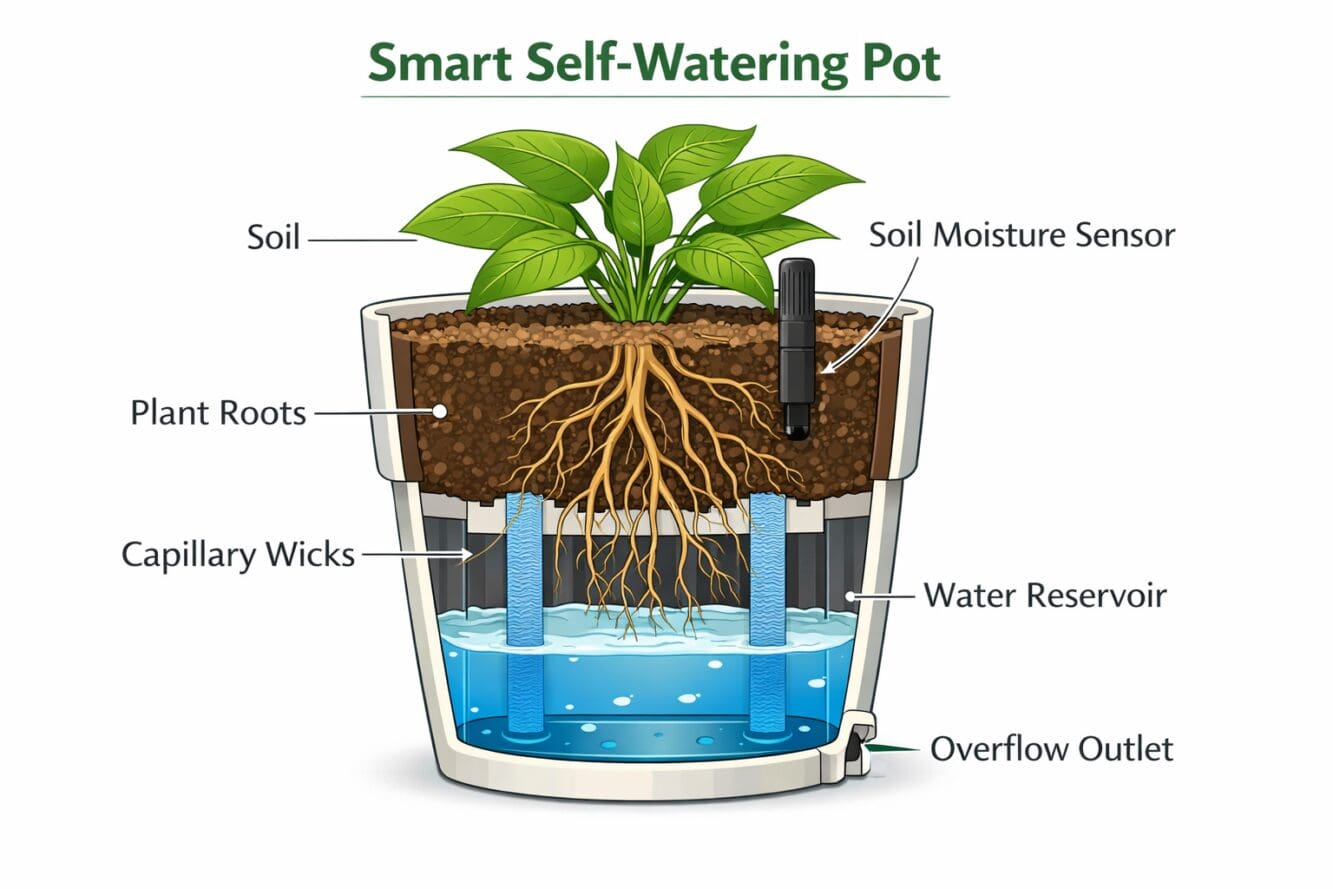
Smart self-watering pots are containers with a built-in water reservoir separated from the soil by a barrier. Water moves upward through a wick or capillary mat into the root zone as the soil dries out. “Smart” versions add electronic sensors and connectivity.
Core components:
- Water reservoir: A chamber below or beside the soil that holds a supply of water, typically enough for 3–14 days depending on pot size and plant type.
- Wicking system: A fabric wick, porous insert, or capillary channel that draws water from the reservoir into the soil through capillary action.
- Water level indicator: Ranges from a simple float gauge to an electronic sensor that sends readings to a smartphone app [5].
- Overflow drain: Prevents waterlogging by releasing excess water after the reservoir is full.
- Smart features (premium models): Bluetooth or Wi-Fi soil moisture sensors, light sensors, temperature monitors, and companion apps that send watering reminders or trigger automated pumps.
The principle is simple: instead of watering from the top down (where much water runs through and out), water is delivered from below, directly to the root zone. This bottom-up approach keeps moisture levels more consistent and wastes far less water.
Choose a basic model if the goal is simply reducing watering frequency for a few kitchen herbs. Choose a sensor-equipped model if managing multiple plants, traveling frequently, or wanting data on light and soil conditions.
Why Are Smart Self-Watering Pots Ideal for Busy Canadian Urbanites?
Canadian urban life creates specific gardening challenges that smart self-watering pots directly address: small living spaces, extreme seasonal variation, and packed schedules.
Space constraints. Over 30% of Canadians live in apartments or condos, particularly in Toronto, Vancouver, Montreal, and Calgary. Smart self-watering pots are designed for balconies, windowsills, and countertops. Many models are stackable or wall-mountable.
Seasonal extremes. Canadian winters mean indoor growing for 5–7 months in most regions. Self-watering pots maintain consistent moisture indoors where dry forced-air heating can parch soil within hours. In summer, when outdoor container plants may need watering twice daily during heat waves, a reservoir-equipped pot can keep plants hydrated through the hottest stretches without daily attention [3].
Busy lifestyles. Self-watering pots can sustain hydration for a full week or longer without any intervention [3]. For professionals who travel for work or spend weekends at cottage country, that autonomy is the difference between thriving plants and dead ones.
Water conservation. Many Canadian municipalities have summer watering restrictions. Smart watering solutions can cut water use by up to 50% [3], which matters both for utility bills and for broader environmental stewardship.
Common mistake: Assuming all self-watering pots work in freezing temperatures. Plastic reservoirs can crack if water freezes inside. Bring outdoor smart pots indoors before the first hard frost, or drain reservoirs completely.
How Do Smart Self-Watering Pots Compare to Traditional Containers?
Smart self-watering pots outperform traditional containers on consistency, water efficiency, and convenience, but they cost more upfront and require specific soil mixes.
| Feature | Traditional Pot | Basic Self-Watering Pot | Smart Self-Watering Pot |
|---|---|---|---|
| Price range (CAD) | $5–$30 | $15–$40 | $60–$200+ |
| Watering frequency | Daily to twice daily (summer) | Every 5–10 days | App-managed; 7–14+ days |
| Water efficiency | Low (runoff, evaporation) | Moderate (reservoir-fed) | High (up to 50% reduction) [3] |
| Monitoring | Visual/manual only | Float gauge | App alerts, soil data |
| Best for | Budget growers, experienced gardeners | Casual growers, herbs | Frequent travelers, multi-plant setups |
| Frost risk | Low (terra cotta can crack) | Moderate (reservoir water) | Moderate (electronics + reservoir) |
| Soil requirement | Any potting mix | Lightweight, wicking mix | Lightweight, wicking mix |
Decision rule: If growing fewer than three plants and home most days, a traditional pot works fine. If managing five or more containers, traveling regularly, or wanting to track growing conditions, a smart self-watering pot pays for itself in saved plants and reduced water bills within one to two growing seasons.
What Should Canadians Look for When Choosing a Smart Self-Watering Pot?
Prioritize reservoir size, material durability, sensor quality, and compatibility with Canadian growing conditions.
Reservoir capacity. For Canadian summers, look for reservoirs that hold at least 1–2 litres for small pots (herbs) and 4–8 litres for larger planters (tomatoes, peppers). Bigger reservoirs mean longer intervals between refills.
Material.
- Recycled plastic (e.g., Keter’s recycled plastic line, introduced in 2022 [5]) is lightweight, affordable, and frost-resistant if drained before winter.
- Ceramic/premium (e.g., Lechuza’s self-watering ceramic collection [5]) looks better indoors but is heavier and more fragile.
- UV-stabilized plastic resists sun damage on south-facing Canadian balconies.
Sensor and app features. Current models offer water level indicators ranging from simple floats to integrated electronic sensors [5]. For smart functionality, look for:
- Bluetooth or Wi-Fi connectivity
- Soil moisture, temperature, and light readings
- Push notifications when water is low
- Compatibility with iOS and Android
Drainage and overflow. Essential for outdoor use during Canadian rainstorms. A good overflow drain prevents waterlogging.
Soil mix compatibility. Self-watering pots require a lightweight, peat-free or coco coir-based mix that wicks effectively. Dense garden soil blocks capillary action and leads to dry roots despite a full reservoir.
Edge case: If growing on a north-facing balcony with limited light, pair a smart planter that includes a light sensor with shade-tolerant herbs like mint, parsley, or chives. The app data will confirm whether plants are getting enough light or need to be relocated.
Which Plants Grow Best in Smart Self-Watering Pots in Canada?
Herbs, leafy greens, and compact fruiting vegetables thrive in self-watering containers. Drought-loving plants like succulents and lavender are poor candidates because consistent moisture can cause root rot.
Best choices for Canadian smart self-watering pots:
- Herbs: Basil, cilantro, parsley, mint, chives (start indoors in February, move to balcony after last frost)
- Leafy greens: Lettuce, spinach, kale, arugula (excellent for spring and fall shoulder seasons)
- Compact vegetables: Cherry tomatoes, peppers, bush beans (need full sun and larger reservoirs)
- Flowers: Petunias, marigolds, impatiens (consistent moisture produces better blooms)
- Indoor year-round: Pothos, peace lily, spider plant, African violets
Avoid in self-watering pots: Succulents, cacti, rosemary (prefers dry soil between waterings), and lavender. These plants need the soil to dry out completely between waterings, which conflicts with the constant-moisture design of self-watering systems.
For those interested in connecting with local community growing initiatives, smart container gardening can complement shared garden plots and neighbourhood food-growing programs.
What Are the Leading Smart Self-Watering Pot Brands and Technologies in 2026?
The market is split between established planter brands adding smart features and tech startups building garden gadgets from scratch.
Notable brands and innovations:
- Click & Grow: Uses proprietary pre-seeded plant pods licensed to partners like Ermonix for integration into the Hydrovase and Garden Cube systems [3]. Good for beginners who want a plug-and-play indoor herb garden.
- Lechuza: Premium ceramic self-watering planters with enhanced wicking technology, expanded for larger plants [5]. Best for design-conscious indoor growers.
- Keter: Recycled plastic self-watering planters emphasizing durability and sustainability [5]. Practical for outdoor Canadian balcony use.
- Glowpear: Launched smart self-watering planters with integrated UV sterilization in the reservoir [5], which helps prevent algae and bacterial growth.
- Watric (Walty 2.0): Launched via crowdfunding in August 2024, this Puerto Rico-based company integrates atmospheric water generation using dehumidification principles, meaning the planter partially generates its own water supply from humidity in the air [3]. An interesting option for indoor growing where refilling is inconvenient.
Technology trends shaping the market in 2026:
AI, IoT, and smart sensing technologies are reshaping planters from passive containers into intelligent care systems. Soil moisture sensors paired with automated irrigation protocols can now be optimized by real-time environmental data [3]. Some systems learn a plant’s specific water needs over time and adjust delivery accordingly.
The growing role of technology in daily life extends naturally into how Canadians manage their homes and gardens, and smart planters fit squarely into that trend.
How Much Do Smart Self-Watering Pots Cost, and Are They Worth It?
A basic self-watering pot costs $15–$40 CAD. Sensor-equipped smart models range from $60 to $200+. Pod-based systems like Click & Grow start around $100–$150 CAD for a starter kit, with ongoing pod costs of $10–$20 per three-pack.
Cost breakdown for a typical Canadian balcony setup (4–6 plants):
| Setup Type | Initial Cost (CAD) | Annual Ongoing Cost | Watering Time Saved |
|---|---|---|---|
| Traditional pots + manual watering | $30–$80 | $20–$40 (soil, fertilizer) | None |
| Basic self-watering pots | $80–$200 | $20–$40 (soil, fertilizer) | 3–5 hours/month |
| Smart self-watering system | $300–$800 | $40–$80 (soil, pods, batteries) | 5–8 hours/month |
Is it worth it? For someone who has killed multiple rounds of plants due to inconsistent watering, yes. The cost of replacing dead herbs and vegetables every few weeks adds up quickly. A $60 smart pot that keeps a basil plant alive for an entire growing season pays for itself versus buying fresh basil at $3–$4 per bunch weekly.
For budget-conscious growers, a middle path works well: use basic self-watering pots for most plants and add one smart sensor (like a standalone Bluetooth soil monitor for $20–$40) to the most important or finicky plant.
What Are Common Problems with Smart Self-Watering Pots, and How to Fix Them?
Most issues stem from improper setup rather than product defects. Here are the most frequent problems and their fixes.
Root rot. Caused by overfilling the reservoir or using soil that retains too much moisture. Fix: use a well-draining potting mix with perlite or coco coir, and never fill the reservoir above the maximum line. Allow the reservoir to empty completely between refills occasionally.
Algae growth in reservoir. Warm, light-exposed water breeds algae. Fix: use an opaque pot (not clear plastic), clean the reservoir monthly with diluted vinegar, or choose a model with UV sterilization like Glowpear’s line [5].
Wicking failure. The wick dries out or becomes clogged with mineral deposits. Fix: replace fabric wicks annually, flush the system with clean water every few months, and avoid using hard tap water (common in many Canadian municipalities). Consider using filtered water or collecting rainwater during summer.
Sensor inaccuracy. Bluetooth sensors can lose connection or give false readings if the battery is low. Fix: replace batteries on a schedule (every 3–6 months), keep the sensor clean, and recalibrate according to the manufacturer’s instructions.
Salt buildup. Fertilizer salts accumulate in the reservoir and wicking zone over time. Fix: flush the entire system with plain water once a month during the growing season. This is especially important for areas with mineral-rich water.
Frozen reservoirs. Canadian-specific problem. Fix: bring all self-watering pots indoors before temperatures drop below 0°C, or drain reservoirs completely if pots must stay outside temporarily.
What Does the Future Look Like for Smart Container Gardening in Canada?
The Canadian self-watering pot market is expected to grow steadily through 2031 [1], driven by urbanization, sustainability concerns, and improving technology.
The broader North American pots and planters market was valued at USD 5.8 billion in 2025 and is projected to reach USD 10 billion by 2035 [2]. Smart solutions are capturing an increasing share of that market as sensor costs drop and app ecosystems mature.
Key trends to watch:
- Atmospheric water generation (like Watric’s Walty 2.0) could reduce dependence on municipal water entirely for small-scale container gardens [3].
- AI-driven plant care that learns individual plant behaviour and adjusts watering, lighting recommendations, and fertilizer schedules automatically.
- Modular systems that connect multiple smart pots into a single app-managed network, ideal for balcony and rooftop setups.
- Sustainable materials continuing to replace virgin plastics, with recycled and biodegradable options becoming standard [5].
- Community integration as urban growing connects with local food initiatives and municipal sustainability programs.
Around 75% of young adults express a preference for sustainable gardening solutions [4], and as this demographic moves into peak home-furnishing years, demand for smart, eco-friendly growing systems will only increase.
Conclusion
Smart self-watering pots make container gardening practical for Canadians who want fresh herbs, greens, and flowers but don’t have the time or space for a traditional garden. The technology is mature enough to be reliable, affordable enough to justify the investment, and increasingly sophisticated with app-based monitoring and AI-driven care.
Actionable next steps:
- Start small. Pick up one basic self-watering pot ($15–$40) and grow a single herb like basil or mint to test the system.
- Upgrade selectively. Add a Bluetooth soil sensor to the plant that matters most, and see whether the data changes how you grow.
- Plan for seasons. Set up indoor growing by October, start seeds in February, and move containers to the balcony after the last frost in your region (typically mid-May for southern Ontario, early June for the Prairies).
- Use the right soil. A lightweight, peat-free mix with perlite and coco coir is essential for proper wicking.
- Join the community. Connect with local gardening groups and neighbourhood events to share tips and surplus harvests.
The best garden is the one that actually produces food and flowers. For busy Canadian urbanites, smart self-watering pots make that far more likely to happen.
FAQ
How long can a smart self-watering pot go without refilling?
Most models sustain plants for 7–14 days depending on pot size, plant type, and ambient temperature. In peak Canadian summer heat, expect closer to 5–7 days for outdoor containers [3].
Do smart self-watering pots work in Canadian winters?
Yes, indoors. They’re excellent for countering dry forced-air heating. Do not leave water-filled reservoirs outdoors in freezing temperatures, as the water will expand and crack the container.
What soil should I use in a self-watering pot?
A lightweight potting mix with perlite and coco coir. Avoid dense garden soil or heavy compost, which blocks capillary wicking and can cause waterlogging.
Can I grow vegetables in a smart self-watering pot?
Absolutely. Cherry tomatoes, peppers, lettuce, kale, and bush beans all perform well. Use a larger pot (at least 5-gallon capacity) for fruiting vegetables and ensure full sun exposure.
Are smart self-watering pots worth the extra cost over basic models?
For single-plant setups, a basic model is usually sufficient. Smart features become valuable when managing multiple plants, traveling frequently, or wanting to track growing conditions over time to improve results.
Do self-watering pots attract mosquitoes?
They can if the reservoir is exposed. Choose models with sealed or covered reservoirs. Adding a few drops of BTI (mosquito dunk) to the water is a safe, organic preventive measure.
How often should I clean the reservoir?
Monthly during active growing season. Flush with diluted white vinegar to remove mineral deposits and algae, then rinse thoroughly with clean water.
Can I use tap water in a smart self-watering pot?
Yes, but hard water (common in many Canadian cities) can cause mineral buildup over time. If possible, use filtered water or collected rainwater, and flush the system monthly.
What happens if the sensor battery dies?
The self-watering mechanism (reservoir + wick) continues working without power. The sensor only provides monitoring data and alerts. Plants won’t die if the sensor goes offline, but refill reminders will stop.
Are there Canadian-made smart self-watering pots?
The market is currently dominated by international brands. However, Canadian retailers stock all major brands, and some local makers produce basic self-watering inserts that fit standard pots. Check local garden centres and maker markets.
References
[1] Self Watering Planters Market 105902 – https://www.globalgrowthinsights.com/market-reports/self-watering-planters-market-105902
[2] North America Pots And Planters Market – https://www.gminsights.com/north-america-pots-and-planters-market
[3] TechSci Research: Self-Watering Pots Market – https://www.techsciresearch.com/report/self-watering-pots-market/19672.html
[4] Self Watering Pot Market – https://www.verifiedmarketreports.com/product/self-watering-pot-market/
[5] Self Watering Planters 1920505 – https://www.datainsightsmarket.com/reports/self-watering-planters-1920505
Content, illustrations, and third-party video appearing on GEORGIANBAYNEWS.COM may be generated or curated with AI assistance or reproduced pursuant to the fair dealing provisions of the Copyright Act, R.S.C. 1985, c. C-42. Attribution and hyperlinks to original sources are provided in acknowledgment of applicable intellectual property rights. Such referencing is intended to direct traffic to and support the original rights holders’ platforms.