

















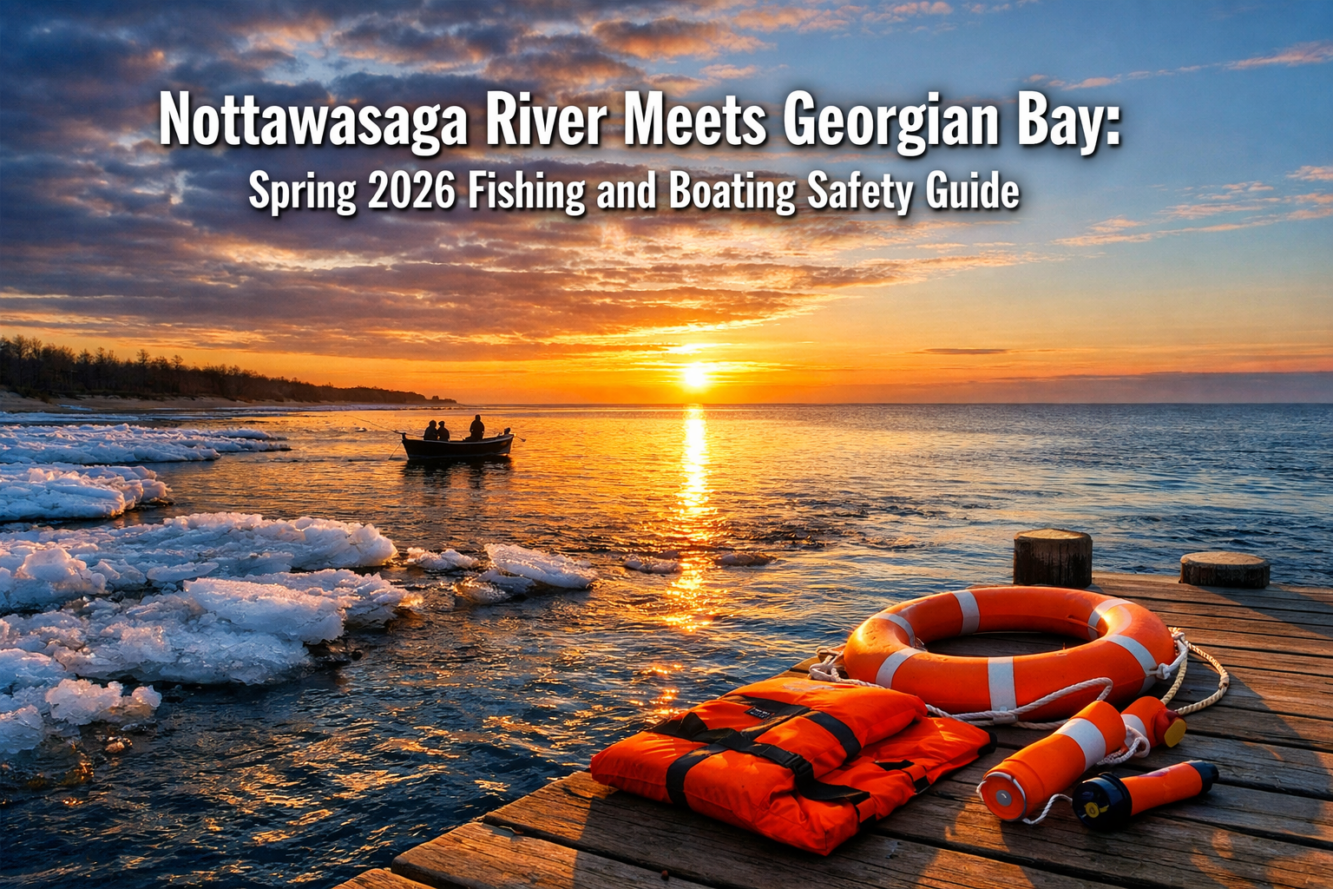
Nottawasaga River Meets Georgian Bay: Spring 2026 Fishing and Boating Safety Guide for Wasaga Beach and Meaford Anglers
Last updated: March 5, 2026
Key Takeaways
- Dual licensing required: Anglers need both an Ontario fishing license and an NVCA permit for Nottawasaga River access points
- Spring 2026 openers: Northern pike (May 1), walleye (May 1), bass (June 22 – fourth Saturday in June)
- Rainbow trout available year-round in FMZ 14 waters with a 5-fish daily limit
- Ice melt safety critical: Spring conditions near Allenwood Beach transfer zone require extra caution for boaters
- McKinnon Road access is the only NVCA location requiring additional permits beyond provincial licenses
- New 2026 regulations effective January 1 include updated size limits and possession rules
- Boating safety gear mandatory: Life jackets, VHF radio, navigation lights essential for Georgian Bay spring conditions
Quick Answer
The Nottawasaga River meets Georgian Bay: Spring 2026 Fishing and Boating Safety Guide for Wasaga Beach and Meaford Anglers addresses dual licensing requirements (Ontario plus NVCA permits), spring season openers for walleye and pike (May 1), and critical safety protocols for navigating ice melt conditions near Allenwood Beach. Anglers targeting rainbow trout, Chinook salmon, and walleye must follow FMZ 14 regulations while preparing for unpredictable spring weather and water conditions unique to this Georgian Bay transfer zone.
What Licenses Do You Need to Fish the Nottawasaga River in Spring 2026?
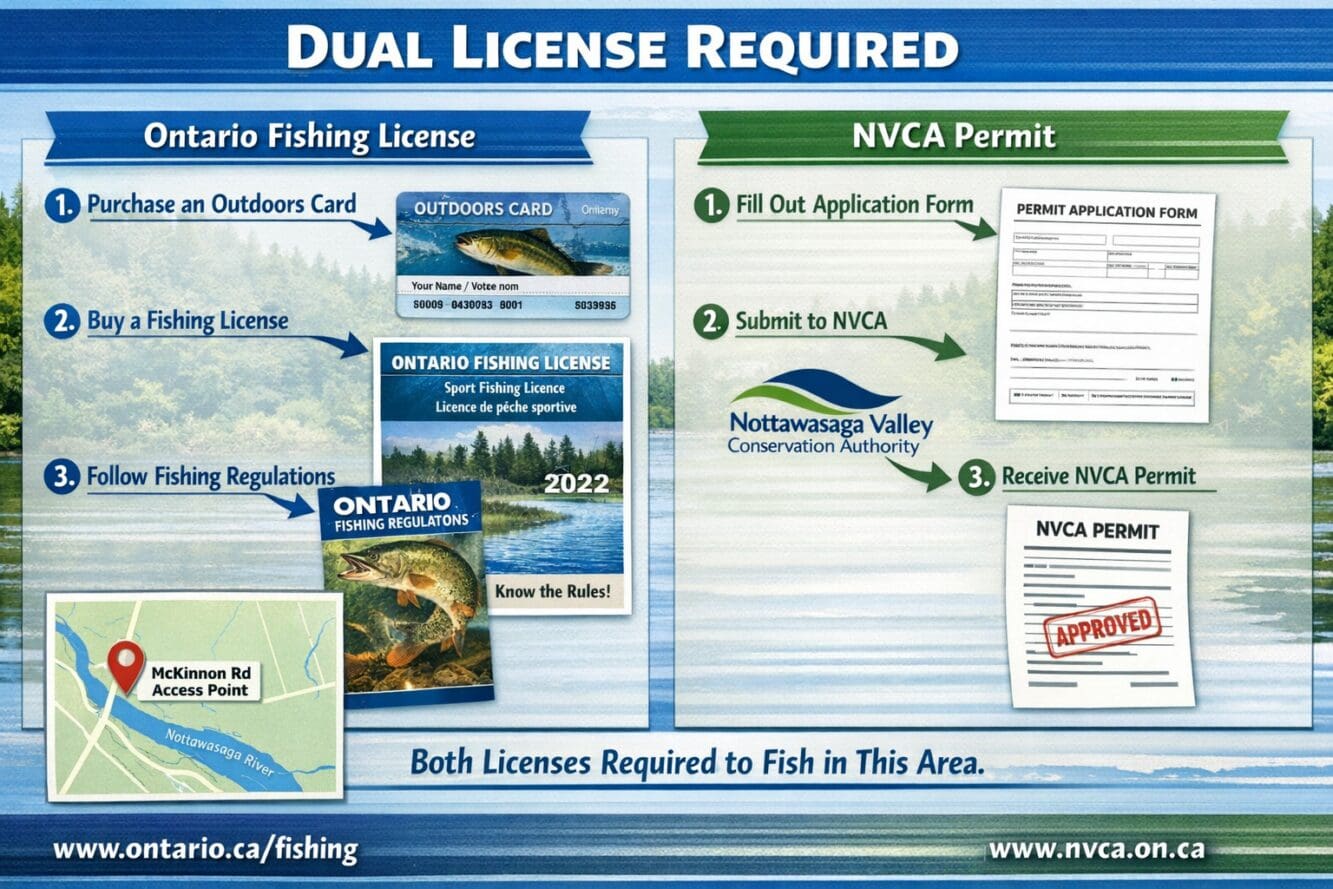
Anglers fishing the Nottawasaga River require two separate permits: a standard Ontario fishing license from the Ministry of Natural Resources and Forestry (MNRF) plus an additional Nottawasaga Valley Conservation Authority (NVCA) permit for the McKinnon Road access point.[1]
The McKinnon Road/Nottawasaga River location is the only NVCA fishing site requiring this dual-license system. Proceeds from NVCA permit sales directly fund conservation land programs and facility maintenance across the watershed.[1]
How to obtain your permits:
- Ontario fishing license: Purchase online through the MNRF website or at authorized retailers
- NVCA permit: Apply through the NVCA Administration Office or complete the Fishing Permit Application Form online
- Cost consideration: Budget for both permits before planning your spring fishing trip
Common mistake: Arriving at McKinnon Road with only a provincial license. Conservation officers check both permits, and fishing without the NVCA authorization can result in fines and removal from the property.
When Are the Spring 2026 Fishing Season Openers Near Wasaga Beach?
Spring 2026 fishing seasons in Fisheries Management Zone 14 (which includes the Nottawasaga River and Georgian Bay waters near Wasaga Beach and Meaford) feature staggered openers designed to protect spawning fish populations.[2]
Key spring season dates:
- Rainbow trout: Open year-round (no closed season), 5 daily catch limit, 2 possession limit[2]
- Northern pike: Opens May 1 after April closure, 2 daily catch, 4 possession (max one over 86 cm)[2]
- Walleye and sauger: Opens May 1 after April closure, 2 daily catch, 4 possession (none 41-56 cm, max one over 56 cm)[2]
- Largemouth/smallmouth bass: Opens fourth Saturday in June (June 22, 2026), 3 daily catch, 1 possession limit[2]
- Lake trout: Open January 1 to September 30, then December 1-31, 2 daily catch, 1 possession[2]
The 2026 Ontario Fishing Regulations Summary became effective January 1, 2026, with all updates shown in red, bold font in the 142-page document.[3][4]
Choose walleye fishing if you want early May action immediately after ice-out. Choose bass fishing if you prefer warmer water temperatures and can wait until late June.
What Fish Species Can You Target Where the Nottawasaga River Meets Georgian Bay?
The Nottawasaga watershed supports Chinook salmon and rainbow trout as primary sports fish species, along with walleye, northern pike, smallmouth bass, and lake trout in the fresh, clean water conditions where the river meets Georgian Bay.[1]
Species by location:
| Species | Best Location | Peak Season | Daily Limit |
|---|---|---|---|
| Rainbow Trout | River mouth, Wasaga Beach shoreline | Year-round, spring peak | 5 |
| Chinook Salmon | Deep river pools, bay transfer zone | Fall run (Sept-Oct) | Varies by zone |
| Walleye | Rocky points near Meaford, river channels | May-June, Sept-Oct | 2 |
| Northern Pike | Shallow bays, weed beds | May-June (post-spawn) | 2 |
| Smallmouth Bass | Rocky shorelines, Allenwood Beach area | June 22-Nov 30 | 3 |
| Lake Trout | Deep Georgian Bay waters | Jan-May, Sept | 2 |
Gear recommendation: Medium-action spinning rods (7-8 feet) work well for rainbow trout and walleye. Heavier gear (medium-heavy baitcasting) suits northern pike and lake trout in deeper Georgian Bay waters.
Edge case: The Allenwood Beach transfer zone experiences unique current patterns where river flow meets bay water. Fish often concentrate along temperature breaks and current seams during spring ice melt.
For more information about regional activities, check out Wasaga Beach community events and Meaford municipal updates.
What Boating Safety Equipment Is Required for Spring Georgian Bay Conditions?
Spring boating near the Nottawasaga River mouth and Allenwood Beach transfer zone requires comprehensive safety equipment because of ice melt, cold water temperatures (4-8°C in April-May), and unpredictable weather patterns.
Mandatory safety gear:
- Canadian-approved life jackets or PFDs (one per person, properly sized and accessible)
- Buoyant heaving line (15 meters minimum) or throwable flotation device
- Watertight flashlight or navigation lights (required if operating after sunset)
- Sound-signaling device (whistle, horn, or bell)
- Fire extinguisher (for boats with inboard engines or fuel-burning appliances)
- VHF marine radio (strongly recommended for Georgian Bay waters)
Additional spring-specific equipment:
- Immersion suits or dry suits: Water temperatures below 10°C cause rapid hypothermia
- Emergency Position Indicating Radio Beacon (EPIRB): Critical for offshore Georgian Bay navigation
- First aid kit with hypothermia treatment supplies
- GPS navigation with Georgian Bay charts: Shoals and rocks near Wasaga Beach shoreline
- Extra anchor and rode: Spring winds can shift quickly on Georgian Bay
Common mistake: Underestimating Georgian Bay spring conditions because the calendar says “spring.” Ice chunks can persist into early May near the river mouth, and sudden squalls develop with minimal warning.
Choose a smaller boat (under 16 feet) if you’re staying within the protected river mouth area. Choose a larger vessel (18+ feet) if you plan to venture into open Georgian Bay waters where wave heights can exceed 2 meters.
How Do Ice Melt and Port Activities Affect Spring Fishing Near Allenwood Beach?
The Allenwood Beach transfer zone experiences unique spring conditions where Nottawasaga River ice melt meets Georgian Bay’s slower ice-out timeline, creating concentrated fish activity but also navigation hazards.
Ice melt timeline (typical years):
- Late March: River ice begins breaking up in shallow sections
- Early April: Main river channel clears, but ice chunks flow toward bay
- Mid-April: Georgian Bay nearshore ice recedes from Wasaga Beach
- Late April to early May: Allenwood Beach transfer zone fully accessible
Navigation hazards during ice melt:
- Floating ice chunks (some submerged) can damage propellers and hulls
- Rapidly changing water levels as ice dams release upstream
- Debris (logs, branches) carried downstream during spring runoff
- Reduced visibility in turbid water from sediment loads
Fish behavior advantage: Walleye and northern pike concentrate along the temperature gradient where warmer river water (6-8°C) meets colder bay water (4-5°C). This creates a narrow fishing zone approximately 200-500 meters from the river mouth.
Port activity consideration: Recreational boat launches increase significantly in May as marinas open for the season. Early morning fishing (before 8 AM) avoids peak boat traffic near Wasaga Beach public launches.
Safety rule: Always check ice conditions with local bait shops or the Nottawasaga Lighthouse Preservation Society before launching in April or early May.
What Tackle and Gear Work Best for Spring Fishing at the River Mouth?
Spring fishing where the Nottawasaga River meets Georgian Bay requires versatile tackle that handles both river current and open-water conditions while targeting multiple species.
Rod and reel combinations:
- Rainbow trout/walleye: 7-8 foot medium-action spinning rod, 2500-3000 size reel, 8-10 lb monofilament or fluorocarbon
- Northern pike: 7-9 foot medium-heavy baitcasting rod, 3000-4000 size reel, 15-20 lb braided line with steel leader
- Chinook salmon (if targeting early spring holdovers): 8-10 foot medium-heavy spinning or casting rod, 4000+ size reel, 12-15 lb line
Effective spring lures and baits:
- Jigs (1/4 to 1/2 oz) with twister tails in white, chartreuse, or pink for walleye
- Spoons (Little Cleo, Krocodile) in silver or gold for rainbow trout
- Crankbaits (shallow to medium diving) for pike in warming bays
- Live minnows on slip-bobber rigs for walleye along current breaks
- Spawn sacs (where legal) for rainbow trout near river inflows
Spring-specific considerations:
- Water clarity varies dramatically after rain events – carry both natural and bright-colored lures
- Cold water means slow retrieves – fish are lethargic until water reaches 10°C
- Polarized sunglasses essential for spotting structure and fish in clear spring water
- Layered clothing (base layer, fleece, waterproof shell) for changing weather conditions
Edge case: During high-water spring runoff, fish move to slack-water areas behind points and in protected bays. Adjust your location rather than fighting heavy current in the main channel.
What Are the Updated 2026 Size and Possession Limits for FMZ 14?
The 2026 Ontario Fishing Regulations Summary introduced specific size restrictions designed to protect breeding populations while allowing sustainable harvest.[2][3]
Key size and possession rules:
- Walleye/sauger: Daily catch 2, possession 4, protected slot 41-56 cm (must release), maximum one over 56 cm
- Northern pike: Daily catch 2, possession 4, maximum one over 86 cm
- Lake trout: Daily catch 2, possession 1 (stricter in some Georgian Bay zones: 1 catch, 0 possession west/south of Killbear Channel)
- Rainbow trout: Daily catch 5, possession 2 (combined limit with other trout species)
- Bass (largemouth/smallmouth): Daily catch 3, possession 1
How to measure correctly:
- Measure from tip of snout (mouth closed) to tip of tail (tail pinched)
- Use a proper fish measuring board or marked ruler
- Round down to nearest centimeter if between marks
- Release protected-slot fish immediately without removing from water if possible
Common mistake: Confusing “daily catch limit” with “possession limit.” You can catch your daily limit each day, but possession limit restricts how many you can have in your freezer or cooler at any time.
The Ministry of Natural Resources is working with federal partners to clarify rules allowing anglers to photograph, measure, and weigh fish during open seasons – visit www.ontario.ca/FishingUpdates for current information.[3]
What Weather and Water Conditions Should You Monitor in Spring 2026?
Spring weather near Wasaga Beach and Meaford changes rapidly and unpredictably, requiring constant monitoring for safe fishing and boating.
Critical weather factors:
- Wind speed and direction: Georgian Bay generates dangerous waves with sustained winds over 20 km/h from west or northwest
- Air temperature swings: 15-20°C daily variation common in April-May
- Precipitation: Spring rain increases river flow and reduces water clarity within hours
- Fog: Common when warm air passes over cold Georgian Bay water (especially May mornings)
Water condition monitoring:
- Water temperature: Use a digital thermometer – fish activity increases dramatically when water reaches 10°C
- Water level: Check NVCA water level data before launching (high water creates strong currents)
- Wave height: Georgian Bay can build 1-2 meter waves quickly – check marine forecasts
- Ice reports: Contact local marinas or bait shops for current ice conditions through early May
Recommended resources:
- Environment Canada marine forecasts (updated twice daily)
- NOAA Great Lakes wave height predictions
- Local VHF weather radio (channel WX-1, 162.55 MHz)
- NVCA watershed conditions and flood warnings
Safety rule: If small craft warnings are posted (winds 20-33 knots or waves 1-2 meters), postpone your trip. Georgian Bay conditions can exceed forecasts quickly, and spring water temperatures (4-8°C) allow only 15-30 minutes of survival if you fall in.
Conclusion
The Nottawasaga River meets Georgian Bay: Spring 2026 Fishing and Boating Safety Guide for Wasaga Beach and Meaford Anglers emphasizes three critical elements: dual licensing compliance (Ontario plus NVCA permits), understanding staggered season openers and size limits under 2026 FMZ 14 regulations, and preparing for unpredictable spring conditions near the Allenwood Beach transfer zone.
Actionable next steps:
- Obtain both required licenses before your first trip – apply for NVCA permit at least one week in advance
- Mark your calendar for May 1 walleye and pike openers, and June 22 bass opener
- Assemble comprehensive safety equipment including immersion suit, VHF radio, and navigation tools
- Check ice and weather conditions 24 hours before launching, and monitor VHF weather updates continuously
- Prepare versatile tackle for multiple species and varying water clarity conditions
- Review 2026 size limits and practice proper fish measurement techniques before heading out
Spring fishing where the Nottawasaga River meets Georgian Bay offers exceptional opportunities for rainbow trout, walleye, and northern pike – but success and safety depend on thorough preparation, proper licensing, and respect for rapidly changing Great Lakes conditions. Start your 2026 season informed, equipped, and ready for some of Ontario’s best spring fishing.
FAQ
Do I need an NVCA permit for all Nottawasaga River fishing locations?
No, the NVCA permit is required only for the McKinnon Road access point. Other river access points on public land require only a standard Ontario fishing license.[1]
Can I keep rainbow trout during the April walleye closure?
Yes, rainbow trout are open year-round in FMZ 14 waters with a 5-fish daily limit and 2-fish possession limit, even during April when walleye and pike are closed.[2]
What’s the earliest safe date to launch a boat near Wasaga Beach in 2026?
Ice conditions vary annually, but mid-to-late April is typically safe for the protected river mouth area. Always verify current ice conditions with local marinas before launching.
How do I know if a walleye is in the protected 41-56 cm slot?
Measure from the tip of the snout (mouth closed) to the tip of the tail (pinched). If the fish measures between 41-56 cm, you must release it immediately. Only walleye under 41 cm or over 56 cm may be kept (maximum one over 56 cm).[2]
What happens if I’m caught fishing without an NVCA permit at McKinnon Road?
You face potential fines and immediate removal from the property. Conservation officers regularly patrol NVCA locations and check both provincial licenses and NVCA permits.[1]
Is catch-and-release fishing allowed during closed seasons?
Generally no – closed seasons prohibit targeting those species entirely. However, if you accidentally catch a closed-season fish while targeting legal species, release it immediately with minimal handling.
What’s the best time of day for spring walleye fishing at the river mouth?
Early morning (sunrise to 9 AM) and late evening (two hours before sunset) produce best results. Walleye move into shallower water during low-light periods to feed.
Can I use multiple fishing rods at the Nottawasaga River access points?
Ontario regulations allow one line per angler in most inland waters. Check specific FMZ 14 rules, but generally plan to fish with one rod at a time.
How long can I survive in Georgian Bay water during spring?
Water temperatures of 4-8°C (typical April-May) allow only 15-30 minutes before hypothermia incapacitation. Wear proper flotation and immersion protection, and never boat alone.
Where can I find updated 2026 fishing regulation changes?
Download the complete 2026 Ontario Fishing Regulations Summary PDF from the MNRF website. Updates appear in red, bold font throughout the 142-page document.[3][4]
Do possession limits apply to frozen fish in my home freezer?
Yes, possession limits apply to fish in your possession anywhere – in your boat, cooler, vehicle, or home freezer. You cannot exceed the possession limit even across multiple fishing trips.
What’s the difference between the river mouth and the Allenwood Beach transfer zone?
The river mouth is where the Nottawasaga River channel enters Georgian Bay. The Allenwood Beach transfer zone is the broader mixing area where river current meets bay water, creating temperature gradients that attract fish.
References
[1] Fishing – https://www.nvca.on.ca/conservation-areas/fishing/
[2] Fisheries Management Zone 14 – http://www.ontario.ca/document/ontario-fishing-regulations-summary/fisheries-management-zone-14
[3] 2026 Fishing Regs Released – https://www.ofah.org/oodonline/news/2026-fishing-regs-released/
[4] 2026 Ontario Fishing Regulations Summary – https://www.afs-oc.org/2026-ontario-fishing-regulations-summary/
Content, illustrations, and third-party video appearing on GEORGIANBAYNEWS.COM may be generated or curated with AI assistance or reproduced pursuant to the fair dealing provisions of the Copyright Act, R.S.C. 1985, c. C-42. Attribution and hyperlinks to original sources are provided in acknowledgment of applicable intellectual property rights. Such referencing is intended to direct traffic to and support the original rights holders’ platforms.