

















With gas prices being so high, how will this effect our farmers with high fuel and fertilizer costs?

Last updated: March 11, 2026
Quick Answer
Yes, high gas and diesel prices can squeeze farmers hard, but fertilizer costs are often an even bigger pressure point. In 2026, many growers face a double hit: expensive fuel to run equipment and move crops, plus elevated fertilizer prices that raise per-acre costs and shrink profit margins, especially for corn producers [1][3][5].
Key Takeaways
- Fuel and fertilizer costs rise together because both depend heavily on energy and transportation.
- Nitrogen fertilizer remains expensive in early 2026, averaging $611 per ton as of early March [1].
- Short-term relief looks unlikely based on current market signals from fertilizer analysts [2].
- Corn growers face more pressure than soybean growers because corn usually needs more fertilizer [5].
- Phosphate prices are especially painful relative to grain values in early 2026 [2].
- Potash appears to offer the best value among major fertilizer products right now [2].
- Forward buying can reduce risk, and many farmers already use it to lock in prices [3].
- Farmers may adjust rates, crop mix, and timing, but cutting too much fertilizer can hurt yields.
- Consumers can feel the impact later through higher food prices and tighter farm income.
- Local communities are affected too, because farm spending supports jobs, repairs, trucking, and retail.
Why are high fuel and fertilizer costs such a big problem for farmers?
High fuel and fertilizer costs matter because they raise the cost of producing every acre. When input costs climb faster than crop prices, farm profits can disappear quickly.
A grain farmer does not just buy seed and wait for harvest. The season includes:
- diesel for tractors, trucks, and grain drying
- fertilizer for crop growth
- hauling inputs to the farm
- transporting harvested grain to market
Fertilizer is one of the largest cash expenses on many row-crop farms. Farm Progress estimated current fertilizer expenses at about $166 per acre for corn and $57 per acre for soybeans [5]. That gap helps explain why corn acres feel more strain when fertilizer remains high.
“High input prices don’t only raise costs. They force harder decisions on every acre.”
A common mistake is assuming fuel is the whole story. Fuel hurts, but fertilizer often drives the larger budget shock.
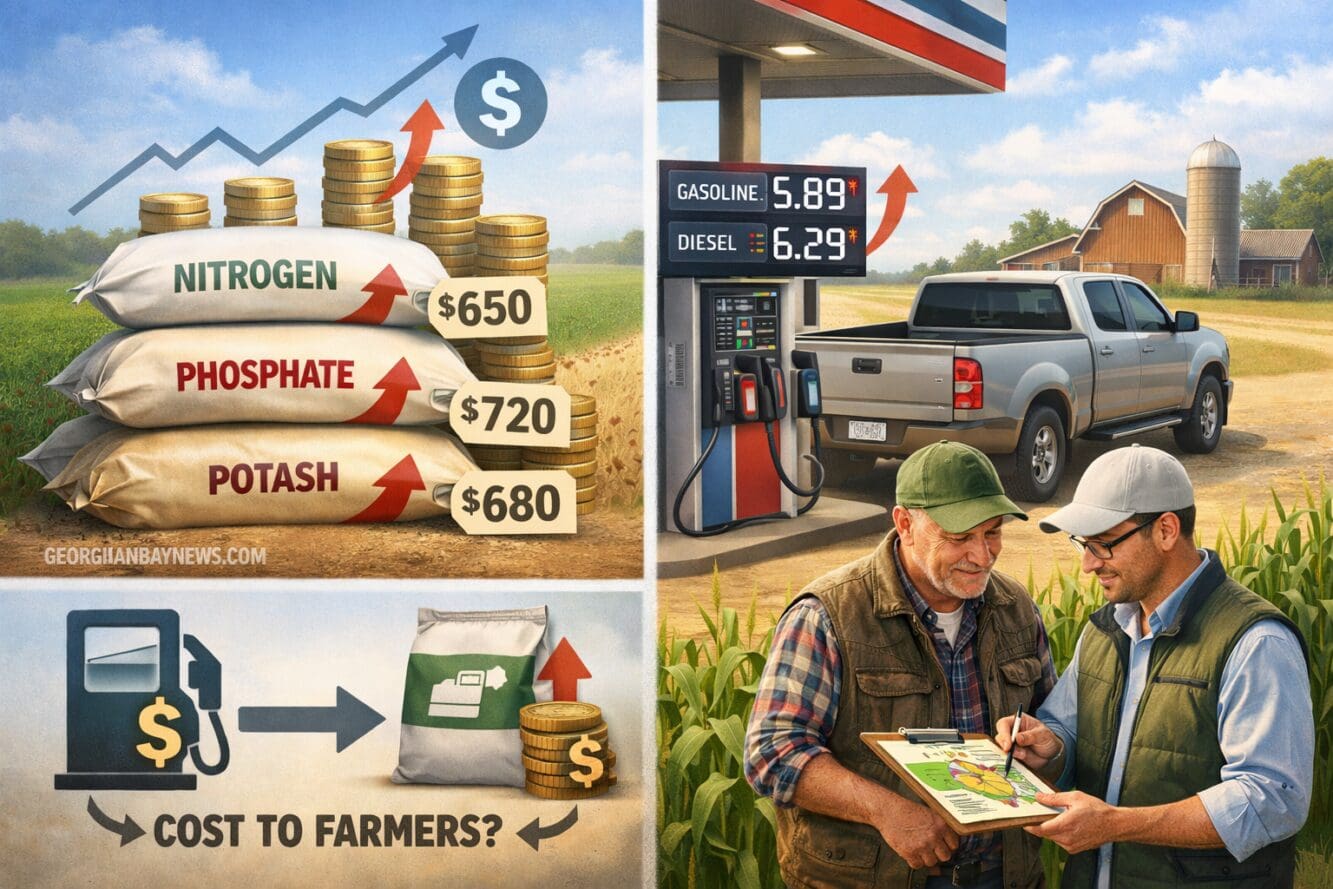
With gas prices being so high, how will this effect our farmers with high fuel and fertilizer costs in 2026?
The short answer is lower margins, tougher planning, and more risk. Farmers in 2026 may still plant large acreage, but many will do it with tighter cash flow and less room for error.
As of March 4, 2026, seven of eight major fertilizers were priced higher, and nitrogen averaged $611 per ton, up 5% from the prior month [1]. Farmdoc Daily also reported that key nitrogen products in Illinois were 6% to 20% higher in August 2025 than a year earlier, which carried into 2026 planning [3].
What that means on the ground:
- Higher borrowing needs for spring inputs
- Less flexibility if weather hurts yields
- Pressure to delay machinery upgrades
- More focus on breakeven prices
Anecdotally, many farm families know the pattern well: a grower fills the diesel tank, picks up fertilizer, and realizes two routine stops now reshape the entire season budget. That is not dramatic language. It is how cash flow stress shows up in real life.
Decision rule: Choose tighter cost controls if crop prices are flat but inputs are rising. That usually means reviewing every pass across the field and every nutrient application plan with an agronomist.
What is pushing fertilizer prices higher right now?
Global supply limits and strong demand are the main drivers. In 2026, fertilizer prices are not high by accident; they are being pushed up by trade restrictions, supply problems, and steady crop demand.
One major factor is China’s export restrictions on phosphate, which has reduced global supply [2]. Analysts also say there is no clear short-term relief in sight, with more reasons for prices to rise than fall [2].
Other pressures include:
- strong demand for nitrogen
- large projected corn acreage in 2026
- domestic supply issues
- transportation and energy costs
- only minor help from tariff changes [4]
Edge case: Even if fuel prices ease in one region, fertilizer may stay expensive because the market is global. Local relief does not always mean cheaper nutrients.
For more context on broader energy change, readers may also find the shift to cleaner energy useful.
With gas prices being so high, how will this effect our farmers with high fuel and fertilizer costs by crop type?
Corn farms usually feel the biggest hit. Soybeans, hay, and some lower-input crops may be less exposed, although no farm is immune.
Here is a simple comparison:
| Crop type | Cost pressure from fertilizer | Fuel sensitivity | Risk level in 2026 |
|---|---|---|---|
| Corn | High | High | High |
| Soybeans | Moderate | High | Moderate |
| Wheat | Moderate to high | High | Moderate to high |
| Forage/Hay | Varies | Moderate to high | Moderate |
Why corn stands out:
- It often needs more nitrogen.
- Demand for corn acres remains high, with projections around 91 to 95 million acres [4].
- High phosphate-to-corn ratios have damaged profitability in early 2026 [2].
Choose corn if strong local pricing or rotation needs justify the extra input cost. Choose lower-input acres if preserving cash matters more than chasing top yield.
For readers interested in environmental impacts around input-heavy systems, see profit obsession inflames environmental racism and industries in denial from burning cigarettes to a burning planet.
Can farmers cut fertilizer costs without hurting yields?
Yes, but only with care. Blind cuts can reduce yields and make the farm lose more money than it saves.
Better options include:
Soil test first
Apply nutrients where they are needed most.Prioritize return on investment
Potash may offer better value than other nutrients right now [2].Use forward purchasing
Farmdoc Daily says many farmers use prepay or forward contracts to manage price risk [3].Review timing and source
Split applications or alternative products may help in some cases.Work with an agronomist
A good recommendation can save more than a rushed cut.- Common mistake: cutting nitrogen too deeply on high-yield corn ground. Savings look good on paper, but yield loss can wipe them out.
A smart lawn-and-land approach to using fewer inputs is also reflected in it’s time to ditch the lawn and go natural.
With gas prices being so high, how will this effect our farmers with high fuel and fertilizer costs over the next few months?
The most likely outcome is continued pressure through the planting season. Relief is possible, but current expert commentary says there is no guarantee of lower prices by spring [4].
Farmers should watch:
- local fertilizer bids
- diesel trends
- crop price swings
- weather delays that increase fieldwork costs
- retailer supply availability
A mini example: A farmer who prepays part of nitrogen early may avoid one price jump, but still pay more for diesel during planting. Another farmer who waits for a dip may save if prices soften, but could also get caught in a tighter market.
For local infrastructure and transport angles, see transit and transportation updates following the announcement of Ace Cabs closure and where are the water refill stations in Collingwood.
What can consumers and communities do?
Consumers cannot set fertilizer markets, but communities can support local agriculture. Strong local demand, fair policy, and better input planning tools can help farms stay resilient.
Practical steps:
- buy from local farms when possible
- support farm-friendly infrastructure
- back extension education and soil testing programs
- understand that food prices reflect real farm costs
Rural communities rise and fall together. When farms cut spending, equipment dealers, truckers, repair shops, and main-street stores feel it too.
FAQ
Is fertilizer more expensive in 2026?
Yes. Early March 2026 pricing showed seven of eight major fertilizers higher, with nitrogen averaging $611 per ton [1].
Are high gas prices the main problem for farmers?
No. High fuel prices hurt, but fertilizer is often the larger per-acre cost, especially for corn [5].
Will fertilizer prices drop soon?
Maybe, but experts say short-term relief is hard to see in 2026 [2].
Which fertilizer looks like the best value now?
Current market commentary suggests potash offers the best value among major nutrients [2].
Do all crops face the same cost pressure?
No. Corn usually faces more fertilizer pressure than soybeans because nutrient needs are higher [5].
Can farmers simply use less fertilizer?
Sometimes, but large cuts can hurt yield. Soil testing and targeted applications are safer choices.
Does China affect fertilizer prices in North America?
Yes. China’s phosphate export restrictions have reduced global supply and pushed prices higher [2].
Do farmers lock in fertilizer prices ahead of time?
Yes. Forward purchasing and prepay are common ways to manage risk [3].
Conclusion
With gas prices being so high, how will this effect our farmers with high fuel and fertilizer costs? The clearest answer is this: farmers face thinner margins, bigger cash demands, and harder decisions in 2026. Fertilizer remains elevated, fuel adds another layer of stress, and short-term relief is uncertain [1][2][4].
The best next steps are practical:
- review per-acre costs now
- soil test before cutting nutrients
- compare fertilizer products carefully
- lock in prices when risk makes sense
- stay flexible on crop and timing decisions
For readers, the takeaway is simple. Farm costs do not stay on the farm. They move through food prices, local jobs, and rural economies.
References
[1] Seven Eight Major Fertilizers Higher – https://www.dtnpf.com/agriculture/web/ag/news/crops/article/2026/03/04/seven-eight-major-fertilizers-higher
[2] Watch – https://www.youtube.com/watch?v=m9CG0lHOFzI
[3] Fertilizer Decisions For The 2026 Crop Year – https://farmdocdaily.illinois.edu/2025/08/fertilizer-decisions-for-the-2026-crop-year.html
[4] Watch – https://www.youtube.com/watch?v=gz3p6S-hgFU
[5] Troubled World Pushes Fertilizer Prices – https://www.farmprogress.com/commentary/troubled-world-pushes-fertilizer-prices
Meta title
High Fuel and Fertilizer Costs: What Farmers Face in 2026
Meta description
With gas prices being so high, how will this effect our farmers with high fuel and fertilizer costs? Learn the 2026 impact, risks, and options.
fertilizer, farmers, fuel costs, fertilizer prices, agriculture, diesel prices, corn farming, soybean farming, farm input costs, potash, nitrogen fertilizer, rural economy
Content, illustrations, and third-party video appearing on GEORGIANBAYNEWS.COM may be generated or curated with AI assistance or reproduced pursuant to the fair dealing provisions of the Copyright Act, R.S.C. 1985, c. C-42. Attribution and hyperlinks to original sources are provided in acknowledgment of applicable intellectual property rights. Such referencing is intended to direct traffic to and support the original rights holders’ platforms.