





















Ontario Unemployment Climbs to 7.6% Amid National Job Losses: Sector Impacts and Worker Survival Guide

Last updated: March 15, 2026
Quick Answer
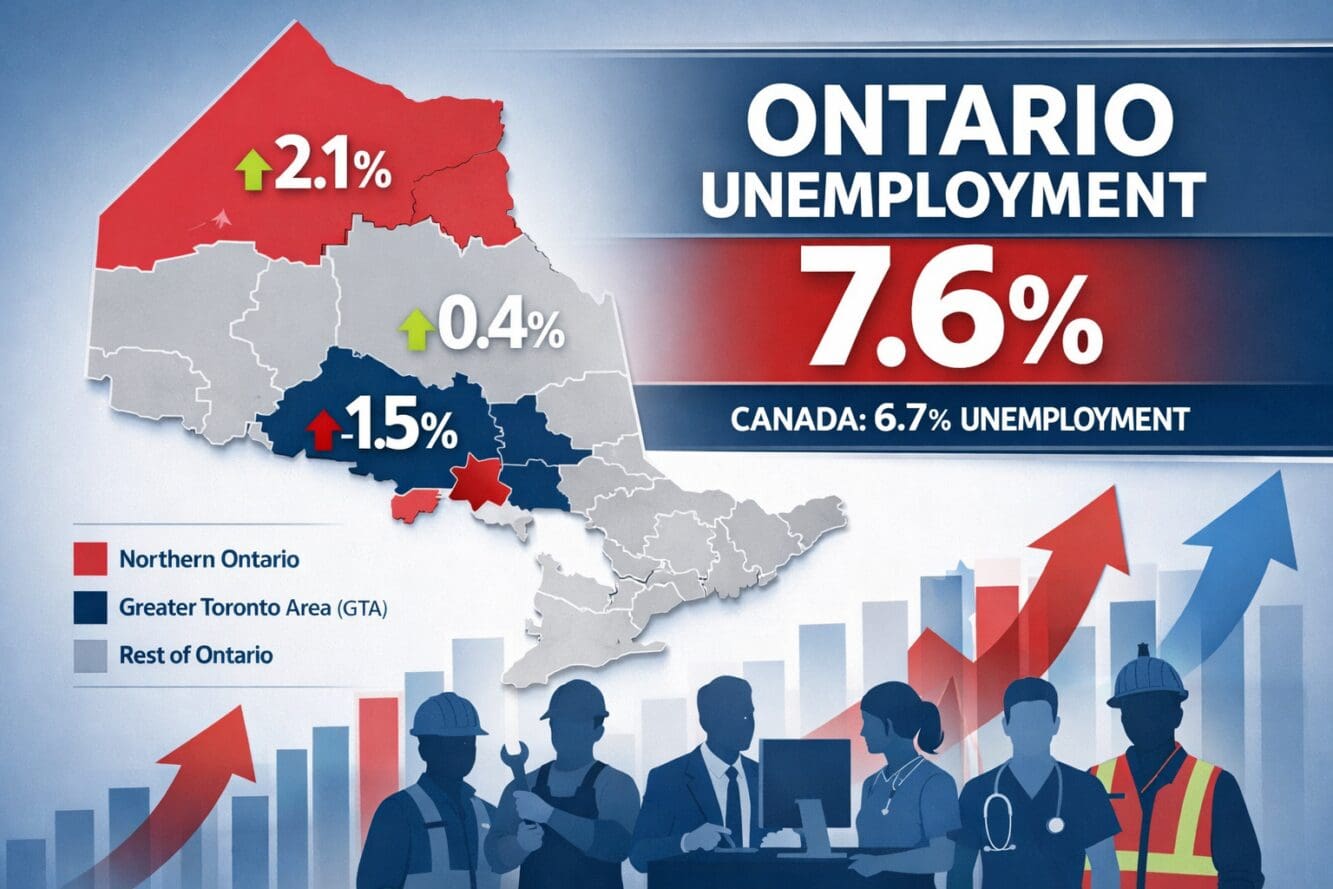
Ontario’s unemployment rate jumped to 7.6% in February 2026 as Canada lost 84,000 jobs nationally, with full-time positions taking the hardest hit. The province saw 28,000 more people searching for work while employment remained relatively flat, creating pressure across finance, education, and agriculture sectors. Workers in the Greater Toronto Area and Northern Ontario face particular challenges as tariff uncertainty and economic headwinds reshape the job market.
Key Takeaways
- Ontario’s unemployment rate increased 0.3 percentage points to 7.6% in February 2026, above the national average of 6.7%[1]
- Canada lost 84,000 jobs in February, marking the second consecutive month of employment decline[2]
- Full-time employment dropped by 108,000 positions, partially offset by 24,500 part-time job gains[3]
- Youth workers aged 15-24 lost 47,000 jobs, making them especially vulnerable in the current market[1]
- Finance, education, and agriculture sectors experienced the steepest job losses in February[4]
- Long-term unemployment remains elevated at 22.8%, significantly above pre-COVID levels[1]
- Core-aged men saw unemployment rise to 5.7%, driven by full-time job losses[1]
- 28,000 more Ontarians began searching for work, increasing competition for available positions[1]
What’s Behind Ontario Unemployment Climbing to 7.6% Amid National Job Losses?
Ontario’s unemployment rate rose to 7.6% in February 2026 because 28,000 more people entered the job market while employment remained essentially flat, creating a mismatch between job seekers and available positions[1]. This 0.3 percentage point increase reflects both economic uncertainty and demographic shifts as more workers actively search for employment.
The province’s situation mirrors broader national trends but with more intensity. While Canada’s overall unemployment rate reached 6.7%, Ontario exceeded this benchmark as the second-largest monthly job loss event in recent history unfolded[2]. The combination of tariff concerns, economic slowdown, and sector-specific challenges created a perfect storm for Ontario workers.
Key factors driving the increase:
- Labor force growth outpacing job creation – More people seeking work than positions available
- Economic uncertainty – Businesses hesitating to hire amid tariff concerns and trade tensions
- Sector-specific contractions – Finance, education, and agriculture shedding positions
- Full-time job losses – Employers shifting to part-time arrangements or cutting hours
For workers in manufacturing hubs like Windsor or Hamilton, the impact compounds as economic uncertainty affects multiple sectors simultaneously.
Which Sectors Are Hardest Hit by Ontario Unemployment and National Job Losses?
The finance, insurance, real estate, and leasing sector lost 8,700 jobs (-0.6%) in February, making it one of the hardest-hit industries[4]. Educational services followed closely with 8,500 job losses (-0.5%), while agriculture experienced the steepest percentage decline at 5,100 positions (-2.1%)[4].
Detailed sector breakdown:
| Sector | Jobs Lost | Percentage Change |
|---|---|---|
| Finance, Insurance, Real Estate | -8,700 | -0.6% |
| Educational Services | -8,500 | -0.5% |
| Agriculture | -5,100 | -2.1% |
| Manufacturing | Moderate losses | Data pending |
| Professional Services | Mixed results | Varies by specialty |
Why these sectors?
- Finance: Rising interest rates and economic uncertainty reducing lending and investment activity
- Education: Budget constraints and demographic shifts affecting hiring
- Agriculture: Seasonal factors combined with trade policy concerns
- Manufacturing: Tariff uncertainty causing businesses to delay expansion and hiring
Workers in these industries should monitor sector-specific trends and consider adjacent fields where skills transfer easily. For example, finance professionals might explore fintech opportunities, while educators could pivot to corporate training roles.
How Are Full-Time and Part-Time Employment Trends Different in Ontario?
Full-time employment plummeted by 108,000 positions (-0.6%) nationally in February, while part-time work increased by 24,500 jobs, showing employers are shifting toward flexible arrangements[3]. This represents a fundamental change in how businesses structure their workforce amid economic uncertainty.
The gap between full-time losses and part-time gains reveals several important trends:
Full-time employment challenges:
- Employers reducing permanent headcount to control costs
- Benefits and overhead making full-time positions less attractive to businesses
- Economic uncertainty driving conservative hiring practices
- Layoffs concentrated in professional and administrative roles
Part-time employment growth:
- Retail and hospitality adding flexible positions
- Gig economy expansion continuing
- Employers testing demand before committing to full-time hires
- Workers accepting part-time roles while searching for full-time opportunities
What this means for workers: Accept part-time work to maintain income and connections, but continue searching for full-time positions. Part-time roles can provide valuable networking opportunities and may convert to full-time as economic conditions improve.
Common mistake: Rejecting part-time offers while waiting for the “perfect” full-time role. In tight labor markets, any employment helps maintain skills and professional networks.
Which Demographics Face the Highest Risk in Ontario’s Job Market?
Youth workers aged 15-24 lost 47,000 jobs (-1.7%) in February, making them the most vulnerable demographic in the current labor market[1]. Core-aged men (25-54) also struggled, with unemployment rising 0.3 percentage points to 5.7% as 41,000 positions disappeared[1].
High-risk groups:
Youth (15-24 years):
- Entry-level positions eliminated first during downturns
- Limited experience making them less competitive
- Higher concentration in hard-hit retail and hospitality sectors
- Student job market particularly tight
Core-aged men (25-54):
- Manufacturing and construction exposure
- Full-time job losses concentrated in this group (-54,000)[1]
- Unemployment rate of 5.7% highest in recent years
- Often primary household earners facing financial pressure
Long-term unemployed:
- 22.8% of unemployed have been searching 27+ weeks[1]
- Well above pre-COVID average of 17.1% (2017-2019)[1]
- Skills atrophy and employer bias increase with time
- Mental health and financial strain compound challenges
Choose retraining if: You’re long-term unemployed in a declining sector. Consider growing fields like healthcare, technology, or skilled trades where community support and new opportunities emerge.
What Practical Steps Can Ontario Workers Take to Navigate Unemployment?
Apply for Employment Insurance (EI) benefits immediately after job loss, as processing can take several weeks and retroactive payments are limited. The federal EI program provides temporary income support while you search for new employment, typically covering 55% of average insurable earnings up to a maximum amount.
Immediate actions (Week 1):
- File for EI benefits – Don’t delay; apply online at Service Canada within days of job loss
- Update your resume and LinkedIn profile – Refresh with recent accomplishments and skills
- Notify your network – Let contacts know you’re seeking opportunities
- Review your budget – Cut non-essential expenses immediately
- Assess your emergency fund – Calculate how long current savings will last
Short-term strategy (Weeks 2-4):
- Apply strategically – Target 10-15 quality applications weekly rather than mass applying
- Consider temporary or contract work – Maintain income and skills while searching
- Attend virtual job fairs – Ontario regularly hosts sector-specific events
- Update skills – Free online courses through libraries and government programs
- Join professional associations – Many offer job boards and networking events
Medium-term planning (Months 2-3):
- Expand your search radius – Consider remote work or relocation
- Explore adjacent industries – Your skills may transfer to growing sectors
- Consider retraining – Government programs offer subsidized training for in-demand fields
- Freelance or consult – Leverage expertise while searching for permanent roles
- Maintain routine – Treat job searching as a full-time job with regular hours
Common mistakes to avoid:
- Waiting to apply for EI (apply immediately)
- Applying only to “perfect fit” positions (cast a wider net)
- Neglecting mental health (seek support if needed)
- Isolating yourself (networking is crucial)
- Depleting savings before adjusting lifestyle
Where Can GTA and Northern Ontario Workers Find Support and Resources?
Service Ontario provides centralized access to employment services, EI applications, and retraining programs through both physical locations and online portals. Workers in the Greater Toronto Area have access to numerous employment centers, while Northern Ontario residents can access services remotely or through regional offices.
Government resources:
Service Ontario Employment Services:
- Resume and interview preparation
- Job matching and placement assistance
- Skills assessment and career counseling
- Free access at locations across Ontario
Employment Ontario:
- Training and apprenticeship programs
- Second Career program for laid-off workers
- Literacy and basic skills upgrading
- Youth employment programs
Service Canada:
- EI application processing
- Career planning services
- Job Bank search tools
- Benefits and support programs
Regional support:
Greater Toronto Area:
- Toronto Employment and Social Services
- Peel Region employment programs
- York Region employment centers
- Durham Workforce Authority
Northern Ontario:
- Far Northeast Training Board
- Workforce Planning for Sudbury & Manitoulin
- Superior North ETC
- Remote service delivery options
Financial support programs:
- Second Career – Up to $28,000 for retraining in high-demand fields
- Canada Training Benefit – $250 annually for skills training
- Apprenticeship grants – Financial support for trades training
- Municipal assistance – Local emergency funds and support services
Choose remote services if: You’re in Northern Ontario or have mobility challenges. Most programs now offer virtual appointments and online applications, making geographic barriers less significant.
Industry-specific resources:
- Manufacturing: Canadian Manufacturers & Exporters support programs
- Technology: Tech sector job boards and bootcamps
- Healthcare: Fast-track programs for in-demand positions
- Trades: Union apprenticeship programs and training centers
Understanding how economic challenges affect communities can help workers identify emerging opportunities and prepare for market shifts.
What Industries Are Still Hiring Despite Ontario Unemployment Rising to 7.6%?
Healthcare, technology, and skilled trades continue hiring despite broader job losses, with particular demand for nurses, software developers, electricians, and HVAC technicians. These sectors face structural labor shortages that persist even during economic downturns.
Growing sectors and roles:
Healthcare:
- Registered nurses and nurse practitioners
- Personal support workers (PSWs)
- Medical laboratory technologists
- Mental health professionals
- Healthcare administrators
Technology:
- Software developers and engineers
- Cybersecurity specialists
- Data analysts and scientists
- Cloud computing professionals
- IT support specialists
Skilled Trades:
- Electricians (residential and industrial)
- Plumbers and pipefitters
- HVAC technicians
- Construction managers
- Welders and millwrights
Professional Services:
- Accountants (especially tax specialists)
- Human resources professionals
- Supply chain and logistics managers
- Environmental consultants
- Project managers
Why these sectors?
- Demographic trends – Aging population driving healthcare demand
- Digital transformation – Businesses investing in technology despite slowdown
- Infrastructure needs – Government spending on construction and green energy
- Regulatory requirements – Compliance and specialized expertise always needed
Retraining timeline: Most healthcare certifications take 6-18 months, technology bootcamps run 3-6 months, and skilled trades apprenticeships span 2-5 years. Choose based on your timeline, financial situation, and aptitude.
Edge case: Workers over 50 may face age bias but have advantages in trades where experience and reliability matter more than cutting-edge skills. Consider supervisory or training roles that leverage decades of industry knowledge.
How Long Might Ontario Unemployment Remain Elevated?
Economic forecasters expect Ontario unemployment to remain between 7.0-8.0% through mid-2026, with improvement dependent on trade policy clarity and business confidence returning. The trajectory depends heavily on factors outside provincial control, including federal policy, U.S. trade relations, and global economic conditions.
Factors affecting timeline:
Accelerating recovery (3-6 months):
- Trade agreement clarity
- Business confidence returning
- Government stimulus programs
- Consumer spending rebounds
Moderate recovery (6-12 months):
- Gradual policy certainty
- Sector-by-sector improvement
- Targeted government support
- Slow business expansion
Extended challenges (12+ months):
- Continued trade uncertainty
- Recession deepening
- Structural industry changes
- Global economic headwinds
Historical context: The 2008-2009 recession saw Ontario unemployment peak at 9.4% and take roughly three years to return to pre-crisis levels. However, recovery patterns vary significantly based on the underlying causes and policy responses.
What workers should assume: Plan for 6-12 months of challenging conditions while hoping for faster improvement. This means maintaining strict budgets, accepting imperfect opportunities, and investing in skills that remain valuable regardless of economic conditions.
Regional variations: The Greater Toronto Area typically recovers faster due to economic diversity, while Northern Ontario and manufacturing-dependent communities may experience longer elevated unemployment due to structural challenges.
Conclusion
Ontario unemployment climbing to 7.6% amid national job losses of 84,000 positions represents a significant challenge for workers across the province, particularly in finance, education, and agriculture sectors. The shift from full-time to part-time employment, combined with youth workers losing 47,000 jobs and long-term unemployment remaining elevated at 22.8%, creates a difficult landscape requiring immediate action and strategic planning.
Workers facing job loss should apply for EI benefits immediately, update their professional profiles, and tap into Ontario’s extensive support network through Service Ontario and Employment Ontario programs. Focus on growing sectors like healthcare, technology, and skilled trades where demand persists despite broader economic weakness.
The path forward requires both short-term survival tactics—accepting part-time work, networking actively, and controlling expenses—and medium-term strategic moves like retraining for in-demand fields or expanding job search parameters. While economic forecasters expect challenging conditions through mid-2026, workers who remain flexible, maintain their skills, and leverage available resources will be best positioned to navigate this period and emerge stronger when conditions improve.
Take action today: File for EI if recently laid off, update your resume and LinkedIn profile this week, and reach out to three professional contacts to let them know you’re seeking opportunities. The sooner you begin actively managing your job search, the better your outcomes will be in this competitive market.
Frequently Asked Questions
What is Ontario’s current unemployment rate in 2026?
Ontario’s unemployment rate stands at 7.6% as of February 2026, representing a 0.3 percentage point increase from January and exceeding the national average of 6.7%[1].
How many jobs did Canada lose in February 2026?
Canada lost 84,000 jobs in February 2026, marking the second consecutive month of employment decline and one of the largest single-month drops in recent years[2].
Which age group is most affected by Ontario unemployment?
Youth workers aged 15-24 are most affected, losing 47,000 jobs (-1.7%) in February 2026, making them particularly vulnerable in the current labor market[1].
What’s the difference between Ontario and national unemployment rates?
Ontario’s unemployment rate of 7.6% exceeds the national rate of 6.7% by 0.9 percentage points, indicating the province faces more severe labor market challenges than Canada overall[1].
How long does EI take to process in Ontario?
Employment Insurance applications typically take 28 days to process, though complex cases may take longer. Apply immediately after job loss to minimize delays in receiving benefits.
Are full-time or part-time jobs declining more in Ontario?
Full-time employment is declining significantly more, with 108,000 full-time positions lost nationally in February compared to a gain of 24,500 part-time jobs[3].
What sectors are still hiring despite high unemployment?
Healthcare, technology, and skilled trades continue hiring despite broader job losses, with particular demand for nurses, software developers, electricians, and HVAC technicians.
How long will Ontario unemployment remain elevated?
Economic forecasters expect Ontario unemployment to remain between 7.0-8.0% through mid-2026, with improvement dependent on trade policy clarity and business confidence returning.
What is long-term unemployment in Ontario?
Long-term unemployment (27+ weeks) affects 22.8% of unemployed Ontarians, significantly above the pre-COVID average of 17.1% from 2017-2019[1].
Can I work part-time while receiving EI benefits?
Yes, you can work part-time while receiving EI benefits. Service Canada allows you to keep 50 cents of EI benefits for every dollar earned, up to 90% of the weekly insurable earnings used to calculate your benefit.
What retraining programs are available for laid-off Ontario workers?
The Second Career program provides up to $28,000 for retraining in high-demand fields, while Employment Ontario offers various skills training and apprenticeship programs for laid-off workers.
How does Ontario unemployment compare to previous recessions?
Ontario’s current 7.6% unemployment rate remains below the 9.4% peak during the 2008-2009 recession but significantly exceeds pre-pandemic levels of approximately 5.5-6.0%.
References
[1] Dq260313a Eng – https://www150.statcan.gc.ca/n1/daily-quotidien/260313/dq260313a-eng.htm
[2] 9096 Weekly Review March 9 13 2026 – https://www.statcan.gc.ca/o1/en/plus/9096-weekly-review-march-9-13-2026
[3] Unemployment Rate – https://tradingeconomics.com/canada/unemployment-rate
[4] February Labour Force Survey – https://www.roberthalf.com/ca/en/insights/research/february-labour-force-survey
Content, illustrations, and third-party video appearing on GEORGIANBAYNEWS.COM may be generated or curated with AI assistance or reproduced pursuant to the fair dealing provisions of the Copyright Act, R.S.C. 1985, c. C-42. Attribution and hyperlinks to original sources are provided in acknowledgment of applicable intellectual property rights. Such referencing is intended to direct traffic to and support the original rights holders’ platforms.