




















Quick-Pickling Techniques from Six Continents: Preserving Spring Vegetables and Building Probiotic Bowls for 2026

Roughly 70% of the human immune system lives in the gut — and fermented, pickled foods are among the most powerful tools for supporting it. Yet most home cooks only know one or two pickling methods from their own culture. The global tradition of preserving spring vegetables spans every inhabited continent, and mastering those diverse methods is the smartest gut-health move of 2026.
This guide covers Quick-Pickling Techniques from Six Continents: Preserving Spring Vegetables and Building Probiotic Bowls for 2026 Gut Health — giving readers a practical, culturally rich roadmap to fermentation success.
Key Takeaways 🥒
- A basic brine of equal parts vinegar and water, plus salt and sugar, forms the universal foundation for quick pickling [1]
- Six continental traditions — Korean, Japanese, Vietnamese, Indian, European, and South American — each offer unique flavor profiles for spring vegetables
- YouTube fermentation timelines let beginners track flavor development day by day without guesswork
- Quick-pickled vegetables can be ready in as little as 24–72 hours, while lacto-fermented versions build deeper probiotic value over 5–7 days
- Building probiotic bowls with multi-continental pickles maximizes gut microbiome diversity in 2026
The Universal Brine: Where Every Continent Starts
Before exploring regional styles, every pickler needs a reliable base. The foundational quick-pickle brine uses equal parts vinegar and water (typically 1 cup each), combined with salt, sugar, and spices, brought to a boil, then poured over fresh vegetables [1].
Best vinegars to use:
- ✅ White vinegar — sharp, neutral
- ✅ Apple cider vinegar — mild, fruity
- ✅ Rice vinegar — delicate, slightly sweet
- ✅ White wine vinegar — bright, complex
- ❌ Balsamic or malt vinegar — too dark and heavy for quick pickling [1]
Spring vegetables that respond beautifully to this brine include radishes, cucumbers, carrots, snap peas, spring onions, and asparagus. Once cooled, jars go into the refrigerator and are ready within a few days [1].
💡 Pull Quote: “The brine is just the beginning. What you add to it — and which continent’s spice tradition you draw from — transforms a simple pickle into a probiotic powerhouse.”
Six Continental Traditions: A Quick-Pickling World Tour
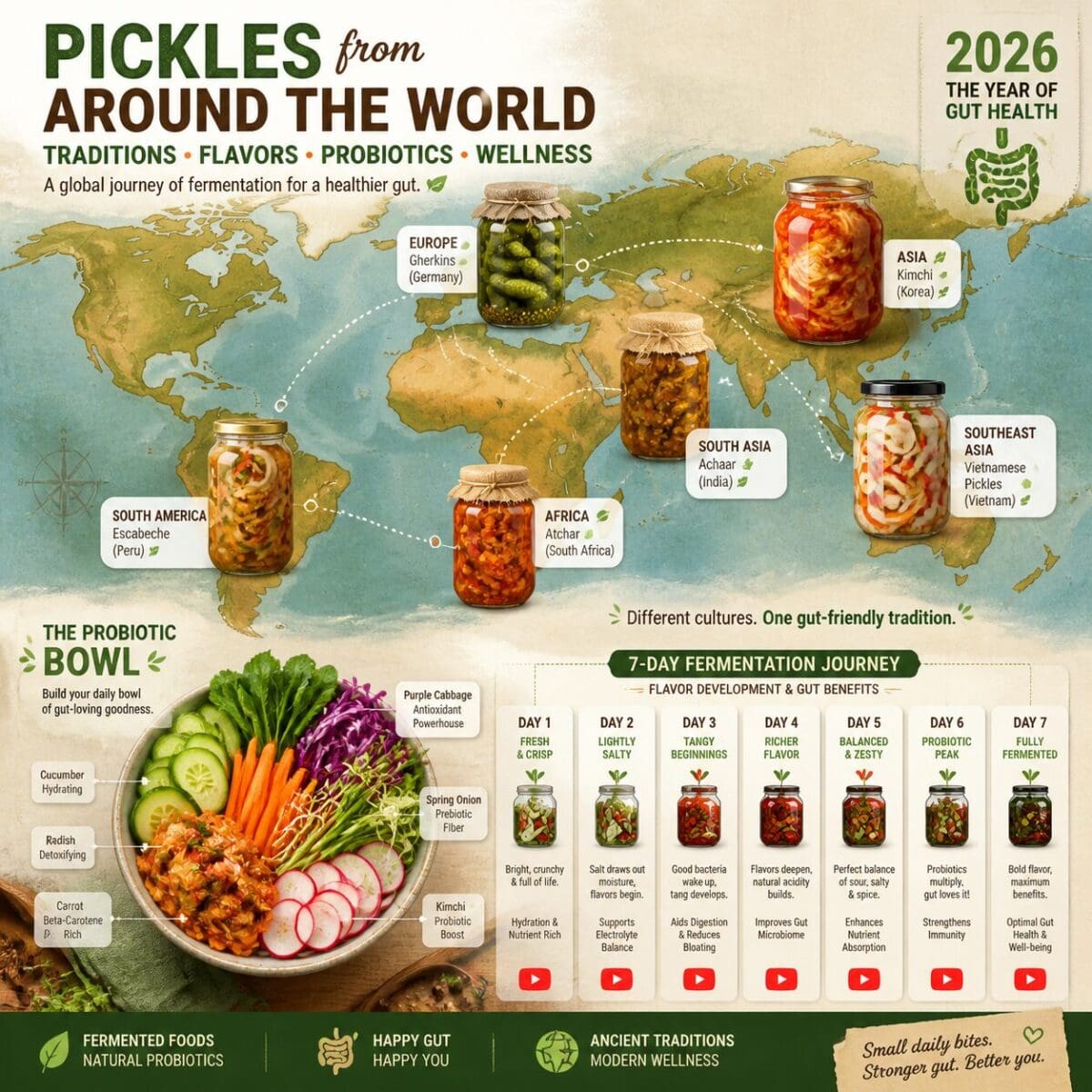
Exploring Quick-Pickling Techniques from Six Continents: Preserving Spring Vegetables and Building Probiotic Bowls for 2026 Gut Health with YouTube Fermentation Timelines means diving into the distinct flavor logic of each region.
🌏 Asia: Korean Kimchi & Japanese Tsukemono
Korean kimchi is arguably the world’s most studied probiotic food. Spring kimchi (geotjeori) uses fresh cabbage, radish, and spring onions with gochugaru (red pepper flakes), garlic, ginger, and fish sauce or miso for umami depth. Fermentation at room temperature for 24–48 hours activates Lactobacillus bacteria before refrigeration slows the process.
Japanese tsukemono (literally “pickled things”) takes a gentler approach. Salt-pressing cucumbers or daikon with kombu seaweed and yuzu creates a clean, mineral-rich quick pickle ready in 2–4 hours. No heat required — just weight and time.
🌿 Southeast Asia: Vietnamese Dưa Chua
Vietnamese dưa chua (sour pickles) typically combine daikon and carrots in a rice vinegar brine with sugar and a touch of fish sauce. The result is a crisp, tangy pickle that tops bánh mì sandwiches and rice bowls. Fermentation timeline: 24 hours for mild flavor, 72 hours for full sourness.
🌶️ South Asia: Indian Achaar
Indian achaar is bold and complex. Mustard oil, fenugreek seeds, turmeric, and asafoetida create a spiced oil-based brine for spring mangoes, cauliflower, or carrots. Unlike vinegar pickles, achaar relies on salt, oil, and sun-fermentation — a process that takes 3–7 days in a warm spot. The result is intensely flavored and rich in beneficial microorganisms. For readers interested in how food traditions intersect with community care and cultural wellness, achaar represents centuries of practical nutritional wisdom.
🫙 Europe: Gherkins, Cornichons & Fermented Cabbage
European pickling spans German sauerkraut, French cornichons, and Eastern European fermented beets. The lacto-fermentation method — salt, no vinegar — dominates here. Shredded cabbage packed tightly with 2% salt by weight ferments in 5–7 days at room temperature, producing sauerkraut loaded with Lactobacillus plantarum.
🌿 Africa: South African Atchar
South African atchar uses green mangoes or cabbage pickled in a spiced oil brine with turmeric, curry leaves, and chili. It shares DNA with Indian achaar (brought by South Asian immigrants) but has evolved its own regional character. Ready in 2–3 days.
🍋 South America: Escabeche
Latin American escabeche pickles jalapeños, carrots, and onions in a vinegar-citrus brine with oregano and bay leaves. It’s a quick-pickle style — ready in 1–2 hours for immediate use, or overnight for deeper flavor. The business of fermented foods has exploded across South America as gut health awareness grows.
YouTube Fermentation Timelines: Tracking Flavor Development
One of the most effective 2026 tools for beginner fermenters is the YouTube fermentation timeline — short-form video series that document a pickle’s flavor evolution day by day. Creators post daily taste-test updates, showing color changes, bubble activity, and aroma shifts [3].
| Day | What to Expect | Best Continental Style |
|---|---|---|
| 0–4 hrs | Crisp, lightly seasoned | Vietnamese, Escabeche |
| 24 hrs | Tangy, bright | Korean geotjeori, Tsukemono |
| 48–72 hrs | Sour, complex | Dưa chua, Atchar |
| 5–7 days | Deep umami, probiotic-rich | Sauerkraut, Kimchi, Achaar |
Searching YouTube for terms like “kimchi day-by-day fermentation” or “sauerkraut timeline” surfaces hundreds of visual guides. These are especially valuable for understanding when lacto-fermentation is active (bubbles = good bacteria at work) versus stalled. For those interested in beyond-the-basics food content, these video timelines represent a new genre of culinary education.
Building Probiotic Bowls for 2026 Gut Health
The final step in mastering Quick-Pickling Techniques from Six Continents: Preserving Spring Vegetables and Building Probiotic Bowls for 2026 Gut Health with YouTube Fermentation Timelines is assembly — turning individual pickles into a complete, gut-nourishing meal.
A balanced probiotic bowl includes:
- 🍚 Base: Brown rice, quinoa, or millet
- 🥬 Fermented greens: Kimchi or sauerkraut (2–3 tbsp)
- 🥕 Quick-pickled vegetables: Vietnamese carrots or escabeche
- 🥚 Protein: Soft-boiled egg, grilled tofu, or salmon
- 🌿 Fresh herbs: Cilantro, shiso, or dill
- 🍋 Finishing acid: Squeeze of lime or yuzu
Contemporary adaptations are also worth exploring — such as boozy quickles that incorporate bourbon, maple syrup, and fresh dill for a creative North American twist on the quick-pickle tradition [2]. These make excellent bowl toppings for adults seeking adventurous flavor profiles.
For readers exploring campaigns around healthy eating and local food culture, probiotic bowls represent an accessible entry point into functional nutrition. Those curious about celebrating community volunteers in local food movements will find that fermentation workshops are among the most popular community-building events of 2026.
Conclusion: Start Pickling, Start Healing 🫙
The world’s best gut-health traditions were never locked behind a pharmacy counter — they were preserved in clay pots, glass jars, and earthenware crocks across six continents. By applying these Quick-Pickling Techniques from Six Continents, any home cook can build a diverse, probiotic-rich kitchen in 2026.
Actionable next steps:
- Start with the universal brine — master the 1:1 vinegar-to-water ratio before experimenting [1]
- Pick one continental style this week: Vietnamese dưa chua is the fastest (24 hours)
- Follow a YouTube fermentation timeline to track your pickle’s progress day by day [3]
- Build one probiotic bowl using at least two different pickled vegetables from different traditions
- Expand gradually — add kimchi, then sauerkraut, then achaar over the following weeks
The gut microbiome thrives on diversity. The more pickling traditions explored, the richer the probiotic benefit. Start simple, go global, and let the fermentation do the work.
References
[1] How To Quick Pickle Vegetables With Basic Brine Recipe – https://marydisomma.com/blogs/recipes/how-to-quick-pickle-vegetables-with-basic-brine-recipe
[2] Sweetnspicy Boozy Quickles – https://theurbannanna.com/2025/09/28/sweetnspicy-boozy-quickles/
[3] 0gfewfjsye – https://www.youtube.com/shorts/_0gfeWfJsyE
Content, illustrations, and third-party video appearing on GEORGIANBAYNEWS.COM may be generated or curated with AI assistance or reproduced pursuant to the fair dealing provisions of the Copyright Act, R.S.C. 1985, c. C-42. Attribution and hyperlinks to original sources are provided in acknowledgment of applicable intellectual property rights. Such referencing is intended to direct traffic to and support the original rights holders’ platforms.