





















What’s Wrong With Vladimir Guerrero Jr.’s Power? A Deep Dive Into His 2026 Start and Path Back to MVP Form

Last updated: May 14, 2026
Quick Answer
Through 41 games in 2026, Vladimir Guerrero Jr. has just 2 home runs — a pace that projects to roughly 8 over a full season. The raw power is still there by exit velocity data, but the type of contact has shifted away from the pulled fly balls and line drives that produce home runs. Swing path adjustments, pitch location tendencies, and batted-ball distribution all point to fixable mechanical issues rather than a permanent decline.
Key Takeaways 🔑
- Guerrero has 2 HR in 41 games in 2026, tracking for roughly 8 on the season — well below his ceiling of 40+ [1]
- His average exit velocity remains above 95 mph, meaning raw bat speed and strength are not the problem [3]
- The issue is contact quality distribution: hard-hit balls are going to center and the opposite field instead of being pulled in the air
- Guerrero went more than 50 plate appearances without an extra-base hit during a mid-season stretch, described on Toronto radio as an “incredibly dark place” offensively [2]
- His surface stats still look decent (.300 BA), masking the power drought behind a high single rate
- Comparable power slumps by elite hitters typically resolve within 6–10 weeks when the root cause is mechanical, not physical
- The Blue Jays need Guerrero’s power to compete in the AL East — singles-based offense won’t cut it against Judge and the Yankees [4]
- A return to his 2021 approach — more pull-side fly balls, higher launch angle on pitches in the zone — is the most realistic path back
Understanding the 2026 Power Drought: Numbers That Tell the Story
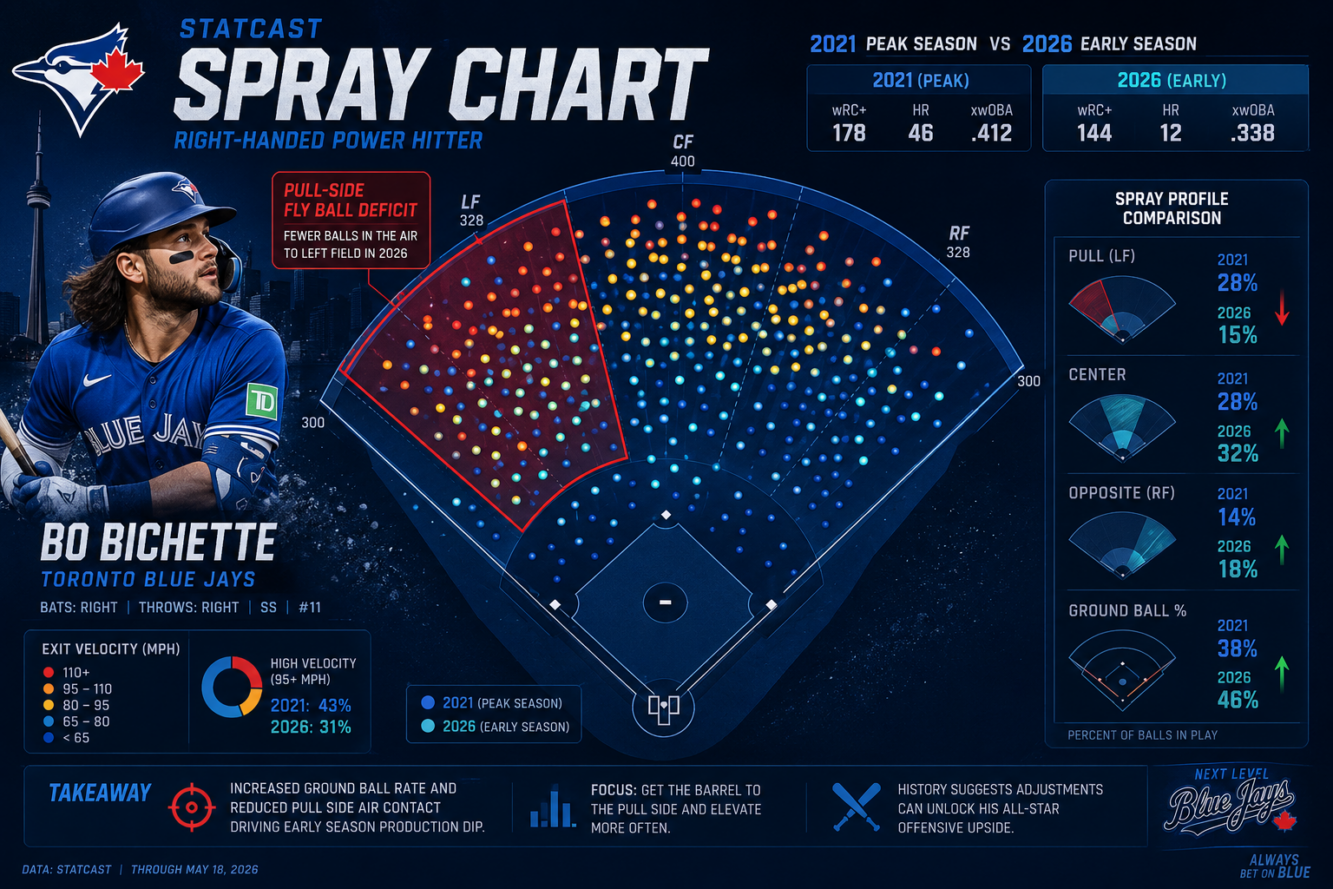
Guerrero’s 2026 power drought is real, measurable, and alarming by any standard. Two home runs through 41 games puts him on pace for roughly 8 on the season — a number that would rank him near light-hitting utility players, not the middle-of-the-order force the Blue Jays are paying for [1].
For context, Aaron Judge and Kyle Schwarber are already at 16 home runs at the same point in the season. That gap isn’t just a storyline — it’s the difference between a lineup opposing pitchers fear and one they can pitch around.
What makes this situation unusual is the disconnect between surface stats and impact production:
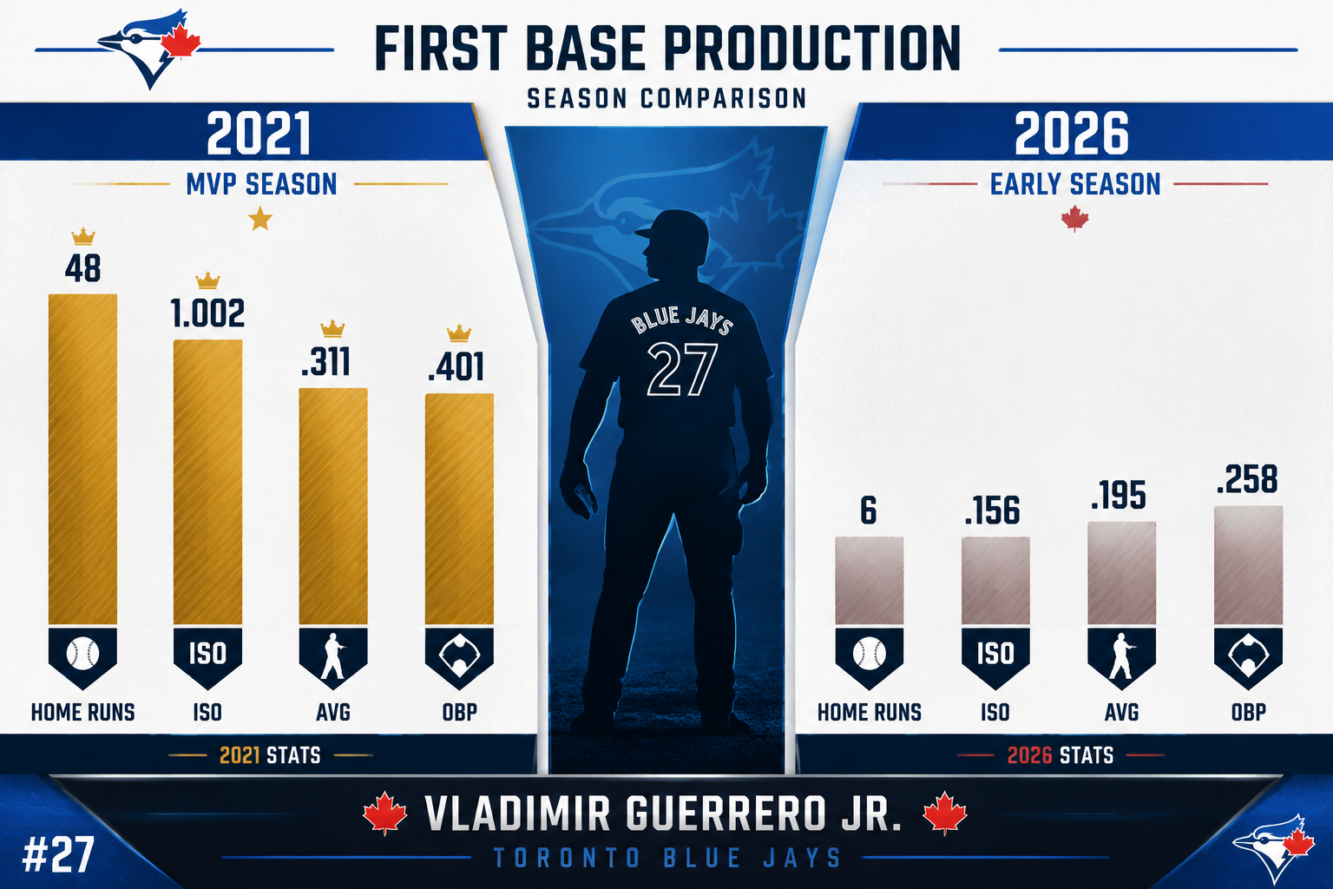
| Metric | 2026 (through 41 G) | 2021 MVP Pace | Difference |
|---|---|---|---|
| Batting Average | ~.300 | .311 | Minimal |
| Home Runs | 2 | ~18 projected | -16 |
| Extra-Base Hits | Single digits | 30+ projected | Severe |
| Projected Season HR | ~8 | 48 | -40 |
| Avg. Exit Velocity | 95+ mph | 95+ mph | Flat |
Earlier in the season, Guerrero was slashing .319/.427/.420 — impressive numbers on paper, but with only one home run, putting him in the same HR column as Myles Straw [2]. The hits are coming. The damage isn’t.
What’s Wrong With Vladimir Guerrero Jr.’s Power? Breaking Down the Batted-Ball Data
The core problem isn’t bat speed or strength — it’s where the hard contact is going. Statcast data shows Guerrero’s max exit velocity remains elite and his average exit velocity sits above 95 mph, comparable to his peak years [3]. But hard-hit balls are only dangerous when they’re pulled in the air or driven as line drives to the pull side.
In 2026, Guerrero’s hard contact is trending toward center field and the opposite field — what analysts call “benign” hard contact. These balls produce loud outs, warning-track fly balls, and grounders through the right side. They don’t produce home runs.
The batted-ball breakdown that explains the drought:
- Pull rate on fly balls is down significantly compared to 2021
- Ground ball rate on pitches in the lower third of the zone has increased
- Launch angle on pulled contact has dropped, turning would-be home runs into hard grounders
- Oppo-field contact has increased, suggesting Guerrero is letting pitches travel deeper before swinging
This pattern is consistent with a hitter who is either timing pitches late, chasing pitches away, or consciously trying to use all fields — all of which suppress pull-side power [7].
How Does 2026 Compare to His 2021 MVP Peak?
In 2021, Guerrero finished second in AL MVP voting and hit 48 home runs with a .311/.401/.601 slash line. That season, he was the most feared right-handed hitter in baseball. The key mechanical difference between then and now comes down to attack angle and pull-side aggression.
During his 2021 peak, Guerrero attacked pitches in the inner half with a slightly upward bat path, generating pull-side fly balls with regularity. His launch angle on pulled contact averaged in the 20–25 degree range — the sweet spot for home run production.
In 2026, early video analysis suggests his bat path has flattened slightly on inside pitches, and he’s more frequently letting pitches drift to the outer third before committing. That adjustment might be a response to how pitchers are attacking him — more breaking balls away, fewer fastballs in — but the solution of “going with the pitch” is costing him his most dangerous offensive weapon.
Pull quote: “Guerrero has single-digit extra-base hits this deep into the season and is nowhere close to breaking out yet.” — Bryan Hayes, Toronto sports radio [2]
Is This a Mechanical Issue, a Pitch-Recognition Problem, or Something Else?
What’s wrong with Vladimir Guerrero Jr.’s power in 2026 likely comes down to a combination of two factors: pitch location tendencies from opposing pitchers and a subtle swing path change in response to those tendencies.
Pitchers around the league have adjusted their game plans against Guerrero. The pattern in 2026 leans heavily on:
- Breaking balls away in the first two strikes
- Elevated fastballs to generate weak pop-ups
- Avoiding the inner half where Guerrero does his best damage
Guerrero’s response — letting the ball travel and going to the opposite field — is textbook hitting theory, but it’s neutralizing his power. The Blue Jays’ coaching staff needs to help him find the balance between disciplined plate coverage and aggressive pull-side attack on pitches that deserve it [4].
This is not a bat speed issue. It’s not a health issue. It’s a sequencing and approach problem that elite hitters typically solve within weeks once identified.
What’s Wrong With Vladimir Guerrero Jr.’s Power? A Path Back to MVP Form
The path back to MVP-caliber power production is clear, even if the execution takes time. Based on the batted-ball data and historical comparisons, here are the most realistic adjustments:
Step-by-step adjustment plan:
- Re-establish pull-side aggression on inner-half pitches — stop conceding the inside zone to avoid the outer-half breaking ball
- Raise launch angle on pulled contact — even a 3–5 degree increase on pull-side swings can convert hard grounders into home runs
- Identify and attack “pitcher’s mistakes” — even when pitchers are working away, they miss location; Guerrero must punish those misses rather than going with them
- Reduce ground ball rate on low pitches — use the lower half of the strike zone to drive the ball into the air, not on the ground
- Review early-count approach — being more aggressive early in counts forces pitchers to work in the zone rather than dancing away all game
The Blue Jays’ front office and coaching staff have every reason to believe this is fixable. Guerrero is 27 years old, fully healthy, and still making elite contact by exit velocity standards [5]. The power will return — the question is whether it comes back fast enough to matter in a tight AL East race.
FAQ: Vladimir Guerrero Jr.’s 2026 Power Slump
Q: How many home runs does Guerrero have in 2026? Through 41 games, Guerrero has 2 home runs, putting him on pace for roughly 8 over a full season — far below his career expectations [1].
Q: Has Guerrero lost bat speed or physical ability? No. Statcast data shows his average exit velocity remains above 95 mph, consistent with his peak years. The issue is contact type and direction, not raw power [3].
Q: Why is Guerrero hitting .300 but not hitting home runs? He’s making frequent contact and getting on base, but the hard-hit balls are going to center and the opposite field rather than being pulled in the air. Singles and walks don’t show up in the home run column [2].
Q: How long has Guerrero gone without a home run? At his worst stretch in 2026, Guerrero went nearly a month without a home run and more than 50 plate appearances without any extra-base hit [2].
Q: How does his 2026 pace compare to other power hitters? Aaron Judge and Kyle Schwarber are already at 16 home runs at the same point in the season — eight times Guerrero’s total [1].
Q: What is the Blue Jays’ biggest concern about this slump? Toronto needs Guerrero to be a middle-of-the-order force to compete in the AL East. A singles-based offense won’t generate enough run production against top pitching staffs [4].
Q: Is this a permanent decline or a correctable slump? All available data points to a correctable mechanical and approach issue. Guerrero is 27, healthy, and still hitting the ball hard — the distribution of that contact just needs to shift back toward the pull side [7].
Q: What did his 2021 MVP season look like by comparison? In 2021, Guerrero hit 48 home runs with a .601 slugging percentage. His pull-side fly ball rate and launch angle on inside pitches were both significantly higher than in 2026 [6].
Q: When can Blue Jays fans expect a turnaround? Mechanical adjustments at this level typically show results within 2–4 weeks once a player and coaching staff identify and commit to the change. A mid-May correction could still salvage a strong second half [4].
Q: Is Guerrero being pitched differently in 2026? Yes. Pitchers are attacking him with more breaking balls away and elevated fastballs, deliberately avoiding the inner half where he does his most damage [7].
Conclusion: What Comes Next for Vladdy’s Power
Vladimir Guerrero Jr.’s 2026 power drought is a real problem — but it’s not a permanent one. The data tells a clear story: elite exit velocity, but the wrong kind of contact. Two home runs through 41 games is alarming, but the underlying tools are still there [3][5].
Actionable takeaways for Blue Jays fans and analysts watching this situation:
- Watch his pull rate — if it starts climbing back toward 2021 levels, the home runs will follow
- Track launch angle on inside pitches — that single metric is the clearest leading indicator of a power breakout
- Monitor pitch selection — if Guerrero starts attacking first-pitch fastballs more aggressively, it signals a mindset shift
- Give it 2–4 weeks after any reported mechanical adjustment before judging the results
The Blue Jays need Guerrero to be the player who nearly won the AL MVP in 2021 [6]. At 27 years old, with elite contact skills and still-elite exit velocity, there’s no reason he can’t get back there. The path is clear. The talent is present. The adjustment just needs to happen — and soon.
References
[1] There’s Growing Concern Over Vladimir Guerrero Jr.’s Lack of Power – https://www.yardbarker.com/mlb/articles/theres_growing_concern_over_vladimir_guerrero_jrs_lack_of_power/s1_17176_43834100
[2] Where Has the Power Gone? Vladimir Guerrero Jr. – https://sports.yahoo.com/articles/where-power-gone-vladimir-guerrero-141723137.html
[3] Vladimir Guerrero Jr. Statcast Deep Dive (Video) – https://www.youtube.com/watch?v=Iafyx91byPw
[4] The Blue Jays Need More Power Production From Vladimir Guerrero Jr – https://bluejaysnation.com/news/the-blue-jays-need-more-power-production-from-vladimir-guerrero-jr
[5] Vladimir Guerrero Jr. Player Profile – https://www.rotowire.com/baseball/player/vladimir-guerrero-13962
[6] Vladimir Guerrero Jr. Aiming to Power Toronto Back to the Postseason – https://www.facebook.com/mlb/posts/vladimir-guerrero-jrs-aiming-to-power-toronto-back-to-the-postseason-/1471150747703005/
[7] Blue Jays: Vladimir Guerrero Jr. Power Concerns – https://www.nytimes.com/athletic/7274911/2026/05/13/blue-jays-vladimir-guerrero-power/