





















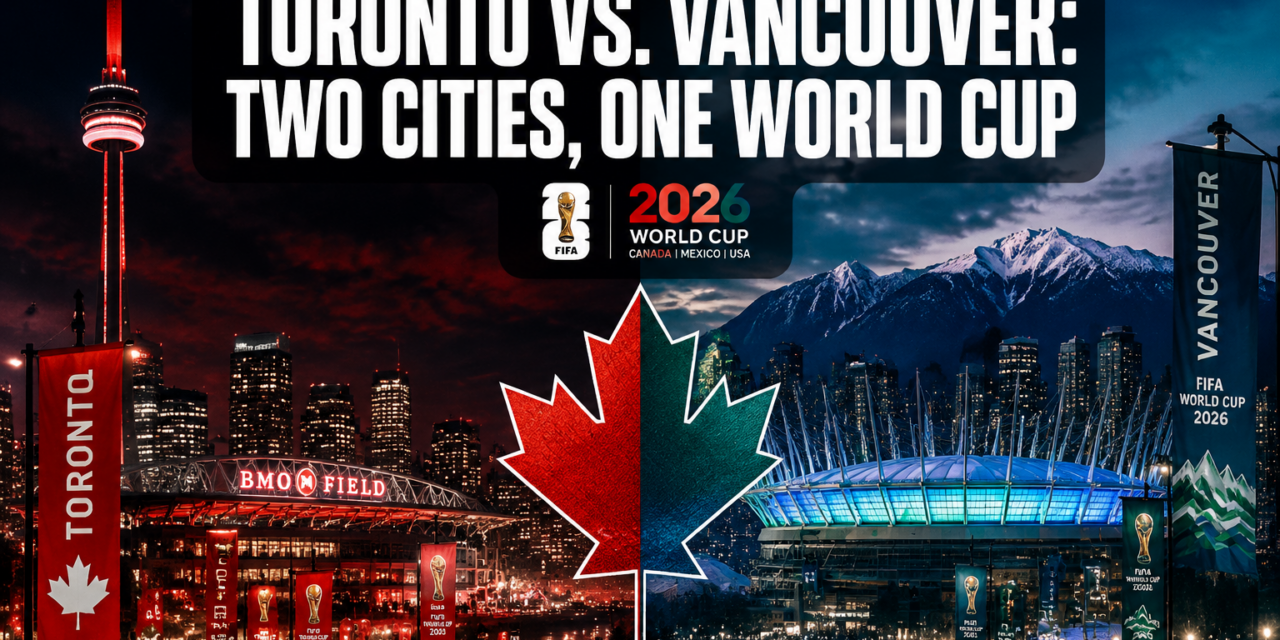
Toronto vs. Vancouver: How Canada’s Two Host Cities Are Creating Completely Different World Cup Experiences
Last updated: May 17, 2026
Quick Answer
Toronto and Vancouver are both hosting FIFA World Cup 2026 matches, but the two cities are delivering strikingly different fan experiences. Toronto leans into its dense urban energy, multicultural street culture, and massive downtown fan zones, while Vancouver pairs its matches with mountain scenery, a laid-back Pacific vibe, and a compact, walkable stadium district. Which city suits a traveling fan depends entirely on what kind of trip they want.
Key Takeaways 🏆
- Toronto hosts matches at BMO Field (expanded for the tournament) in a dense, transit-connected urban core with access to some of North America’s most diverse food and nightlife scenes.
- Vancouver hosts matches at BC Place, a covered dome stadium steps from downtown hotels, with the added backdrop of mountains and ocean.
- Toronto’s fan zones are larger, louder, and more spread across the city; Vancouver’s are more concentrated and easier to navigate on foot.
- Accommodation costs and availability differ significantly between the two cities, with Toronto offering more options at a wider price range.
- Vancouver’s covered stadium means weather is never a concern on matchday; Toronto’s outdoor BMO Field is fully exposed to summer conditions.
- Nightlife, food culture, and the overall “vibe” of each city are genuinely different — not just slightly different versions of the same experience.
- Traveling fans should choose Toronto for urban intensity and multicultural energy, and Vancouver for scenic beauty and a more relaxed matchday atmosphere.
How Toronto and Vancouver Are Branding Their World Cup Presence Differently
Toronto is marketing itself as the cultural capital of the tournament’s Canadian leg. The city’s pitch to fans centers on its sheer scale: over 200 spoken languages, neighborhoods like Kensington Market and Little Portugal that double as unofficial fan villages, and a downtown core that can absorb massive crowds without losing its character.
Vancouver is taking a different approach. Its branding leans heavily on the natural environment — the idea that fans can watch a World Cup match and be on a ski run or kayaking in English Bay within an hour. The city is positioning the tournament as a full outdoor adventure, not just a soccer event.
The core difference: Toronto sells the city itself as the experience. Vancouver sells what surrounds the city.
Stadium Comparison: BMO Field vs. BC Place
Both venues are legitimate World Cup-caliber stadiums, but they offer very different atmospheres.
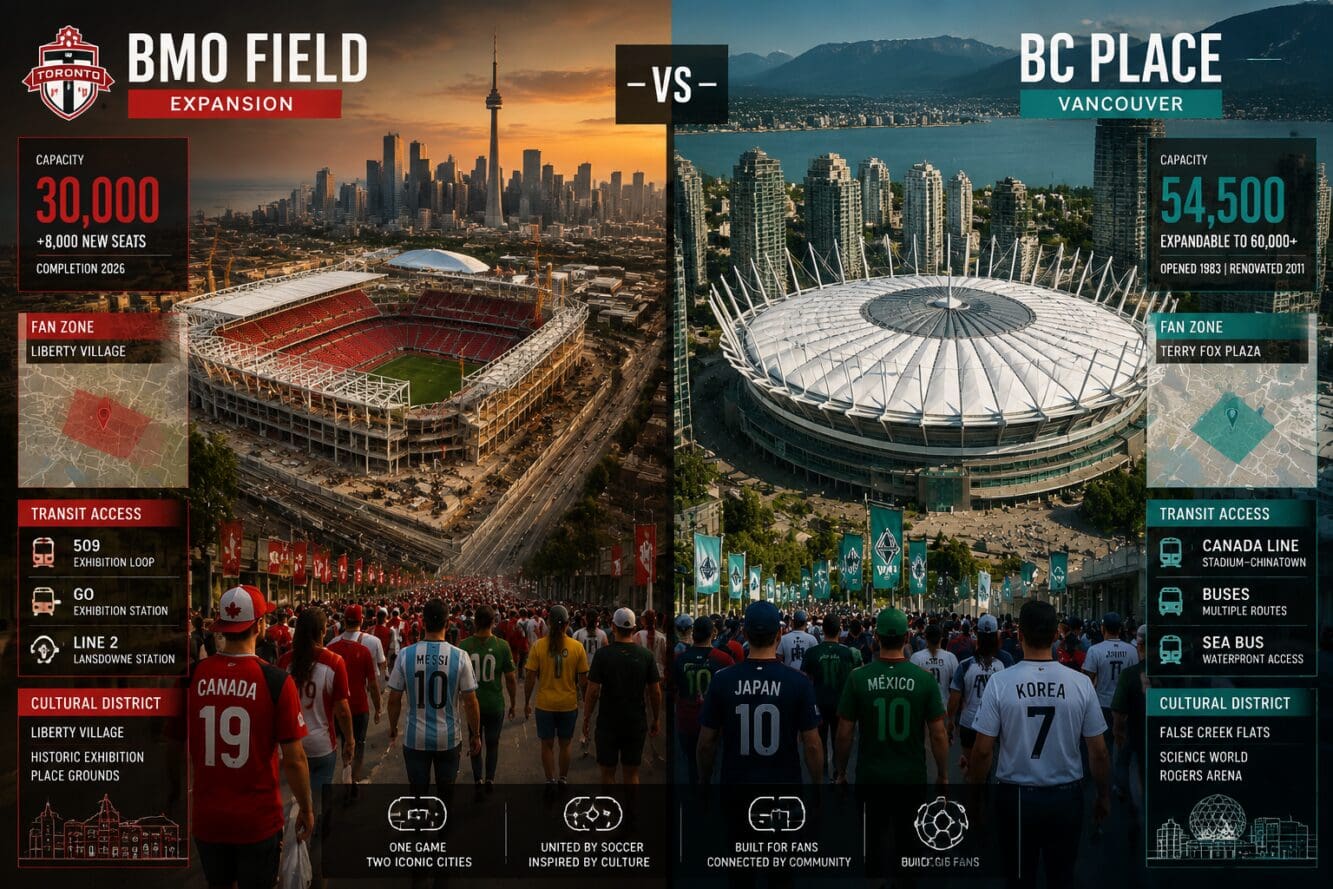
| Feature | BMO Field (Toronto) | BC Place (Vancouver) |
|---|---|---|
| Roof | Open air | Retractable dome (fully covered) |
| Capacity (2026) | ~45,000 (expanded) | ~54,500 |
| Location | Exhibition Place, west of downtown | Downtown core, False Creek waterfront |
| Transit access | Streetcar + shuttle | SkyTrain (stadium stop) |
| Weather risk | Yes — heat and rain possible | None — dome protects all matches |
| Surrounding area | Lake Ontario waterfront | Mountains, False Creek seawall |
Choose BMO Field if the open-air atmosphere and lakeside setting appeal to you. Choose BC Place if you want guaranteed comfort and the easiest possible stadium access from a hotel.
Fan Zones and Matchday Logistics: Toronto vs. Vancouver
Toronto’s fan zone strategy is deliberately decentralized. The city has set up viewing areas across multiple neighborhoods — Nathan Phillips Square, Harbourfront, and Yonge-Dundas Square — so that fans spread out rather than bottlenecking in one spot. This works well for a city of Toronto’s size but requires more planning to navigate.
Vancouver’s fan zones are concentrated near BC Place and along the False Creek seawall. The layout is compact enough that fans can walk from their hotel to the fan zone to the stadium without ever needing transit. For first-time visitors or fans who prefer simplicity, Vancouver’s setup is noticeably easier.
Common mistake: Toronto fans who skip transit planning end up in gridlock. The city’s streetcar network near Exhibition Place gets overwhelmed on matchdays. The subway and pre-booked rideshare are the smarter options.
Culture, Food, and Nightlife: Where Toronto vs. Vancouver Really Diverge
This is where the two cities feel most different. Toronto’s restaurant and bar scene is one of the densest in North America. Within walking distance of any downtown hotel, fans can find cuisine representing nearly every nation competing in the tournament — a meaningful detail when you’re traveling with supporters from multiple countries.
Vancouver’s food scene is excellent but smaller. Its strength is in fresh Pacific seafood, Asian cuisine (particularly along Richmond’s food strip), and craft beverage culture. The nightlife is more relaxed — closing times are earlier, and the general energy is quieter than Toronto after 11 p.m.
- Toronto nightlife: Late-closing bars, live music venues, club districts in King West and Queen West
- Vancouver nightlife: Gastown cocktail bars, Granville Street entertainment strip, earlier wind-down overall
- Best food neighborhoods: Toronto’s Kensington Market and St. Lawrence Market; Vancouver’s Chinatown and Richmond’s No. 3 Road corridor
Accommodation and Cost: What Traveling Fans Should Budget
Toronto has more hotel inventory, which creates more price competition. Fans booking early can find mid-range options within a 20-minute transit ride of BMO Field. Vancouver’s hotel supply is tighter, and its downtown properties command a premium during the tournament, particularly for matches involving high-demand national teams.
Practical guidance:
- Book Vancouver accommodation at least 6 months before your match date if you haven’t already.
- Toronto’s Airbnb and short-term rental market is larger, giving budget travelers more flexibility.
- Both cities have strong public transit, so staying slightly outside the core is a viable cost-saving strategy.
FAQ
Which city has the better stadium experience for World Cup 2026? BC Place in Vancouver offers more comfort (covered roof, easier transit access), while BMO Field in Toronto delivers a rawer, open-air atmosphere. Neither is objectively better — it depends on personal preference.
Is Toronto or Vancouver easier to get around during the World Cup? Vancouver is easier for matchday logistics because its stadium is in the downtown core. Toronto requires more transit planning, especially near BMO Field.
Which city is more expensive for World Cup travel? Vancouver hotel prices are generally higher during the tournament due to limited supply. Toronto offers more accommodation options at varied price points.
Can fans do day trips from either city during the tournament? Yes. Vancouver fans can access Whistler, the Sea-to-Sky corridor, and Vancouver Island. Toronto fans can reach Niagara Falls, Prince Edward County, and Muskoka within a few hours.
Which city has better food options for international fans? Toronto, by volume and variety. Its multicultural neighborhoods offer cuisine from virtually every country represented in the tournament.
What’s the weather like in both cities during the 2026 World Cup? Toronto in summer is warm and humid, with occasional thunderstorms. Vancouver is mild and drier than its reputation suggests in summer, though BC Place’s dome makes weather irrelevant on matchday.
Do both cities have strong soccer fan cultures? Yes, but differently expressed. Toronto has a passionate TFC supporter base that brings stadium culture to BMO Field. Vancouver’s Whitecaps fans are loyal but the city’s sports culture is more evenly split with hockey and outdoor recreation.
Which city is better for families attending the World Cup? Vancouver’s compact layout and walkable fan zones make it slightly more family-friendly for matchday logistics. Toronto is excellent for families who want more entertainment options between matches.
Conclusion: Choosing Your Canadian World Cup City
Toronto vs. Vancouver: How Canada’s Two Host Cities Are Creating Completely Different World Cup Experiences isn’t just a marketing distinction — it’s a genuine fork in the road for traveling fans. Both cities are delivering high-quality tournaments, but they’re doing it in ways that reflect their own identities.
Choose Toronto if you want maximum urban energy, the world’s most diverse food scene, and a city that feels like it was built for a crowd this size.
Choose Vancouver if you want a compact, easy matchday, mountain scenery, and a more relaxed pace between games.
Actionable next steps:
- Lock in accommodation immediately — both cities are filling fast for key match dates.
- Research transit options specific to your stadium before arrival.
- Plan at least one non-match day activity in whichever city you choose — both reward exploration beyond the fan zones.
- If budget allows, consider splitting time between both cities. The two experiences genuinely complement each other.
Meta Title: Toronto vs. Vancouver World Cup 2026: Which City Wins?
Meta Description: Toronto and Vancouver are hosting FIFA World Cup 2026 very differently. Compare stadiums, fan zones, food, nightlife, and costs to pick the right city for your trip.