















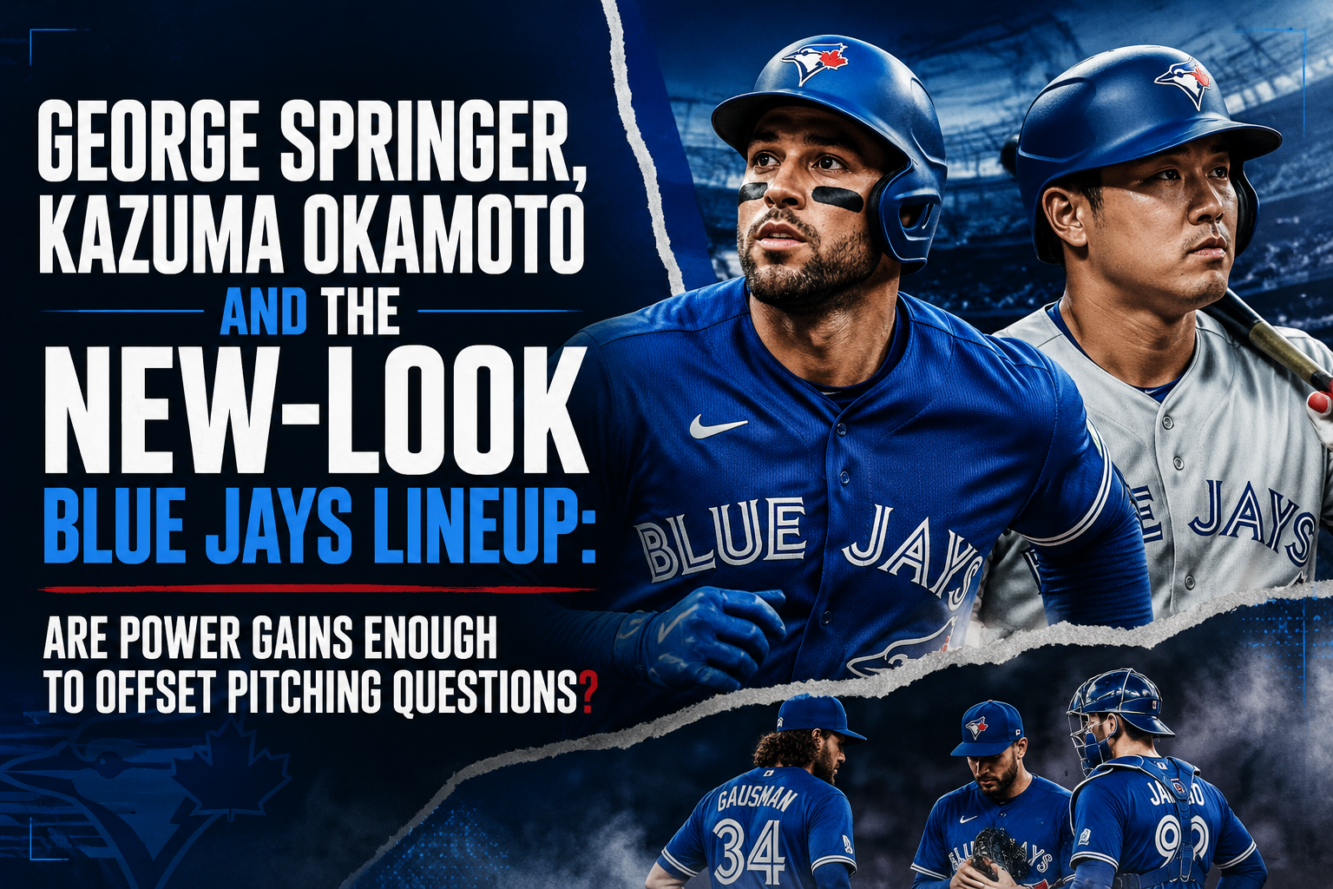
George Springer, Kazuma Okamoto and the New-Look Blue Jays Lineup: Are Power Gains Enough to Offset Pitching Questions?
Last updated: May 15, 2026
Quick Answer
The 2026 Toronto Blue Jays have assembled one of the most power-laden lineups in the American League, anchored by George Springer’s leadoff production and Kazuma Okamoto’s emerging home run threat. However, whether that offensive firepower can compensate for legitimate questions about the pitching staff remains the central debate heading into the heart of the 2026 season. Early indicators are promising but not yet conclusive.
Key Takeaways 🔑
- George Springer has transitioned to a full-time designated hitter role, batting leadoff to preserve his body while maximizing his on-base skills [1]
- Kazuma Okamoto signed a four-year, $60 million deal and brings 248 career NPB home runs and a .277/.361/.521 slash line into his MLB debut [2]
- Okamoto bats seventh in the order, a deliberate choice to ease his MLB transition while still adding lineup depth [1]
- The Blue Jays’ projected 2026 batting order ranks among the most formidable in baseball, with Vladimir Guerrero Jr. and Anthony Santander anchoring the middle [3]
- Pitching acquisitions this offseason included Dylan Cease, Cody Ponce, and Tyler Rogers, but the rotation carries real risk [7]
- ZiPS projections suggest Okamoto will acclimate well, making the power gains meaningful rather than cosmetic [6]
- The team still holds roster flexibility for additions like Kyle Tucker or Cody Bellinger if the lineup needs further depth [3]
- The key question for 2026: can the offense score enough runs to carry a rotation that lacks a true ace?
What Does the 2026 Blue Jays Lineup Actually Look Like?
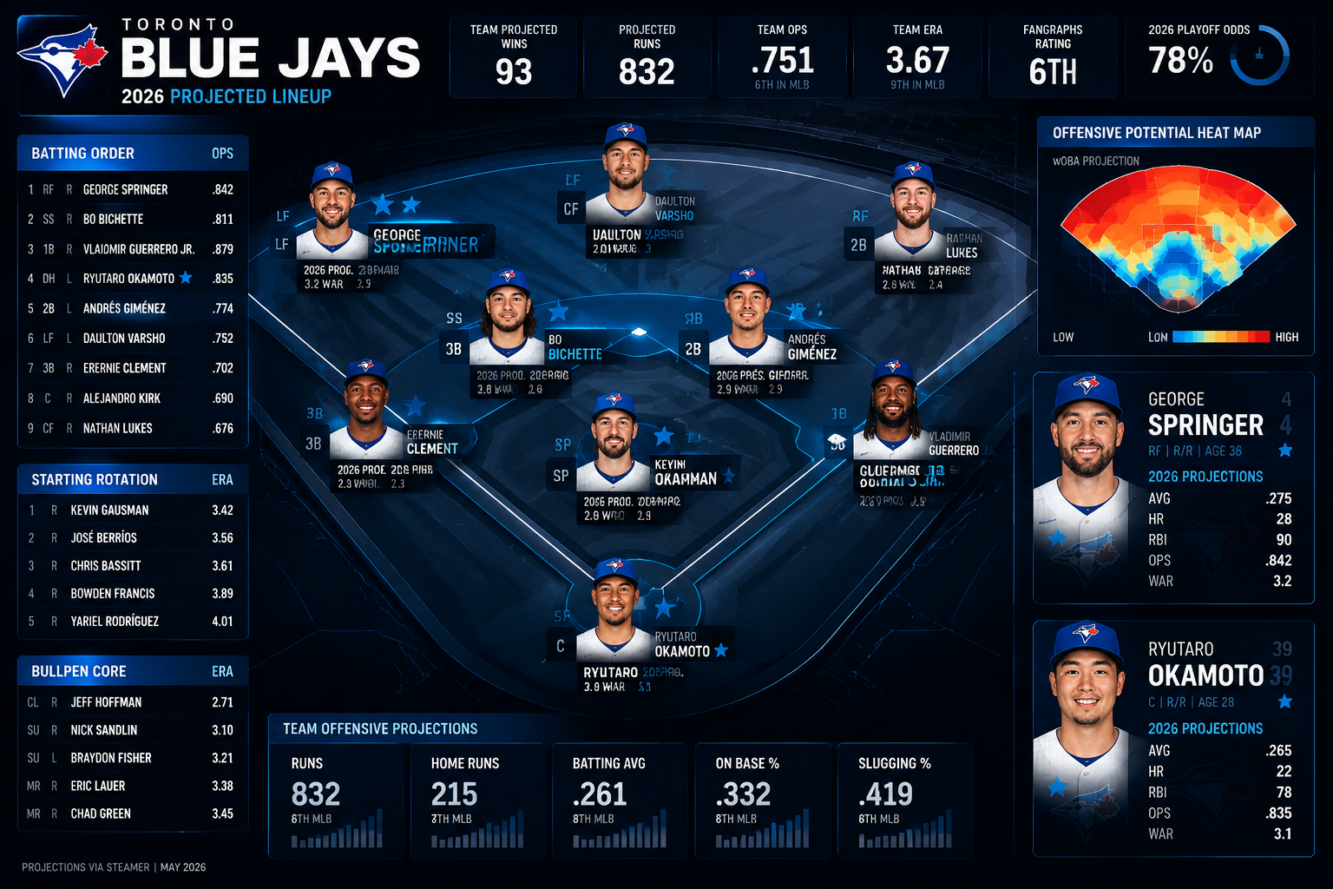
The 2026 Toronto Blue Jays batting order is one of the deepest the franchise has fielded in years. George Springer, Kazuma Okamoto and the New-Look Blue Jays Lineup represent a significant shift in how the team constructs its offense, moving away from the Bichette era toward a more internationally sourced, power-first approach.
Here is the projected starting lineup [1]:
| Batting Order | Player | Position |
|---|---|---|
| 1st | George Springer | DH |
| 2nd | Addison Barger | RF |
| 3rd | Vladimir Guerrero Jr. | 1B |
| 4th | Anthony Santander | LF |
| 5th | Alejandro Kirk | C |
| 6th | Daulton Varsho | CF |
| 7th | Kazuma Okamoto | 3B |
| 8th | Ernie Clement | 2B |
| 9th | Andrés Giménez | SS |
Key structural note: Okamoto’s arrival pushed Addison Barger to right field and moved Ernie Clement to second base, replacing Bo Bichette entirely. The infield corners are now significantly upgraded in terms of power projection [7].
Who Is Kazuma Okamoto and Why Does He Matter?
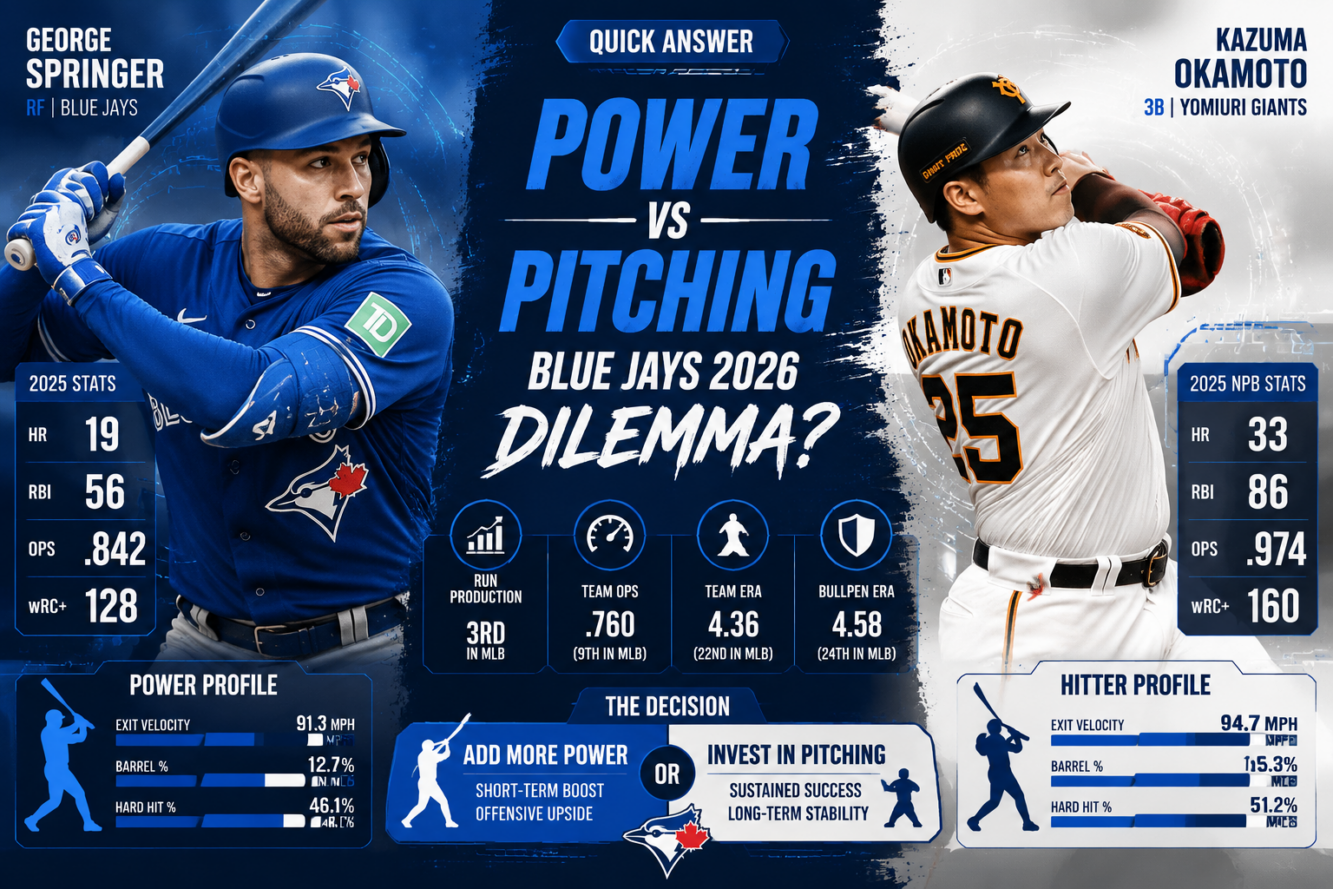
Okamoto is the most important offensive addition Toronto has made in years. Across 11 NPB seasons, the 32-year-old third baseman posted a .277/.361/.521 slash line with 248 home runs and 717 RBIs, credentials that place him among the most decorated position players to cross from Japan to MLB in recent memory [2].
His four-year, $60 million contract reflects genuine confidence in his ability to translate that production. Blue Jays hitting coach Popkins has been direct about what makes Okamoto special: “He has a really good flow. He has the ability to adjust and hit off his lead leg. He can really do a lot of things.” [5]
Why batting seventh matters: Placing Okamoto seventh is a deliberate acclimatization strategy. He faces less pressure in that spot while still providing lineup protection for the hitters above him. As of early May 2026, he’s already showing signs of his hottest stretch since joining Toronto, with his home run potential beginning to reshape the team’s offensive profile [8].
Defensive outlook: His dWAR of 0.6 at third base in Japan in 2025 suggests solid but not elite defense at the position. He’ll likely grade out as below MLB average defensively, which is an acceptable trade-off given the offensive upside [7].
“ZiPS modeling projects Okamoto to acclimate quite well in his first MLB season, suggesting the power gains from adding the Japanese star may indeed provide meaningful offensive benefits.” [6]
What Is George Springer’s Role in the New-Look Lineup?
George Springer leads off and now plays exclusively as a designated hitter. The move away from center field is a practical one: it preserves Springer’s body from the wear of outfield play during the later stage of his career while keeping his on-base skills at the top of the order where they do the most damage [1].
Why this works for Toronto:
- Springer’s ability to get on base sets the table for Guerrero Jr. and Santander
- The DH role reduces injury risk and keeps him in the lineup more consistently
- Daulton Varsho takes over center field, maintaining solid defense in the outfield
Springer’s leadoff production is the engine of this offense. When he’s reaching base at a healthy clip, the lineup’s middle-order power becomes far more dangerous. The George Springer, Kazuma Okamoto and the New-Look Blue Jays Lineup: Are Power Gains Enough to Offset Pitching Questions? debate starts and ends with whether Springer can stay healthy and productive enough to make the whole machine run.
Are the Power Gains Real or Overstated?
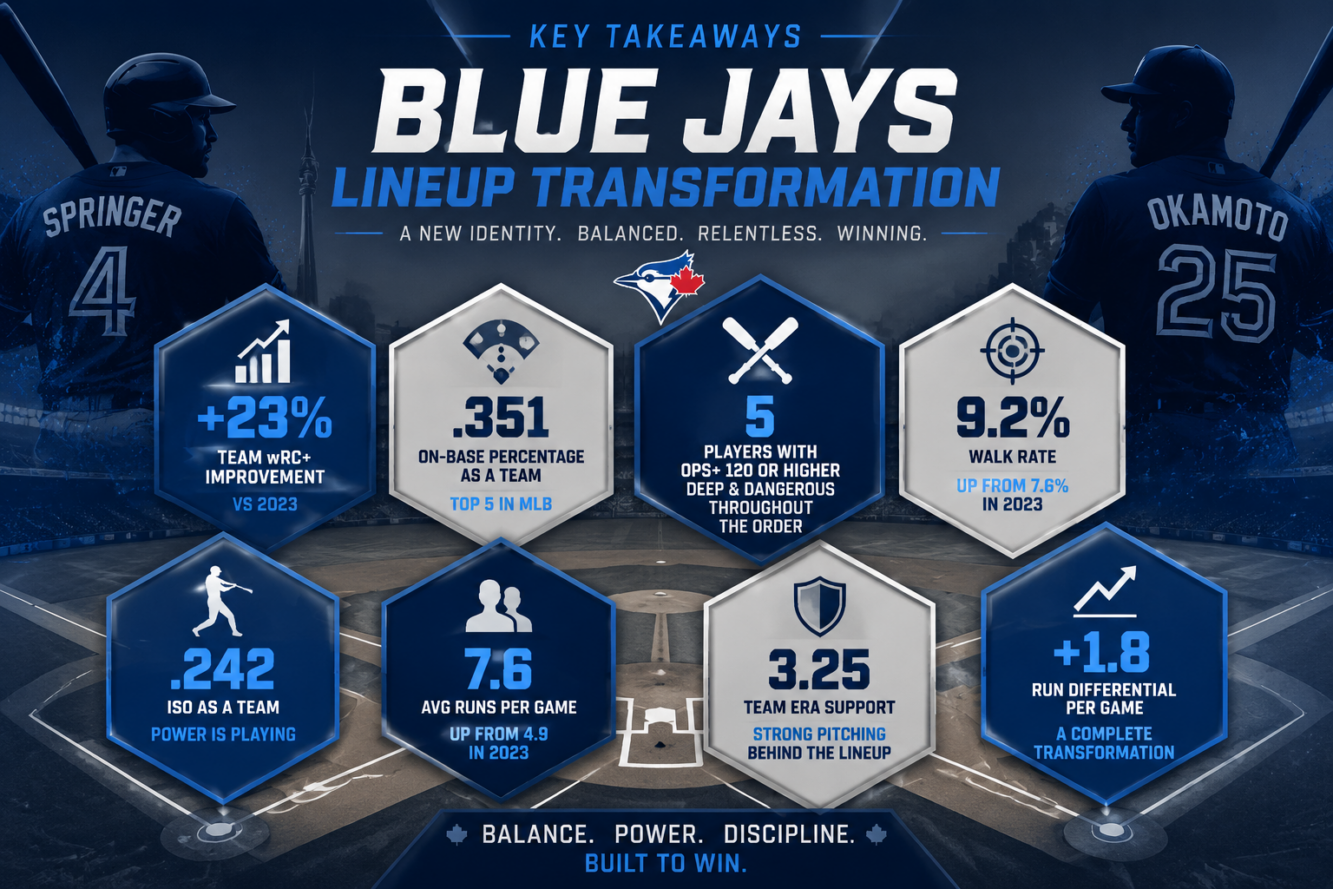
The power gains are real, and early 2026 batted-ball data supports that conclusion. The lineup now has legitimate home run threats from positions one through seven, which is unusual depth for any MLB roster.
Where the power comes from:
- Guerrero Jr. remains the centerpiece, a perennial 35-plus home run threat at first base
- Santander adds another 30-home run bat in left field
- Okamoto projects for 25-30 home runs in his MLB debut year based on ZiPS modeling [6]
- Springer contributes 15-20 home runs from the leadoff spot in a healthy season
- Barger and Varsho provide secondary pop from the two and six spots
Industry analysts project the Blue Jays’ lineup has the potential to rank among the elite in MLB for 2026, with room to improve further through additional free agent moves [3]. That’s not hype. The lineup construction is genuinely strong.
The honest caveat: NPB-to-MLB transitions carry real uncertainty. Okamoto will face harder breaking balls, more analytical pitching approaches, and a longer schedule than he’s ever experienced. The power is likely to come, but the timing and consistency of that production in year one is an open question.
What Are the Pitching Questions Surrounding the 2026 Blue Jays?
The pitching staff is where the George Springer, Kazuma Okamoto and the New-Look Blue Jays Lineup: Are Power Gains Enough to Offset Pitching Questions? debate gets genuinely complicated. Toronto’s 2026 offseason prioritized pitching, bringing in Dylan Cease, Cody Ponce, and Tyler Rogers, but the rotation still lacks a clear, undisputed ace [7].
The core pitching concerns:
- Rotation depth: Cease is a quality starter, but the backend of the rotation carries significant risk
- Bullpen reliability: Tyler Rogers and Cody Ponce add depth, but the late-inning picture is not locked down
- Run prevention: A lineup this good needs a rotation that can keep games close; if the staff gives up four or more runs per game consistently, the offense will be under constant pressure
Choose this team if: You believe a top-five offense can mask a mid-tier rotation in a 162-game season. History shows this is possible, but it requires the offense to be nearly automatic.
Be cautious if: The rotation underperforms early and the team falls behind in the AL East standings, because catching up requires near-perfect execution from an offense that includes a first-year MLB player in Okamoto.
Can the Offense Carry a Shaky Pitching Staff?
Offenses can carry shaky rotations, but only within limits. The 2026 Blue Jays have the lineup depth to score five or more runs per game on a consistent basis, which would make them competitive even with a below-average pitching staff. The math works if the offense performs at its ceiling.
What needs to go right:
- Springer stays healthy and reaches base at a .350-plus clip
- Okamoto delivers 20-plus home runs in his debut season
- Guerrero Jr. and Santander each post 30-home run, 90-plus RBI seasons
- The rotation ERA stays below 4.50 as a unit
What could go wrong:
- Okamoto’s MLB adjustment takes longer than projected
- Springer misses significant time due to injury
- The rotation ERA climbs above 5.00, putting the offense in a constant deficit
The team still has flexibility to address these concerns. Potential additions like Kyle Tucker, Cody Bellinger, or even a Bo Bichette re-acquisition remain possibilities heading into the summer [3]. Toronto is not locked into its current roster construction.
How Does This Lineup Compare to AL East Competition?
The AL East in 2026 is as competitive as any division in baseball. The Blue Jays’ lineup compares favorably on paper, but paper lineups don’t win games.
Quick comparison framework:
- Offense: Blue Jays rank near the top of the AL East in projected run-scoring potential [3]
- Pitching: This is where Toronto trails division rivals who have invested more heavily in starting pitching
- Roster flexibility: Toronto has more room to maneuver than most AL East competitors heading into the trade deadline
The Blue Jays are built to win with their bats. That’s a viable strategy, but it’s also a fragile one if key hitters underperform or the pitching staff collapses early.
FAQ: Blue Jays Lineup and Pitching Questions in 2026
Q: How much did Kazuma Okamoto sign for with the Blue Jays? Okamoto signed a four-year, $60 million contract with Toronto this offseason [1].
Q: What position does George Springer play in 2026? Springer is now a full-time designated hitter, batting leadoff. He no longer plays in the outfield [1].
Q: Where does Okamoto bat in the Blue Jays lineup? He bats seventh, a deliberate choice to ease his transition to MLB competition [1].
Q: What were Okamoto’s NPB career stats? Over 11 NPB seasons, Okamoto posted a .277/.361/.521 slash line with 248 home runs and 717 RBIs [2].
Q: Who replaced Bo Bichette at second base? Ernie Clement shifted to second base following Okamoto’s signing, with Addison Barger moving to right field [7].
Q: What pitchers did the Blue Jays add this offseason? Toronto acquired Dylan Cease, Cody Ponce, and Tyler Rogers as their primary pitching additions [7].
Q: Do ZiPS projections favor Okamoto succeeding in MLB? Yes. ZiPS modeling projects Okamoto to acclimate well in his first MLB season, supporting optimism about his power production [6].
Q: Can the Blue Jays still add players to improve the roster? Yes. Toronto retains cap space and roster flexibility, with potential targets including Kyle Tucker, Cody Bellinger, or Bo Bichette [3].
Q: Is the Blue Jays’ 2026 lineup considered elite? Industry analysts project the lineup has the potential to rank among the best in MLB for 2026, even without further additions [3].
Q: What is Okamoto’s defensive profile at third base? His dWAR of 0.6 in Japan in 2025 suggests solid but likely below-MLB-average defense at third base [7].
Conclusion: What Should Blue Jays Fans Watch For?
The George Springer, Kazuma Okamoto and the New-Look Blue Jays Lineup: Are Power Gains Enough to Offset Pitching Questions? debate will be answered over the next three months of the 2026 season. The lineup is genuinely elite on paper. The pitching staff is a real concern that won’t disappear through optimism alone.
Actionable next steps for fans and analysts tracking this team:
- Watch Okamoto’s plate discipline: His walk rate and strikeout numbers in May and June will signal whether the NPB-to-MLB adjustment is on track
- Monitor Springer’s health: His ability to stay in the lineup through a full season is the single biggest variable in the offense’s success
- Track the rotation ERA weekly: If Cease and the backend of the rotation are consistently above 4.75 ERA by the All-Star break, expect Toronto to be active at the trade deadline targeting starting pitching
- Follow roster moves closely: The Blue Jays have the flexibility to improve, and a mid-season addition could change the team’s trajectory significantly [3]
The power is real. The pitching questions are real. Which force wins out will define Toronto’s 2026 season.
References
[1] Building The Blue Jays 2026 Starting Lineup That Now Includes Kazuma Okamoto – https://jaysjournal.com/building-the-blue-jays-2026-starting-lineup-that-now-includes-kazuma-okamoto-01ke2z6ja9dv
[2] Okamoto NPB Career Stats – https://www.instagram.com/p/DTDzbf6jb0q/
[3] Blue Jays Projected Lineup 2026 – https://sports.yahoo.com/articles/blue-jays-projected-lineup-2026-202631796.html
[5] Blue Jays Five Most Important Hitters For 2026 Season – https://www.mlb.com/news/blue-jays-five-most-important-hitters-for-2026-season
[6] Top Notes Blue Jays ZiPS Projections 2026 – https://www.justbaseball.com/mlb/top-notes-blue-jays-zips-projections-2026/
[7] Breaking Down Kazuma Okamoto To The Jays – https://www.reddit.com/r/Torontobluejays/comments/1q347gv/breaking_down_kazuma_okamoto_to_the_jays/
[8] Blue Jays Kazuma Okamoto Tyler Heineman – https://www.nytimes.com/athletic/7251182/2026/05/04/blue-jays-kazuma-okamoto-tyler-heineman/
Content, illustrations, and third-party video appearing on GEORGIANBAYNEWS.COM may be generated or curated with AI assistance or reproduced pursuant to the fair dealing provisions of the Copyright Act, R.S.C. 1985, c. C-42. Attribution and hyperlinks to original sources are provided in acknowledgment of applicable intellectual property rights. Such referencing is intended to direct traffic to and support the original rights holders’ platforms.