





Famous Canadian Heroes You Didn’t Learn About in School: True Stories of Quiet Bravery
Last updated: May 29, 2026
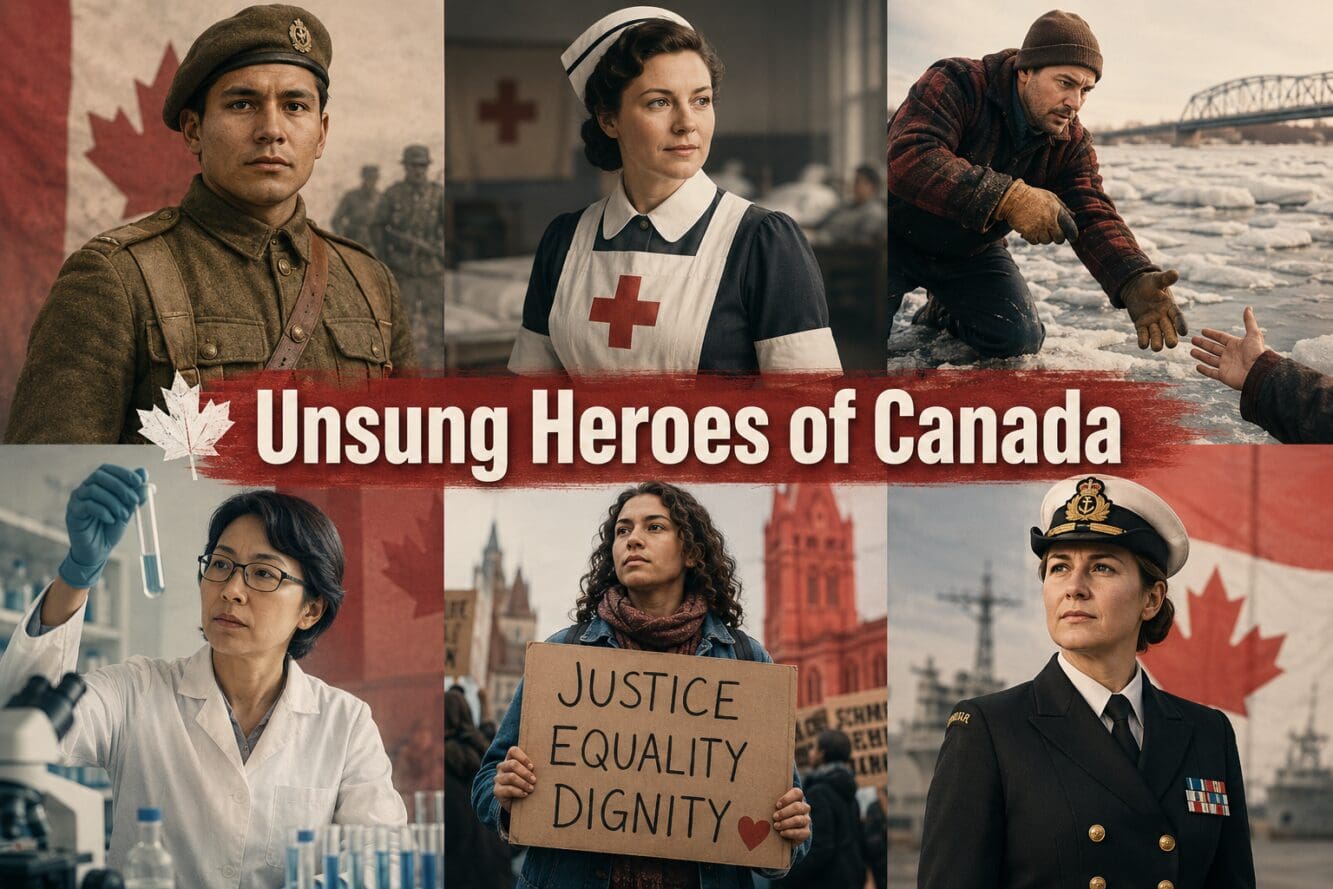
Quick Answer: Canada’s history is filled with remarkable individuals whose courage shaped the country — but most never made it into school textbooks. The Famous Canadian Heroes You Didn’t Learn About in School: True Stories of Quiet Bravery range from Indigenous snipers and wartime nurses to civilian rescuers and social justice pioneers. Their stories deserve to be heard, shared, and remembered.
Key Takeaways 🍁
- Francis Pegahmagabow was the deadliest sniper of World War I, with 378 confirmed kills — and most Canadians have never heard his name.
- Tommy Prince, an Indigenous Canadian soldier, carried moccasins behind enemy lines to move silently past German forces.
- Ernest “Smokey” Smith single-handedly destroyed a German tank and earned the Victoria Cross — yet rarely appears in school curricula.
- Frances Cluett, a Newfoundland schoolteacher, left her classroom to nurse wounded soldiers in WWI.
- Sergeant James McKnight defied military orders to rescue 18 German children from a bombed-out schoolhouse.
- Indigenous, female, and working-class heroes are the most consistently overlooked groups in Canadian history education.
- Recent bravery awards in Saskatchewan (2025) show that quiet heroism is still very much alive in Canada today.
- Canadian heroes tend to act without expectation of recognition — a defining national trait.
Who Are Some Lesser-Known Canadian Heroes That Changed History?
Canada has produced dozens of individuals whose actions changed the course of events — locally, nationally, and globally — yet who remain largely unknown to the general public. These are not figures who sought fame. They acted because the moment demanded it.
Here are some of the most compelling examples:
HeroEraAct of CourageFrancis PegahmagabowWWI378 confirmed kills; 300 enemy captures [4]Tommy PrinceWWIICovert operations behind German lines [2]Ernest “Smokey” SmithWWIIDestroyed enemy tank; earned Victoria Cross [3]Frances CluettWWINursed wounded soldiers as a civilian volunteer [7]Sergeant James McKnightWWIIRescued 18 German children from bombed school [8]Laura SecordWar of 181220-mile solo trek to warn British forces [5]Laraine OrthliebModern eraFirst female flag officer, Canadian Naval Reserve [6]
What Makes a Canadian Hero Different From Other National Heroes?
Canadian heroes tend to act quietly, without fanfare, and often against the grain of official orders or social expectations. Unlike the mythologized warrior-heroes of American popular culture or the empire-building figures celebrated in British history, Canadian heroes frequently appear in the space between duty and conscience.
- Many acted in defiance of authority to protect civilians or enemies.
- A significant number came from marginalized communities — Indigenous peoples, women, working-class immigrants.
- Recognition often came decades late, if at all.
“They just act.” — A phrase used to describe Saskatchewan bravery award recipients in 2025, and one that captures the spirit of Canadian heroism across generations. [1]
How Did Indigenous Canadian Heroes Contribute to National Progress?
Indigenous Canadians made extraordinary contributions to Canada’s military and social history, often while facing discrimination at home. Francis Pegahmagabow, an Ojibwa soldier, is widely recognized as the most decorated Indigenous Canadian in military history and the deadliest sniper of World War I, with 378 confirmed kills and 300 prisoners captured [4]. After the war, he became a chief and advocate for Indigenous rights — a form of bravery that continued long after the guns fell silent.
Tommy Prince of the Brokenhead Ojibway Nation served in both World War II and the Korean War. He carried moccasins on missions so he could move silently through enemy territory, and once walked openly past German soldiers while posing as a farmer to report artillery positions [2]. Despite his service, Prince returned to poverty and struggled with the lack of recognition afforded to Indigenous veterans [10].
Recent efforts to formally honor these men acknowledge a long overdue historical correction. For more on Indigenous stories and Canadian heritage, explore Georgian Bay News coverage of space and science and community history.
Are There Canadian Heroes Who Weren’t Military or Political Figures?
Yes — and these are among the most overlooked stories in Canadian history. Civilian heroes, scientists, activists, and everyday people have all performed acts of extraordinary courage.
Frances Cluett was a schoolteacher from Newfoundland who left her classroom to serve as a nurse during World War I, caring for wounded soldiers under brutal conditions [7]. She had no military rank and no formal medical training — just determination.
In October 2025, Saskatchewan honored Elaine Ratt for pulling a child from an icy river, and Dana Ahenakew Andres for attempting to save a driver from a submerged vehicle. Neither was a soldier or politician. Both were ordinary Canadians who acted without hesitation [1].
These stories remind readers that bravery isn’t reserved for uniforms. It shows up in frozen rivers, bombed schoolhouses, and hospital wards.
What Hidden Stories of Canadian Bravery Happened During World War Two?
World War II produced some of Canada’s most dramatic — and least taught — acts of courage. Ernest “Smokey” Smith from New Westminster, British Columbia, single-handedly engaged a German tank with a PIAT anti-tank weapon and then fought off two waves of enemy infantry to protect his wounded comrades. He earned the Victoria Cross, the Commonwealth’s highest military honour [3].
Sergeant James McKnight took a different kind of risk. He defied direct orders to enter a bombed German schoolhouse and rescue 18 children trapped inside [8]. His act of compassion toward the enemy’s civilians is rarely discussed in Canadian classrooms — but it speaks volumes about the character of the people who served.
These stories sit at the intersection of Canadian sovereignty and moral courage.
How Much Do Canadian Schools Actually Teach About Diverse National Heroes?
Honestly, not enough. Canadian school curricula have historically focused on political leaders, military generals, and founding figures — most of whom were white, male, and English or French-speaking. Indigenous veterans, female nurses, civilian rescuers, and immigrant heroes are consistently underrepresented.
Common gaps in Canadian history education:
- Indigenous soldiers and their post-war treatment
- Female contributions outside of “Famous Five” narratives
- Working-class and immigrant acts of bravery
- Civilian heroism during wartime and peacetime
This isn’t unique to Canada — it mirrors patterns in British and American education — but it leaves generations of Canadians without a full picture of who built and defended this country.
Which Canadian Heroes Have Been Overlooked by Mainstream History Books?
The Famous Canadian Heroes You Didn’t Learn About in School: True Stories of Quiet Bravery include figures who were overlooked precisely because they didn’t fit the dominant narrative of their time.
- Tommy Prince was celebrated briefly after WWII but returned to poverty and obscurity [10].
- Laraine Orthlieb became the first female flag officer in the Canadian Naval Reserve — a historic milestone that received almost no mainstream coverage [6].
- Laura Secord was largely forgotten for decades after the War of 1812 before a slow rehabilitation of her legacy began [5].
- Frances Cluett’s nursing service was not formally recognized for nearly a century [7].
The pattern is clear: heroes from outside the political and military establishment are the last to be remembered.
What Canadian Heroes Made Important Scientific or Medical Breakthroughs?
Canada’s unsung heroes extend well beyond the battlefield. Frederick Banting and Charles Best are somewhat known for discovering insulin in 1921 — but the full story of how a young, underfunded researcher fought the medical establishment to save millions of lives is rarely told in depth. Their work remains one of the most consequential medical breakthroughs in human history.
Less known is Jennie Trout, the first licensed female physician in Canada, who fought legal and social barriers in the 1870s to practice medicine and open a free clinic for women and children. Her story connects directly to the South Georgian Bay Community Health Clinic tradition of accessible care that continues in communities today.
Can You List Canadian Heroes Who Fought for Social Justice and Human Rights?
Canada’s social justice heroes are among the most overlooked in the Famous Canadian Heroes You Didn’t Learn About in School: True Stories of Quiet Bravery conversation.
- Viola Desmond refused to leave a whites-only section of a Nova Scotia cinema in 1946 — nearly a decade before Rosa Parks’ famous act of resistance. She now appears on the Canadian $10 bill.
- James Gladstone became Canada’s first Indigenous senator in 1958, advocating for Indigenous rights at the highest levels of government.
- Rosemary Brown was the first Black woman elected to a Canadian legislature (1972) and ran for the federal NDP leadership in 1975.
These individuals faced systemic resistance, personal risk, and public hostility. Their courage was not a single dramatic moment — it was sustained, daily, and often invisible to mainstream Canada. For related community perspectives, see Building Up Simcoe County.
Why Don’t Most Canadians Know About Their Own Unsung National Champions?
Several factors contribute to this gap. Curriculum decisions are made provincially, which creates inconsistency. Marginalized groups were historically excluded from official records. And Canada’s cultural modesty — the same trait that makes its heroes act without seeking recognition — also makes the country slow to celebrate them.
Key reasons these stories get lost:
- Provincial curriculum fragmentation means no national standard for history education.
- Official records excluded women, Indigenous peoples, and immigrants for generations.
- Canada’s cultural tendency toward understatement discourages self-promotion — even of heroes.
- Media attention gravitates toward American and British historical narratives.
What Are Some Canadian Heroes From Marginalized Communities?
Marginalized Canadians have consistently performed acts of extraordinary courage — in war, in medicine, in activism, and in everyday life. Beyond the figures already mentioned, William Hall became the first Black Canadian and first Nova Scotian to receive the Victoria Cross, earning it during the Indian Rebellion of 1857. His story is almost entirely absent from school curricula.
In 2025, Dana Ahenakew Andres, an Indigenous Canadian from Saskatchewan, was honored for attempting to save a drowning driver — a modern example of the same quiet bravery that has always existed in Indigenous communities [1].
These stories matter not just as history, but as living proof that heroism has never belonged to one group.
How Do Canadian Heroes Compare to American or British National Heroes?
The difference is mostly one of style and recognition. American heroes are often mythologized — larger than life, celebrated loudly, commercially marketed. British heroes tend to be tied to empire and institutional military history. Canadian heroes, by contrast, are frequently ordinary people who acted in extraordinary moments and then went home.
Smokey Smith returned to Vancouver after earning the Victoria Cross and worked as a groundskeeper [3]. Tommy Prince struggled with poverty and addiction after two wars [10]. Laura Secord ran a candy shop [5]. The gap between the act and the recognition is wider in Canada than in almost any comparable nation.
That gap is exactly why stories like these deserve more space — in classrooms, in media, and in national conversation.
What Surprising Acts of Courage Have Canadians Performed That Most People Don’t Know About?
Some of the most surprising acts of Canadian bravery involve crossing enemy or social lines to protect others. Sergeant James McKnight rescuing German children during WWII is one example [8]. Tommy Prince once walked calmly through a German patrol in a stolen farmer’s disguise to gather intelligence [2]. Elaine Ratt jumped into an icy Saskatchewan river in November 2024 to pull out a child she didn’t know [1].
What unites these acts is that none of them were planned. Each person saw a need, assessed the risk, and acted. That’s the truest definition of bravery — and it’s a thread that runs through Canadian history from 1812 to 2026.
For more stories about courage in everyday Canadian life, explore Georgian Bay News coverage of community stories.
Conclusion: Bring These Stories Into the Light
The Famous Canadian Heroes You Didn’t Learn About in School: True Stories of Quiet Bravery aren’t hard to find — they’ve simply been overlooked. From Indigenous snipers to civilian rescuers, from trailblazing women in medicine to soldiers who saved enemy children, Canada’s real history is richer and more diverse than most textbooks suggest.
Actionable next steps:
- Share one of these stories with a young person in your life — at the dinner table, in a classroom, or on social media.
- Visit a local museum or heritage site that focuses on underrepresented Canadian history.
- Support curriculum advocacy organizations pushing for more inclusive history education in Canadian schools.
- Read deeper — Legion Magazine, Parks Canada, and Reader’s Digest Canada have all published accessible accounts of these figures.
Canada’s heroes didn’t ask for recognition. But they deserve it.
FAQ
Q: Who is the most overlooked Canadian war hero?
Francis Pegahmagabow is arguably the most overlooked. He was the deadliest sniper of WWI with 378 confirmed kills, yet his name rarely appears in Canadian school curricula [4].
Q: Was Tommy Prince Indigenous?
Yes. Tommy Prince was a member of the Brokenhead Ojibway Nation and served with distinction in both WWII and the Korean War [2].
Q: What did Ernest “Smokey” Smith do to earn the Victoria Cross?
Smith single-handedly destroyed a German tank with a PIAT launcher and then repelled two waves of enemy infantry to protect his wounded comrades in Italy, 1944 [3].
Q: Who was Laura Secord?
Laura Secord was a Canadian civilian who walked 20 miles through enemy-held territory during the War of 1812 to warn British forces of an American attack [5].
Q: Are there modern-day Canadian heroes?
Yes. In October 2025, Saskatchewan honored Elaine Ratt for rescuing a child from an icy river and Dana Ahenakew Andres for attempting to save a drowning driver [1].
Q: Why aren’t these heroes taught in Canadian schools?
Curriculum decisions vary by province, and historically, official records excluded women, Indigenous peoples, and immigrants. The result is a fragmented and incomplete national history.
Q: Who was the first female flag officer in the Canadian Naval Reserve?
Commodore Laraine Orthlieb became the first female flag officer in the Canadian Naval Reserve and helped establish the Naval Museum of Alberta [6].
Q: What is the Victoria Cross?
The Victoria Cross is the highest military honour in the Commonwealth, awarded for exceptional bravery in the face of the enemy. Canada has its own version, the Canadian Victoria Cross, established in 1993.
Q: Did any Canadian heroes act against orders to save lives?
Yes. Sergeant James McKnight defied orders during WWII to rescue 18 German children from a bombed schoolhouse [8].
Q: How can I learn more about underrepresented Canadian heroes?
Parks Canada’s Heroes website, Legion Magazine, and Reader’s Digest Canada are reliable starting points with verified, accessible stories [6][9][10].
References
[1] They Just Act Saskatchewan Heroes Honoured For Courage – https://www.ckom.com/2025/10/19/they-just-act-saskatchewan-heroes-honoured-for-courage/?utm_source=openai
[2] Tommy Prince – https://www.warhistoryonline.com/instant-articles/tommy-prince.html?utm_source=openai
[3] Ernest Smokey Smith Vc Courage Beyond Measure – https://theroadtovalour.ca/2025/11/01/ernest-smokey-smith-vc-courage-beyond-measure/?utm_source=openai
[4] 29 8 2019 – https://www.hohtribute.ca/en/stories-honour/29-8-2019?utm_source=openai
[5] Laura Secord – https://en.wikipedia.org/wiki/Laura_Secord?utm_source=openai
[6] Heros Heroes – https://parks.canada.ca/culture/heros-heroes?utm_source=openai
[7] Heros Hero – https://www.parks.canada.ca/lhn-nhs/nl/signalhill/culture/heros-hero?utm_source=openai
[8] Check It Out Stories Of Canadian Super Heroes Who Saved Lives – https://www.yourwestcentral.com/articles/check-it-out-stories-of-canadian-super-heroes-who-saved-lives?utm_source=openai
[9] Remembrance Day Veteran Stories – https://www.readersdigest.ca/travel/canada/remembrance-day-veteran-stories/?utm_source=openai
[10] Prince Of Death Canadas Indigenous War Hero – https://legionmagazine.com/prince-of-death-canadas-indigenous-war-hero/?utm_source=openai