
















🇨🇦 From Local Farmers to Global Impact: Inspiring Canadian Agricultural Stories
Last updated: May 31, 2026
Quick Answer: Canada is home to thousands of farmers and agricultural innovators whose work reaches far beyond their fields. From Local Farmers to Global Impact: Inspiring Canadian Agricultural Stories captures how Canadian producers are feeding the nation, pioneering sustainable practices, and shaping global food systems. These stories span every province and involve everyone from small co-op members to tech-driven agribusinesses.
Key Takeaways
- Canada exports agricultural products to over 150 countries, making its farm sector a major force in global food supply
- Innovators like Ukko Agro are using artificial intelligence to improve crop quality and farmer income [3]
- Manitoba Harvest has grown hemp from a niche crop into a globally recognized superfood since 1998 [3]
- Indigenous farmers now operate about 2.1% of Canadian farms, contributing unique knowledge and biodiversity [5]
- Government programs like the Advance Payments Program provide critical financial support to keep farms viable [7]
- British Columbia’s Environmental Farm Plan helps producers cut water and nutrient waste [4]
- Food waste innovators Clean Works Inc. and Genecis Bioindustries Inc. won national recognition for their solutions [6]
- Technology, co-operatives, and policy support are the three pillars driving Canada’s agricultural global reach
What Canadian Farms Are Making a Global Impact?
Several Canadian farms and agricultural businesses have built international reputations. Manitoba Harvest, for example, has spent more than two decades expanding hemp cultivation and consumption worldwide, turning a once-overlooked crop into a household name [3]. Ontario’s crop disease detection technology, developed through provincial agricultural research programs, has moved from lab concept to commercial product with export potential [1].
The Fireweed Food Co-op in Manitoba is a smaller but equally meaningful example. By connecting sustainable local producers directly to consumers, it strengthens regional food systems while modeling a co-operative approach that other countries are watching closely [2].
Who Are Some Canadian Agricultural Innovators?
Canadian agricultural innovation is driven by both entrepreneurs and researchers. Ukko Agro, working alongside Protein Industries Canada, is developing AI tools that analyze crop data to improve yields and nutritional profiles [3]. Emmertech, an agritech investment firm, is channeling capital into Canadian food technology startups to accelerate productivity gains [3].
On the ground level, farmers participating in British Columbia’s Environmental Farm Plan have adopted water-efficient irrigation and precision nutrient management, reducing environmental impact while maintaining output [4].
These stories, and many more like them, are exactly what From Local Farmers to Global Impact: Inspiring Canadian Agricultural Stories is about: real people making measurable change.
What Challenges Do Canadian Farmers Face Today?
Canadian farmers deal with rising input costs, unpredictable weather, and shifting trade policies. Financial pressure is a constant reality, which is why the Canadian Federation of Agriculture welcomed the 2026 extension of the $250,000 interest-free threshold under the Advance Payments Program as a meaningful form of relief [7].
Other common challenges include:
- Labour shortages in rural communities
- Climate variability, including drought in the Prairies and flooding in coastal regions
- Market access barriers when trade agreements shift
- Food waste, which costs the Canadian food system billions annually [6]
For community-level perspectives on rural resilience, stories from the street offer a window into how everyday Canadians navigate these pressures.
How Do Local Canadian Farms Contribute to Global Food Security?
Local Canadian farms are a direct link in the global food chain. Canada is one of the world’s top exporters of wheat, canola, pulses, and pork. When a Saskatchewan grain farmer harvests a strong crop, that grain may end up in bread baked in North Africa or noodles served in Southeast Asia.
Co-operatives like Fireweed Food Co-op show that even small-scale producers contribute to food security by keeping local supply chains healthy and reducing dependence on long-distance imports [2]. A stable local food system is also a buffer against global supply disruptions.
Are There Government Programs Supporting Canadian Agricultural Expansion?
Yes, and they are varied. The Advance Payments Program, extended in 2026, gives farmers interest-free loans to cover pre-harvest costs [7]. Ontario’s agricultural research grants have funded innovations like the crop disease detector that is now reaching commercial markets [1]. British Columbia’s Environmental Farm Plan provides technical and financial support for sustainable practice adoption [4].
At the federal level, the Food Waste Reduction Challenge funded by Agriculture and Agri-Food Canada recognized Clean Works Inc. and Genecis Bioindustries Inc. in 2024 for breakthrough waste-reduction technologies [6]. These programs show that government investment in agriculture is not just about subsidies; it is about building long-term capacity.
Readers interested in how conservation intersects with policy will find these programs worth following closely.
What Is the Difference Between Small Local Farms and Large Canadian Agricultural Businesses?
Small local farms typically serve regional markets, rely on direct-to-consumer or co-op sales channels, and prioritize biodiversity and community relationships. They are often family-operated and more agile in adopting niche practices like organic certification or heritage seed preservation.
Large agricultural businesses operate at industrial scale, export to global markets, and invest heavily in technology and infrastructure. Companies like Manitoba Harvest started small and scaled by finding international demand for a product (hemp) that larger conventional producers ignored [3].
The two are not in competition so much as they are complementary. Small farms diversify the food system; large operations provide volume and export capacity.
How Can I Invest in Canadian Agriculture?
Canadians can invest in agriculture through several channels:
- Agritech funds and firms like Emmertech, which focus on food technology startups [3]
- Co-operative membership, which provides direct financial participation in local food systems [2]
- Publicly traded agricultural companies listed on the TSX, including grain handlers and food processors
- Farm real estate investment trusts (REITs), which hold agricultural land as an asset class
- Government-backed programs that offer matched funding for farm innovation projects
Those in the Georgian Bay region curious about land and investment trends can explore the Southern Georgian Bay real estate market for context on rural property values.
What Are Common Misconceptions About Modern Canadian Farming?
Misconception 1: Canadian farms are all large and industrial.
In fact, many Canadian farms are small or medium-sized family operations. The Fireweed Food Co-op model is built on small-scale producers who collectively access markets they could not reach alone [2].
Misconception 2: Farming and technology do not mix.
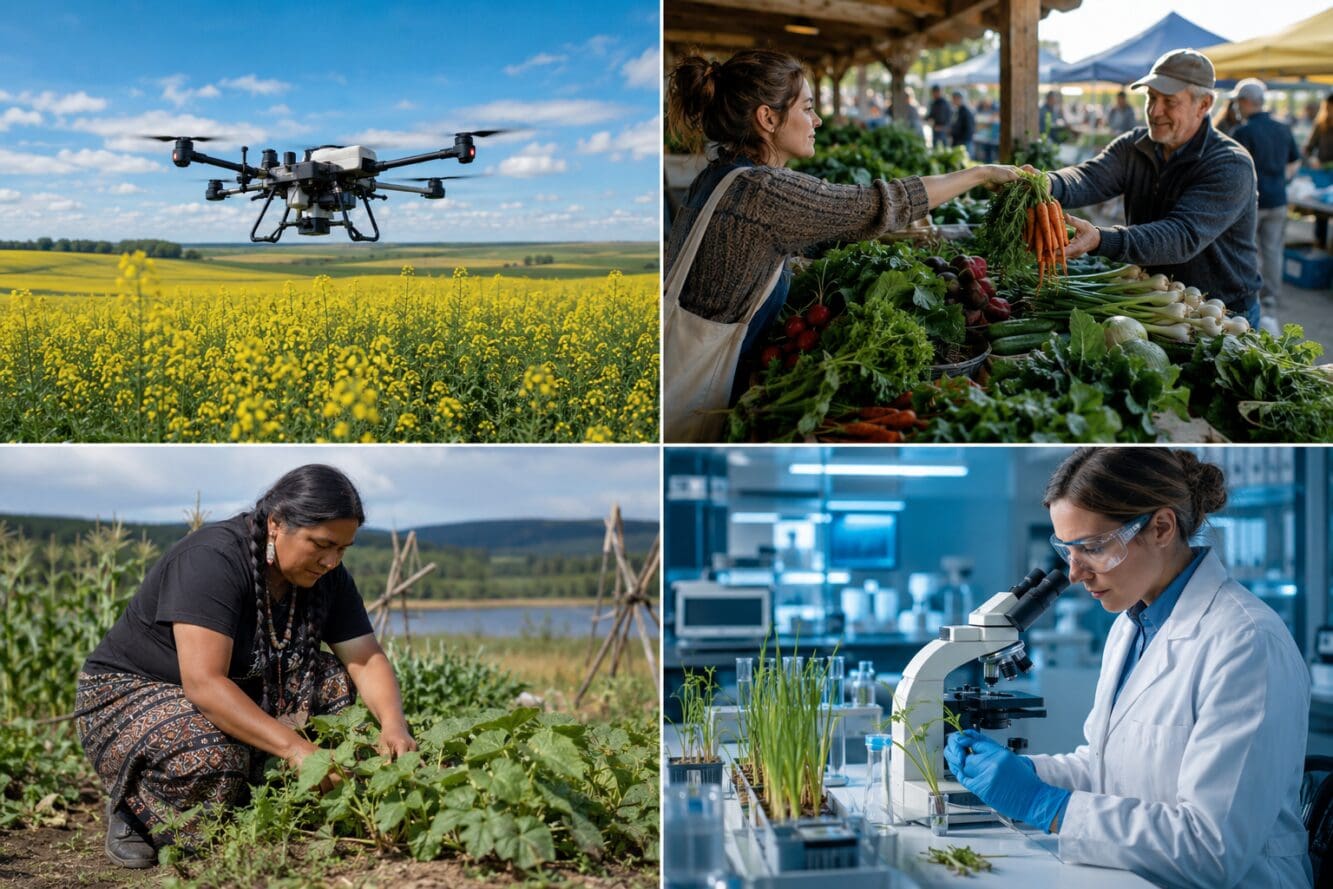
AI-driven crop analysis, drone monitoring, and precision irrigation are now common tools on Canadian farms [3][4].
Misconception 3: Indigenous agriculture is a historical footnote.
Indigenous farmers operate roughly 2.1% of Canadian farms and bring traditional ecological knowledge that improves biodiversity and long-term soil health [5].
Misconception 4: Food waste is unavoidable.
Canadian innovators are proving otherwise, with technologies that convert food waste into usable materials and energy [6].
What Role Does Technology Play in Canadian Agriculture’s Global Reach?
Technology is the single biggest driver of Canada’s expanding agricultural footprint. AI tools developed by companies like Ukko Agro help farmers produce higher-quality crops with fewer inputs, making Canadian products more competitive internationally [3]. Crop disease detectors developed in Ontario reduce losses before they reach export markets [1].
Precision agriculture, which uses GPS mapping, sensor data, and automated equipment, allows Canadian farms to produce more per acre while reducing environmental impact. This efficiency is what allows Canada to compete in global markets where buyers demand both volume and quality.
For more on how spatial intelligence is reshaping industries, including agriculture, Georgian Bay News has covered the broader technology trend.
What Are Some Unique Agricultural Practices Found in Canada?
Canada’s geographic diversity produces equally diverse farming practices:
- Hemp cultivation in Manitoba, pioneered by Manitoba Harvest since 1998, remains one of Canada’s most distinctive contributions to global nutrition [3]
- Indigenous polyculture, which grows multiple crop species together to mimic natural ecosystems and reduce pest pressure [5]
- Environmental farm planning in British Columbia, where farmers map their land’s ecological assets and set measurable sustainability targets [4]
- Co-operative market models in the Prairies, where small producers pool resources to access buyers they could not reach independently [2]
What Kinds of Produce or Products Are Canadian Farms Known for Internationally?
Canada is internationally recognized for:
ProductKey RegionGlobal SignificanceCanola oilSaskatchewan, AlbertaCanada supplies a large share of global canola exportsWheat and durumPrairie provincesUsed in bread and pasta worldwidePulses (lentils, peas)SaskatchewanMajor supplier to South Asia and the Middle EastHempManitobaGrowing global demand for food and wellness productsPorkOntario, QuebecExported to Asia, Europe, and the U.S.Maple syrupQuebecCanada produces over 70% of the world’s supply
Where Can I Find More Stories About Successful Canadian Farms?
MNP’s “Ag Across Canada” video series profiles 12 diverse agricultural operations from coast to coast, covering financial strategies, family dynamics, and the real challenges farmers face [8]. Protein Industries Canada publishes detailed success stories about agritech innovation projects [3].
Georgian Bay News covers community and regional stories that often touch on rural life, local enterprise, and the people behind the land. The building up Simcoe County series is one example of locally rooted storytelling that connects readers to the people shaping their region.
What Is the Future Outlook for Canadian Agriculture on the Global Stage?
The outlook is strong, with some important conditions. From Local Farmers to Global Impact: Inspiring Canadian Agricultural Stories is not just a retrospective; it is a forward-looking framework. Canada’s agricultural sector is positioned to grow its global role as demand for sustainable, traceable food increases worldwide.
Key trends shaping that future:
- AI and precision agriculture will reduce costs and improve crop consistency
- Indigenous-led food systems will contribute biodiversity and resilience
- Co-operative models will help small farms access global markets
- Government investment in food waste reduction and innovation will improve efficiency [6][7]
The biggest risks are climate change, geopolitical trade shifts, and rural labour shortages. Farms that invest in technology and sustainable practices now will be best positioned to adapt.
Conclusion
Canadian agriculture is one of the country’s most consequential and underappreciated sectors. The stories explored here, from Manitoba hemp growers to Ontario crop scientists to British Columbia environmental planners, show that farming in Canada is dynamic, innovative, and globally significant.
Actionable next steps for readers:
- Support local co-ops and farmers markets to strengthen community food systems
- Explore agritech investment options through firms like Emmertech or co-operative memberships
- Follow government programs like the Advance Payments Program if you are a producer seeking financial support
- Read the MNP “Ag Across Canada” series for firsthand farm stories [8]
- Engage with Indigenous food sovereignty initiatives to understand the full scope of Canadian agriculture
The connection between a local farm and a global dinner table is shorter than most people realize. Every purchase, investment, and policy decision shapes it.
FAQ
What percentage of Canada’s economy does agriculture represent?
Agriculture and agri-food contribute roughly 7% of Canada’s GDP when the full value chain is included, making it one of the country’s most important economic sectors.
Are Canadian farms environmentally sustainable?
Many are actively improving. Programs like British Columbia’s Environmental Farm Plan support measurable sustainability goals, and AI tools are helping reduce input waste across the country [4][3].
What is the Advance Payments Program?
It is a federal program that provides farmers with interest-free loans to cover pre-harvest costs. In 2026, the $250,000 interest-free threshold was extended to provide continued relief [7].
How does Indigenous farming differ from conventional farming?
Indigenous farming often incorporates traditional ecological knowledge, polyculture planting, and land stewardship practices that prioritize long-term soil and ecosystem health over short-term yield [5].
Can small farms compete globally?
Yes, through co-operatives and niche product development. The Fireweed Food Co-op model shows how small producers can access markets collectively [2].
What is hemp used for in Canada?
Hemp is used in food products (seeds, oil, protein powder), textiles, and wellness products. Manitoba Harvest has been expanding its global market since 1998 [3].
What is Ukko Agro?
Ukko Agro is a Canadian agritech company using artificial intelligence to improve crop quality and support farmer livelihoods, in partnership with Protein Industries Canada [3].
How can I find Canadian farm success stories?
MNP’s “Ag Across Canada” series, Protein Industries Canada’s success story library, and provincial government websites are reliable starting points [8][3].
References
[1] Agricultural Research Success Stories – https://www.ontario.ca/page/agricultural-research-success-stories?utm_source=openai
[2] Success Story Fireweed Food Co Op – https://ised-isde.canada.ca/site/ised/en/programs-and-initiatives/co-operatives-canada/co-operatives-canada-success-stories/success-story-fireweed-food-co-op?utm_source=openai
[3] Success Stories – https://www.proteinindustriescanada.ca/success-stories?utm_source=openai
[4] Environmental Farm Plan Success Stories – https://www2.gov.bc.ca/gov/content/industry/agriculture-seafood/programs/environmental-farm-plan-success-stories?utm_source=openai
[6] Minister Macaulay Announces Novel Technologies Streams Winners Under The Food Waste Reduction Challenge – https://www.canada.ca/en/agriculture-agri-food/news/2024/05/minister-macaulay-announces-novel-technologies-streams-winners-under-the-food-waste-reduction-challenge.html?utm_source=openai
[7] News And Events – https://cfa-fca.ca/news-and-events/?utm_source=openai
[8] Ag Across Canada – https://www.mnp.ca/en/clients/agriculture/ag-across-canada?utm_source=openai