
















Fall Prevention for Seniors at Home: Evidence-Based Strategies Every Family Should Know
Last updated: July 16, 2026
Quick Answer: Falls are the leading cause of injury-related death among adults 65 and older in North America, yet most falls at home are preventable. Fall prevention for seniors at home combines targeted home modifications, balance-focused exercise, medication review, and assistive technology, and families can implement most of these strategies without expensive renovations.
Key Takeaways
- One in four adults over 65 falls each year, according to the U.S. Centers for Disease Control and Prevention (CDC)
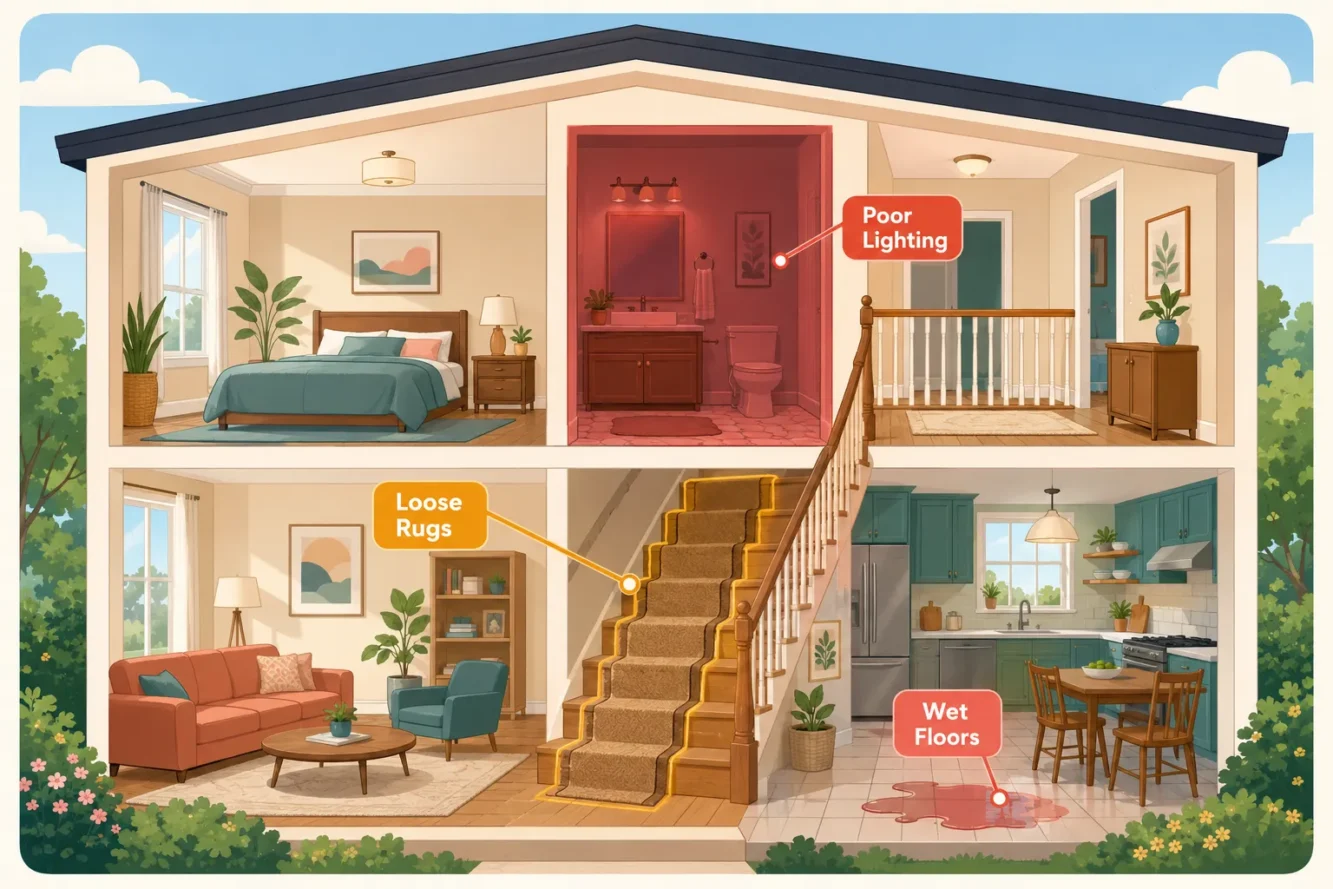
- Most falls happen in the bathroom, on stairs, or in poorly lit areas, all fixable with low-cost changes
- Balance and strength training (such as Tai Chi) is among the most evidence-backed fall prevention tools available
- Certain medications, including sedatives, blood pressure drugs, and diuretics, significantly raise fall risk
- Fall detection devices (wearables, sensors) and fall prevention strategies serve different purposes, you need both
- A formal fall risk assessment by a doctor or physiotherapist is the most reliable way to identify high-risk seniors
- Most home safety upgrades cost between $200 and $1,500 CAD and can be done without structural renovation
- Medical alert systems alone are not enough; they respond after a fall, not before
How Common Are Falls in Seniors, and What Are the Risks?
Falls are the number one cause of injury-related hospitalization for Canadians and Americans over 65. The CDC reports that roughly 36 million falls occur among older adults in the United States each year, resulting in more than 32,000 deaths annually (CDC, 2023). In Canada, the Public Health Agency estimates that falls account for 85% of injury-related hospitalizations among seniors.
Beyond the physical harm, the consequences compound quickly:
- Hip fractures from falls lead to surgery in most cases, and up to 30% of seniors who fracture a hip die within one year
- Fear of falling causes many older adults to reduce activity, which weakens muscles and paradoxically increases future fall risk
- Cognitive decline can accelerate after a serious fall due to hospitalization, reduced mobility, and social isolation
The risk is not distributed evenly. Adults over 80, those with a previous fall, and those with balance disorders or dementia face the highest likelihood of a serious fall.
What Causes Falls in Elderly People at Home?
Falls in older adults rarely have a single cause. They result from a combination of physical, environmental, and medical factors interacting at the same moment.
Physical factors:
- Reduced muscle strength, especially in the legs and core
- Impaired balance and slower reaction time
- Vision loss, including cataracts and reduced depth perception
- Foot problems such as bunions, neuropathy, or ill-fitting footwear
Environmental factors:
- Loose rugs, cluttered walkways, and slippery floors
- Inadequate lighting, particularly at night
- Lack of grab bars in bathrooms and on stairs
- Furniture arranged in ways that block clear paths
Medical and medication factors:
- Chronic conditions including Parkinson’s disease, arthritis, and osteoporosis
- Postural hypotension (a sudden drop in blood pressure when standing)
- Multiple medications taken simultaneously (polypharmacy)
Understanding the cause is the first step. A fall that happens because of a loose rug is fixed differently than one caused by a blood pressure medication.
How Do I Know If My Parent Is at High Risk for Falling?
A senior is considered high risk if they answer “yes” to any of the following:
- Have they fallen in the past 12 months?
- Do they feel unsteady when walking or standing?
- Do they worry about falling?
These three questions form the core of the CDC’s STEADI (Stopping Elderly Accidents, Deaths & Injuries) screening tool, which is used by primary care providers across North America. A “yes” to any one of them should prompt a full fall risk assessment with a physician or physiotherapist.
Additional red flags include: walking slowly, needing to hold furniture while moving around the home, taking four or more prescription medications, or having a recent diagnosis of Parkinson’s disease, stroke, or significant vision loss.
Can Medication Cause Falls in Elderly People?
Yes, and this is one of the most underappreciated risk factors. Certain drug classes directly impair balance, alertness, or blood pressure regulation.
High-risk medication categories:
| Drug Class | Why It Raises Fall Risk |
|---|---|
| Benzodiazepines (e.g., lorazepam) | Sedation, slowed reflexes |
| Antihypertensives | Can cause postural hypotension |
| Diuretics | Dehydration, urgency-related rushing |
| Antidepressants (SSRIs, TCAs) | Dizziness, sedation |
| Antipsychotics | Muscle stiffness, sedation |
| Opioids | Sedation, impaired coordination |
A medication review by a pharmacist or geriatrician, sometimes called a “brown bag review” where the patient brings all their pill bottles, can identify dangerous combinations. Reducing or substituting even one high-risk medication has been shown to lower fall rates in clinical studies (AGS/BGS Clinical Practice Guideline, 2019).
Best Home Modifications to Prevent Senior Falls
Most effective home modifications cost far less than a single emergency room visit. The goal is to remove hazards and add support, not to redesign the home.
Bathroom (highest-risk room):
- Install grab bars beside the toilet and inside the shower or tub (not towel bars, which pull out of walls)
- Use a non-slip bath mat with suction cups
- Consider a shower chair or bench for seniors with balance problems
- Install a handheld showerhead
Hallways and stairs:
- Secure or remove all loose rugs
- Ensure handrails run the full length of every staircase, on both sides if possible
- Install night lights or motion-sensor lighting along the path from bedroom to bathroom
General living areas:
- Arrange furniture to create clear, straight walking paths
- Move frequently used items to between waist and shoulder height to avoid bending or reaching
- Replace low chairs or sofas that are difficult to rise from
These changes align with evidence-based recommendations from the American Geriatrics Society and the Canadian Institute for Health Information. Families exploring housing adaptations for aging in place can also find useful context in coverage of small home design and accessibility strategies.
How Much Does It Cost to Make a Home Fall-Proof for Seniors?
Most families can address the highest-priority fall hazards for between $200 and $1,500 CAD without hiring a contractor. Here is a realistic cost breakdown:
- Grab bars (bathroom): $30,$80 each, plus $50,$100 for professional installation
- Non-slip bath mats and treads: $15,$40
- Night lights (motion-sensor, 6-pack): $20,$40
- Stair handrail extension or second rail: $100,$300 installed
- Shower chair: $40,$120
- Rug removal or rug tape: $0,$30
For seniors with more complex needs, a home safety assessment by an occupational therapist (OT) typically costs $150,$300 and produces a prioritized list of changes. Some provincial and state programs subsidize these assessments and the modifications that follow, worth checking with local health authorities.
Structural changes such as stair lifts ($3,000,$6,000) or walk-in tubs ($5,000,$12,000) are reserved for seniors with severe mobility limitations.
Fall Prevention Exercises for Older Adults
Exercise is one of the most evidence-backed fall prevention strategies available. Specifically, programs that combine balance training with lower-body strength work reduce fall rates by 23-34%, according to a Cochrane Review of over 100 randomized controlled trials (Sherrington et al., 2019).
Most effective exercise types:
- Tai Chi: Improves balance, coordination, and reaction time. Two to three sessions per week for 12 weeks show measurable results in clinical trials
- Otago Exercise Programme: A structured home-based program of leg strengthening and balance exercises developed in New Zealand, shown to reduce falls by up to 35% in adults over 80
- Seated resistance exercises: For seniors with severe mobility limitations, chair-based leg lifts and resistance band exercises maintain muscle mass
- Walking programs: Regular brisk walking maintains leg strength and confidence, but should be combined with balance training for best results
Seniors with arthritis or balance problems should start with a physiotherapist to get a personalized program. Pushing through joint pain without guidance can worsen instability.
Fall Prevention Strategies for Seniors With Balance Problems or Arthritis
Seniors with balance disorders or arthritis need a modified approach because standard exercises may be painful or unsafe without supervision.
For balance problems (vestibular disorders, Parkinson’s):
- Work with a vestibular physiotherapist for targeted exercises
- Use a rollator walker rather than a standard cane for better stability
- Avoid abrupt head movements and allow extra time when changing positions
For arthritis:
- Aquatic (pool-based) exercise reduces joint load while building strength
- Anti-inflammatory management (medication or physiotherapy) should run parallel to exercise
- Adaptive footwear with good arch support and a low, wide heel reduces ankle instability
Families supporting seniors with these conditions can also benefit from community resources. Friendly visits and connection programs in many communities provide check-ins that help identify new mobility concerns early.
What Is the Difference Between Fall Prevention and Fall Detection Devices?
Fall prevention devices reduce the likelihood of a fall happening. Fall detection devices identify that a fall has already occurred and trigger a response. Both serve important roles, but they are not interchangeable.
Fall prevention tools:
- Grab bars, non-slip mats, proper footwear
- Canes, walkers, and rollators
- Smart lighting that activates automatically at night
- Bed and chair alarms that alert caregivers when a senior rises unexpectedly
Fall detection tools:
- Wearable medical alert buttons (e.g., Life Alert, Bay Alarm Medical)
- Automatic fall detection pendants that sense sudden movement changes
- In-home passive sensors (floor pressure mats, motion cameras)
- Smart door access and monitoring systems that track movement patterns
The key distinction: detection saves time after a fall; prevention stops the fall from happening. A senior who falls and cannot get up for hours faces a much higher risk of complications (hypothermia, dehydration, pressure injuries), so detection matters even when prevention measures are in place.
Is a Medical Alert System Enough, or Do I Need Other Fall Prevention Measures?
A medical alert system alone is not sufficient fall prevention. It is a safety net, not a preventive strategy. Medical alert systems reduce the harm caused by a fall, they do not reduce the number of falls.
Think of it this way: a smoke detector does not prevent fires. It alerts you when one starts. Fall prevention is the equivalent of fire-proofing the home.
Families should treat a medical alert system as one layer of a broader plan that includes home modifications, exercise, medication review, and regular vision and hearing checks. For seniors who live alone, combining a wearable alert with motion-sensor monitoring provides the most complete coverage.
What Assistive Devices Actually Help Prevent Falls vs. Gimmicks
Not every product marketed for senior safety delivers real results. Here is a practical breakdown:
Evidence-backed devices:
- Rollator walkers with four wheels and hand brakes (superior to standard walkers for outdoor use)
- Hip protectors (padded undergarments), reduce hip fracture severity on impact, though compliance is a challenge
- Non-slip footwear with a low heel, firm sole, and closed back
- Bed rails for seniors who roll or shift during sleep
- Canes fitted to the correct height by a physiotherapist
Limited or no evidence:
- Grip socks marketed as “fall-proof” (helpful in hospitals, less so at home)
- Balance boards sold for home use without professional instruction (injury risk if used incorrectly)
- Smart insoles with vibration feedback (promising early research, not yet widely validated)
When evaluating any device, look for products referenced in occupational therapy guidelines or endorsed by national geriatric associations rather than relying on retail marketing claims.
What Should I Do Immediately After a Senior Falls at Home?
The first minutes after a fall matter. A calm, systematic response reduces the risk of secondary injury.
Step 1, Do not rush to lift them. Moving a person who has fallen without assessing for injury can worsen a fracture or spinal injury.
Step 2, Check for injuries. Ask if they have pain in their hip, back, neck, or head. Look for visible deformity or swelling.
Step 3, If they are conscious and uninjured, help them up safely. Have them roll to their side, push up to hands and knees, and use a sturdy chair to rise. Stay close but let them do the work.
Step 4, If there is any doubt, call for help. In Canada, calling 911 or a local paramedic service is appropriate when injury is suspected. Some regions have community paramedic programs (such as those connected to Springwater paramedic services) that provide non-emergency fall response.
Step 5, Document and follow up. Record when, where, and how the fall happened. Report it to the senior’s physician, a fall is a medical event that warrants reassessment of medications, balance, and home safety.
Common Mistakes Families Make With Senior Fall Prevention
Even well-intentioned families make errors that leave seniors at risk.
- Waiting for a fall to happen before acting. Fall prevention is far more effective as a proactive strategy than a reactive one
- Removing all rugs but ignoring lighting. Poor lighting at night is as dangerous as a loose rug
- Buying a medical alert system and considering the job done (see above)
- Ignoring footwear. Worn-out shoes, loose slippers, and socks on hardwood floors are among the most common fall triggers
- Overlooking vision. An outdated eyeglass prescription or untreated cataracts significantly impairs depth perception and stair navigation
- Discouraging activity out of fear. Restricting a senior’s movement to “keep them safe” weakens muscles and increases long-term fall risk
Families looking for broader community strategies and support resources for aging at home will find that the most effective approaches combine home safety with social engagement and physical activity, not isolation.
When Should a Senior Move to Assisted Living Due to Fall Risk?
Moving to assisted living is appropriate when the fall risk can no longer be safely managed at home, even with modifications and support. Specific indicators include:
- Two or more falls in the past six months, especially with injury
- A fall that resulted in lying on the floor for an extended time without ability to get up
- Cognitive decline that prevents the senior from using assistive devices correctly or following a safety plan
- Caregiver burnout that compromises the quality of supervision at home
- Medical conditions (severe Parkinson’s, advanced dementia) that require 24-hour monitoring
This is not a failure, it is a recognition that some fall risk levels exceed what a home environment can safely accommodate. An honest conversation with the senior’s physician and a geriatric care manager can help families make this decision based on clinical evidence rather than guilt or guesswork.
Conclusion
Fall prevention for seniors at home is not a single action, it is a layered plan that addresses the home environment, physical fitness, medications, vision, and the right mix of assistive and detection technology. The evidence is clear: most falls are preventable, and the cost of prevention is a fraction of the cost of a single hospitalization.
Actionable next steps for families in 2026:
- Complete a home walkthrough using a fall hazard checklist, starting with the bathroom and stairs
- Book a medication review with a pharmacist or geriatrician to identify high-risk drugs
- Schedule a vision and hearing check if either has not been updated in the past year
- Ask the senior’s physician for a formal fall risk assessment using a validated tool (STEADI or equivalent)
- Enroll the senior in a structured balance exercise program, Tai Chi or the Otago Programme are the best-supported options
- Install grab bars, improve night lighting, and remove loose rugs before investing in any technology
- Add a medical alert system as a final safety layer, not the first
Families who treat fall prevention as an ongoing conversation rather than a one-time fix will see the greatest results. The goal is not to restrict a senior’s life, it is to protect their independence.
Frequently Asked Questions
Q: At what age should fall prevention measures begin?
Fall prevention is most urgent after age 65, but balance training and home safety reviews are beneficial starting in the mid-50s, especially for those with chronic conditions or a family history of osteoporosis.
Q: Are falls always preventable?
Not always. Some falls result from medical events (stroke, cardiac episode) that cannot be anticipated. However, the majority of home falls involve identifiable and modifiable risk factors.
Q: How long does it take for balance exercises to reduce fall risk?
Most structured programs show measurable improvement in balance and fall rates within 8 to 12 weeks of consistent practice (two to three sessions per week).
Q: Does vitamin D supplementation help prevent falls?
Vitamin D deficiency is associated with muscle weakness and increased fall risk. Supplementation in deficient seniors has shown modest benefit in some trials, but it should be guided by blood test results and a physician’s recommendation.
Q: What is the best flooring for fall prevention?
Low-pile carpet provides more grip than hardwood or tile and cushions impact if a fall occurs. If hard flooring is preferred, non-slip area rugs with rubber backing and no curled edges are acceptable.
Q: Can a senior use a cane and a rollator walker interchangeably?
No. A cane provides light support for mild balance issues. A rollator walker is appropriate for more significant instability. Using the wrong device for the level of need can increase fall risk. A physiotherapist should fit and recommend the correct device.
Q: Is it safe for a senior to live alone after a fall?
It depends on the severity of the fall, the underlying cause, and what changes have been made since. Many seniors safely continue living alone after a fall when appropriate modifications and monitoring are in place.
Q: Do smart home devices (voice assistants, sensors) actually reduce falls?
Passive monitoring sensors can detect unusual inactivity and alert caregivers, which reduces the time a fallen senior spends on the floor. They do not directly prevent falls, but they improve response time significantly.
References
- Centers for Disease Control and Prevention (CDC). STEADI, Stopping Elderly Accidents, Deaths & Injuries. 2023. https://www.cdc.gov/steadi
- Sherrington, C., et al. “Exercise for preventing falls in older people living in the community.” Cochrane Database of Systematic Reviews. 2019.
- American Geriatrics Society / British Geriatrics Society (AGS/BGS). Clinical Practice Guideline for Prevention of Falls in Older Persons. 2019.
- Public Health Agency of Canada. Seniors’ Falls in Canada: Second Report. 2014. https://www.canada.ca
- Campbell, A.J., & Robertson, M.C. “Otago Exercise Programme to Prevent Falls in Older Adults.” Accident Compensation Corporation, New Zealand. 2003.
Content, illustrations, and third-party video appearing on GEORGIANBAYNEWS.COM may be generated or curated with AI assistance or reproduced pursuant to the fair dealing provisions of the Copyright Act, R.S.C. 1985, c. C-42. Attribution and hyperlinks to original sources are provided in acknowledgment of applicable intellectual property rights. Such referencing is intended to direct traffic to and support the original rights holders’ platforms.