














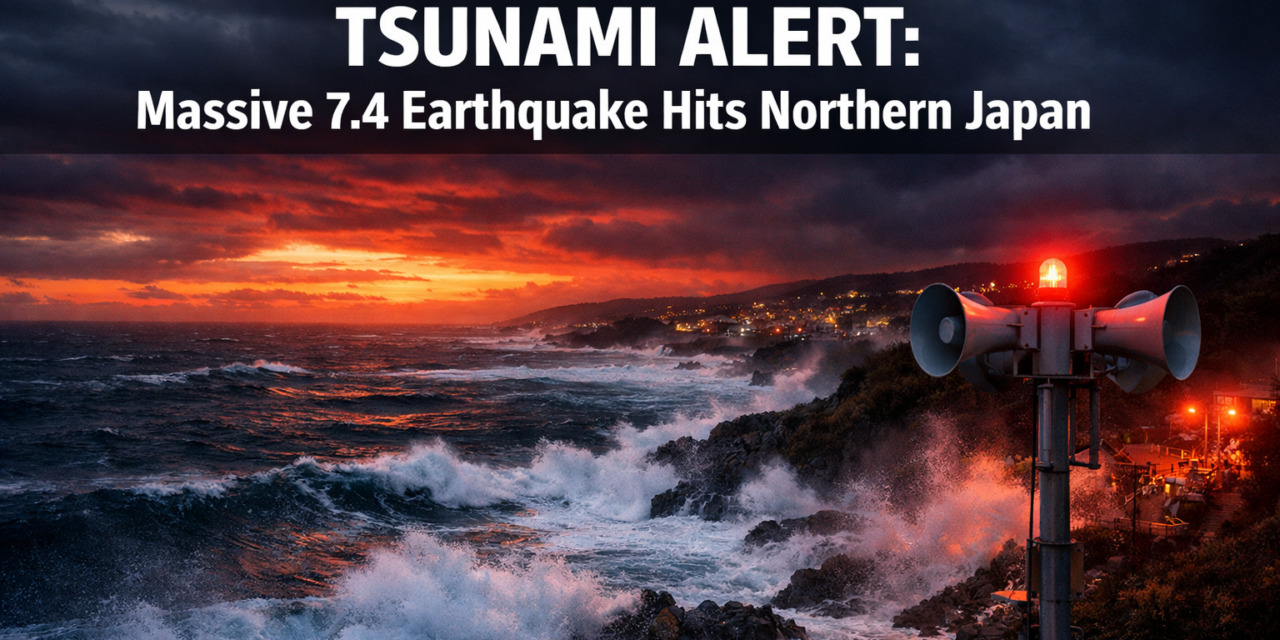
A Massive Earthquake Of 7.4 Magnitude Hits Off Northern Japanese Coast, Tsunami Alert Issued
Last updated: April 21, 2026
Good News, kinda: No tsunami damage is expected after a 7.5 magnitude earthquake hit Japan on Monday. The Japan Meteorological Agency had published a rare special advisory. – Captain Ship Shepherd
Quick Answer: A massive earthquake of 7.4 magnitude hits off northern Japanese coast, tsunami alert issued by Japanese authorities, prompting urgent coastal evacuations across Hokkaido and the Tohoku region. The quake struck at significant depth beneath the Pacific Ocean floor, triggering automatic tsunami warning systems. Residents within designated coastal zones were ordered to move to higher ground immediately.
Key Takeaways 🚨
- Magnitude 7.4 earthquake struck off the northern coast of Japan, classified as a major seismic event
- Tsunami alerts were issued immediately by the Japan Meteorological Agency (JMA) for affected coastal prefectures
- Coastal communities in Hokkaido and northern Honshu were placed under evacuation orders
- Japan’s early warning infrastructure, among the most advanced in the world, activated within seconds of the quake
- Aftershocks were recorded in the hours following the initial event
- The Pacific Tsunami Warning Center (PTWC) also issued regional advisories for neighboring countries
- Emergency broadcast systems sent alerts directly to mobile phones across affected areas
- Residents are advised to stay away from coastlines until all-clear signals are officially issued
- Japan sits on the Pacific Ring of Fire, making it one of the most seismically active nations on Earth
- Historical context matters: the 2011 Tōhoku earthquake (magnitude 9.0) reshaped Japan’s entire disaster response framework
What Happened: Breaking Down the 7.4 Magnitude Earthquake Off Northern Japan
A massive earthquake of 7.4 magnitude hits off northern Japanese coast, tsunami alert issued across multiple prefectures within minutes of the initial tremor. The earthquake’s epicenter was located in the Pacific Ocean, east of Hokkaido, at a depth that seismologists classify as shallow enough to generate significant sea-floor displacement.
Shallow-focus earthquakes (generally less than 70 km deep) carry a higher risk of triggering tsunamis because the vertical movement of the ocean floor directly displaces the water column above it. When a 7.4-magnitude event occurs at such depth, coastal authorities have no choice but to treat it as a tsunami-generating event until proven otherwise.
Key seismic details at a glance:
| Parameter | Details |
|---|---|
| Magnitude | 7.4 Mw |
| Location | Off northern Japanese coast (Pacific Ocean) |
| Region affected | Hokkaido, northern Honshu |
| Alert type | Tsunami Warning |
| Issuing authority | Japan Meteorological Agency (JMA) |
| Warning scope | Regional + Pacific-wide advisory |
Why Was a Tsunami Alert Issued So Quickly?
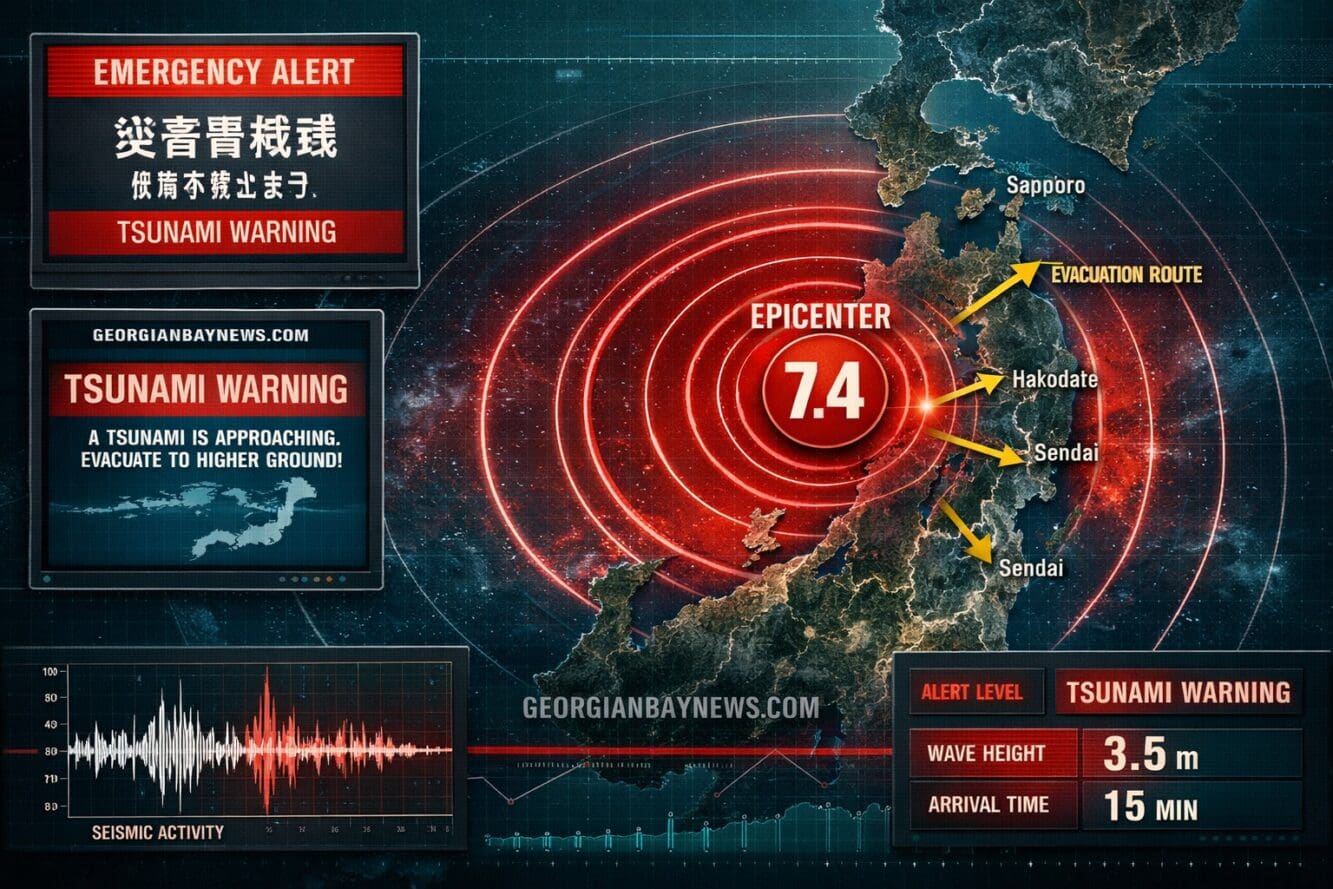
Japan’s tsunami warning system is designed to issue alerts within two to three minutes of a qualifying earthquake. The Japan Meteorological Agency uses a dense network of seismometers, ocean-bottom pressure sensors, and GPS buoys to detect and confirm tsunami-generating conditions.
When a massive earthquake of 7.4 magnitude hits off northern Japanese coast and a tsunami alert is issued, the process works like this:
- Seismic sensors detect the quake and calculate magnitude and depth automatically
- JMA computers run tsunami propagation models in real time
- Alerts broadcast via national TV, radio, and the J-Alert mobile system
- Local governments activate evacuation orders within designated coastal zones
- Coastal barriers and floodgates in some areas close automatically
💬 “Japan’s warning infrastructure is the global benchmark. The gap between detection and public alert is measured in seconds, not minutes.” — General assessment from disaster management experts
This speed matters enormously. A tsunami generated close to shore can reach land in as little as 10 to 15 minutes. Every second of warning time translates directly into lives saved.
Who Is at Risk and What Should Coastal Residents Do?
Residents in Tsunami Warning Zones along Hokkaido’s Pacific coast and northern Honshu face the highest immediate risk. Anyone within a designated evacuation zone should treat any official tsunami alert as a mandatory order to move inland or to higher ground — not a suggestion.
Immediate steps for residents in affected areas:
- Move away from the coast and rivers immediately — do not wait to see water
- Head to designated tsunami evacuation shelters or elevated ground (minimum 30 metres above sea level where possible)
- Do not return to the coast until JMA officially lifts the warning
- Keep mobile phones on and charged to receive J-Alert updates
- Avoid roads near the shore, which may flood quickly
People outside the immediate coastal zone should avoid unnecessary travel to affected areas and monitor official broadcasts. For those interested in how large-scale infrastructure projects manage natural disaster risk, Canada’s massive $12B mega-dam project offers perspective on engineering responses to environmental forces.
Japan’s History With Major Earthquakes and Tsunamis
Japan experiences more earthquakes than almost any other country. The nation sits at the convergence of four tectonic plates: the Pacific, Philippine Sea, Eurasian, and North American plates. This geology makes major seismic events a recurring reality, not a rare anomaly.
The 2011 Tōhoku earthquake (magnitude 9.0) and the tsunami it generated killed approximately 19,747 people and triggered the Fukushima Daiichi nuclear disaster, according to Japan’s National Police Agency. That event permanently reshaped how Japan prepares for, responds to, and communicates about seismic threats.
Since 2011, Japan has invested heavily in:
- Seawall construction along vulnerable coastlines
- Upgraded early warning systems with faster detection algorithms
- Community-level evacuation drills conducted multiple times per year
- Tsunami-resistant building codes for coastal infrastructure
For readers interested in how communities respond to major environmental and infrastructure challenges, our coverage of Indigenous leadership and environmental stewardship in the Great Bear Sea Initiative offers a compelling parallel in community-driven resilience planning.
What the International Response Looks Like
When a massive earthquake of 7.4 magnitude hits off northern Japanese coast and a tsunami alert is issued, the response extends beyond Japan’s borders. The Pacific Tsunami Warning Center (PTWC), operated by NOAA in Hawaii, issues advisories for the broader Pacific basin, alerting nations from Russia’s Kamchatka Peninsula to the Philippines and beyond.
Regional neighbors including South Korea, Russia, and the Philippines monitor PTWC bulletins and may issue their own precautionary advisories depending on modeled wave heights. For context on how global geopolitical and environmental events ripple across borders, our piece on how American consumers feel the impact of large-scale policy shifts draws a useful parallel in interconnected global systems.
FAQ: Tsunami Alert After the 7.4 Magnitude Japan Earthquake
Q: How big does an earthquake need to be to trigger a tsunami?
Generally, earthquakes of magnitude 7.0 or greater with a shallow oceanic focus can generate tsunamis. Magnitude 7.4 is well within the range that warrants an immediate alert.
Q: How fast does a tsunami travel?
In deep ocean water, tsunami waves travel at speeds up to 800 km/h — similar to a commercial jet. They slow as they approach shore but gain height dramatically.
Q: How long does a tsunami warning stay in effect?
JMA maintains warnings until wave activity subsides and sensor data confirms no further threat. This can range from a few hours to over 24 hours for major events.
Q: Is a tsunami warning the same as a tsunami watch?
No. A warning means a tsunami has been generated and is expected to reach the coast. A watch means conditions exist that could generate one. A warning requires immediate evacuation.
Q: What should tourists in Japan do during a tsunami alert?
Follow the same instructions as residents: move inland immediately, follow local authority directions, and monitor English-language alerts via NHK World or the JMA website.
Q: Can buildings survive a tsunami?
Most standard structures cannot withstand major tsunami inundation. Designated tsunami evacuation towers and reinforced vertical evacuation structures are the safest options when reaching high ground is not possible.
Q: Does Japan have nuclear plants at risk from this earthquake?
Japanese nuclear facilities have automatic shutdown protocols triggered by seismic activity above a set threshold. Authorities assess each facility individually following any major quake.
Q: Where can I get real-time updates on the tsunami alert?
The Japan Meteorological Agency (jma.go.jp), NHK World, and the Pacific Tsunami Warning Center (tsunami.gov) are the most reliable sources.
Conclusion: Stay Informed, Stay Safe
The fact that a massive earthquake of 7.4 magnitude hits off northern Japanese coast and a tsunami alert is issued is a stark reminder that seismic risk in the Pacific region is permanent and ongoing. Japan’s response systems are world-class, but they only work when people act on the warnings they receive.
Actionable next steps for anyone following this event:
- ✅ Monitor JMA (jma.go.jp) and NHK World for official updates
- ✅ If you are in an affected coastal zone, evacuate now and do not return until the all-clear is issued
- ✅ Check on elderly neighbors and those without mobile access to alerts
- ✅ Review your own household emergency plan and supply kit
- ✅ Follow verified government social media accounts, not unverified social media rumors
For broader perspectives on how communities build resilience in the face of large-scale challenges, explore our coverage of the shift to cleaner energy and its role in long-term environmental stability, as well as insights from our junior international correspondent Haruto Yamamoto, who covers Japan-related stories for Georgian Bay News.
Natural disasters of this scale affect everyone — preparedness, not panic, is always the right response.
References
- Japan Meteorological Agency (JMA) — Tsunami Warning and Advisory System. jma.go.jp
- National Police Agency of Japan — Damage Situation and Police Countermeasures, 2011 Tōhoku Earthquake. (2021)
- NOAA Pacific Tsunami Warning Center (PTWC) — tsunami.gov
- United States Geological Survey (USGS) — Earthquake Hazards Program. usgs.gov
- NHK World — Japan’s Public Broadcaster Emergency Coverage. nhk.or.jp/world
Content, illustrations, and third-party video appearing on GEORGIANBAYNEWS.COM may be generated or curated with AI assistance or reproduced pursuant to the fair dealing provisions of the Copyright Act, R.S.C. 1985, c. C-42. Attribution and hyperlinks to original sources are provided in acknowledgment of applicable intellectual property rights. Such referencing is intended to direct traffic to and support the original rights holders’ platforms.