





















Last updated: May 11, 2026
Quick Answer: The most effective exercises for aging well and preserving balance and mobility include single-leg balance holds, chair rises, yoga, tai chi, and progressive strength training. Adults who train these skills consistently maintain greater independence, reduce fall risk, and show measurable improvements in longevity markers.
Balance and mobility decline because multiple body systems weaken simultaneously: muscle mass drops, proprioception (the body’s ability to sense its position in space) becomes less accurate, and the coordination between the visual system, inner ear, muscles, and nervous system slows down [1].
This isn’t just about feeling unsteady. Falls are among the leading causes of injury-related hospitalization for older adults. The good news: these systems respond to training at any age. Aging well through exercises to ensure balance and mobility is not about reversing time — it’s about slowing decline and maintaining function.
Key systems affected by aging:
Before starting any program, knowing where you stand helps set realistic goals. These four self-assessments are practical and backed by clinical benchmarks.
1. Single-Leg Balance Test
Stand near a wall for safety. Lift one foot and time how long you can hold the position. Adults in their 40s should manage roughly 42 seconds with eyes open; adults 60+ should aim for at least 5 seconds. Balance drops sharply with eyes closed — a 40-year-old averages about 13 seconds closed-eye, highlighting how much vision compensates for other weaknesses [2].
2. Chair Rise Test
Sit in a standard chair with arms crossed. Count how many times you can stand and sit fully in 30 seconds. A 60-year-old male should hit 14+ repetitions; a 60-year-old female, 12+ [1].
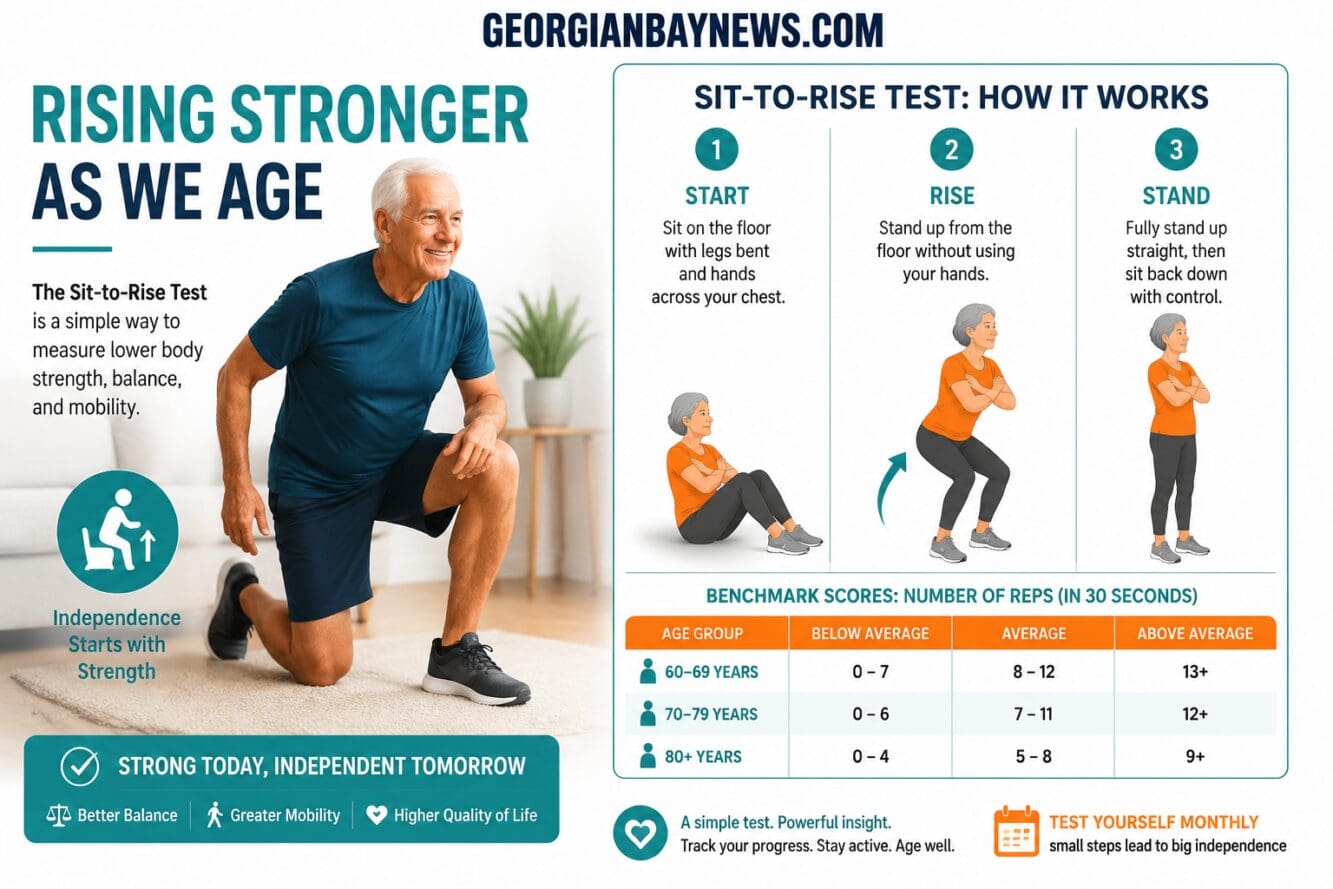
3. Sit-to-Rise Test (SRT)
Lower yourself to the floor cross-legged, then stand without using hands, knees, or forearms for support. Each assist costs points from a 10-point scale. Research published in the European Journal of Preventive Cardiology confirms this test simultaneously measures muscle tone, coordination, flexibility, core strength, and balance — all critical for healthy aging [4].
4. Gait Speed
Walk a measured 10-meter stretch at your normal pace. Adults 60+ typically clock 0.8–1.2 meters per second. Midlife adults aiming to age well should target at least 1.3 meters per second [2].
Common mistake: Skipping the baseline. Without a starting point, it’s impossible to track progress or know when a plateau signals the need to change your routine.
The most effective approach combines balance-specific training, lower body strength work, and flexibility — ideally spread across the week rather than crammed into one session.
Trail walking on grass or uneven ground naturally challenges balance with every step [3]. Even 20–30 minutes of brisk walking three to five times per week improves gait speed and cardiovascular endurance — two of the five key aging indicators [2].
Choose tai chi if: you prefer group settings, have joint pain, or want a low-impact option with strong evidence behind it.
Choose strength training if: your chair rise score is below benchmark or you want the fastest functional gains.
For those who can’t yet perform the SRT or struggle with single-leg balance, a progressive approach avoids injury while building real capacity [1].
Step-by-step progression for floor mobility:
For balance training, start with two-hand wall support, then one hand, then fingertip contact, then no contact. Adding a slight surface challenge (folded towel, balance pad) comes after you can hold 20+ seconds unassisted.
Strength training frequency: At least twice weekly produces meaningful improvements in sit-to-rise performance and fall risk reduction [4]. Three sessions per week is better for faster progress.
Aging well through exercises to ensure balance and mobility doesn’t require a gym membership or hours of daily training. It requires consistency, progressive challenge, and honest self-assessment.
Actionable next steps:
Small, consistent improvements in balance and mobility compound over years into significantly better independence, fewer injuries, and a longer active life. The best time to start was ten years ago. The second-best time is today.
Q: At what age should I start balance and mobility training?
The earlier the better, but it’s never too late. Adults in their 40s still have time to build significant reserves. Adults in their 70s and 80s can still improve measurably with consistent training.
Q: How long does it take to see improvement in balance?
Most people notice measurable improvement in single-leg balance within 4–6 weeks of consistent training (3+ sessions per week). Functional strength gains from chair rises typically appear within 6–8 weeks.
Q: Is tai chi really effective for fall prevention?
Yes. Tai chi is one of the most studied interventions for fall prevention in older adults and consistently shows reductions in fall frequency and improvements in balance scores [3].
Q: Can I do these exercises if I have arthritis or joint pain?
Most balance and mobility exercises can be modified for joint pain. Chair-based exercises, water aerobics, and tai chi are particularly joint-friendly. Consult a physiotherapist for a personalized plan.
Q: What is a safe single-leg balance time for a 70-year-old?
Adults 60+ should aim for at least 5 seconds. Anything under 5 seconds is associated with significantly higher fall risk and warrants focused balance training [2].
Q: Does grip strength really predict aging outcomes?
Yes. Grip strength is one of the five key predictors of long-term independence. Declining grip strength often signals broader muscle loss. Tracking it with an inexpensive dynamometer can catch problems early [2].
Q: How many days per week should older adults exercise for balance?
Most guidelines suggest balance and strength training at least 2–3 days per week, with daily low-intensity activity like walking. Consistency matters more than intensity, especially early on.
Q: What’s the difference between balance training and mobility training?
Balance training focuses on stability and fall prevention (single-leg stands, tai chi). Mobility training focuses on range of motion and functional movement (hip bridges, lunges, yoga). Both are essential and complement each other.
[1] Home Longevity Tests – https://www.henryford.com/blog/2026/01/home-longevity-tests
[2] National Geographic These Five Simple Tests Can Reveal How Well You’re Aging – https://www.gaylord.org/patients-families/about/news/news-list/national-geographic-these-five-simple-tests-can-reveal-how-well-youre-aging
[3] How Well Are You Aging – https://www.aarp.org/health/healthy-living/how-well-are-you-aging/
[4] A Brief Fitness Test May Predict How Long You’ll Live – https://www.health.harvard.edu/healthy-aging-and-longevity/a-brief-fitness-test-may-predict-how-long-youll-live
Content, illustrations, and third-party video appearing on GEORGIANBAYNEWS.COM may be generated or curated with AI assistance or reproduced pursuant to the fair dealing provisions of the Copyright Act, R.S.C. 1985, c. C-42. Attribution and hyperlinks to original sources are provided in acknowledgment of applicable intellectual property rights. Such referencing is intended to direct traffic to and support the original rights holders’ platforms.