




















Carney’s Nordic Security Summit: Arctic Defense, NATO Commitments, and Canada’s Pivot Away from Middle East Focus

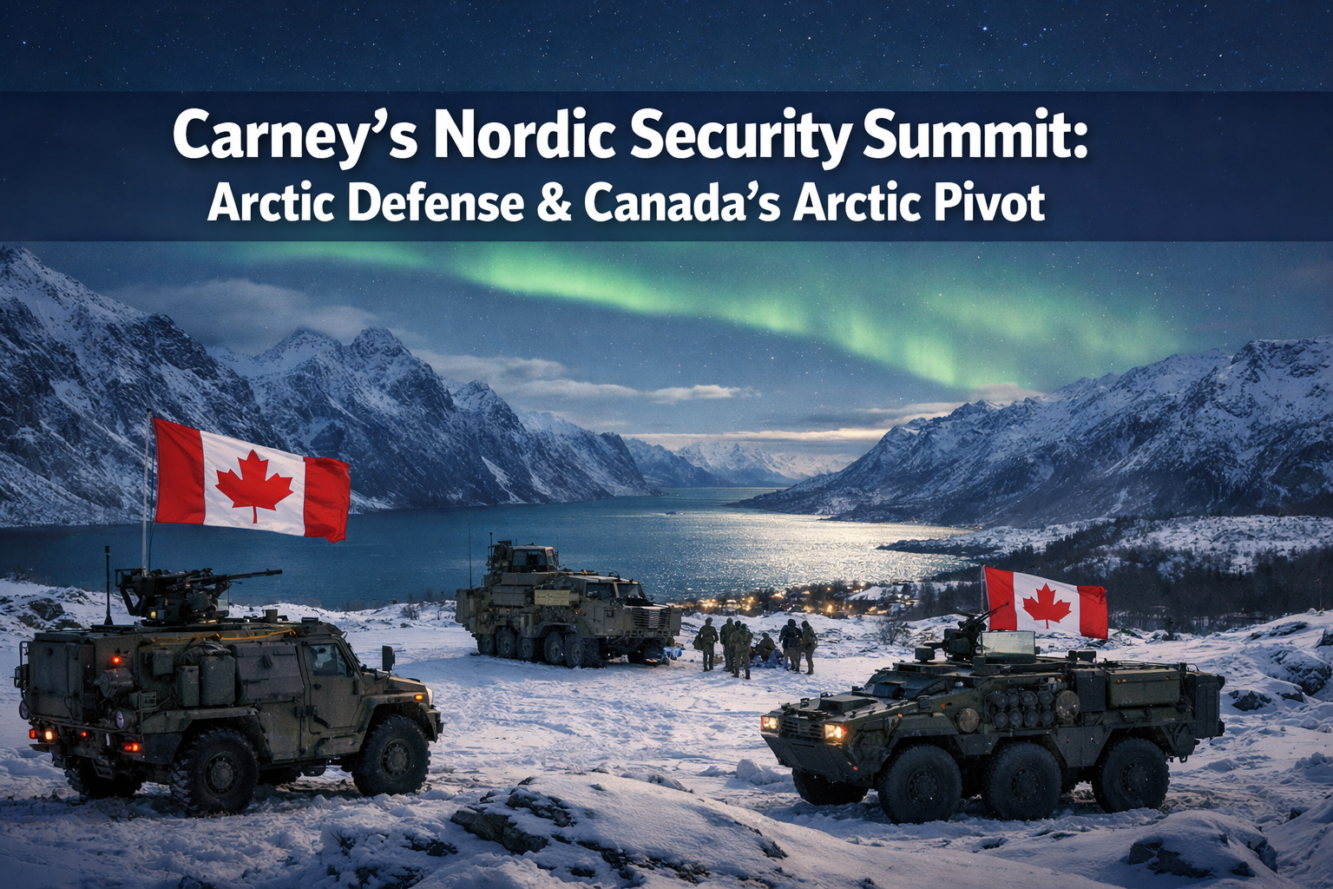
Prime Minister Mark Carney just returned from a historic trip to Norway — his first as leader and the first by any Canadian Prime Minister since 1980. Carney’s Nordic Security Summit: Arctic Defense, NATO Commitments, and Canada’s Pivot Away from Middle East Focus dominated the agenda as he met with leaders from five Nordic nations in Oslo and observed NATO troops training above the Arctic Circle. The visit signals a clear shift in Canadian foreign policy: the Arctic is now the top priority, even as pressure mounts from Washington to focus on the Middle East and the Strait of Hormuz.

This was not just a diplomatic handshake tour. Carney announced $35 billion in Arctic defense investments, watched 34,000 NATO troops train in freezing conditions during Exercise Cold Response, and signed joint statements with Norway on everything from critical minerals to artificial intelligence. The message was unmistakable — Canada is planting its flag firmly in the North.
Key Takeaways 🔑
- 💰 $35 billion committed to Arctic defense, sovereignty, and northern infrastructure — Canada’s largest-ever Arctic military investment.
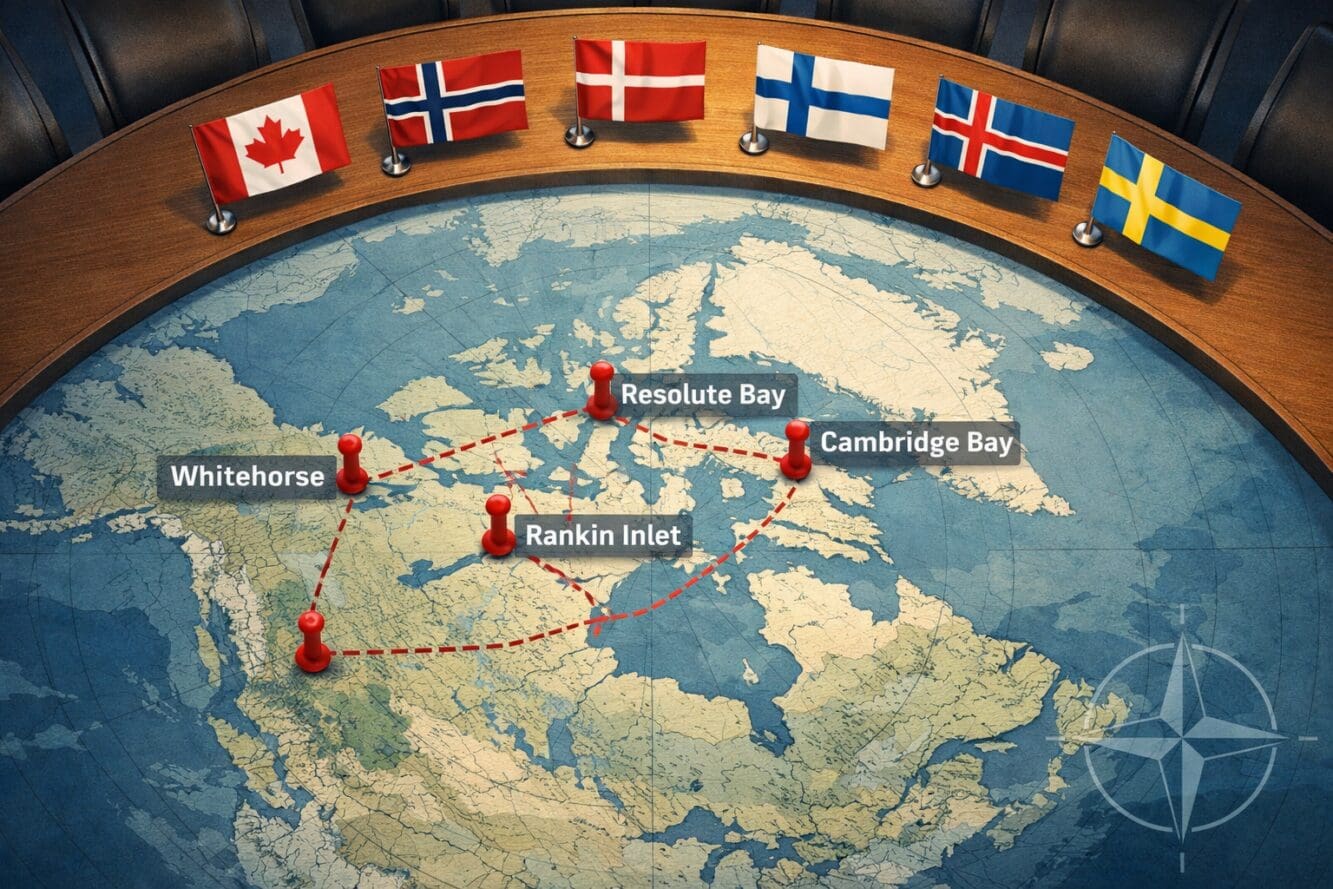
- 🏗️ Four new operational support hubs planned at Whitehorse, Resolute Bay, Rankin Inlet, and Cambridge Bay for year-round Arctic operations.
- 🤝 Six-nation Nordic summit produced joint commitments on trade, technology, energy, defense, and Ukraine support.
- ⚠️ Russia named the primary Arctic threat by multiple Nordic leaders, driving urgency behind NATO’s Arctic Sentry initiative.
- 🔄 Strategic pivot away from Middle East entanglements raises questions about alignment with U.S. demands on the Strait of Hormuz.
What Happened at the Nordic Security Summit
Carney traveled to Bardufoss and Oslo, Norway, accompanied by Minister of National Defence David J. McGuinty and Secretary of State Stephen Fuhr. The trip had two major components: observing NATO military exercises and holding a multilateral summit with Nordic leaders.
Exercise Cold Response
At Bardufoss, located above the Arctic Circle, Carney observed Exercise Cold Response — a Norwegian-led NATO exercise designed to test Alliance readiness in extreme cold weather. The numbers alone tell the story:
| Detail | Figures |
|---|---|
| Participating nations | 14 |
| Total troops | 34,000 |
| Exercise locations | Northern Finland & Northern Norway |
| Key participants | Norway, USA, UK, Germany, Canada, France, Italy, Sweden, Finland, Denmark, and others |
This exercise is not routine. It represents NATO’s growing recognition that the Arctic has become a contested space — and that allies need to train together in the harshest conditions on Earth. For anyone fascinated by the extreme Arctic environment, the challenges these troops face echo the kind of extreme Arctic adventures that push human endurance to its limits.
The Canada-Nordic Summit
Following the military observation, Carney met in Oslo with leaders from Denmark, Finland, Iceland, Norway, and Sweden. The six nations issued a joint statement covering:
- Defense and security cooperation in the Arctic
- Trade and economic partnerships
- Energy and critical minerals development
- Emerging technologies including space communications and AI
- Continued support for Ukraine
Carney and Norwegian Prime Minister Jonas Gahr Støre also released a separate bilateral joint statement outlining new ambitions for the Canada-Norway relationship. This covered shared NATO commitments, Arctic cooperation, and new partnerships in energy and technology sectors.
The $35 Billion Arctic Defense Plan
The headline number from the summit is staggering. Carney announced approximately $35 billion in investments to enhance Canada’s military presence in the North. This is not a vague promise — it comes with specific infrastructure plans.
New Operational Support Hubs
Canada will build four northern operational support hubs to enable Canadian Armed Forces aircraft deployment across remote Arctic areas:
- 🏔️ Whitehorse, Yukon
- 🧊 Resolute Bay, Nunavut
- ❄️ Rankin Inlet, Nunavut
- 🌊 Cambridge Bay, Nunavut
Defense Infrastructure Upgrades
Additional upgrades are planned for existing military facilities in:
- Yellowknife
- Inuvik
- Colville
- Goose Bay
These investments support Operation Nanuk, Canada’s ongoing Arctic patrol mission, and aim to enable year-round operations rather than seasonal deployments. The scale of this commitment reflects how seriously Ottawa now takes Arctic sovereignty — a concern that connects to broader questions about global surveillance and security networks that modern nations must navigate.
“Russia will remain to be a threat for Nordic Arctic countries.”
— Joint statement from Nordic leaders at the Oslo summit
Russia as the Primary Arctic Threat
Multiple leaders at the summit explicitly named Russia as the primary physical security threat to the Arctic region. This is significant. For decades, Arctic diplomacy operated under a cooperative framework. That era is over.
The summit emphasized the NATO Arctic Sentry initiative, which calls for:
- More Arctic military capabilities across the Alliance
- Joint planning for Arctic contingencies
- Coordinated exercises like Cold Response
- Enhanced surveillance of Arctic sea routes and airspace
Russia has been expanding its Arctic military infrastructure for years — reopening Soviet-era bases, deploying new icebreakers, and increasing submarine patrols under the polar ice cap. The Nordic nations see this as a direct threat to their sovereignty and security. Canada, with the world’s longest Arctic coastline, shares that concern.
The geopolitical tensions driving this Arctic buildup are part of a larger pattern of global power shifts that have accelerated in recent years.
Canada’s Pivot Away from Middle East Focus
Here is where the summit gets politically interesting. Carney’s Nordic Security Summit: Arctic Defense, NATO Commitments, and Canada’s Pivot Away from Middle East Focus represents more than a geographic reorientation — it is a strategic choice with consequences.
The Trump Factor
The United States under President Trump has been pressing allies — Canada included — to contribute more to security operations in the Strait of Hormuz and the broader Middle East. Washington wants allied naval assets protecting oil shipping lanes and countering Iranian influence.
Carney’s response? Fly to Norway and announce $35 billion for the Arctic.
This is not a direct rebuff, but it sends a clear signal. Canada is choosing to invest its defense resources where it has the most at stake: its own northern territory. The logic is straightforward:
| Middle East Focus | Arctic Focus |
|---|---|
| Protects global oil shipping lanes | Protects Canadian sovereign territory |
| Serves U.S. strategic interests | Serves Canadian national interests |
| Requires naval expeditionary forces | Requires cold-weather ground and air forces |
| Limited direct threat to Canada | Direct sovereignty implications |
Can Canada Do Both?
The honest answer is: probably not at current spending levels. Even with the $35 billion Arctic commitment, Canada’s military remains stretched thin. The Canadian Armed Forces face recruitment challenges, equipment delays, and aging infrastructure. Trying to simultaneously patrol the Arctic year-round and contribute meaningfully to Middle East operations would strain resources beyond capacity.
The summit’s emphasis on NATO burden-sharing suggests Canada is betting that collective Arctic defense through the Alliance is more sustainable than unilateral Middle East deployments. This approach also reflects the kind of community-level infrastructure planning that Canada applies domestically — prioritizing local needs while contributing to broader coalitions.
Technology, Energy, and the Economic Dimension
Carney’s Nordic Security Summit: Arctic Defense, NATO Commitments, and Canada’s Pivot Away from Middle East Focus was not purely a military affair. The economic agenda was equally ambitious.
Critical Minerals Partnership
Canada and the Nordic nations agreed to deepen cooperation on critical minerals — the raw materials essential for batteries, electronics, and defense systems. Canada holds vast mineral reserves in its northern territories, and Nordic nations have advanced mining and processing expertise. Together, they aim to reduce Western dependence on Chinese supply chains for materials like lithium, cobalt, and rare earth elements. This aligns with broader efforts to build domestic battery and energy technology capacity.
Emerging Technologies
The joint statements highlighted cooperation on:
- Space communications for Arctic monitoring
- Artificial intelligence for defense and surveillance applications
- Clean energy technologies suited to northern climates
These partnerships reflect a modern understanding that Arctic security is not just about troops and tanks. It requires satellites, sensors, AI-driven analytics, and resilient communications networks that can function in extreme conditions. The intersection of AI and strategic planning is a rapidly evolving field, much like the broader AI developments reshaping industries worldwide.
Ukraine Connection
Every participating nation reaffirmed its commitment to supporting Ukraine. Leaders framed Arctic security and Ukraine support as interconnected priorities — both driven by the need to counter Russian aggression. The message: defending the rules-based international order requires action on multiple fronts simultaneously.
What This Means for Canadians 🇨🇦
For everyday Canadians, particularly those in northern communities, this summit could bring tangible changes:
- Jobs and infrastructure in Arctic communities through military base construction
- Improved connectivity through space communications investments
- Economic development through critical minerals partnerships
- Enhanced sovereignty over Canadian Arctic waters and territory
The pivot also carries risks. A cooler relationship with Washington on Middle East security could have diplomatic consequences. And $35 billion is a massive commitment that will need sustained political will across multiple election cycles. Canadians who care about how their country positions itself on the world stage — whether through celebrating national identity or engaging with global affairs — should pay close attention to how this strategy unfolds.
Conclusion
Carney’s Nordic Security Summit marks a defining moment in Canadian foreign policy in 2026. The $35 billion Arctic defense investment, the four new operational hubs, and the deepened Nordic partnerships represent a clear strategic choice: Canada is prioritizing its own backyard over distant theaters.
Whether this pivot away from Middle East focus creates friction with Washington remains to be seen. But the logic is sound. Canada has the world’s longest Arctic coastline, faces a direct Russian threat in the North, and has natural allies in the Nordic nations who share the same geography and the same concerns.
Here is what to watch next:
- Follow the money — track whether the $35 billion commitment translates into actual contracts and construction timelines.
- Watch NATO Arctic Sentry — this initiative will show whether the Alliance is serious about collective Arctic defense.
- Monitor the U.S. response — Trump’s reaction to Canada’s Arctic-first strategy will shape the bilateral relationship for years to come.
The Arctic is no longer a frozen afterthought. It is the new frontline. And Canada just declared it is showing up. 🧊
Content, illustrations, and third-party video appearing on GEORGIANBAYNEWS.COM may be generated or curated with AI assistance or reproduced pursuant to the fair dealing provisions of the Copyright Act, R.S.C. 1985, c. C-42. Attribution and hyperlinks to original sources are provided in acknowledgment of applicable intellectual property rights. Such referencing is intended to direct traffic to and support the original rights holders’ platforms.
Much Appreciate You Sharing This Post - It Helps MUCH!!!