






















Canada’s Defense Overhaul: How Trump’s Threats Are Forcing Ottawa to Boost Military Spending and Arctic Security

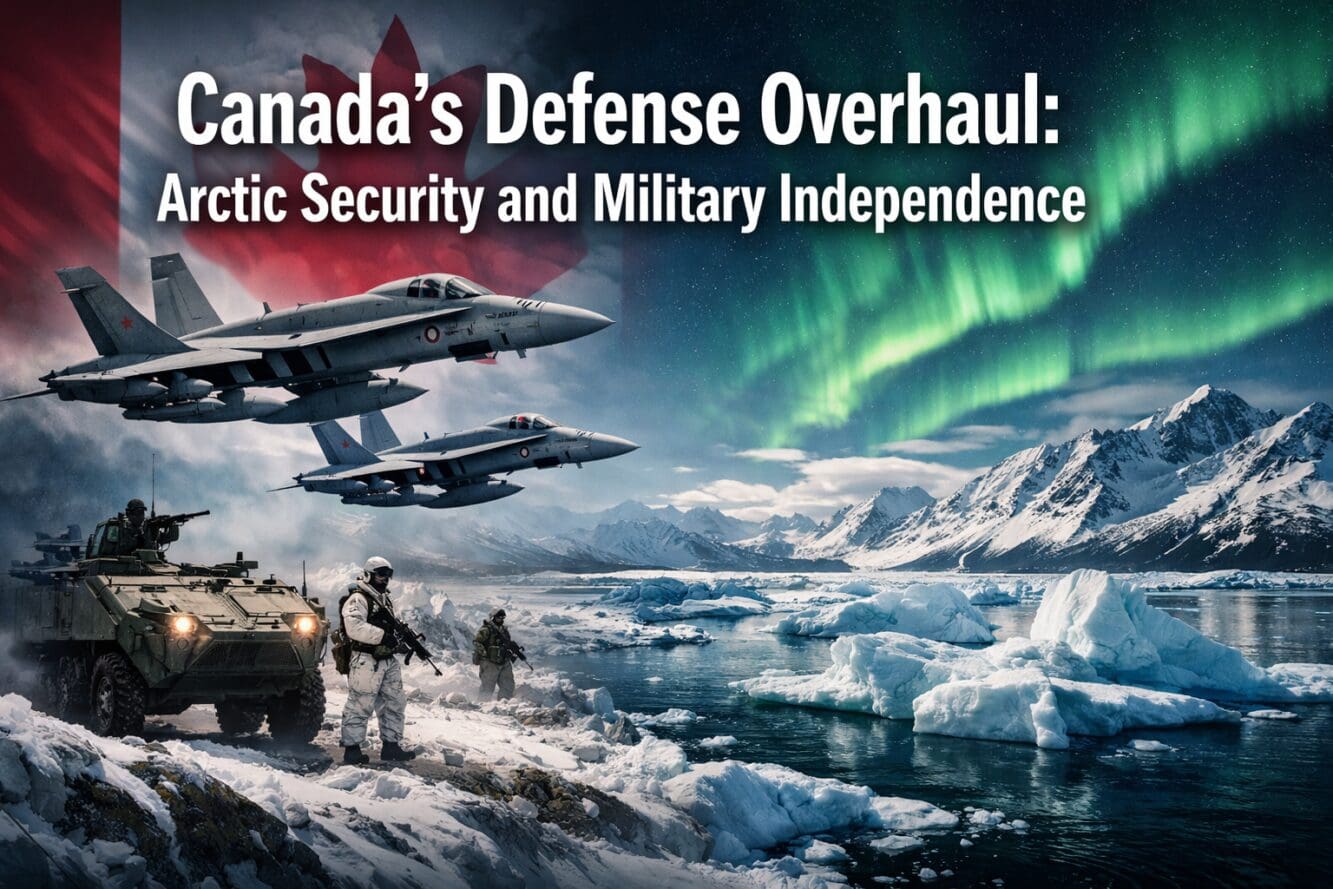
When U.S. President Donald Trump suggested Canada should become America’s 51st state, most Canadians dismissed it as typical Trump bluster. But behind closed doors in Ottawa, alarm bells were ringing. For decades, Canada had relied on the assumption that its southern neighbor would always stand as a stalwart protector. That comfortable certainty has now shattered, triggering the most significant Canada’s defense overhaul in generations—one that prioritizes Arctic security, military independence, and a dramatic reduction in reliance on American defense contractors.
Under Prime Minister Mark Carney, who rose to power in 2025 partly on promises to stand up to Trump’s hostility, Canada has announced an unprecedented C$500 billion defense and security investment package that will fundamentally reshape the nation’s military capabilities and defense industry. This transformation represents not just increased spending, but a strategic pivot toward sovereignty and self-reliance in an increasingly unpredictable geopolitical landscape.
Key Takeaways
- 🎯 Canada announced a C$500 billion ($370 billion USD) comprehensive defense investment plan through 2035, including C$50 billion over five years and C$180 billion in equipment procurement
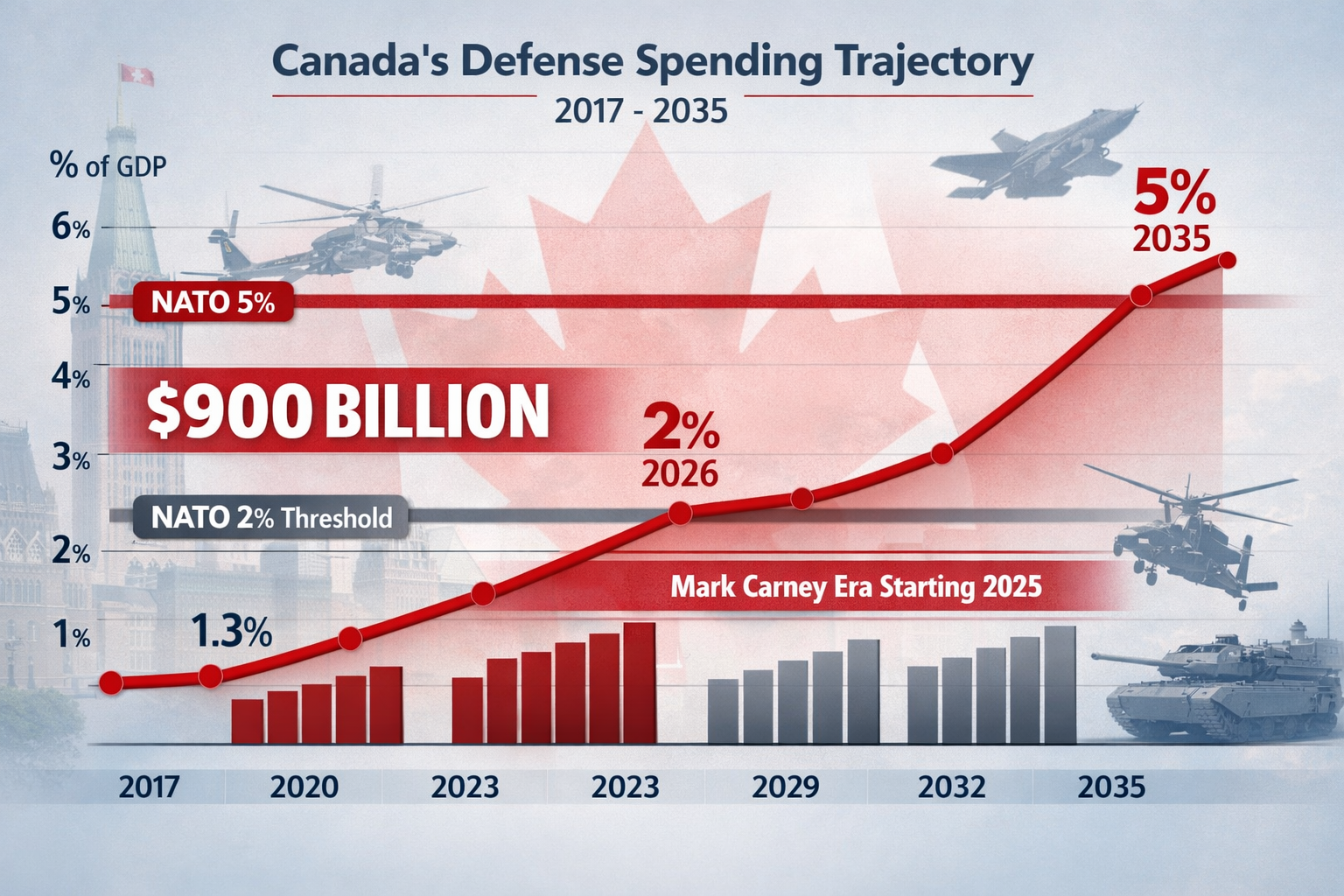
- 🌍 Defense spending will reach NATO’s 2% GDP target by spring 2026 and climb to an ambitious 5% by 2035—tripling total spending to $900 billion over the next decade
- 🇨🇦 Strategic shift away from U.S. dependence: Canada will reverse the historical pattern of buying 70-75% of weapons from American contractors, targeting 70% domestic procurement within a decade
- ❄️ Enhanced Arctic sovereignty operations include multiple Operation NANOOK missions and Northern Operational Support Hubs to defend Canada’s vulnerable northern territories
- 💼 Economic transformation: The strategy will create 125,000 high-paying defense jobs and generate $125 billion in downstream economic benefits by 2035
The Trump Catalyst: How Presidential Hostility Shattered Canadian Complacency

For generations, Canada operated under what defense analysts call “strategic complacency”—the comfortable assumption that the U.S.-Canada security partnership was unshakeable. The two nations share the world’s longest undefended border, jointly command NORAD (North American Aerospace Defense Command), and have fought side-by-side in conflicts from World War II to Afghanistan.
But Trump’s second presidency has fundamentally altered that calculus. His repeated suggestions about Canadian annexation, combined with threats against NATO allies like Denmark over Greenland and his treatment of Ukraine, have dispelled Canadians of their belief in the sanctity of the U.S.-Canada security partnership. [1]
“Trump shocked Canada out of complacency on defense,” noted Foreign Policy in their analysis of the transformation. The president’s actions demonstrated that even America’s closest allies could no longer take Washington’s protection for granted.
This realization prompted a wholesale reassessment of Canadian defense policy. At the World Economic Forum in Davos in early 2026, Prime Minister Carney spoke about a permanent “rupture” in the world order, calling upon middle-sized nations to cooperate as a counter to superpowers—without explicitly naming Trump or the United States, but with the implication crystal clear.
The political landscape in North America has shifted dramatically, forcing Canada to reconsider fundamental assumptions about continental security.
Canada’s Defense Overhaul: The Numbers Behind the Military Buildup
On February 17, 2026, Prime Minister Carney formally launched Canada’s first-ever Defence Industrial Strategy, unveiling the scope of the military transformation. [1] The numbers are staggering:
Investment Breakdown
| Category | Amount (CAD) | Timeline | Purpose |
|---|---|---|---|
| Direct Defense Spending | $50 billion | 5 years | Immediate capability enhancement |
| Arms & Equipment Procurement | $180 billion | 10 years | Modern weapons systems |
| Defense Infrastructure | $290 billion | Through 2035 | Bases, facilities, support systems |
| Total Investment | $500 billion | Through 2035 | Comprehensive overhaul |
This massive investment will bring Canada’s defense spending to approximately $63 billion (2% of GDP) by fiscal year 2025-26, meeting NATO’s minimum threshold for the first time in decades. But Canada isn’t stopping there—the commitment extends to reaching 5% of GDP by 2035, tripling total defense spending to $900 billion over the next decade. [1]
The strategy represents a $125 billion anticipated downstream economic benefit by 2035, transforming Canada’s defense industrial base from a minor player into a significant economic driver. [1]
Strategic Independence: Reducing Reliance on U.S. Defense Contractors
Perhaps the most significant aspect of Canada’s defense overhaul is the deliberate pivot away from American suppliers. Historically, 70-75% of Canadian defense spending went to U.S. contractors like Lockheed Martin, Boeing, and Raytheon. [1]
Prime Minister Carney has explicitly stated that Canada will no longer acquire 70-75% of its weapons from the United States. Instead, the new strategy aims to raise the share of defense acquisitions awarded to Canadian firms to 70% within a decade—a complete reversal of the traditional pattern. [1]
This shift has practical implications:
- ✅ Ongoing review of F-35 fighter jet purchases from American manufacturers
- ✅ Increased defense exports to European partners rather than continental integration
- ✅ Partnerships with non-U.S. allies, including South Korean companies positioned for submarine programs
- ✅ Development of domestic manufacturing capacity for critical defense systems
The New York Times reported that American defense companies, which long benefited from Canadian military spending, will no longer automatically reap those rewards. The Canadian government plans to divert billions of dollars it traditionally gave to U.S. defense companies and direct it instead to domestic manufacturers. [1]
This represents a fundamental break from decades of defense procurement patterns and signals Canada’s determination to achieve genuine strategic autonomy.
Arctic Security: Canada’s Defense Overhaul Focuses on the Frozen Frontier
The Arctic has emerged as the most critical theater for Canada’s defense overhaul. Climate change has opened new shipping routes through the Northwest Passage, while geopolitical competition from Russia, China, and even the United States has intensified focus on the resource-rich region.
Operation NANOOK: Comprehensive Arctic Sovereignty
Throughout 2026, the Canadian Armed Forces are conducting an unprecedented series of Operation NANOOK missions designed to assert sovereignty across Canada’s northern territories. These operations include:
Operation NANOOK-NUNALIVUT 🚢
- Focus: Long-range sustainment along the Northwest Passage
- Defensive activities across Yukon, Northwest Territories, and Nunavut
- Year-round presence in previously under-monitored regions
Operation NANOOK-QIMAAVIVUT 🏗️
- Focus: Military engineering and infrastructure development
- Construction of Northern Operational Support Hubs
- Enhanced logistics and supply chain resilience
Operation NANOOK-TATIGIIT 🚨
- Focus: Whole-of-government crisis response
- Coordination with territorial governments and Indigenous communities
- Emergency preparedness in remote regions
Operation NANOOK-TAKUNIQ ✈️
- Focus: Air-land integration with Canadian Ranger patrols
- Enhanced surveillance and rapid response capabilities
- Integration of new Arctic-capable aircraft
Operation NANOOK-TUUGAALIK ⚓
- Focus: Maritime interoperability with Canadian Coast Guard and NATO allies
- Naval presence in Arctic waters
- Joint exercises with European partners
Operation NANOOK-NUNAKPUT 🌐
- Focus: All-domain activities along the Northwest Passage
- Integrated land, sea, air, cyber, and space operations
- Comprehensive sovereignty assertion
These operations are supported by Northern Operational Support Hubs that will enhance presence, reach, mobility, and responsiveness in northern regions—addressing the reality that Canada’s Arctic territories have been dangerously under-defended for decades.
Working in collaboration with Inuit and Northern Indigenous governments and communities, the Canadian Armed Forces are establishing a meaningful and enduring presence that safeguards sovereignty amid heightened global attention on the Arctic.
Economic Transformation: Jobs, Industry Growth, and Domestic Manufacturing
Beyond military capability, Canada’s defense overhaul represents an ambitious economic development strategy. The Defence Industrial Strategy will fundamentally reshape Canada’s industrial landscape:
Employment and Industry Impact
Job Creation 💼
- 125,000 high-paying careers by 2035 in defense and related sectors
- Skilled manufacturing, engineering, and technology positions
- Geographic distribution across provinces, with significant concentration in Ontario, Quebec, and British Columbia
Industry Revenue Growth 📈
- 240% increase in Canadian defense industry revenues
- Current contribution: Nearly $10 billion to GDP supporting over 81,000 jobs
- Projected expansion into aerospace, shipbuilding, cybersecurity, and advanced manufacturing
Defense Export Expansion 🌍
- 50% increase in defense exports targeted
- Focus on European markets seeking alternatives to U.S. suppliers
- Integrated packages combining shipbuilding, construction, and energy cooperation
The strategy explicitly aims to build what Prime Minister Carney calls a “lethal domestic growth” capacity—the ability to design, manufacture, maintain, and upgrade sophisticated weapons systems entirely within Canadian borders. [1]
This economic dimension addresses a critical vulnerability: Canada’s defense industry has atrophied over decades of relying on foreign suppliers, leaving the country dependent on imports for basic military needs.
Equipment Serviceability: Addressing Decades of Neglect
One of the most embarrassing aspects of Canada’s military has been the poor condition of its equipment. Years of under-investment left the armed forces with:
- 🚢 Navy serviceability at just 54% (many ships unable to deploy)
- 🚙 Army land fleet serviceability at 55% (vehicles frequently broken down)
- ✈️ Air force readiness significantly compromised by aging aircraft
The new strategy sets ambitious equipment serviceability targets:
| Service Branch | Current Rate | 2035 Target | Improvement |
|---|---|---|---|
| Maritime Fleet | 54% | 75% | +21 percentage points |
| Land Fleets | 55% | 80% | +25 percentage points |
| Aerospace Fleets | ~60% | 85% | +25 percentage points |
Achieving these targets requires not just new equipment purchases, but building domestic maintenance, repair, and overhaul (MRO) capacity—another driver of the shift away from U.S. dependence. [1]
Canadian military personnel have long complained about being sent on missions with inadequate or broken equipment. This overhaul addresses those concerns directly, recognizing that military readiness depends on reliable, well-maintained systems.
NATO Implications: Canada’s Defense Overhaul and Alliance Dynamics
Canada’s military transformation has significant implications for NATO and the broader Western alliance. For years, Canada was among the alliance members failing to meet the 2% GDP defense spending benchmark, drawing criticism from American presidents including Trump.
Meeting and Exceeding NATO Targets
2026: Reaching 2% GDP 🎯
- Canada is on track to meet the 2% NATO spending target by spring 2026
- Defense spending at approximately $63 billion in fiscal year 2025-26
- Removes a major source of transatlantic tension
2035: Ambitious 5% Goal 🚀
- Commitment to reach 5% of GDP by 2035
- Would make Canada one of NATO’s highest spenders relative to economy size
- Demonstrates long-term commitment to alliance burden-sharing
This dramatic increase positions Canada as a more credible military partner, but the strategic shift toward domestic procurement and reduced U.S. dependence also reflects broader trends within NATO. European allies, particularly Germany and France, have similarly begun discussing “strategic autonomy” and reducing reliance on American defense systems.
At the Munich Security Conference in early 2026, German Chancellor Friedrich Merz declared that the international rules-based order “no longer exists,” while he and French President Emmanuel Macron spoke about Europe’s push for military autonomy—echoing themes from Prime Minister Carney’s Davos speech.
Canada’s transformation is part of a broader Western recalibration in response to American unpredictability under Trump.
Recruitment Surge: Canadians Answering the Call
One surprising indicator of the strategy’s impact: applications to join the Canadian Armed Forces are up nearly 13% since the government’s defense commitment announcements. [1]
This recruitment surge suggests that:
✅ Canadians support increased defense investment when framed around sovereignty and independence
✅ Career prospects in the military have improved with guaranteed long-term funding
✅ National pride and purpose have been reinvigorated by the focus on Arctic sovereignty
✅ Economic opportunities in defense-related careers are attracting younger Canadians
For years, the Canadian Armed Forces struggled with recruitment and retention, hampered by aging equipment, inadequate funding, and unclear strategic direction. The new policy provides clarity and resources that make military service more attractive.
The changing dynamics in Canadian society reflect a renewed sense of national purpose around defense and sovereignty issues.
Challenges and Skepticism: Can Canada Deliver?
Despite the ambitious goals, significant challenges remain:
Industrial Capacity Constraints
Question: Can Canada actually build a defense industry capable of supplying 70% of military needs?
Canadian manufacturing has declined significantly over recent decades. Building sophisticated weapons systems requires:
- Advanced engineering expertise
- Specialized manufacturing facilities
- Complex supply chains
- Quality control and testing infrastructure
- Decades of institutional knowledge
Developing this capacity from scratch or rebuilding atrophied capabilities will take time and sustained investment beyond the initial announcements.
Political Sustainability
Question: Will future governments maintain these spending levels?
Defense policy in Canada has historically been subject to political cycles. The massive spending commitments extend through 2035, spanning multiple election cycles. A change in government could result in cuts or redirection of funds.
However, the broad public support for standing up to Trump and the bipartisan concern about Arctic sovereignty suggest this policy may have more durability than past defense initiatives.
Workforce Development
Question: Where will the 125,000 skilled workers come from?
Canada faces labor shortages across many sectors. Training engineers, technicians, and specialized manufacturing workers for defense applications requires:
- Educational pipeline development
- Immigration of skilled workers
- Retention strategies to prevent brain drain
- Competitive compensation packages
The timeline is aggressive, and workforce development often takes longer than anticipated.
Cost Overruns
Question: Will the actual costs exceed projections?
Defense procurement is notorious for cost overruns and delays. Canada’s history includes projects that ran years behind schedule and billions over budget. The F-35 fighter jet program, for example, has been controversial for cost escalation.
Maintaining fiscal discipline while rapidly expanding capabilities will test government procurement systems.
Conclusion: A New Era of Canadian Defense Independence
Canada’s defense overhaul represents far more than increased military spending—it marks a fundamental shift in how Canada views its place in the world. For decades, Canadian defense policy operated on the assumption of permanent American protection. Trump’s hostility has shattered that assumption, forcing Ottawa to confront uncomfortable truths about vulnerability and dependence.
The C$500 billion investment package, the commitment to reach 5% GDP spending by 2035, and the strategic pivot toward domestic manufacturing all signal that Canada is serious about achieving genuine military independence. The enhanced Arctic operations demonstrate that sovereignty requires presence, not just rhetoric.
Yet challenges remain substantial. Building a defense industrial base capable of supplying most Canadian military needs will require sustained political will, massive workforce development, and overcoming decades of industrial decline. The economic benefits—125,000 jobs, $125 billion in downstream value, 240% industry revenue growth—are compelling, but only if Canada can actually deliver on the ambitious timelines.
What This Means for You
Whether you’re a Canadian citizen, defense industry professional, investor, or international observer, Canada’s defense transformation will have ripple effects:
- 🗳️ Voters: Expect defense and sovereignty to remain central political issues through multiple election cycles
- 💼 Job seekers: Defense-related careers will offer significant opportunities, particularly in skilled manufacturing and engineering
- 📊 Investors: Canadian defense contractors and related industries may see substantial growth
- 🌍 Allies: Canada is positioning itself as a more capable and independent security partner
- 🇺🇸 Americans: The U.S. defense industry will lose billions in traditional Canadian contracts
The Trump presidency, intended to pressure allies into higher defense spending, has succeeded—but with the unintended consequence of pushing Canada toward strategic independence rather than deeper integration. As Prime Minister Carney noted, “Defending Canada means more than the size of our military. It also means the strength of our industries, the resilience of our economy and our capacity to act independently when it matters most.”
In 2026, Canada is charting a course toward that independence, transforming Trump’s threats into a catalyst for the most significant military and industrial transformation in generations. Whether this ambitious vision becomes reality will shape North American security dynamics for decades to come.
References
[1] Prime Minister Carney Launches Canadas First Defence Industrial – https://www.pm.gc.ca/en/news/news-releases/2026/02/17/prime-minister-carney-launches-canadas-first-defence-industrial
[2] Watch – https://www.youtube.com/watch?v=w4u9tgos3pA
[3] Canada Advances Defence Industrial Strategy To Strengthen Security Sovereignty And Prosperity – https://www.canada.ca/en/global-affairs/news/2026/02/canada-advances-defence-industrial-strategy-to-strengthen-security-sovereignty-and-prosperity.html
[4] Carney Billions Canada Military Us – https://www.japantimes.co.jp/news/2026/02/18/world/politics/carney-billions-canada-military-us/
[5] Security Sovereignty Prosperity – https://www.canada.ca/en/department-national-defence/corporate/reports-publications/industrial-strategy/security-sovereignty-prosperity.html
[6] Bc To See 20b In Defence Spending As Ottawa Targets Lethal Domestic Growth 11901682 – https://www.biv.com/news/economy-law-politics/bc-to-see-20b-in-defence-spending-as-ottawa-targets-lethal-domestic-growth-11901682
Content, illustrations, and third-party video appearing on GEORGIANBAYNEWS.COM may be generated or curated with AI assistance or reproduced pursuant to the fair dealing provisions of the Copyright Act, R.S.C. 1985, c. C-42. Attribution and hyperlinks to original sources are provided in acknowledgment of applicable intellectual property rights. Such referencing is intended to direct traffic to and support the original rights holders’ platforms.
Much Appreciate You Sharing This Post - It Helps MUCH!!!