



















Private Credit Meltdown: Are They Are Hiding Trillions in Risky Junk?

Last updated: March 9, 2026
A private credit panic rarely begins with sirens. It begins with small denials, delayed withdrawals, bland valuation memos, and executives insisting everything is “manageable” just before investors discover that illiquid loans were sold with liquid-sounding expectations. That is why Private Credit Meltdown: How They Are Hiding Trillions in Risky Junk matters now: the sector has swollen to roughly $2 trillion globally, and recent redemption stress at major firms has forced a hard question about what these assets are really worth [2].

Key Takeaways
- Private credit is direct lending outside traditional public bond markets, often to highly leveraged companies.
- The market has expanded about fivefold since the 2008 financial crisis, increasing its systemic relevance [2].
- In March 2026, BlackRock restricted withdrawals from its largest private credit fund after heavy redemption requests [1].
- In early March 2026, Blackstone reportedly sought emergency capital from top executives to meet redemption pressure in a retail-oriented private credit vehicle [1].
- The core risk is not just defaults. It is the combination of opaque valuations, illiquid assets, and investors wanting cash at the same time.
- Software loans are a major concentration risk, representing roughly 40% of private equity-backed loans outstanding, according to reporting cited here [1].
- A full 2008-style collapse is not the base case, but economists increasingly view private credit stress as a potential warning sign for wider markets [2].
- Retail investors should treat redemption terms, valuation methods, and sector concentration as seriously as headline yield.
- If private credit stress spreads, banks can still feel it indirectly through funding lines and counterparty exposure [2].

Quick Answer
Private credit is under pressure because many funds hold hard-to-price loans to leveraged companies while offering investors periodic liquidity. When defaults rise or confidence falls, fund managers can slow withdrawals, re-mark assets, or seek emergency capital, which exposes the mismatch between what investors thought they owned and what can actually be sold [1][2].
What is the private credit meltdown, really?
The private credit meltdown is not a single crash date. It is a stress process in which private lenders, fund managers, and investors discover that hidden credit risk and limited liquidity can no longer be masked by optimistic internal valuations.
Private credit generally refers to non-bank lending, often sponsored by private equity firms, to companies that may be too leveraged, too small, or too bespoke for the syndicated loan or bond markets. The attraction is obvious: higher yields, tighter lender control, and less mark-to-market volatility. The danger is just as obvious once sentiment turns: less transparency, fewer natural buyers, and valuation discretion.
A useful analogy comes from another kind of “meltdown”: emotional overload. The difference between a tantrum and a real breakdown is intent versus loss of control. That same distinction appears in markets. Early private credit stress can look orderly, but once redemptions and defaults interact, control starts slipping. For a non-finance framing of that distinction, see understanding the difference between tantrum vs meltdown.
“When you see one cockroach, there’s probably more.” Jamie Dimon’s 2025 warning captured the market’s basic fear: isolated defaults may not stay isolated [1].
Common mistake
A common mistake is assuming private credit is safer because prices do not update daily. In many cases, the risk is merely hidden longer.

Why are people suddenly searching “Private Credit Meltdown: How They Are Hiding Trillions in Risky Junk”?
People are searching that phrase because several 2025 and 2026 events punctured the narrative that private credit was insulated from public-market volatility. The trigger was not one bankruptcy alone, but a sequence of defaults, redemption limits, and growing skepticism about marks [1][3].
Recent developments matter because they are concrete, not theoretical:
- BlackRock limited withdrawals from its HPS Corporate Lending Fund after receiving $1.2 billion in redemption requests in Q1 2026 and approving only $620 million, equal to 5% of NAV, under its contractual gate provisions [1].
- Blackstone reportedly asked more than 25 top executives to raise $150 million to help meet redemption pressure in a retail-facing private credit fund [1].
- Tricolor Holdings and First Brands filed for bankruptcy in September 2025, helping shift attention from yield to credit quality [1].
- Mohamed El-Erian warned that parts of private markets had gone too far and faced a necessary valuation correction [1].
For readers tracking broader hidden-risk stories, the pattern resembles other sectors where glossy narratives can obscure structural fragility, such as the hidden cost of innovation in AI power demand or how an idyllic retirement resort became a financial prison.
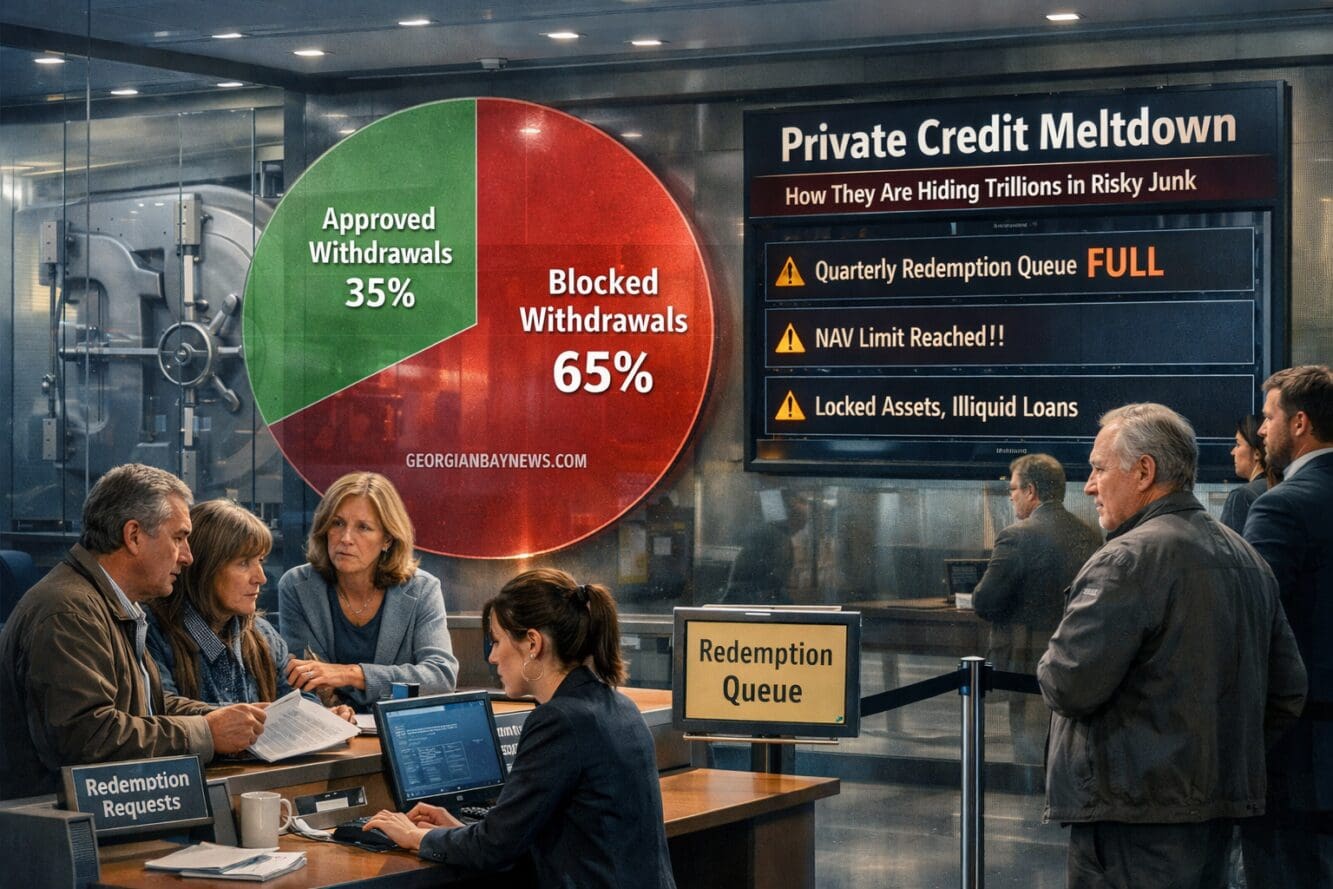
Private Credit Meltdown: How They Are Hiding Trillions in Risky Junk through valuation and liquidity
The main way risky assets stay “hidden” is not literal concealment. It is a combination of internal pricing discretion, infrequent trading, and investor structures that do not fully match the underlying loan liquidity.
Here is how that usually works:
Loans are bespoke and thinly traded.
A direct loan to a sponsor-backed company may have no active market price on any given day.Managers rely on models and internal marks.
That is not inherently improper, but it creates room for delay in reflecting deteriorating credit quality [3].Funds offer periodic redemptions.
Monthly or quarterly windows can create the impression of easy access to cash, even when the assets are hard to sell.Gates and limits become the shock absorber.
When redemption demand rises, managers can restrict exits, as BlackRock did under fund terms [1].
Decision rule
Choose caution if a fund promises:
- stable valuations,
- elevated yield,
- and regular withdrawals,
while holding loans that could take months, not days, to exit under stress.
Mini comparison table
| Feature | Public high-yield bond fund | Private credit fund |
|---|---|---|
| Price visibility | Daily market pricing | Periodic internal valuation |
| Liquidity | Usually higher | Often limited |
| Loan customization | Lower | Higher |
| Transparency | Greater | Lower |
| Stress response | Market repricing | Gates, delayed marks, side pockets in some structures |
Who is most exposed if the private credit market weakens?
The most exposed groups are retail investors in semi-liquid private funds, private equity-backed borrowers, and institutions that assumed marks would remain stable. Banks are not always the direct lender, but they can still be exposed through financing relationships and fund-level connections [2].
The “democratization” story is especially relevant. Axios described signs that retail investors may have less tolerance for volatility and redemption restrictions than sponsors expected [4]. That matters because retail money often behaves differently from locked-up institutional capital.
Likely pressure points
- Retail feeder funds with redemption queues
- Pension and endowment portfolios holding marked-to-model positions
- PE-backed companies refinancing at higher rates
- Banks providing leverage or other support to private credit managers [2]
Edge case
A strong manager with conservative underwriting may survive a shakeout well. The problem is that investors often do not know whether they own the strong manager until stress reveals the difference.
Why does AI disruption matter to private credit?
AI matters because private credit has substantial exposure to sectors that could be repriced by faster automation, margin compression, and weaker enterprise spending. UBS outlined a worst-case scenario in which private credit defaults could reach 15% under rapid and aggressive AI disruption [1].
The sector concentration is critical. Reporting cited here notes that software accounts for roughly 40% of private equity-backed loans outstanding [1]. That means an industry long viewed as relatively resilient may actually become a focal point of earnings disappointment if AI weakens legacy business models faster than debt structures can adjust.
Anecdotally, consider the mid-market software company that borrowed during the cheap-money era to finance expansion, then faced slowing renewals, AI feature competition, and a refinancing wall. Nothing dramatic happens on day one. Hiring freezes appear, sales targets are missed, covenant amendments are negotiated quietly, and then the “temporary” issue becomes a permanent capital problem.
Readers interested in how technological hype can obscure infrastructure stress may also find useful parallels in Microsoft AI’s public remarks about the future of artificial intelligence and why generative AI is straining power grids.
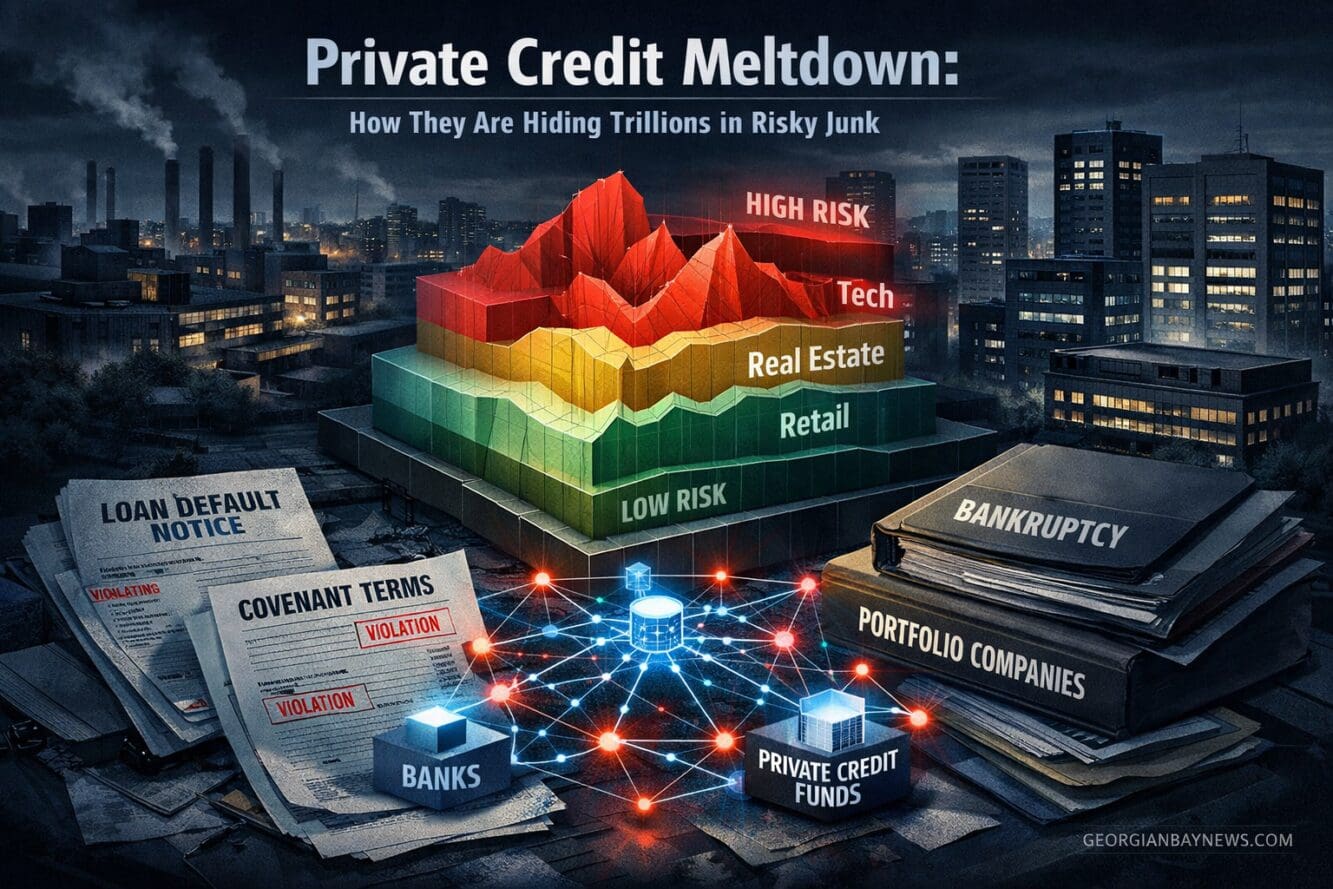
Private Credit Meltdown: How They Are Hiding Trillions in Risky Junk without causing a 2008 repeat
A private credit blowup does not need to recreate 2008 to matter. The more plausible outcome is a rolling valuation reset, tighter lending, selective fund gates, and losses concentrated in weaker borrowers rather than an immediate collapse of the global banking system [1][2].
Marketplace reported that economists do not see an immediate crisis as the base case, but they do see private credit as a potential “canary in the coal mine” for broader weakness [2]. That is an important distinction. The relevant question is less “Will everything crash tomorrow?” and more “Which assets are mispriced because bad news has not fully surfaced yet?”
What changes the outcome?
- Refinancing conditions: easier credit markets can defer pain
- Default cycle depth: isolated failures are manageable, clusters are not
- Valuation honesty: faster markdowns restore credibility sooner
- Redemption behavior: patient capital reduces forced selling risk
For a broader lens on sectors that resist acknowledging inconvenient evidence, see industries in denial from cigarettes to climate.
What should investors, employees, and borrowers watch right now?
Watch liquidity, concentration, and documentation first. Yield alone is the least informative metric in a late-cycle private credit market.
Practical checklist
- Read the redemption terms before the return target.
- Ask how the fund values loans when there is no active market.
- Check sector concentration, especially software and sponsor-backed borrowers [1].
- Look for recent amend-and-extend activity, covenant resets, or payment-in-kind features.
- Separate funds backed by long-lock institutional capital from products sold as quasi-liquid.
- Monitor live event coverage around major firms and market stress, including reporting on BlackRock and Blackstone.
Choose X if…
- Choose Treasuries or investment-grade bonds if capital preservation matters more than incremental yield.
- Choose public credit funds if transparency and tradability matter more than yield smoothing.
- Choose private credit only if lockups, valuation lags, and borrower-level risk are fully understood.
What are the best alternatives to private credit exposure?
For most general investors, the best alternatives are simpler and more transparent. The right substitute depends on whether the goal is income, diversification, or inflation resistance.
Alternatives by use case
- Income with liquidity: short-duration bond funds
- Higher quality carry: investment-grade corporate bonds
- Rate sensitivity hedge: Treasury ladders
- Diversified public risk: broad credit ETFs
- Illiquidity premium with caution: listed business development companies, though these carry their own risks
A common mistake is chasing the appearance of stability. Public markets often look more volatile because they show the price every day. That visibility can be uncomfortable, but it is also honest.
FAQ
Is private credit the same as junk bonds?
No. Private credit includes direct loans that are privately negotiated, while junk bonds are publicly traded high-yield debt. Risk can overlap, but structure and transparency differ.
Is a private credit collapse happening now?
Not in the sense of a single market-wide crash. The stronger case is that private credit is entering a period of sharper scrutiny, tighter liquidity, and possible valuation resets [2].
Why do redemption gates matter?
Redemption gates matter because they reveal a mismatch between investor liquidity expectations and the time needed to sell or finance illiquid loans [1].
Are banks safe if private credit weakens?
Banks may still face indirect exposure through lending relationships, financing lines, and interconnected market stress, even when they are not the primary lender [2].
Why is software a concern in private credit?
Software is a concern because it represents a large share of private equity-backed loans, and AI disruption could pressure margins, growth assumptions, and refinancing capacity [1].
Are private credit valuations reliable?
They can be reasonable, but they are less transparent than public market prices and can lag changing credit conditions [3].
Should retail investors own private credit funds?
Only if they understand lockups, valuation methods, sector concentration, and the possibility that withdrawals may be restricted during stress [4].
Could this become another 2008 crisis?
That is not the base-case assessment in the cited reporting, but private credit stress could still amplify broader market problems and expose hidden leverage [1][2].
Conclusion
The core issue behind Private Credit Meltdown: How They Are Hiding Trillions in Risky Junk is not mystery for mystery’s sake. It is a familiar financial pattern: rising yield demand meets opaque assets, thin liquidity, and optimistic assumptions. The private credit market may not implode overnight, but 2025 and 2026 have already shown how quickly confidence can erode when redemptions rise and valuations come under suspicion.
The sensible next steps are straightforward:
- Investors: review redemption rights, valuation methods, and sector concentrations now, not after a gate is imposed.
- Borrowers: assess refinancing risk early and renegotiate from relative strength, not distress.
- Employees and advisers: question “stable NAV” narratives when underlying credit quality is visibly weakening.
- General readers: follow the live public signals, including fund gating, bankruptcies, and changes in bank funding appetite.
Private credit was sold as a sophisticated alternative. In stress, sophistication often turns out to mean complicated enough that problems surface late. That delay is precisely why vigilance matters.
References
[1] Blackstone Private Credit Warning Signs Financial Crisis Risks 2026 3 – https://www.businessinsider.com/blackstone-private-credit-warning-signs-financial-crisis-risks-2026-3
[2] Why Concerns Are Growing Over The Private Credit Market – https://www.marketplace.org/story/2026/02/26/why-concerns-are-growing-over-the-private-credit-market
[3] Outlook For Private Credit In 2026 – https://www.clearygottlieb.com/news-and-insights/publication-listing/outlook-for-private-credit-in-2026
[4] Private Credit Blue Owl – https://www.axios.com/2026/03/03/private-credit-blue-owl
[5] Private Credit 2026 Outlook – https://www.morganstanley.com/im/fr-fr/institutional-investor/insights/outlooks/private-credit-2026-outlook.html
Content, illustrations, and third-party video appearing on GEORGIANBAYNEWS.COM may be generated or curated with AI assistance or reproduced pursuant to the fair dealing provisions of the Copyright Act, R.S.C. 1985, c. C-42. Attribution and hyperlinks to original sources are provided in acknowledgment of applicable intellectual property rights. Such referencing is intended to direct traffic to and support the original rights holders’ platforms.
Much Appreciate You Sharing This Post - It Helps MUCH!!!