




















Carney’s Defiant Stance in CUSMA Trade Talks: Canada Rejects U.S. Demands Ahead of July 1 Review

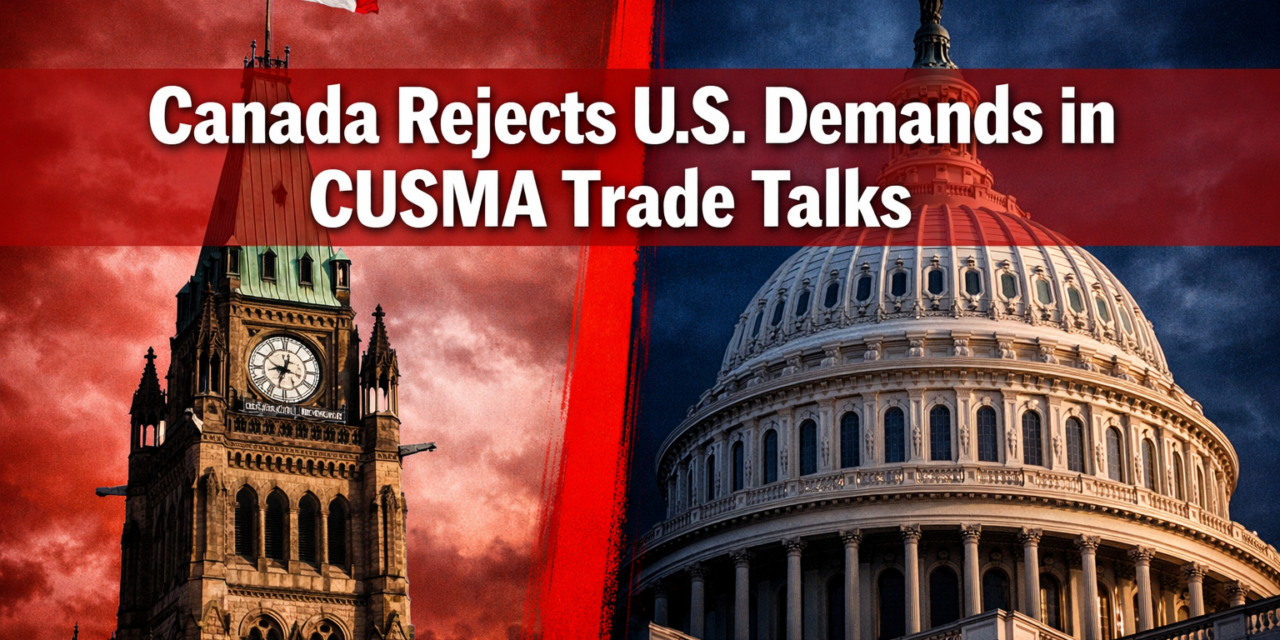
When asked whether Canada would offer additional concessions to bring the United States to the bargaining table, Prime Minister Mark Carney needed exactly one word: “No.” [2] That single syllable, delivered on April 22, 2026, outside a Liberal caucus meeting in Ottawa, has become the defining moment of Carney’s defiant stance in CUSMA Trade Talks: Canada Rejects U.S. Demands Ahead of July 1 Review. With fewer than 70 days until the mandatory review of the Canada-United States-Mexico Agreement, the two nations remain locked in a standoff over metals, autos, lumber, alcohol tariffs, and a so-called “entry fee” the Trump administration insists Canada must pay before formal discussions even begin [3].
Canada, it seems, isn’t taking notes from Washington.
Key Takeaways 📌
- Prime Minister Carney has flatly refused to make pre-negotiation concessions demanded by the Trump administration ahead of the July 1, 2026, CUSMA review deadline [2].
- The U.S. is requiring an “entry fee” — a package of Canadian concessions on procurement, supply management, and tariffs — before formal talks can start [3].
- Mexico has already begun formal review talks with the U.S. (since January 2026), while Canada-U.S. negotiations remain stalled at the preliminary stage [3].
- Canada’s “Buy Canadian” procurement policy and supply management system for dairy, poultry, and eggs are two of the biggest flashpoints [3][4].
- Carney has submitted counter-proposals and insists the outcome must be “mutually successful,” not dictated by one side [2].
Understanding the CUSMA Review and Why July 1 Matters
The Canada-United States-Mexico Agreement — which replaced NAFTA in 2020 — contains a built-in review clause. Every six years, the three signatory nations must formally assess whether the deal is working and decide whether to extend it. The first mandatory review falls on July 1, 2026 [1][2].
This isn’t a casual check-in. If the parties cannot resolve outstanding issues, the agreement could be shortened or even allowed to expire. For Canada, which sends roughly 75% of its exports to the United States, the stakes are enormous.
“It’s not the case that the United States dictates the terms. We have a negotiation. We can come to a mutually successful outcome.”
— Prime Minister Mark Carney [2]
The urgency is compounded by the fact that Mexico and the U.S. agreed to begin formal review talks back in January 2026 [3]. Canada, by contrast, hasn’t even reached the formal negotiation stage — largely because of Washington’s insistence on pre-conditions.
For Canadians watching these developments closely, community events like the Collingwood Festival for Canada on Canada Day take on added significance this year, as national pride and economic sovereignty dominate the public conversation.
Carney’s Defiant Stance in CUSMA Trade Talks: Canada Rejects U.S. Demands Ahead of July 1 Review — The “Entry Fee” Explained

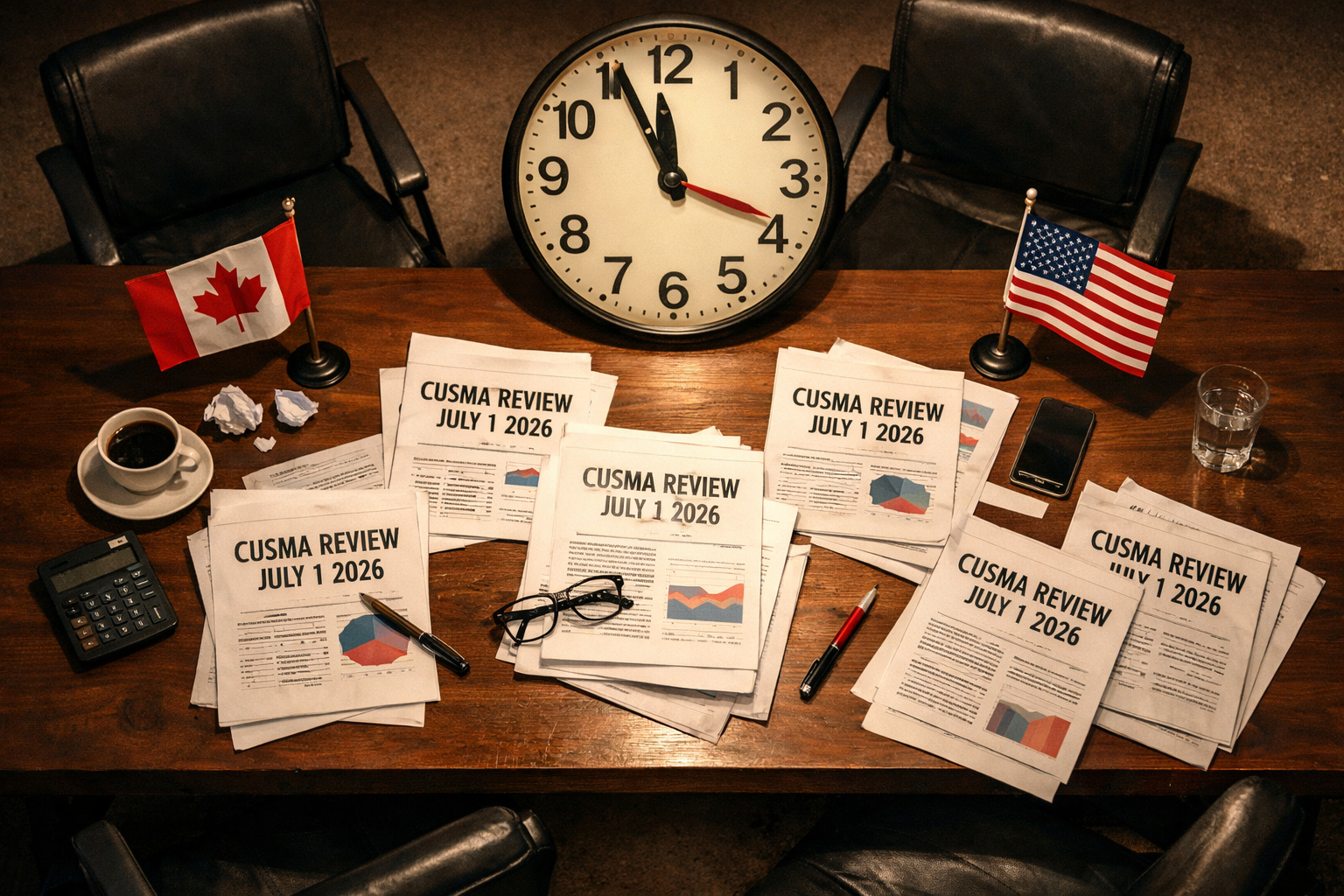
At the heart of the current impasse is what trade analysts are calling an “entry fee.” The Trump administration has laid out a series of concessions it expects Canada to accept before formal negotiations can even begin [2][3]. These demands span several key sectors:
| U.S. Demand | What It Means for Canada |
|---|---|
| 🔩 Metals tariffs | Pressure to accept U.S. tariffs on Canadian steel and aluminum without retaliation |
| 🚗 Auto sector rules | Stricter rules of origin that could disadvantage Canadian auto manufacturers |
| 🪵 Softwood lumber | Continued U.S. duties on Canadian lumber exports |
| 🍺 Alcohol tariffs | Elimination of provincial barriers to U.S. alcohol imports |
| 🛒 “Buy Canadian” policy | Rollback of procurement rules favoring Canadian products on projects over $25 million |
| 🥛 Supply management | Opening Canada’s protected dairy, poultry, and egg markets |
Carney has made it clear that accepting these demands as a precondition is a non-starter. Speaking in both English and French to reporters on April 22–23, he stated that “Canada will seek concessions from the U.S. but will not make any concessions” as a prerequisite to sitting down at the table [3].
The U.S. trade representative has also criticized Canada for “doubling down on globalization” — a reference to Ottawa’s strategy of diversifying trade relationships with the European Union, the United Kingdom, and Indo-Pacific nations in response to American tariffs [2]. From Washington’s perspective, Canada should be moving closer to the U.S. orbit, not broadening its trade horizons.
This tension mirrors broader geopolitical shifts. As some analysts have noted, the current U.S. administration’s policy priorities often conflict with multilateral trade frameworks.
Canada’s Counter-Proposals and Negotiation Strategy
Despite the public firmness, Carney has signaled that Canada is not simply stonewalling. He confirmed that Ottawa has submitted counter-proposals to Washington, though he declined to reveal specifics [2].
“We’ve made some counter proposals, which they’re aware of. And the time will come to really roll up our sleeves.”
— Prime Minister Mark Carney [2]
What Canada Is Protecting
Supply management sits at the top of Canada’s defensive priorities. The system — which controls production and pricing for dairy, poultry, and eggs — has been a political sacred cow for decades. Carney has explicitly promised to shield it during negotiations [4].
The “Buy Canadian” procurement policy is another line in the sand. This policy gives priority to Canadian products and workers on government-funded projects worth more than $25 million [3][4]. The U.S. views it as protectionist; Canada views it as a legitimate domestic economic tool — and one that mirrors America’s own “Buy American” provisions.
Ontario’s Alcohol Blockade
One of the more colorful flashpoints involves provincial alcohol regulations. Ontario’s restrictions on U.S. alcohol imports have drawn particular ire from American trade officials. Some provinces have responded to U.S. tariff threats by tightening — not loosening — barriers to American products, a move that has been described as a grassroots “Buy Canadian” movement.
This kind of community-level economic resilience is visible across the country. Local businesses and community initiatives are increasingly emphasizing Canadian-made goods and local economic self-sufficiency.
The “Load-Bearing Pillars” Argument
Canada’s chief trade negotiator recently testified before the U.S. House Ways and Means Committee, arguing that the “load-bearing pillars” of CUSMA are functioning well [2]. This framing is strategic: it suggests that the agreement’s core structure is sound and that renegotiation should focus on targeted adjustments rather than a wholesale overhaul.
Key areas where CUSMA is working effectively include:
- Dispute resolution mechanisms 🏛️
- Digital trade provisions 💻
- Labor and environmental standards 🌿
- Intellectual property protections 📜
By highlighting these successes, Canada is attempting to shift the narrative away from the U.S. framing of a “broken” deal that needs dramatic fixes. The message is clear: don’t tear down the house to fix the plumbing.
This approach to protecting shared resources and frameworks resonates with broader environmental and civic priorities that many Canadians hold dear.
Worker Support and Economic Preparedness
With the possibility that talks could stall or that U.S. tariffs could escalate, the Carney government has begun signaling potential worker support measures. While specific programs have not yet been announced, the government has indicated it is prepared to assist industries — particularly auto manufacturing, steel, aluminum, and forestry — that could face disruption.
Canadian workers in trade-dependent sectors are understandably anxious. The auto sector alone employs over 125,000 Canadians directly, with hundreds of thousands more in the supply chain. A breakdown in CUSMA talks could trigger layoffs, plant closures, and supply chain disruptions.
Communities across Canada are already exploring ways to build economic resilience. From innovative housing models to local cultural investments like the Sidelaunch Days celebration of Collingwood’s industrial heritage, there is a growing emphasis on strengthening local economies regardless of what happens at the negotiating table.
What Happens Next? Timeline to July 1 ⏰
| Date | Expected Development |
|---|---|
| Late April 2026 | U.S. reviews Canada’s counter-proposals [2] |
| May 2026 | Potential resumption of preliminary talks |
| June 2026 | Final push for formal negotiation framework |
| July 1, 2026 | CUSMA mandatory review deadline [1][2] |
If formal talks do not begin soon, both countries risk arriving at the July 1 deadline without a clear path forward. That scenario could trigger automatic uncertainty provisions in the agreement, potentially shortening its lifespan and rattling markets on both sides of the border.
Staying informed about cybersecurity and digital threats is also relevant here, as trade disputes increasingly play out in digital and information spaces.
Conclusion
Carney’s defiant stance in CUSMA trade talks represents a calculated gamble. By refusing to pay the U.S. “entry fee” and insisting on mutual respect at the negotiating table, Canada is betting that Washington needs this deal as much as Ottawa does. The July 1, 2026, deadline is fast approaching, and the clock is not slowing down for either side.
Here’s what to watch for in the coming weeks:
- ✅ Monitor whether the U.S. responds to Canada’s counter-proposals — this will signal whether formal talks can begin before June.
- ✅ Pay attention to provincial actions — Ontario’s alcohol blockade and other provincial measures could either escalate or de-escalate tensions.
- ✅ Watch for worker support announcements — federal programs to cushion trade-exposed industries may be unveiled as the deadline nears.
- ✅ Follow Mexico’s parallel track — the outcome of U.S.-Mexico talks will directly influence what Washington expects from Canada.
The message from Ottawa is unmistakable: Canada will negotiate, but it will not be bullied. Whether that resolve holds through the pressure of a ticking deadline remains the defining question of 2026’s most consequential trade negotiation.
References
[1] Carney Stands Strong In U.S. Trade Negotiations In Lead Up To CUSMA Review – https://www.chch.com/chch-news/carney-stands-strong-in-u-s-trade-negotiations-in-lead-up-to-cusma-review/
[2] Mark Carney CUSMA Talks – https://globalnews.ca/news/11812024/mark-carney-cusma-talks/
[3] CUSMA Trade Talks Latest – https://kitchener.citynews.ca/2026/04/22/cusma-trade-talks-latest/
[4] Carney Says The U.S. Can’t Dictate The Terms Of Trade Talks Ahead Of CUSMA Review – https://www.cjme.com/2026/04/22/carney-says-the-u-s-cant-dictate-the-terms-of-trade-talks-ahead-of-cusma-review-2/
[5] Carney Says The U.S. Can’t Dictate The Terms Of Trade Talks Ahead Of CUSMA Review – https://www.timescolonist.com/the-mix/carney-says-the-us-cant-dictate-the-terms-of-trade-talks-ahead-of-cusma-review-12179659
[6] Carney Says The U.S. Can’t Dictate The Terms Of Trade Talks Ahead Of CUSMA Review – https://www.ipolitics.ca/2026/04/22/carney-says-the-u-s-cant-dictate-the-terms-of-trade-talks-ahead-of-cusma-review/
Content, illustrations, and third-party video appearing on GEORGIANBAYNEWS.COM may be generated or curated with AI assistance or reproduced pursuant to the fair dealing provisions of the Copyright Act, R.S.C. 1985, c. C-42. Attribution and hyperlinks to original sources are provided in acknowledgment of applicable intellectual property rights. Such referencing is intended to direct traffic to and support the original rights holders’ platforms.
Much Appreciate You Sharing This Post - It Helps MUCH!!!