





















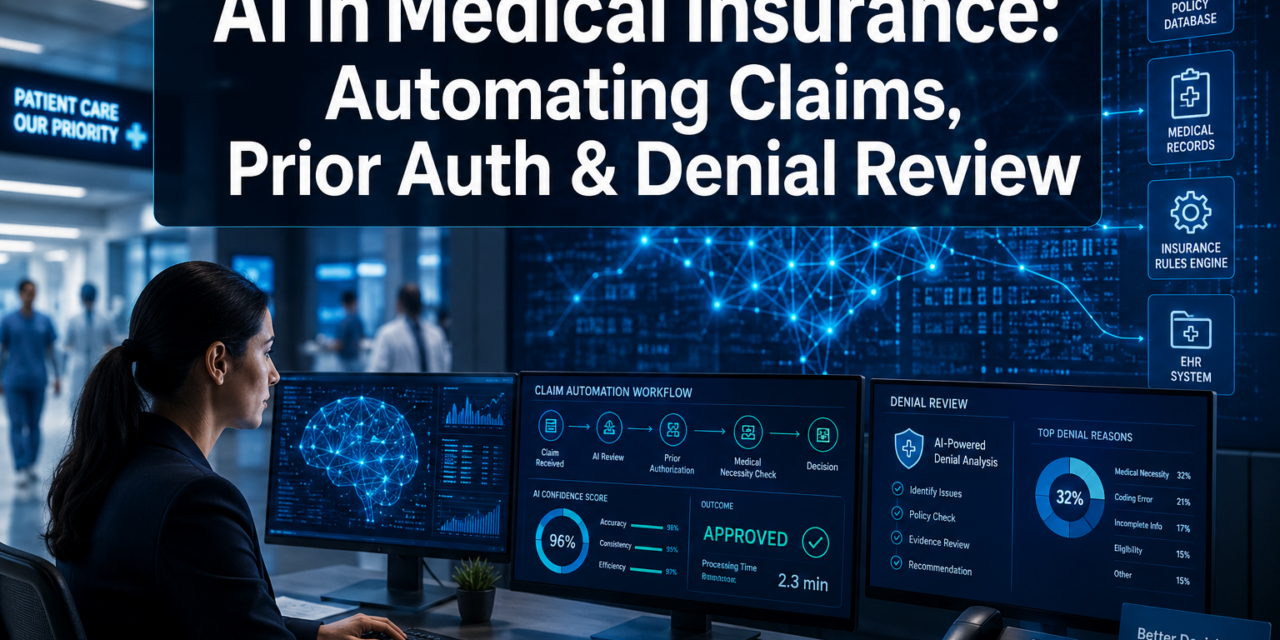
AI in Medical Insurance: How Claims, Prior Authorization, and Denial Review Are Being Automated

Last updated: May 27, 2026
CONCERNING, TO SAY THE LEAST – John Malloy
Quick Answer: AI in medical insurance is automating the most time-consuming parts of healthcare administration — claims processing, prior authorization, and denial management — by analyzing clinical data, payer rules, and billing codes faster and more consistently than manual review. Hospitals and clinics using these systems are seeing fewer denials, shorter payment cycles, and significantly reduced administrative overhead. The technology is already live across thousands of U.S. providers, though it comes with real risks around bias, transparency, and patient privacy.
Key Takeaways
- AI systems can process insurance claims, flag errors, and route prior authorization requests in seconds rather than days.
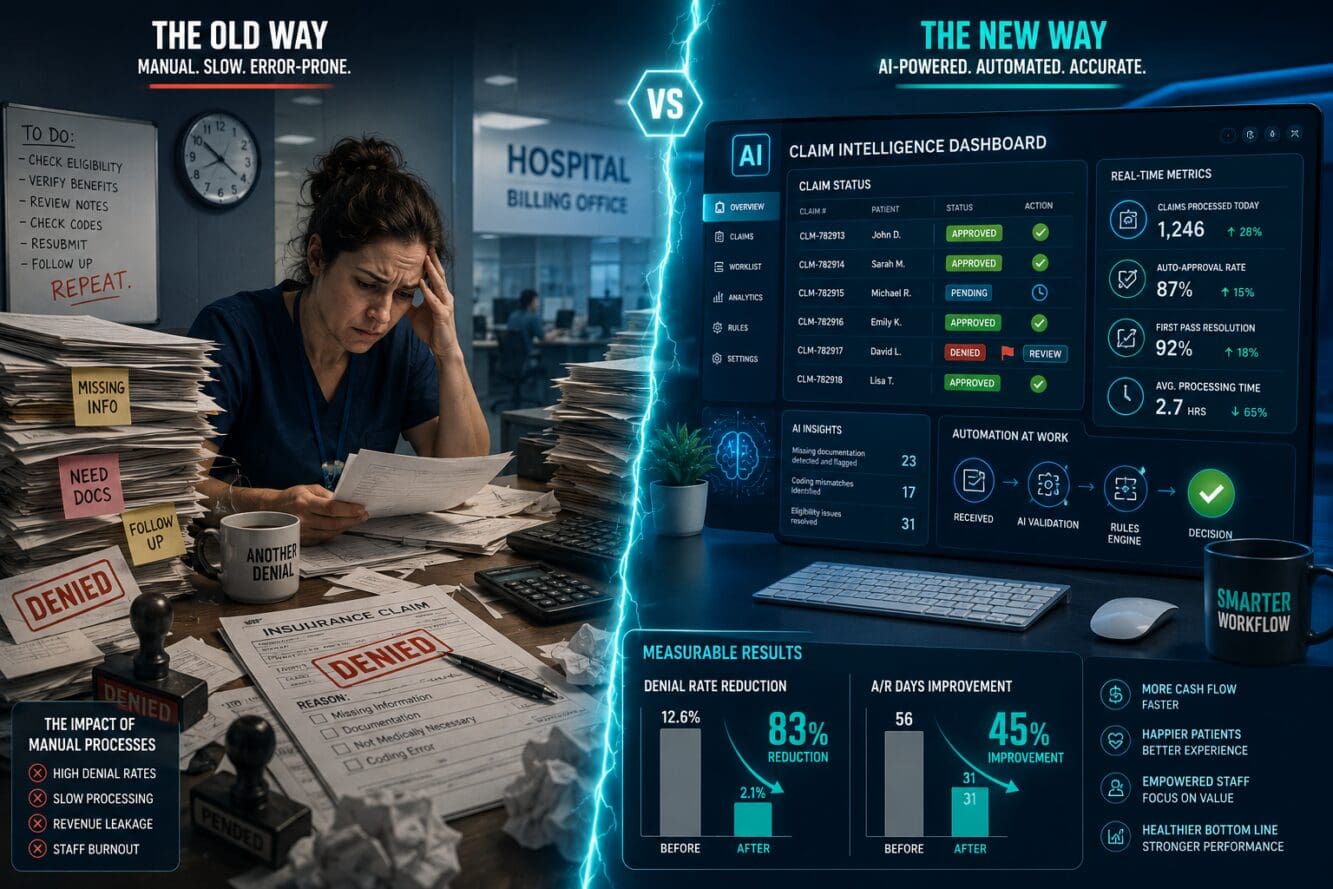
- Platforms like QuickIntell report a 35% reduction in claim denials and a drop in accounts receivable days from 48–55 down to 34–40 within 90 days of implementation. [1]
- InvisaClaim currently manages $2.4 billion in active denial, appeal, and underpayment workflows, with a 76% first-pass appeal rate for medical-necessity denials. [5]
- SwiftAuth’s AI decision engine evaluates CPT and ICD-10 code pairs against live payer criteria in under two seconds, achieving over 94% first-pass accuracy. [6]
- AI is not replacing human reviewers entirely — the strongest systems use a human-in-the-loop model where AI drafts and flags, and humans approve.
- Privacy risks are real: AI systems process sensitive patient data at scale, making HIPAA-compliant architecture non-negotiable.
- A March 2026 study found that large language models generating prior authorization letters consistently missed key administrative elements like billing codes and authorization duration requests.
- Medical specialties with high prior authorization volumes — oncology, radiology, and orthopedics — benefit most from automation.
- Common implementation mistakes include poor EHR integration, inadequate training data, and skipping the human review layer.
- AI claims automation costs vary widely, from subscription-based SaaS tools to enterprise platforms priced by claim volume.

What Exactly Does AI Do in Medical Insurance Claims Processing?
AI in medical insurance claims processing handles the verification, coding, submission, and tracking of claims automatically — tasks that previously required large billing teams working through paper and portal queues. The core functions include eligibility verification, medical coding assistance, error detection before submission, and payment posting after adjudication.
Here’s what a modern AI claims platform typically does step by step:
- Verifies patient eligibility against payer databases before the appointment or procedure.
- Assigns or validates billing codes (CPT, ICD-10) based on clinical documentation pulled from the EHR.
- Checks for common errors — mismatched codes, missing modifiers, incomplete documentation — before submission.
- Routes the claim to the correct payer through automated clearinghouse connections.
- Monitors claim status in real time and flags rejections or requests for additional information.
- Posts payments and reconciles remittance data automatically.
QuickIntell’s platform, for example, connects to over 3,500 U.S. payers and integrates with Epic, Cerner, and Athenahealth to run this entire cycle with minimal manual input. [1] The practical result: billing staff spend less time on data entry and more time resolving genuinely complex cases.
How Much Money Can Hospitals Save by Using AI for Claims?
The savings are substantial, though they vary by facility size and existing denial rates. QuickIntell reports that its AI-driven revenue cycle management platform reduced accounts receivable days from 48–55 to 34–40 within 90 days of going live — a meaningful cash flow improvement for any hospital system. [1] InvisaClaim has increased throughput per biller by 11 times after providers migrated from manual queues to its automated workflow. [5]
To put that in practical terms: a mid-size hospital processing thousands of claims monthly can recover significant revenue simply by catching coding errors before submission rather than after denial. Denial rework is expensive — each appeal cycle costs administrative time, delays payment, and sometimes results in write-offs.
Choose AI claims automation if: your denial rate is above 5%, your A/R days exceed 40, or your billing team spends more than 30% of its time on rework.
Are AI Insurance Claim Systems More Accurate Than Human Reviewers?
In high-volume, rule-based tasks, AI systems are generally more consistent than humans — they don’t fatigue, don’t skip steps, and apply the same logic to every claim. SwiftAuth’s decision engine evaluates CPT and ICD-10 code pairs against live payer criteria in under two seconds with over 94% first-pass accuracy. [6]
That said, accuracy depends heavily on training data quality and how current the payer rules are. A March 2026 study evaluating GPT-4o, Claude Sonnet 4.5, and Gemini 2.5 Pro found that while these large language models produced prior authorization letters with strong clinical content, they consistently lacked essential administrative elements — billing codes, authorization duration requests, and follow-up plans. Clinical accuracy alone isn’t enough; administrative completeness matters just as much to payers.
Edge case to watch: AI performs best on standardized claim types. Complex, multi-diagnosis cases or rare procedures still benefit from human clinical judgment layered on top of AI recommendations.
How Does Prior Authorization Work With AI Technology?
Prior authorization — the process where a provider must get insurer approval before delivering certain treatments — is one of the most administratively burdensome tasks in healthcare. AI automates it by intercepting physician orders from the EHR, determining whether authorization is required, identifying the necessary documentation, and submitting the request to the payer.
EthermedAI, for instance, integrates directly into existing prior authorization workflows without requiring staff to open additional portals. [3] The system reads the order, checks payer-specific criteria, flags documentation gaps, and prepares the submission — all before a human has to touch it.
Ember AI takes a similar approach, reducing manual prior authorization work by up to 80% and enabling same-day approvals in many cases. [10] EasyPA.ai supports native FHIR API submission with UnitedHealthcare and Humana, allowing electronic prior authorization (ePA) directly from within the EHR. [7]
Adjudicator’s platform adds a layer of transparency by providing real-time probability scoring and human-in-the-loop quality control before any authorization letter goes out. [8]
Can AI Help Reduce Insurance Claim Denials?
Yes — and this is one of the clearest documented benefits. AI reduces denials in two ways: by catching errors before submission (preventing denials) and by automating appeal workflows after denials occur.
Aira’s platform cross-references clinical data against payer-specific rules at every stage of the compliance lifecycle, flagging documentation gaps before a claim is ever submitted. [4] This upstream approach is more cost-effective than fighting denials after the fact.
When denials do happen, tools like CoClaim.AI’s platform (featuring an AI named Elena) pull remittance data, chart notes, and payer rules to draft appeal letters in under 60 seconds. [2] A human reviews and dispatches — the AI handles the drafting and research. Luma similarly generates payer-ready documentation by converting clinical notes and payer rules into structured appeal response letters. [9]
Pull quote: “Preventing a denial costs a fraction of what it takes to appeal one. AI systems that flag gaps before submission are where the real ROI lives.”
Which Insurance Companies and Platforms Are Leading in AI Claims Automation?
Several platforms are currently active in this space, each with a distinct focus:
PlatformPrimary FocusNotable StatQuickIntell [1]Full RCM cycle35% denial reductionInvisaClaim [5]Denial & appeal management$2.4B in active workflowsSwiftAuth [6]Prior auth decision engine94%+ first-pass accuracyEmber AI [10]End-to-end prior auth80% manual work reductionCoClaim.AI [2]Denial appeal draftingAppeals drafted in <60 secondsAira [4]Payer compliance lifecyclePre-denial gap detectionEasyPA.ai [7]ePA submissionFHIR API with UHC & Humana
On the payer side, large U.S. insurers including UnitedHealthcare and Humana have begun accepting electronic prior authorization submissions via FHIR APIs, signaling broader industry movement toward automated workflows. [7]
What Medical Specialties Benefit Most From AI Claims Review?
Specialties with high prior authorization volumes and complex billing codes see the greatest benefit. These include:
- Oncology — frequent biologics and specialty drug authorizations
- Radiology — high volume of imaging studies requiring pre-approval
- Orthopedics — surgical procedures with detailed documentation requirements
- Behavioral health — ongoing authorization renewals for therapy and medication
- Cardiology — device implants and interventional procedures
Luma specifically supports prior authorization for biologics and audit responses, making it particularly useful for oncology and rheumatology practices. [9] For specialties like these, where a single denied claim can represent tens of thousands of dollars, automation isn’t a convenience — it’s a financial necessity. Readers interested in broader healthcare access topics may also find coverage on healthy aging and care programs relevant to understanding why administrative efficiency matters for patients.
What Are the Biggest Risks of Using AI for Medical Insurance Decisions?
The risks are real and worth taking seriously. The main categories:
1. Algorithmic bias: A March 2026 fairness evaluation of automated prior authorization models found consistent error rates across most demographics — but sample sizes for certain subgroups were too small to draw firm conclusions. Bias may exist in ways current data can’t yet detect.
2. Lack of transparency: When AI denies or flags a claim, providers and patients need to understand why. Systems without explainable AI reasoning create friction and legal exposure.
3. Over-automation: Removing humans from the loop entirely increases the risk of systematic errors affecting large numbers of patients before anyone catches the problem.
4. Data security: AI systems process enormous volumes of protected health information (PHI). A breach or misuse of that data carries serious HIPAA consequences.
5. Payer rule lag: If an AI system’s payer criteria aren’t updated in real time, it will make decisions based on outdated rules — leading to avoidable denials.
Those interested in broader societal implications of automated decision-making may find parallels in discussions around social programs and policy and how algorithmic systems affect access to services.
Is AI in Medical Insurance Safe for Patient Privacy?
AI claims systems can be HIPAA-compliant, but compliance isn’t automatic — it depends on how the platform is built and contracted. Any AI system processing PHI must operate under a Business Associate Agreement (BAA) with covered entities, use encrypted data transmission, and maintain audit logs.
The concern isn’t just external breaches. AI systems trained on patient data can inadvertently expose patterns or be used in ways that exceed the original consent scope. Platforms like InvisaClaim emphasize auditable workflows precisely because traceability matters for both compliance and patient trust. [5]
Common mistake: Assuming a cloud-based AI tool is HIPAA-compliant because the vendor says so. Always verify the BAA, data retention policies, and where PHI is stored and processed.
What Are Common Mistakes When Implementing AI in Insurance Claims?
The biggest implementation failures share a few patterns:
- Poor EHR integration: AI that can’t pull clean, structured data from the EHR will produce unreliable outputs. Integration with Epic, Cerner, or Athenahealth is a baseline requirement. [1]
- Skipping the human review layer: Fully automated systems without human checkpoints amplify errors at scale. The strongest platforms — including Adjudicator and CoClaim.AI — build human review into the workflow by design. [2][8]
- Inadequate training data: AI systems trained on a narrow set of payer rules or claim types will underperform on edge cases. Verify that the platform covers your specific payer mix.
- No change management plan: Staff who don’t trust or understand the AI will work around it, negating the efficiency gains.
- Ignoring denial pattern analytics: AI generates data on why claims are denied. Not using that data to fix upstream documentation issues is a missed opportunity.
How Much Does an AI Claims Processing System Cost?
Pricing varies significantly by platform type and claim volume. General ranges as of 2026:
- SaaS subscription tools (e.g., prior auth automation for small practices): roughly $500–$3,000/month depending on volume and features.
- Mid-market RCM platforms: typically priced as a percentage of collections (often 2–5%) or a per-claim fee.
- Enterprise platforms managing billions in claim workflows: custom pricing, often negotiated annually.
Implementation costs — EHR integration, staff training, data migration — add to the total and are frequently underestimated. Platforms that offer pre-built connectors to major EHRs reduce this friction considerably. [1]
Decision rule: If your practice collects under $1M annually, a lightweight SaaS prior auth tool likely delivers better ROI than a full enterprise RCM platform.
Will AI Replace Human Insurance Claim Reviewers Completely?
No — at least not in the near term, and probably not entirely even long-term. The most effective systems use AI to handle volume and consistency while humans manage exceptions, appeals requiring clinical judgment, and edge cases.
CoClaim.AI’s Elena drafts appeals in under 60 seconds, but a human reviews and dispatches every letter. [2] Adjudicator provides probability scoring and reasoning, but keeps human quality control in the loop. [8] This hybrid model is both more accurate and more defensible — legally and ethically — than full automation.
What AI is replacing is the repetitive, rules-based work: eligibility checks, code validation, status tracking, and standard appeal drafting. That frees human reviewers to focus on cases where judgment and context actually matter. For context on how automation is reshaping workforce dynamics more broadly, software engineers and technology workers are navigating similar transitions across industries.
What Kind of Training Data Do AI Insurance Systems Use?
AI claims systems are trained on combinations of:
- Historical claims data — approved, denied, and appealed claims with outcomes
- Payer policy documents — coverage rules, medical necessity criteria, and LCD/NCD guidelines
- Clinical documentation — physician notes, lab results, imaging reports linked to claim outcomes
- CPT/ICD-10 code relationships — billing code logic and common pairing errors
- Remittance data — explanation of benefits (EOB) documents that explain payer decisions
The quality and diversity of this training data directly determines how well the system performs across different specialties, payer types, and patient demographics. A system trained primarily on large urban health system data may underperform in rural or community health settings.
Ongoing model updates are essential — payer rules change frequently, and a system running on stale criteria will generate outdated recommendations. [6]
Conclusion
AI in medical insurance — covering claims processing, prior authorization, and denial review — is already delivering measurable results for providers willing to implement it thoughtfully. Denial rates are falling, payment cycles are shortening, and billing teams are handling more volume with less manual effort.
But the technology is not a plug-and-play fix. The risks around bias, transparency, and patient privacy are genuine and require active management. The platforms doing this well share a common approach: AI handles the volume and consistency, humans handle the judgment and exceptions.
Actionable next steps for providers and administrators:
- Audit your current denial rate and A/R days — these are your baseline metrics.
- Identify your highest-volume prior authorization specialties and target automation there first.
- Evaluate platforms based on your EHR compatibility and payer mix, not just feature lists.
- Require a Business Associate Agreement and clear data governance terms from any AI vendor.
- Build human review into every automated workflow — don’t remove the human layer entirely.
- Use denial pattern data from your AI system to fix documentation issues upstream.
The administrative burden on healthcare providers has been a persistent problem for decades. AI in medical insurance isn’t eliminating that burden overnight, but for organizations that implement it carefully, it’s making a real dent. Those interested in how technology intersects with community health and social inclusion will find these administrative improvements matter most for patients who depend on timely access to care.
Frequently Asked Questions
Q: How long does it take to implement an AI claims processing system?
Most mid-market platforms report functional integration within 30–90 days, depending on EHR compatibility and staff training requirements. Enterprise deployments typically take longer.
Q: Can small medical practices afford AI claims automation?
Yes. SaaS-based tools designed for smaller practices are available at accessible price points, often starting under $1,000/month. The ROI calculation depends on current denial rates and billing staff costs.
Q: Does AI prior authorization work with all payers?
Not universally. Platforms like EasyPA.ai support FHIR API submission with major payers like UnitedHealthcare and Humana, but full electronic prior authorization coverage across all payers is still expanding. [7]
Q: What happens when an AI system makes a wrong decision on a claim?
The claim is denied or incorrectly coded, same as a human error — but at scale, AI errors can affect many claims simultaneously. This is why human review checkpoints and audit logs are essential.
Q: Are AI-generated prior authorization letters accepted by payers?
They can be, but a March 2026 study found that AI-generated letters often miss key administrative elements. Human review before submission remains important.
Q: Is AI in medical insurance regulated?
Partially. HIPAA governs data privacy. The CMS has issued guidance on prior authorization timelines. AI-specific regulation in healthcare is evolving, with increased scrutiny on automated denial systems at the federal level.
Q: Which EHR systems are most compatible with AI claims platforms?
Epic, Cerner, and Athenahealth have the broadest integration support across major AI claims platforms. [1]
Q: Can AI help with underpayment recovery, not just denials?
Yes. InvisaClaim explicitly manages underpayment workflows alongside denials and appeals, with $2.4 billion in active workflows across all three categories. [5]
Q: How does AI detect claim errors before submission?
By cross-referencing billing codes, clinical documentation, and payer-specific rules in real time — flagging mismatches, missing modifiers, and documentation gaps before the claim leaves the practice.
Q: What is a human-in-the-loop AI system?
A model where AI handles drafting, analysis, and routing, but a human reviews and approves before any action is taken. This is the standard recommended approach for medical insurance automation.
References
[1] quickintell – https://quickintell.com/?utm_source=openai
[2] coclaim.ai – https://coclaim.ai/?utm_source=openai
[3] ethermed.ai – https://www.ethermed.ai/?utm_source=openai
[4] airahealth – https://www.airahealth.io/?utm_source=openai
[5] invisaclaim – https://www.invisaclaim.com/?utm_source=openai
[6] ethiks.ai – https://www.ethiks.ai/?utm_source=openai
[7] easypa.ai – https://easypa.ai/?utm_source=openai
[8] adjudicator – https://www.adjudicator.io/?utm_source=openai
[9] useluma – https://www.useluma.io/?utm_source=openai
[10] Prior Auth Automation EPA Submission – https://www.embercopilot.ai/prior-auth-automation-epa-submission?utm_source=openai
Much Appreciate You Sharing This Post - It Helps MUCH!!!