

















What’s New in Ai This Week: The Biggest Shifts to Watch in 2026

Sharing is SO MUCH APPRECIATED!


Last updated: March 7, 2026
A week in AI can now change pricing, products, and policy all at once. What’s new in Ai this week is simple to answer: stronger models launched, costs shifted fast, AI agents took a bigger step toward doing real work, and defense ties became a major part of the story.[1][2]

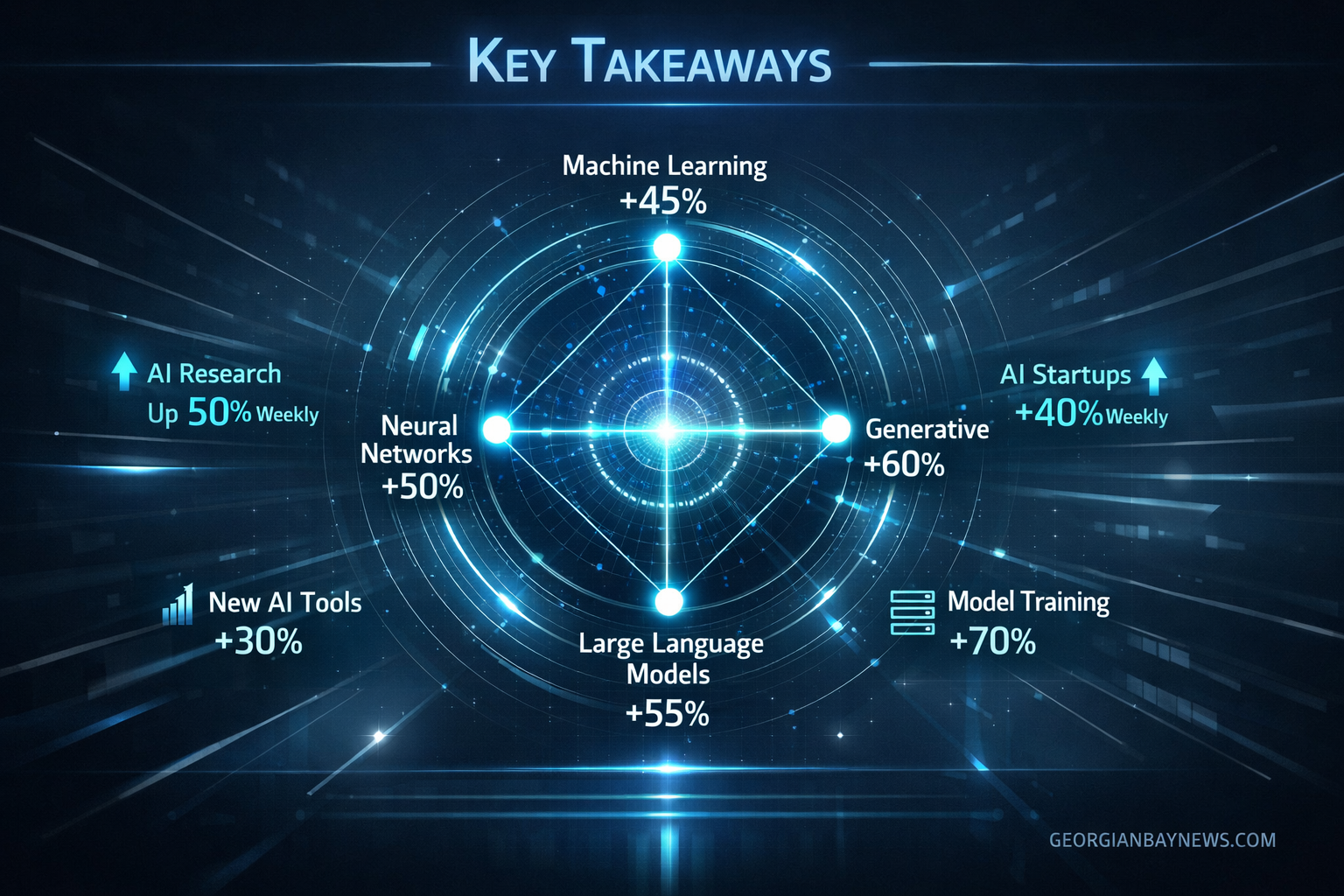
Key Takeaways
- GPT-5.4 launched on March 5, 2026 with combined reasoning and coding, a 1 million token context window, and lower token use through tool search.[1]
- DeepSeek V3.2 is pushing prices down by offering GPT-4-level quality at much lower cost, which matters for teams with heavy usage.[1]
- Claude 4.6 still stands out for complex reasoning, especially when accuracy matters more than lowest price.[1]
- Gemini 2.5 offers a 2 million token context window and tight Google search integration, useful for long documents and multimodal work.[1]
- AI is moving from chat to action, with products like Microsoft Copilot Tasks focused on completing workflows, not just answering prompts.[2]
- Defense and AI policy are becoming harder to ignore, with Pentagon-linked deals involving OpenAI and xAI, while Anthropic reportedly faced government backlash over usage limits.[2]
- Vertical AI is gaining ground in healthcare, legal work, and manufacturing because buyers want domain expertise, not generic chatbots.[3]
- Funding remains huge, but headline numbers need context: OpenAI’s announced round includes conditional commitments, not all immediate cash.[2]
Quick Answer
What’s new in Ai this week comes down to four changes: new flagship models, lower prices, more agent-style tools, and bigger political stakes. For most readers, the practical takeaway is clear: AI tools are getting better at long-context work and task automation, but choosing the right model now depends heavily on budget, workflow, and risk tolerance.
What’s new in Ai this week in model launches?
The biggest product news is the launch of GPT-5.4, plus sharper competition from Claude, Gemini, and DeepSeek. If the goal is to understand the week quickly, start with model capabilities and pricing because those changes affect almost every business decision.[1]
A simple way to read the market:
| Model | Best known for | Context window | Pricing signal |
|---|---|---|---|
| GPT-5.4 | Reasoning + coding mix | 1M tokens | $2.50 in / $10 out per 1M tokens[1] |
| Claude 4.6 | Complex reasoning | Not the headline here | $5 in / $25 out per 1M tokens[1] |
| Gemini 2.5 | Very long context + multimodal | 2M tokens | Best for Google-heavy workflows[1] |
| DeepSeek V3.2 | Low-cost strong performance | Not emphasized in source | Around 10x cheaper than OpenAI in the cited comparison[1] |
What matters most:
- GPT-5.4 launched March 5, 2026, with combined reasoning and coding capabilities.[1]
- GPT-5.4 offers a 1 million token context window, which is double the previous level cited in the source.[1]
- GPT-5.4’s tool search reportedly reduces token consumption by 47%, which can lower practical cost for certain workflows.[1]
- Claude 4.6 remains a leading choice for hard reasoning tasks.[1]
- Gemini 2.5 leads on context length with 2 million tokens.[1]
- DeepSeek V3.2 is putting serious pressure on pricing.[1]
Decision rule:
Choose GPT-5.4 if coding and broad reasoning both matter. Choose Claude 4.6 if careful reasoning is the priority. Choose Gemini 2.5 if very long documents or multimodal workflows are central. Choose DeepSeek V3.2 if cost control is non-negotiable.
A product manager reviewing contracts this week would likely notice something that felt new even six months ago: model choice is no longer mostly about “which AI is smartest?” It is now also about price per token, context size, tool access, and workflow fit.

Prices and value?
The clearest pricing story is that competition is getting sharper. DeepSeek V3.2’s lower-cost positioning is forcing buyers to ask whether premium models are worth the extra spend for each task.[1]
For teams and individuals, pricing now shapes behavior in real ways:
- A writer or researcher may pay more for stronger reasoning on complex drafts.
- A support team may prefer cheaper models for high-volume, repeatable tasks.
- A developer may blend models, using one for planning and another for execution.
Common buying logic in 2026:
- Use a premium model for high-risk output.
- Use a low-cost model for drafts, summaries, and volume work.
- Test both on the same workflow before locking in.
Common mistake:
Comparing AI tools only by benchmark buzz. A lower-cost model can be the better business choice if the task is structured, repeatable, and easy to check.
This week’s changes also fit a broader trend covered in AI industry trends for March 2026, where the conversation around model quality increasingly overlaps with cost, deployment speed, and business use.
Beyond chatbots?
The short answer is agentic AI. AI systems are shifting from replying to prompts toward planning and carrying out multi-step tasks, especially in office workflows.[2][3][4][5]
That shift showed up clearly with Microsoft Copilot Tasks, which aims to move AI from conversation into action completion.[2] The larger trend is also echoed in industry reporting that 2026 is the year AI moves from experimentation to execution.[5]
What “agentic AI” means in practice:
- Scheduling meetings after checking calendars
- Organizing project steps across apps
- Drafting emails and then triggering follow-up actions
- Managing structured internal workflows
- Supporting purchasing or operations decisions with human review
A quick example:
A small operations team once spent hours every Friday updating a task board, emailing reminders, and checking missed deadlines. Agent-style AI tools target exactly that kind of repetitive coordination work.
Choose agentic tools if the process has clear rules, repeatable steps, and human oversight.
Avoid full automation if the task involves legal judgment, sensitive data, or unclear accountability.
Readers interested in the social and economic stakes around AI may also want the broader perspective in America is about to crash into a brick wall: wealth, war, AI, Elon Musk.
Business and jobs?
The practical business shift is toward vertical AI, not just general-purpose assistants. Companies increasingly want tools built for healthcare, legal work, and manufacturing because specific domain knowledge can justify higher pricing and better results.[3]
This matters because generic AI often fails in the last mile:
- It may sound fluent but miss industry rules
- It may require too much checking
- It may not fit existing software or compliance needs
Vertical AI works best when it includes:
- Domain-specific workflows
- Industry language and terminology
- Audit trails or review steps
- Better integration with existing tools
A healthcare clinic, for example, has different needs from a marketing agency. The same pattern shows up in local interest around recent developments in healthcare using artificial intelligence, where usefulness depends on context, accuracy, and trust.
Edge case:
Some teams don’t need “industry AI.” They need a flexible general model plus better process design. If a workflow changes every week, a rigid vertical tool may slow things down.
Politics, defense, and regulation?
The biggest policy signal this week is that AI companies are being pulled into national security choices more openly. OpenAI announced a Pentagon deal, xAI’s Grok reportedly secured a Pentagon agreement for classified systems, and Anthropic reportedly faced backlash after refusing some military and surveillance uses.[2]
Why this matters:
- AI policy is no longer abstract
- Government contracts can shape product priorities
- Safety policies may affect who gets access to major public-sector work
This part of the story is not just about technology. It is about values, control, and acceptable use.
Key developments cited this week:
- Anthropic refused uses tied to mass surveillance or fully autonomous weapons.[2]
- President Trump and the Pentagon reportedly blacklisted Anthropic as a national security risk.[2]
- OpenAI announced a Pentagon deal.[2]
- xAI’s Grok secured a Pentagon agreement for classified systems.[2]
Common mistake:
Treating defense news as separate from consumer AI. In reality, government deals can influence funding, infrastructure, and competitive positioning across the whole sector.
For readers following debates around risk and power, an ex-OpenAI employee’s warning about the future of AI adds useful context, even if opinions differ.
Funding and competition?
The answer is that the money remains enormous, but the structure matters. OpenAI announced a $110 billion fundraising round, yet only about $15 billion was described as immediately usable, with much of the rest tied to conditions or later triggers.[2]
That changes how the headline should be read.
Important context:
- Big fundraising numbers do not always mean all capital is available now.
- Conditional funding can depend on future milestones.
- Revenue growth and deployment matter as much as headline valuation.
Another notable signal: a report cited this week suggests Anthropic may outpace OpenAI in revenue.[2] That does not settle who “wins,” but it does show the field is less one-sided than many people assumed.
Decision rule:
If evaluating the market, watch usable capital, real enterprise adoption, and product fit. A flashy funding headline alone says less than it used to.
A good side reading here is the Microsoft AI executive discussion on the future of artificial intelligence, which helps frame how infrastructure, products, and business strategy connect.
How should regular users respond to what’s new in Ai this week?
Most people do not need every new model. Most people need a simple test plan. The best response this week is to match the tool to the task, check costs, and keep humans in the loop for important decisions.
A simple checklist
- Define the task clearly: writing, coding, research, support, planning
- Decide what matters most: cost, speed, reasoning, long context, multimodal input
- Run the same prompt or workflow across two tools
- Compare not just quality, but editing time and reliability
- Set a review step for anything sensitive
- Recheck pricing before scaling usage
Best use cases right now:
- Drafting and summarizing
- Research with source checking
- Coding support
- Repetitive workflow automation
- Long-document analysis
Poor use cases right now:
- Unsupervised legal or medical judgment
- High-stakes financial decisions without review
- Autonomous action on sensitive systems
If AI use overlaps with infrastructure and security, readers may find parallels in how Tesla reinvented the supercomputer and in the University of Guelph smart door access system study, both of which show how software decisions quickly become real-world systems decisions.
What mistakes should people avoid when tracking AI news each week?
The main mistake is chasing headlines instead of practical impact. A better approach is to ask what changed for performance, price, workflow, and risk.
Watch out for these traps:
- Assuming the most expensive model is always best
- Ignoring context window limits for long tasks
- Trusting polished output without verification
- Confusing product demos with stable deployment
- Treating every “AI agent” claim as real autonomy
A useful filter is simple:
If a weekly AI update does not change cost, capability, or workflow, it is probably noise for most users.
FAQ
What’s new in Ai this week in one sentence?
New flagship models launched, pricing got more competitive, agentic AI advanced, and defense partnerships became more visible.[1][2]
Which AI model looks best this week?
There is no single best model. GPT-5.4, Claude 4.6, Gemini 2.5, and DeepSeek V3.2 each fit different needs.[1]
Is GPT-5.4 better than GPT-4-level tools?
GPT-5.4 brings stronger combined reasoning and coding plus a larger context window, so it is a meaningful step up for many workflows.[1]
What does agentic AI mean?
Agentic AI means software that can plan and complete multi-step tasks, not just answer a prompt.[2][3][5]
Is AI getting cheaper in 2026?
Yes, competitive pressure is pushing costs down, especially with lower-cost alternatives like DeepSeek V3.2.[1]
Why are defense deals part of AI news now?
Defense partnerships can shape funding, deployment, access, and public debate around how advanced AI is used.[2]
Is vertical AI replacing general chatbots?
Not fully, but vertical AI is becoming more important where domain expertise and compliance matter.[3]
Should regular users switch tools every week?
No. Most users should test major updates quarterly or when pricing and workflow needs change.
Conclusion
What’s new in Ai this week is not just another round of flashy demos. The real story is sharper competition: better models, lower prices, more task-focused automation, and bigger political stakes.
The practical next steps are straightforward:
- Pick one workflow to test, such as research, coding, or admin tasks.
- Compare two models based on cost and output quality.
- Use agentic features carefully, especially for repetitive office work.
- Keep human review for sensitive or high-stakes tasks.
- Track policy and platform changes, not just model names.
For most people in 2026, the winning strategy is not chasing every launch. It is choosing the right AI for the right job, then reviewing results with a clear eye.
References
[1] Ai Product Launches March 2026 – https://www.tldl.io/blog/ai-product-launches-march-2026
[2] Newsletter 03 03 2026 – https://ai-weekly.ai/newsletter-03-03-2026/
[3] Ai Startups To Watch In 2026 The Companies Reshaping Industries Through Artificial Intelligence – https://europeanbusinessmagazine.com/business/ai-startups-to-watch-in-2026-the-companies-reshaping-industries-through-artificial-intelligence/
[4] Ai Industry Trends March 2026 – https://blog.mean.ceo/ai-industry-trends-march-2026/
[5] innovationnewsnetwork – https://www.innovationnewsnetwork.com/2026-the-year-ai-moves-from-experimentation-to-execution/64945/
Content, illustrations, and third-party video appearing on GEORGIANBAYNEWS.COM may be generated or curated with AI assistance or reproduced pursuant to the fair dealing provisions of the Copyright Act, R.S.C. 1985, c. C-42. Attribution and hyperlinks to original sources are provided in acknowledgment of applicable intellectual property rights. Such referencing is intended to direct traffic to and support the original rights holders’ platforms.
Sharing is SO MUCH APPRECIATED!