





















🛶 Algonquin Park Camping for Beginners: Reservations, Gear, and First-Time Itineraries

Last updated: June 23, 2026
Quick Answer
Algonquin Park camping for beginners starts with one decision: car camping or backcountry. Book through Ontario Parks at ontarioparks.com as early as January for peak summer dates, pack the ten essentials, and plan a 2-3 day itinerary around one of the Highway 60 corridor campgrounds. Most first-timers are ready to go with a weekend’s worth of preparation.
Key Takeaways
- Algonquin Provincial Park offers two main camping styles for beginners: frontcountry (car camping) and backcountry (canoe or hiking).
- Reservations open through Ontario Parks and fill fast; booking 3-5 months ahead is strongly recommended for July and August.
- The 2026 season runs roughly May through mid-October, with campgrounds like Whitefish Lake open May 9 to October 12, 2026.
- Blackfly season peaks from mid-May through June; late June, September, and early October offer the best conditions for first-timers.
- A solid beginner gear list covers shelter, sleep system, navigation, fire-starting, food storage, and a bear canister or hang bag.
- The Highway 60 corridor is the best starting zone for beginners, with visitor services, flush toilets, and marked trails nearby.
- A 2-night itinerary is enough to experience the park without overwhelming logistics.
- Park entry requires a daily vehicle permit in addition to the campsite reservation fee.
Car Camping vs. Backcountry: Which Should First-Timers Choose?
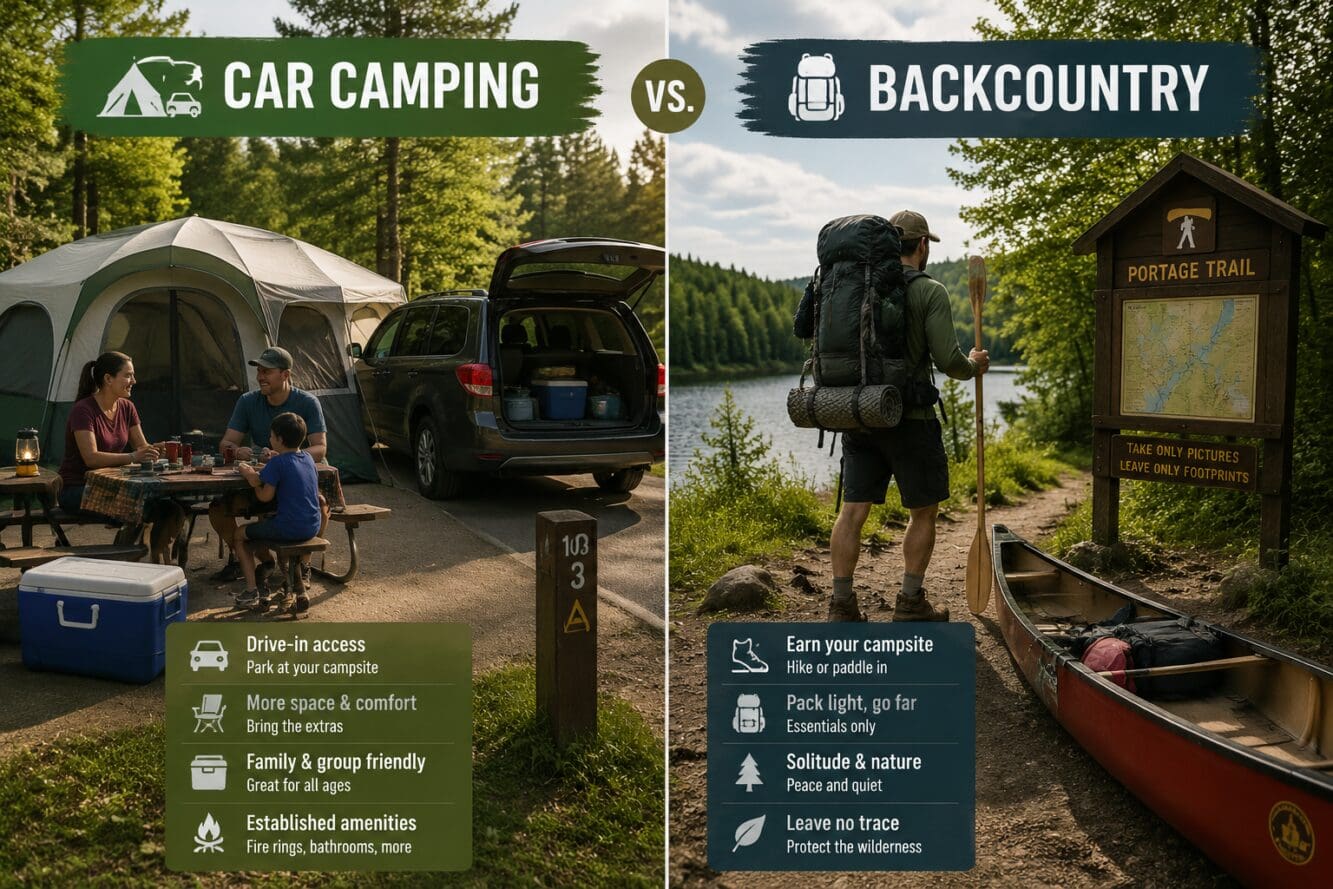
Car camping (frontcountry) is the right starting point for most beginners. Frontcountry sites along the Highway 60 corridor offer drive-in access, picnic tables, fire rings, and washroom facilities. Backcountry camping requires paddling or hiking to a permit site, carrying all gear, and managing food storage in bear country without any infrastructure.
Choose car camping if:
- This is your first or second camping trip
- You are traveling with children or older adults
- You want access to showers, flush toilets, or a camp store
- You have not yet practiced setting up a tent or cooking outdoors
Choose backcountry if:
- You are comfortable with map reading and basic paddling
- You want solitude and a true wilderness experience
- You have camped frontcountry at least twice before [2]
“The Highway 60 corridor campgrounds are the best entry point for anyone new to Algonquin. The infrastructure is there, but the wildlife and scenery are just as wild.” [6]
How to Make Reservations for Algonquin Park Camping
Reservations for Algonquin Park camping are made through Ontario Parks at ontarioparks.com. The system opens reservations up to five months in advance, so a July long weekend site can be booked as early as February [3].
Step-by-step booking process:
- Create a free Ontario Parks account at ontarioparks.com.
- Search for Algonquin Park and select your campground and dates.
- Filter by site type: electrical, non-electrical, or backcountry permit.
- Add the site to your cart and pay the reservation fee plus the nightly rate.
- Print or save your confirmation; you will need it at the gate.
For backcountry, purchase a backcountry permit separately through the same portal. Permits are site-specific and must be booked for each night [5].
Common mistake: Many first-timers book a site but forget to add the daily vehicle permit. The park charges a separate fee per vehicle per day, even for campers [3].
The 2026 operating season varies by campground. Whitefish Lake campground, for example, runs May 9 to October 12, 2026, while other campgrounds open on different dates. Always confirm your campground’s specific operating period before booking [5].
When Is the Best Time for Beginner Camping in Algonquin?
Late June, September, and early October are the best windows for first-time campers. Mid-May through early June brings blackfly season, when biting insects are at their worst and can make outdoor activities genuinely miserable for those unprepared [2].
| Period | Conditions | Crowd Level | Insects |
|---|---|---|---|
| Mid-May to early June | Cool, green | Low | Blackflies peak |
| Late June to August | Warm, busy | High | Mosquitoes, manageable |
| September | Crisp, fall color | Moderate | Minimal |
| Early October | Cold nights | Low | Almost none |
September is the single best month for beginners: insects are gone, crowds thin out, and the fall colours in Algonquin are exceptional. Nights drop to 5-10 degrees Celsius, so a three-season sleeping bag rated to 0°C is essential [4].
If visiting the broader Southern Georgian Bay region around the same trip, note that shoulder-season conditions apply across the entire area.
What Gear Do Beginners Need for Algonquin Park Camping?

The core gear list for Algonquin Park camping for beginners covers shelter, sleep, cooking, safety, and navigation. Overpacking is a common mistake; the list below covers what actually matters [4][7].
Essential gear checklist:
- Shelter: Three-season tent with a full rainfly (Algonquin weather changes fast)
- Sleep system: Sleeping bag rated to 0°C, sleeping pad (R-value 2 or higher)
- Clothing: Moisture-wicking base layer, fleece mid-layer, waterproof shell, warm hat
- Food and cooking: Camp stove, fuel canister, cookpot, biodegradable soap, bear hang bag or approved bear canister
- Navigation: Printed park map plus a compass (cell service is unreliable in most of the park)
- Safety: First aid kit, headlamp with extra batteries, whistle, fire-starting kit
- Water: Water filter or purification tablets; tap water is available at frontcountry sites
- Sun and insects: Sunscreen, DEET-based insect repellent, head net for blackfly season
For gear rentals and local supplies near the park, the South Georgian Bay area has several outfitters worth checking before departure.
A 2-3 Day First-Timer Itinerary for Algonquin Park
A focused 2-3 night trip along the Highway 60 corridor gives beginners enough time to experience Algonquin without logistical overload [2][8].
Day 1 (Arrival)
- Arrive before 2:00 PM to claim your site and set up camp in daylight.
- Walk the Beaver Pond Trail (18 km round trip, easy) near the west gate.
- Cook a simple camp dinner; practice fire-building in the fire ring.
Day 2 (Full Day)
- Morning: Paddle a rented canoe on Canoe Lake or Smoke Lake. Rentals are available from outfitters near the park entrance.
- Afternoon: Visit the Algonquin Visitor Centre on Highway 60 for wildlife exhibits and trail maps.
- Evening: Attend a ranger-led interpretive program if one is scheduled (check the park bulletin board on arrival).
Day 3 (Departure)
- Pack out all waste; follow Leave No Trace principles.
- Hike the Lookout Trail (1.9 km loop) for a panoramic view before heading home.
This itinerary works for solo campers, couples, and families with older children [8].
What Are the Rules and Fees Beginners Must Know?
Algonquin Park has clear rules that first-timers must follow to avoid fines and protect the ecosystem [3][6].
Key rules:
- Quiet hours run from 11:00 PM to 7:00 AM at all campgrounds.
- Firewood must be purchased locally; bringing wood from outside the park risks spreading invasive species.
- All food, garbage, and scented items must be stored in a vehicle or bear-proof container when not in use.
- Pets are allowed but must be leashed at all times.
- Swimming is permitted but there are no lifeguards at any beach.
2026 fee estimates (verify current rates at ontarioparks.com):
- Daily vehicle permit: approximately $22 CAD per day
- Frontcountry campsite: $42-$55 CAD per night depending on site type
- Backcountry permit: approximately $12 CAD per person per night
FAQ
Do I need a reservation, or can I walk in?
Walk-in sites exist but are extremely limited in summer. Booking online through Ontario Parks is strongly recommended, especially for July and August weekends [5].
Is Algonquin Park safe for solo beginners?
Yes, with preparation. Tell someone your itinerary, carry a map, and stick to frontcountry sites on a first solo trip. Wildlife encounters are common but rarely dangerous if food is stored correctly [2].
Can I bring my dog to Algonquin?
Yes. Dogs are permitted on leash throughout the park, including campgrounds and most trails. They are not permitted in the interior on some designated routes [6].
What should I do if I see a bear?
Stay calm, do not run, make yourself appear large, and back away slowly. Never approach or feed wildlife. Report the encounter to park staff [7].
Is cell service available in the park?
Coverage is unreliable and often absent in most of the park interior. Download offline maps before arrival and carry a printed map as backup [4].
How far in advance should I book for a summer weekend?
Book 4-5 months ahead for July and August long weekends. Reservations open five months in advance on Ontario Parks [3][5].
Are there showers at Algonquin campgrounds?
Some frontcountry campgrounds have shower facilities; others offer only flush or pit toilets. Check the specific campground listing on Ontario Parks before booking [3].
Can beginners do backcountry camping on their first trip?
It is possible but not recommended without prior frontcountry experience. Backcountry requires portaging, bear food storage, and navigation skills that take practice to develop safely [7].
Conclusion
Algonquin Park camping for beginners is genuinely accessible when the planning is done in the right order. Start with a frontcountry site along the Highway 60 corridor, book through Ontario Parks at least four months before a summer visit, and target late June or September to avoid the worst of the insects and the peak-season crowds.
Actionable next steps:
- Create an Ontario Parks account today and check availability for your target dates.
- Build your gear list from the checklist above and identify what you already own versus what needs to be rented or bought.
- Plan a 2-night itinerary using the framework above, then add one activity per day.
- Read the park’s official camping rules at algonquinpark.on.ca before arrival.
The park rewards preparation. First-timers who arrive with a booked site, the right gear, and a basic plan almost always leave wanting to come back.
References
[1] Algonquin Provincial Park – https://northernontario.travel/outdoor-adventures/algonquin-provincial-park
[2] Beginners Guide To Camping In Algonquin Park – https://www.fourcornersalgonquin.ca/post/beginners-guide-to-camping-in-algonquin-park
[3] Algonquin – https://www.ontarioparks.ca/park/algonquin
[4] Algonquin Park Camping – https://www.ecoflow.com/ca/blog/algonquin-park-camping
[5] Campground Reservations And Availability – https://www.algonquinpark.on.ca/visit/camping/campground-reservations-and-availability.php
[6] Camping – https://www.algonquinpark.on.ca/visit/camping/
[7] Beginners Guide To Backcountry Camping In Algonquin – https://www.parksbloggerontario.com/beginners-guide-to-backcountry-camping-in-algonquin/
[8] Good Algonquin Camping Spots – https://www.reddit.com/r/algonquinpark/comments/1py59m4/good_algonquin_camping_spots/
Content, illustrations, and third-party video appearing on GEORGIANBAYNEWS.COM may be generated or curated with AI assistance or reproduced pursuant to the fair dealing provisions of the Copyright Act, R.S.C. 1985, c. C-42. Attribution and hyperlinks to original sources are provided in acknowledgment of applicable intellectual property rights. Such referencing is intended to direct traffic to and support the original rights holders’ platforms.
Much Appreciate You Sharing This Post - It Helps MUCH!!!