





















Automatic Line Calling Comes to Pro Pickleball: Inside Owl AI’s Tech and What It Means for the Sport

Last updated: May 17, 2026
Quick Answer
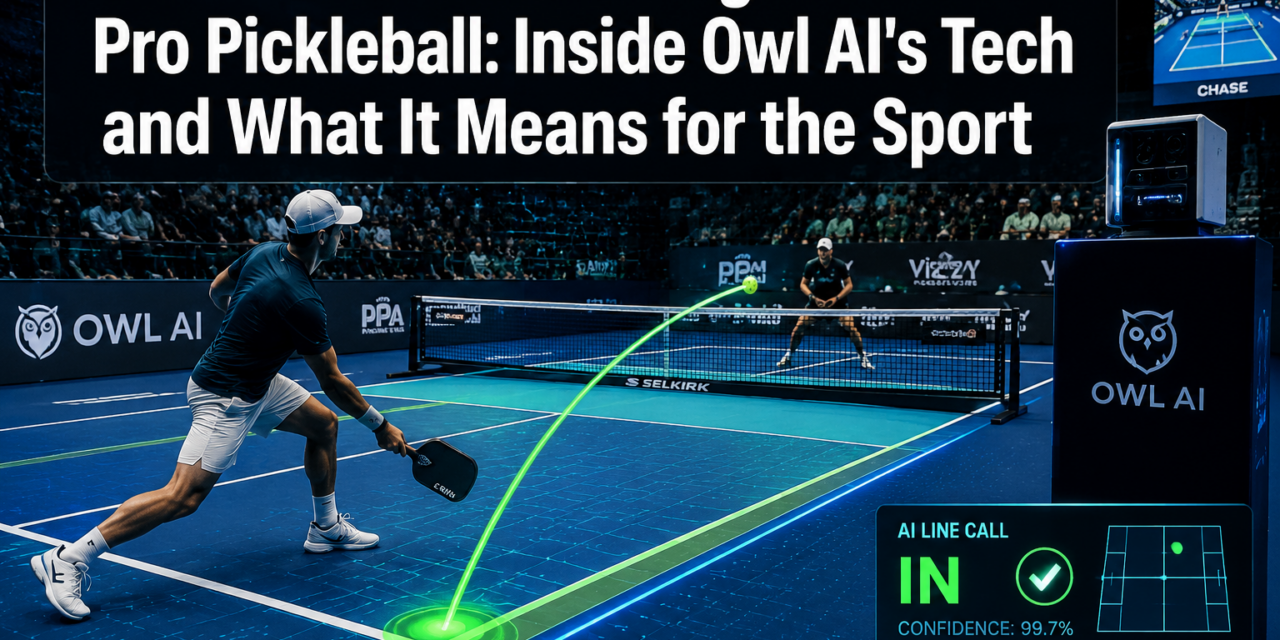
Major League Pickleball (MLP) partnered with Owl AI in December 2025 to introduce automatic line calling powered by AI technology, debuting at the March 2026 Greater Zion Cup and rolling out across the entire 2026 MLP season [1][3]. The system uses computer vision and generative AI running on existing broadcast cameras—no extra hardware required—to make instant line calls and power video challenges, marking the first full-league adoption of AI officiating in professional pickleball.
Key Takeaways
- MLP announced its partnership with Owl AI on December 4, 2025, making it the first pro pickleball league to adopt AI-powered automatic line calling [1][3]
- The technology debuted in March 2026 at the Carvana PPA Tour’s Greater Zion Cup in Utah, then became standard for all MLP matches starting May 2026 [2]
- Owl AI’s system requires zero additional hardware—it runs entirely in software using existing broadcast cameras or even 4K smartphones [4][5]
- The AI processes video at millisecond-level precision to determine whether balls land in or out, eliminating disputed line calls [6]
- MLP joined Owl’s “Trailblazer Program”, positioning the league as an early adopter of sports officiating technology [3]
- The system also powers video challenges, allowing players and officials to review calls instantly during matches [1]
- Cost advantages are significant compared to traditional hardware-heavy systems like Hawk-Eye, which require specialized cameras and sensors [5][6]
- Recreational and club play could eventually adopt similar technology as the software becomes more accessible and affordable
What Is Owl AI’s Automatic Line Calling System and How Does It Work?
Owl AI’s automatic line calling system is a software-based officiating tool that uses computer vision and artificial intelligence to determine whether a pickleball lands in or out on the court. Unlike traditional electronic line-calling systems that require expensive hardware installations, Owl AI runs entirely in software using existing video feeds from broadcast cameras or high-quality smartphones [4][5].

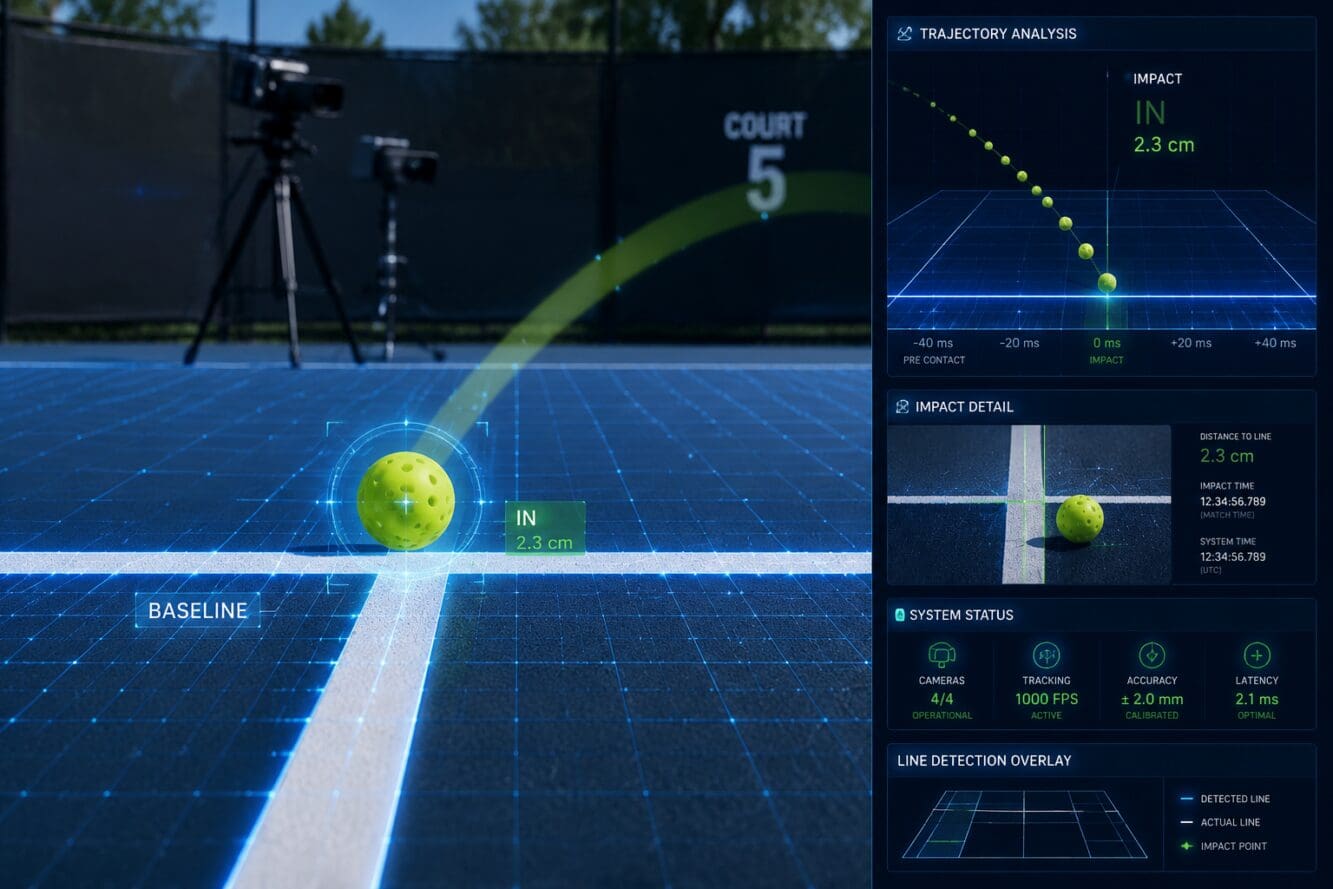
The technology works by:
- Analyzing video frames in real-time using computer vision algorithms trained on thousands of pickleball matches
- Tracking ball trajectory and court boundaries with millisecond-level precision to pinpoint exact landing spots
- Generating instant decisions that can be displayed on scoreboards or communicated to officials immediately
- Operating on standard cameras without in-ground sensors, laser systems, or proprietary camera rigs [5]
Choose this system if: You’re running professional tournaments with existing broadcast infrastructure and need cost-effective, accurate line calling without major equipment investments.
Common mistake: Assuming AI line calling requires the same expensive hardware setup as tennis systems like Hawk-Eye. Owl AI specifically designed its platform to eliminate those barriers [6].
When Did Automatic Line Calling Come to Pro Pickleball?
Automatic line calling officially came to professional pickleball in March 2026, when Owl AI’s system debuted at the Carvana PPA Tour’s Greater Zion Cup in Zion, Utah [2]. This marked the first live use of AI-powered line calling in a professional pickleball tournament.
The rollout timeline unfolded as follows:
- December 4, 2025 – MLP announced partnership with Owl AI and joined the Trailblazer Program [1][3]
- March 2026 – System debuts at Greater Zion Cup (Carvana PPA Tour event) [2]
- Late May 2026 – Full implementation begins across all MLP regular season matches [2]
- Throughout 2026 – Technology becomes standard for MLP competitions
MLP’s decision to adopt this technology represents a significant shift in professional pickleball officiating, moving away from human line judges for critical calls and embracing AI-assisted accuracy [3].
Why Did Major League Pickleball Partner with Owl AI?
MLP partnered with Owl AI to eliminate disputed line calls, improve match fairness, and enhance the viewing experience for fans watching broadcasts. The partnership addresses one of the most controversial aspects of competitive pickleball—close line calls that can determine match outcomes and frustrate players [1][3].
Key reasons for the partnership:
- Accuracy improvements – AI eliminates human error on close calls that occur at high speeds
- Cost efficiency – Software-only approach costs a fraction of traditional systems [5][6]
- Fan engagement – Instant replays and visual confirmations make broadcasts more compelling
- Player confidence – Objective technology reduces arguments and maintains competitive integrity
- Innovation leadership – MLP positions itself as a forward-thinking league embracing sports tech [3]
Josh Gwyther, CEO of Owl AI, emphasized that the partnership allows MLP to “streamline line calls and video challenges” while maintaining the fast pace that makes pickleball exciting to watch [7].
Edge case: Some players and purists may resist technology replacing human officials, preferring the traditional “honor system” approach common in recreational play. However, at the professional level where prize money and rankings are at stake, objective accuracy typically outweighs tradition.
How Does Owl AI Compare to Other Line-Calling Technologies?
Owl AI differs fundamentally from established systems like Hawk-Eye (used in tennis) and PlaySight (used in some racket sports facilities) because it operates entirely in software without requiring specialized hardware installations [5][6].
FeatureOwl AIHawk-EyePlaySightHardware RequiredNone (uses existing cameras)10+ high-speed cameras per courtMultiple fixed cameras + sensorsInstallation CostLow (software license)$60,000-$100,000+ per court$15,000-$30,000 per courtSetup TimeMinutes (software configuration)Days (hardware installation)Hours to daysPortabilityHigh (works with mobile cameras)Low (fixed installation)Medium (semi-permanent)Sports SupportedPickleball, tennis, padelTennis, cricket, soccerTennis, basketball, volleyball
Choose Owl AI if: You need flexible, cost-effective line calling that can be deployed across multiple venues without permanent installations.
Choose Hawk-Eye if: You’re running Grand Slam-level tennis tournaments with massive budgets and need the most established, proven technology.
Choose PlaySight if: You’re equipping a permanent training facility and want multi-sport video analysis beyond just line calling.
The software-based approach makes Owl AI particularly attractive for touring professional leagues like MLP that play in different venues throughout the season [2][3].
What Does Automatic Line Calling Mean for Professional Pickleball Players?
For professional players, automatic line calling means fewer disputed calls, more focus on gameplay, and potentially faster match resolution. Players can trust that close calls will be decided objectively rather than by human judgment, which becomes especially important in high-stakes situations [1].
Practical impacts for pros:
- Reduced arguments with officials – Objective technology settles disputes instantly
- Video challenge system – Players can request reviews of calls they believe were incorrect [1]
- Mental focus – Less energy spent questioning calls means more concentration on strategy
- Fair competition – All players benefit equally from consistent, accurate officiating
- Faster play – Instant decisions eliminate lengthy discussions that slow matches
Common concern: Some players worry that removing human officials changes the sport’s character. However, MLP’s implementation still includes referees for other rule enforcement—AI handles only line calls [3].
Decision rule: If you’re a player who frequently questions close calls, you’ll benefit most from this technology. If you rarely dispute calls, the impact on your game will be minimal beyond slightly faster match pace.
Will Automatic Line Calling Come to Recreational and Club Pickleball?
Automatic line calling will likely reach recreational and club-level pickleball within the next few years as the technology becomes more accessible and affordable. Owl AI’s software-based approach, which works with standard cameras including smartphones, creates a pathway for broader adoption beyond professional tournaments [4][5].
Potential adoption scenarios for rec play:
- High-end clubs and facilities (2026-2027) – Premium venues may install the system for league play and tournaments
- Regional tournaments (2027-2028) – Local competitions could use portable camera setups with Owl AI software
- Mobile app versions (2028+) – Simplified versions might allow players to use their own phones for casual line calling [5]
- Community leagues (2029+) – As costs decrease, organized recreational leagues may adopt the technology
Barriers to widespread recreational adoption:
- Cost of software licenses (even if lower than hardware systems)
- Need for quality video capture equipment
- Technical setup and calibration requirements
- Cultural preference for self-officiating in casual play
Reality check: Most casual pickleball will continue using the honor system where players call lines on their own side of the net. Technology adoption will focus first on competitive recreational play where disputes are more common and stakes are higher.
What Are the Potential Controversies Around AI Line Calling in Pickleball?
AI line calling in pickleball may spark controversies around technology dependence, accuracy concerns, cost barriers, and the changing nature of officiating. While the technology promises greater accuracy, any system can face skepticism during early adoption [6].
Potential controversy areas:
Accuracy questions – Players may dispute AI calls just as they disputed human calls, especially if the system makes rare errors or faces challenging lighting/weather conditions.
Technology failures – Software crashes, camera malfunctions, or connectivity issues during crucial points could create chaos and undermine confidence in the system.
Access inequality – If only top professional leagues can afford the technology, it creates a two-tier system where elite players benefit from better officiating than everyone else [5].
Loss of human element – Traditionalists argue that human officials are part of sports culture, and removing them changes the fundamental nature of competition.
Player adaptation – Some players may struggle to trust AI decisions, particularly those accustomed to reading line judges’ body language or questioning borderline calls [6].
Common mistake: Expecting AI to be perfect. Even the best systems have error rates, and transparent communication about accuracy levels (typically 95-99%) helps set realistic expectations.
Edge case: Outdoor tournaments with extreme sun glare, shadows, or weather conditions may challenge computer vision systems more than indoor controlled environments. Owl AI will need to prove its system handles these variables reliably.
How Much Does Owl AI’s Line Calling System Cost?
Owl AI has not publicly disclosed specific pricing for its line calling system, but industry analysis suggests it operates at “a fraction of the cost” of traditional hardware-based systems like Hawk-Eye, which can exceed $60,000-$100,000 per court installation [5][6]. The software-only approach eliminates major capital expenditures for specialized cameras and sensors.
Estimated cost factors:
- Software licensing fees – Likely subscription-based pricing per court or per event
- Camera equipment – Uses existing broadcast cameras or requires standard 4K cameras (not proprietary hardware) [4]
- Integration costs – Technical setup and calibration for each venue
- Support and maintenance – Ongoing software updates and technical assistance
For comparison:
- Traditional Hawk-Eye systems: $60,000-$100,000+ per court plus maintenance [5]
- PlaySight installations: $15,000-$30,000 per court [5]
- Owl AI (estimated): Likely $5,000-$15,000 annually per court for software licensing
Choose this investment if: You’re running professional tournaments where accurate line calling directly impacts competitive integrity and broadcast quality justifies the expense.
Not worth it if: You’re organizing casual recreational play where the honor system works fine and technology costs can’t be justified by the level of competition.
What Other Sports Use Similar AI Line Calling Technology?
Tennis, padel, and other racket sports are increasingly adopting AI-powered line calling systems similar to Owl AI’s approach. The trend toward automated officiating accelerated in 2024-2026 as computer vision technology improved and costs decreased [6].
Sports using AI line calling:
- Tennis – Electronic Line Calling (ELC) systems now used at ATP and WTA events, including some Grand Slams for qualifying rounds [6]
- Padel – Growing adoption in European professional tours [6]
- Table tennis – Experimental systems for edge calls at international competitions
- Volleyball – Video challenge systems with AI assistance for line calls and net violations
- Soccer – Goal-line technology and VAR (Video Assistant Referee) use similar computer vision principles
The broader trend shows professional sports embracing technology to improve officiating accuracy and reduce controversial calls that affect outcomes and fan experience [6].
Key difference: Owl AI’s software-only approach makes it more accessible than sport-specific hardware systems, potentially accelerating adoption across multiple racket sports simultaneously [4][5].
Conclusion: The Future of Line Calling in Pickleball
Automatic line calling comes to pro pickleball through MLP’s partnership with Owl AI, bringing AI-powered accuracy to one of the sport’s most controversial aspects—disputed line calls. The technology’s March 2026 debut at the Greater Zion Cup and subsequent rollout across the entire MLP season represents a turning point in professional pickleball officiating, eliminating human error on close calls while maintaining the sport’s fast pace and excitement [1][2][3].
The software-based approach, which requires no specialized hardware beyond existing broadcast cameras, makes this technology more accessible and affordable than traditional systems used in tennis and other sports [4][5]. As Owl AI proves its accuracy and reliability throughout the 2026 season, expect other professional pickleball tours to adopt similar systems, followed eventually by high-level recreational tournaments and premium club facilities.
Next steps for different audiences:
If you’re a professional player: Familiarize yourself with how video challenges work under the new system and adjust your mental approach to trust objective technology over arguing calls.
If you’re a tournament director: Contact Owl AI to learn about pilot programs and pricing for your events, especially if you already have broadcast infrastructure in place.
If you’re a club owner or facility manager: Monitor the technology’s performance throughout 2026 to assess whether it makes sense for your competitive leagues and tournaments in 2027-2028.
If you’re a recreational player: Continue using the honor system for casual play, but expect to encounter AI line calling at higher-level tournaments within the next few years.
The arrival of automatic line calling in pro pickleball doesn’t just improve accuracy—it signals the sport’s maturation and its embrace of technology that enhances fairness, speeds up play, and creates better experiences for players and fans alike.
FAQ
When will automatic line calling be used in Major League Pickleball?
Automatic line calling debuted in March 2026 at the Greater Zion Cup and became standard across all MLP matches starting with the regular season in late May 2026 [2].
Does Owl AI’s system require special cameras or equipment?
No. Owl AI runs entirely in software using existing broadcast cameras or standard 4K cameras, requiring no specialized hardware, sensors, or proprietary equipment [4][5].
How accurate is AI line calling compared to human officials?
While Owl AI hasn’t published specific accuracy rates, computer vision systems typically achieve 95-99% accuracy, significantly better than human line judges on high-speed calls [6].
Can players challenge AI line calls?
Yes. MLP’s partnership with Owl AI includes a video challenge system that allows players to request reviews of calls they believe were incorrect [1].
Will recreational pickleball use automatic line calling?
Eventually, yes—but likely not until 2027-2028 for high-level club play and regional tournaments. Casual recreational play will continue using the honor system for the foreseeable future [5].
What happens if the AI system fails during a match?
MLP has not publicly detailed backup procedures, but standard practice in sports technology is to revert to human officials if systems malfunction during competition.
How much does Owl AI’s line calling system cost?
Owl AI hasn’t disclosed specific pricing, but industry estimates suggest it costs significantly less than traditional systems like Hawk-Eye ($60,000-$100,000+ per court), likely in the range of $5,000-$15,000 annually per court [5][6].
Does automatic line calling work outdoors in all weather conditions?
Computer vision systems can face challenges with extreme sun glare, shadows, or weather conditions. Owl AI will need to demonstrate reliability across various outdoor tournament environments throughout 2026.
What other pickleball tours besides MLP will use this technology?
As of early 2026, MLP is the first full-league adopter. The Carvana PPA Tour hosted the debut event in March 2026, suggesting potential broader adoption across professional pickleball tours [2].
Can I use Owl AI for my local pickleball club?
Contact Owl AI directly to inquire about availability and pricing for club-level installations. The technology is currently focused on professional tournaments but may expand to recreational facilities in future years.
Does AI line calling replace all referees in pickleball?
No. AI handles only line calls. Human referees remain responsible for other rule enforcement, including faults, lets, timeouts, and conduct violations [3].
How fast does the AI make line call decisions?
Owl AI processes video at millisecond-level precision, providing near-instantaneous decisions that don’t disrupt the flow of play [4][6].
References
[1] Mlp Announces Partnership With Owl Ai To Streamline Line Calls And Video Challenges – https://pickleball.com/news/mlp-announces-partnership-with-owl-ai-to-streamline-line-calls-and-video-challenges
[2] Major League Pickleball Owl Ai Automatic Line Calls – https://thekitchenpickle.com/blogs/news/major-league-pickleball-owl-ai-automatic-line-calls
[3] Major League Pickleball Announces Partnership With Sports Tech Company Owl Ai – https://majorleaguepickleball.co/news/major-league-pickleball-announces-partnership-with-sports-tech-company-owl-ai/
[4] Owl Al Owlai Majorleaguepickleball Sportstech Activity 7450235263504658432 X1yv – https://www.linkedin.com/posts/owl-al_owlai-majorleaguepickleball-sportstech-activity-7450235263504658432-x1YV
[5] Pickleball Line Calling Technology – https://empowerpickleball.com/pickleball-line-calling-technology/
[6] Ai Referees Revolutionizing Racket Sports How Tennis Padel And Pickleball Are Ditching Human Officials In 2026 – https://rallyracket.com/ai-referees-revolutionizing-racket-sports-how-tennis-padel-and-pickleball-are-ditching-human-officials-in-2026/
Content, illustrations, and third-party video appearing on GEORGIANBAYNEWS.COM may be generated or curated with AI assistance or reproduced pursuant to the fair dealing provisions of the Copyright Act, R.S.C. 1985, c. C-42. Attribution and hyperlinks to original sources are provided in acknowledgment of applicable intellectual property rights. Such referencing is intended to direct traffic to and support the original rights holders’ platforms.
Much Appreciate You Sharing This Post - It Helps MUCH!!!