



















Canadian Skies Are About to See the Full Moon Known as the Strawberry Moon
Last updated: June 26, 2026
Quick Answer
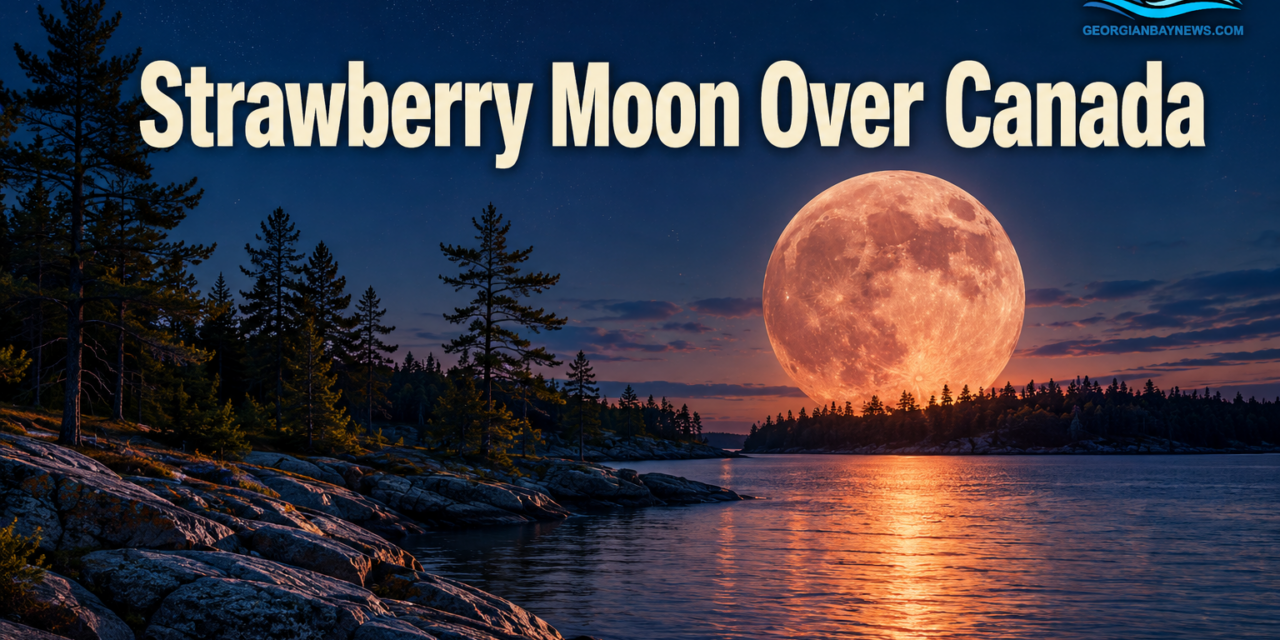
The Strawberry Moon is June’s full moon, named by Algonquin peoples for the short wild strawberry harvest that coincides with it. In 2026, it reaches peak fullness on the night of Tuesday, June 30, becoming visible across Canada shortly after sunset in the southeastern sky. Look low on the horizon for a warm amber or pinkish glow — it’s one of the lowest, most colourful full moons of the year.
Key Takeaways
- The 2026 Strawberry Moon peaks on June 30, 2026, but appears nearly full on June 29 and July 1.
- Best viewing across Canada is from moonrise (roughly 9:00–9:45 p.m. local time) through midnight.
- Its reddish-pink tint comes from looking through more of Earth’s atmosphere near the horizon — not from its name.
- No telescope needed. A clear southeastern view and dark surroundings are enough.
- Indigenous names for this moon vary widely across Canada and carry deep cultural meaning.
- The next Strawberry Moon after 2026 is June 19, 2027.
)
What Is the Strawberry Moon and Why Is It Called That?
The Strawberry Moon is the traditional name for the full moon that occurs in June. The name comes from the Algonquin, Ojibwe, and Dakota peoples, who used it to mark the brief wild strawberry harvest in late spring and early summer across northeastern North America.
It has nothing to do with the moon’s colour. Other historical names include the Blooming Moon, Hatching Moon, and Birth Moon, depending on the nation and region. European traditions sometimes called it the Rose Moon or Honey Moon, again tied to seasonal cycles rather than appearance.
When Is the Strawberry Moon Visible From Canada in 2026?
In Canada, the 2026 Strawberry Moon reaches peak illumination at approximately 7:57 a.m. EDT on June 30, meaning the best viewing happens the night of June 29 into June 30, and again the evening of June 30. It will look essentially full for three nights.
Approximate moonrise times (June 30, 2026):
| City | Moonrise (local time) |
|---|---|
| Halifax, NS | 9:18 p.m. ADT |
| Toronto, ON | 9:12 p.m. EDT |
| Ottawa, ON | 9:09 p.m. EDT |
| Winnipeg, MB | 9:42 p.m. CDT |
| Calgary, AB | 9:57 p.m. MDT |
| Vancouver, BC | 9:44 p.m. PDT |
Check a local almanac for exact times in your town.
What Time Should You Look for the Strawberry Moon Tonight?
Look east within 15 minutes of moonrise. The moon will be largest-looking and most colourful when it’s still close to the horizon. By midnight it climbs higher, shrinks visually, and turns silvery-white.
The lower the moon sits, the redder it looks. That’s atmosphere doing the work — not magic.
Why Does the Strawberry Moon Look Red or Pink?
Near the horizon, moonlight passes through more of Earth’s atmosphere. Blue and green wavelengths scatter away, leaving the warmer reds, oranges, and pinks to reach your eyes. The same effect makes sunsets glow.
Because June’s full moon rides unusually low across the southern sky (the sun is high, so the opposite full moon is low), it spends more hours near the horizon than most full moons. That extends the colourful window.
How to Photograph the Strawberry Moon With a Phone
A direct phone shot usually produces a tiny white blob. Use these steps for better results:
- Tap and hold on the moon in your camera app to lock focus and exposure.
- Drag the exposure slider down until the moon’s surface detail appears.
- Turn off flash and HDR.
- Use 2x or 3x optical zoom — avoid digital zoom past that.
- Brace the phone against a railing, tripod, or post.
- Include foreground: a tree line, lighthouse, dock, or skyline adds scale and story.
Night mode helps for landscape framing but can overexpose the moon itself. Shoot both.
Strawberry Moon vs Other Full Moons: What’s the Difference?
Every full moon has a traditional name tied to the season. The Strawberry Moon stands out for three reasons:
- It rides the lowest arc of any full moon of the year in the Northern Hemisphere.
- It often appears warmer in colour because of that low angle.
- It signals the official arrival of summer, falling near the solstice.
It is not larger or brighter than other full moons, despite popular claims. A “supermoon” requires the full moon to coincide with lunar perigee — the 2026 Strawberry Moon is not a supermoon.
Best Location in Canada to See the Strawberry Moon
Anywhere with a low, unobstructed view to the southeast works. Standout spots include:
- Georgian Bay shoreline — open water, dark skies, dramatic horizons. See coverage on southern Georgian Bay communities for vantage points.
- Bruce Peninsula and Tobermory — minimal light pollution.
- Prairie horizons in Saskatchewan and Manitoba — flat sightlines for hundreds of kilometres.
- East-facing Atlantic beaches in Nova Scotia and PEI.
- Mountain valleys in BC and Alberta — wait until the moon clears the peaks.
For more lunar coverage from across the region, browse our Strawberry Moon archive.
Is the Strawberry Moon Actually Bigger Than Other Moons?
No. The moon’s size in the sky barely changes month to month. What you’re seeing is the moon illusion — a well-documented optical trick where the brain perceives the moon as larger when it’s near the horizon next to trees and buildings.
Hold a pencil eraser at arm’s length next to a “huge” moonrise, then again two hours later when it’s high overhead. The size is identical.
Strawberry Moon Mythology, History, and Indigenous Meaning
Across Turtle Island, June’s full moon carries names tied to plants, animals, and ceremony. The Anishinaabe call it Ode’imini-giizis (Strawberry Moon). The Cree name it Opâskowipîsim (Egg Hatching Moon). The Mi’kmaq call it Nipniku’s (Trees Fully Leafed Moon).
For many Indigenous communities, strawberries (the “heart berry”) symbolize forgiveness, reconciliation, and the renewal of relationships. Strawberry ceremonies still take place across Canada at this time of year.
Will Clouds Block the Strawberry Moon in My Area?
Check Environment and Climate Change Canada (weather.gc.ca) or a clear-sky chart 24–48 hours ahead. If your local forecast shows heavy cloud, drive 30–60 minutes inland or toward a different lake. June weather is variable, so the night before or after peak is often a backup.
What if You Miss the Strawberry Moon? When’s the Next One?
If clouds, work, or sleep get in the way, the moon will still look about 97% full on July 1, 2026. The next true Strawberry Moon is June 19, 2027. The next full moon of any kind after June 30, 2026, is the Buck Moon on July 29, 2026.
Do You Need Special Equipment to View the Strawberry Moon Safely?
No. Unlike the sun, the moon is completely safe to view with the naked eye. Binoculars (7×50 or 10×50) reveal craters along the terminator — though at full moon the surface is mostly washed out. A small telescope shows more detail a few nights before or after full.
Strawberry Moon Superstition and Folklore
Folklore attributes a range of effects to June’s full moon: heightened emotions, restless sleep, romantic energy, and the start of “honeymoon” season (the name may trace to mid-summer weddings and mead). Modern astrology has popularized claims about energy shifts, but no peer-reviewed evidence supports lunar effects on human behaviour or sleep beyond brighter light exposure.
How Long Will the Strawberry Moon Be Visible?
The moon will be visibly full for roughly three nights (June 29, 30, and July 1) and above the horizon for about 8–9 hours each night across most of Canada, setting in the southwest before sunrise.
Conclusion
The 2026 Strawberry Moon is a low, warm, slow-moving full moon worth stepping outside for. Mark June 30 on your calendar, scout an east-facing spot before dusk, and arrive at moonrise. Bring a phone, a chair, and maybe a thermos. If the weather cooperates, you’ll see one of the most colourful full moons of the year — and join a tradition of moon-watching that stretches back thousands of years on this land.
For more sky and seasonal coverage, explore stories on Canada’s space projects, Starlink across rural Canada, and solar energy trends.
FAQ
Is the 2026 Strawberry Moon a supermoon?
No. It does not coincide with lunar perigee in 2026.
What direction should I look?
Southeast at moonrise, then south through midnight, setting in the southwest.
Can I see it from a city?
Yes. Light pollution doesn’t dim the moon itself. Find a clear east-facing view.
Why is it sometimes called the Honey Moon?
European tradition tied the name to the colour and to mid-summer weddings.
Will it actually look pink?
Warm amber to rose-pink near the horizon, fading to white as it rises.
Is it safe for kids to watch?
Completely. No eye protection needed at any time.
Does the Strawberry Moon affect tides?
Like every full moon, it produces slightly stronger spring tides.
Best app to track it?
Stellarium, SkySafari, or the free Stellarium Web work well.
Sources
- The Old Farmer’s Almanac, “Full Moon Names” (2024) — almanac.com
- NASA Science, “Moon Phases” (2024) — science.nasa.gov/moon
- Royal Astronomical Society of Canada, Observer’s Handbook (2025)
- Environment and Climate Change Canada — weather.gc.ca
- Anishinabek Nation, “Thirteen Moons Teachings” (2023)
Content, illustrations, and third-party video appearing on GEORGIANBAYNEWS.COM may be generated or curated with AI assistance or reproduced pursuant to the fair dealing provisions of the Copyright Act, R.S.C. 1985, c. C-42. Attribution and hyperlinks to original sources are provided in acknowledgment of applicable intellectual property rights. Such referencing is intended to direct traffic to and support the original rights holders’ platforms.