














Chinese Consulate’s Alleged Interference in Vancouver Arts Show: Exclusive Details, Diplomatic Fallout, and Free Speech Concerns
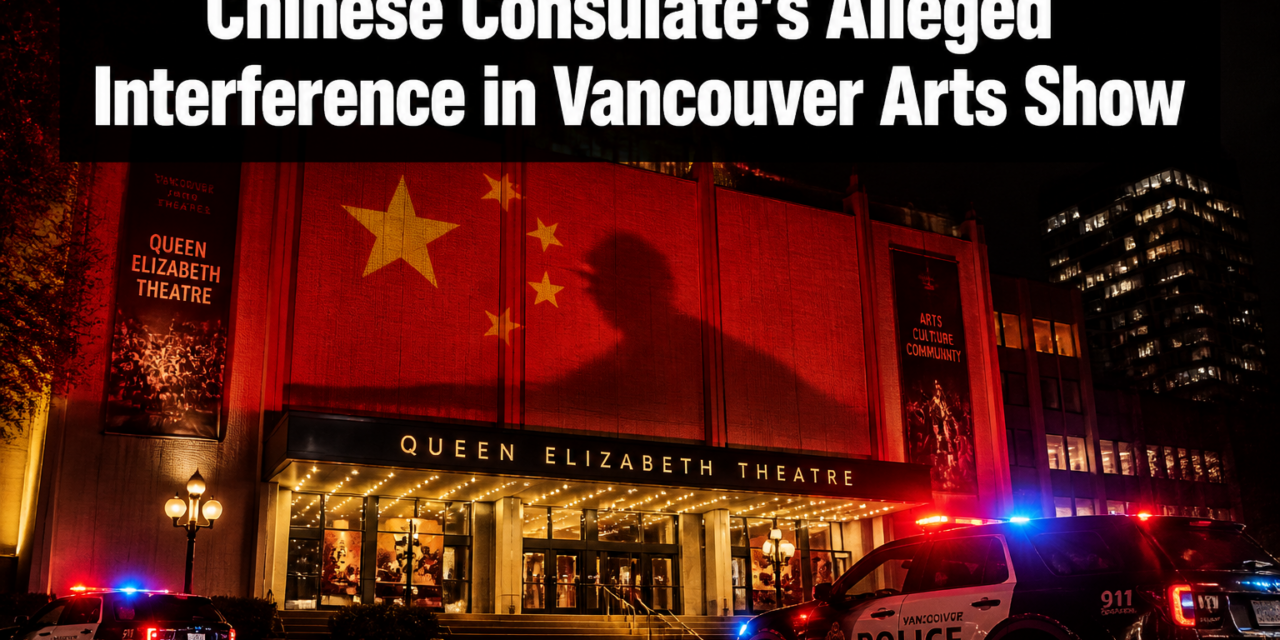
On April 3, 2026, six sold-out performances of Shen Yun—a traditional Chinese dance production—were cancelled in Toronto after a bomb threat. It marked the first time in the show’s global touring history that such threats successfully shut down a performance [3]. Just days later, the same show opened in Vancouver under police protection and completed all five scheduled performances, defying what organizers call a systematic campaign of intimidation orchestrated by Beijing [2]. The Chinese Consulate’s alleged interference in Vancouver arts show: exclusive details, diplomatic fallout, and free speech concerns have since dominated national headlines, raising urgent questions about foreign influence on Canadian soil and the limits of artistic freedom in a democracy.
Key Takeaways
- 🎭 Shen Yun completed all 5 Vancouver performances (April 8–12, 2026) at the Queen Elizabeth Theatre despite receiving two separate bomb threats [2].
- 🚨 Over 150 similar threats have targeted Shen Yun globally in the past two years, with investigators tracing origins to China [2].
- 🇨🇦 Toronto’s cancellation sparked national outrage, with Canadian lawmakers condemning what they called transnational repression [3].
- 📧 Threatening emails were traced to a user in China, with one sender boasting of CCP connections [2].
- 🏛️ Multiple Canadian venues have declined to host Shen Yun in 2026, citing various concerns beyond the bomb threats [1].
The Timeline: How the Chinese Consulate’s Alleged Interference in Vancouver Arts Show Unfolded
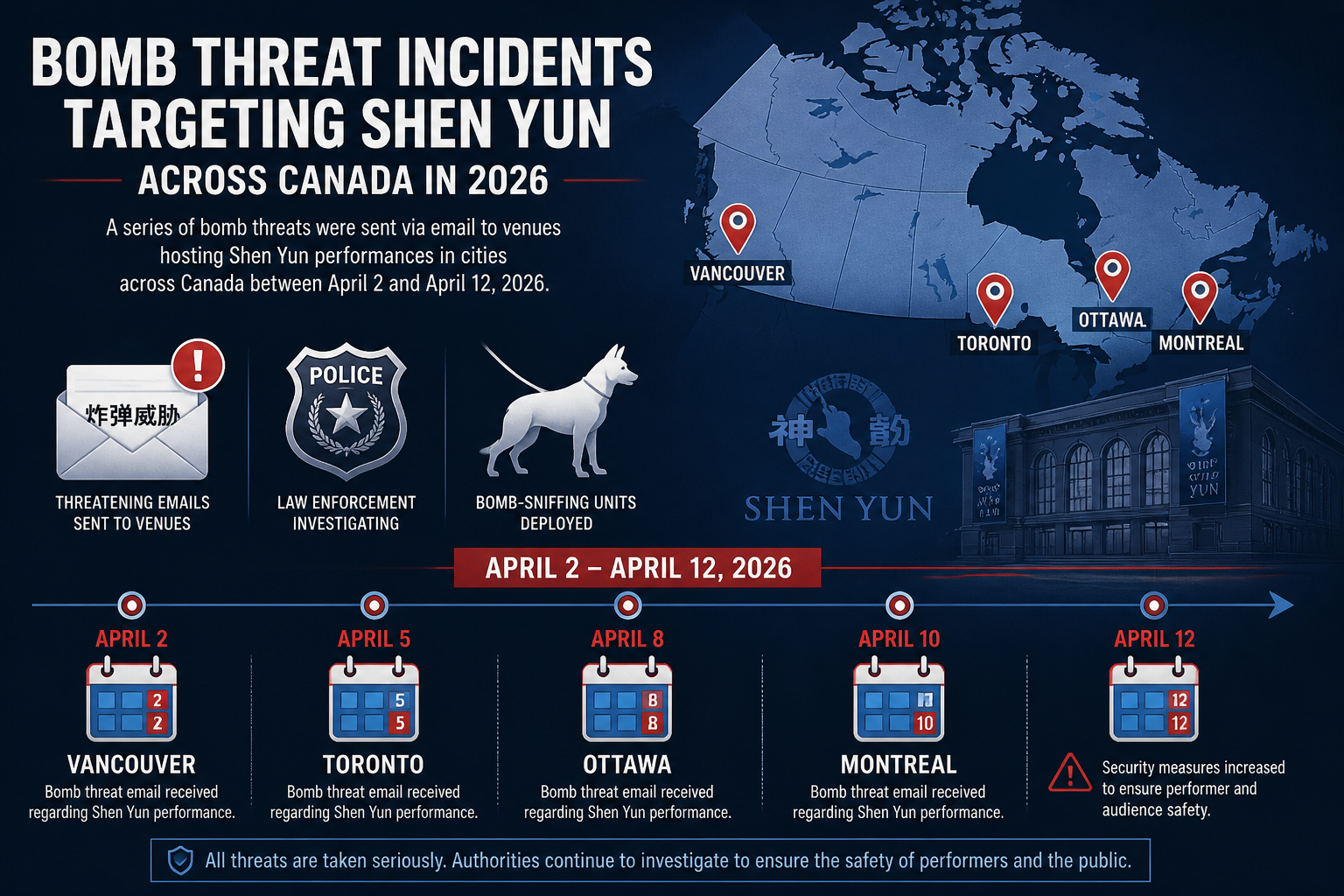
The sequence of events that brought the Chinese Consulate’s alleged interference in Vancouver arts show: exclusive details, diplomatic fallout, and free speech concerns into public view began with an emailed bomb threat received by Vancouver Civic Theatres on April 2, 2026 [2].
The First Threat
The email, translated from Chinese, claimed that a “large quantity” of explosives would be detonated if Shen Yun performances proceeded at the Queen Elizabeth Theatre [2]. Vancouver Police Department immediately launched an investigation, deploying a bomb-sniffing dog to sweep the premises. No traces of explosives were found, and police confirmed the threat was “unfounded” [2].
The Second Threat
A follow-up threatening email arrived on April 6, 2026, just two days before the first scheduled performance. It followed the same pattern as threats received at other venues across Canada and internationally [2].
The Connection to China
Investigators traced a phone number associated with the threatening email to a user based in China [2]. This finding aligned with earlier investigations by Taiwanese authorities, who had traced similar threat emails to Xi’an, China, with digital origins appearing near the Huawei Research Institute [2].
💬 “A sender of threatening emails boasted in Chinese about CCP links and claimed ‘victory’ for cancelling Toronto performances.” — NTD News report [2]
Vancouver’s Decision to Proceed
Unlike Toronto, Vancouver authorities chose to increase security rather than cancel the shows. The result: five successful performances completed without incident between April 8 and 12, 2026 [2].
The Broader Pattern: Over 150 Threats and Counting
The Vancouver incident did not occur in isolation. According to Shen Yun’s organizers, more than 150 similar threats have been issued against the production over the past two years [2]. This pattern suggests a coordinated campaign rather than isolated acts of intimidation.
| Location | Outcome | Year |
|---|---|---|
| Vancouver, Canada | 5 shows completed | 2026 |
| Toronto, Canada | 6 shows cancelled | 2026 |
| Ottawa, Canada | Venue declined to host | 2026 |
| Montreal, Canada | Venue declined to host | 2026 |
| Seoul, South Korea | Embassy pressured theatre | Prior years |
The Chinese Embassy has previously applied direct pressure on venues internationally. In Seoul, South Korea, the embassy contacted a theatre directly in an attempt to cancel Shen Yun performances [4]. This tactic—combining official diplomatic pressure with anonymous threats—represents what security analysts describe as a multi-pronged interference strategy.
Diplomatic Fallout: Canadian Lawmakers Respond
The cancellation in Toronto and the threats against Vancouver performances triggered a strong political response. Canadian lawmakers condemned the incidents, with concerns raised over artistic freedom and foreign interference on Canadian soil [3].
The controversy arrives amid heightened awareness of Beijing’s influence operations in Canada. Parliamentary committees have spent years examining allegations of Chinese government interference in Canadian elections, academic institutions, and community organizations. The targeting of cultural events represents what many see as a new frontier in transnational repression.
Key Political Reactions
- Parliamentary condemnation of threats against artistic performances [3]
- Calls for stronger enforcement of foreign interference laws
- Demands for diplomatic consequences against Chinese officials
- Renewed scrutiny of consular activities across Canada
The diplomatic fallout extends beyond rhetoric. Canada’s evolving foreign interference framework—including the Foreign Interference Registry—may now face pressure to address cultural and artistic intimidation specifically.
Free Speech and Artistic Freedom Under Threat
At its core, this controversy raises fundamental questions about free expression in democratic societies. Shen Yun, produced by Falun Gong practitioners, presents traditional Chinese culture and includes content critical of the Chinese Communist Party. Beijing has long opposed the production, viewing it as political propaganda.
However, the use of bomb threats to silence artistic expression crosses a clear line. Whether one agrees with Shen Yun’s messaging or not, the principle at stake is straightforward: no foreign government should have the power to determine what art Canadians can see.
The Chilling Effect on Venues
The threat campaign appears to be achieving partial success through a chilling effect on Canadian venues:
- 🏛️ The National Arts Centre in Ottawa announced it will not host Shen Yun in 2026, citing concerns about contract breaches and potential human rights complaints related to alleged mistreatment of audience members with disabilities [1].
- 🏛️ Place des Arts in Montreal is also not hosting Shen Yun in 2026 [1].
While these venues cite reasons unrelated to bomb threats, the broader context of intimidation creates an environment where declining to host the show becomes easier to justify. Critics argue this represents exactly the outcome Beijing seeks—cancellation by any means.
International Context: Beijing’s Global Influence Tactics
The Chinese Consulate’s alleged interference in Vancouver arts show: exclusive details, diplomatic fallout, and free speech concerns mirror patterns observed worldwide. Beijing’s approach to silencing overseas critics typically involves:
- Direct diplomatic pressure — Contacting venues, sponsors, and government officials [4]
- Anonymous threats — Bomb threats, harassment campaigns, and intimidation
- Community mobilization — Organizing protests through diaspora organizations
- Economic leverage — Threatening business relationships with China
- Legal complaints — Filing regulatory or human rights complaints to create administrative burdens
The Shen Yun case demonstrates how these tactics can be combined simultaneously to maximize pressure on democratic institutions.
What Happens Next: Implications for Cultural Events in Canada
The events of April 2026 have set a precedent—both positive and negative. Vancouver’s decision to proceed with enhanced security demonstrates that threats can be resisted. Toronto’s cancellation shows that they can also succeed.
Steps Forward
For Canadian institutions and policymakers, several actions could address the vulnerability:
- Standardized threat protocols — Ensuring venues have clear guidelines that don’t default to cancellation
- Government security support — Providing police resources so venues don’t bear the full cost of threat response
- Diplomatic accountability — Formally raising the issue with Chinese officials
- Public transparency — Informing audiences about threats so they can make informed decisions
- Legal consequences — Pursuing international cooperation to prosecute threat-makers
Conclusion
The Chinese Consulate’s alleged interference in Vancouver arts show represents more than a dispute over one performance. It tests whether democratic nations can protect artistic freedom against sustained, state-backed intimidation campaigns. Vancouver’s successful completion of all five Shen Yun performances proves that resistance is possible—but only when authorities treat threats seriously without surrendering to them.
Canadian citizens, lawmakers, and cultural institutions must now decide: Will the country establish clear protections for artistic expression against foreign interference, or will the chilling effect gradually narrow what Canadians are permitted to see on their own stages? The answer will shape not just the future of one dance show, but the boundaries of free expression in Canada for years to come.
Actionable next steps for readers:
- Contact local representatives to express support for artistic freedom protections
- Stay informed about foreign interference legislation developments
- Support venues that resist intimidation by attending performances
- Report suspicious threats or interference attempts to law enforcement
References
[1] Watch – https://www.youtube.com/watch?v=ysvcLPL__Nk
[2] Shen Yun Stages 5 Successful Shows In Vancouver Despite Hoax Bomb Threat 1139002 – https://www.ntd.com/shen-yun-stages-5-successful-shows-in-vancouver-despite-hoax-bomb-threat_1139002.html
[3] Watch – https://www.youtube.com/watch?v=2Xsi8xRm2mU
[4] Chinese Embassy Pressures Seoul Theater – https://www.shenyun.org/blog/view/article/e/ZYpBhUCrEx4/chinese-embassy-pressures-seoul-theater.html
[5] Bomb Threats Target Shen Yun In Canada Raising Alarm Over Foreign Interference – https://www.visiontimes.com/2026/04/01/bomb-threats-target-shen-yun-in-canada-raising-alarm-over-foreign-interference.html
Content, illustrations, and third-party video appearing on GEORGIANBAYNEWS.COM may be generated or curated with AI assistance or reproduced pursuant to the fair dealing provisions of the Copyright Act, R.S.C. 1985, c. C-42. Attribution and hyperlinks to original sources are provided in acknowledgment of applicable intellectual property rights. Such referencing is intended to direct traffic to and support the original rights holders’ platforms.
Content, illustrations, and third-party video appearing on GEORGIANBAYNEWS.COM may be generated or curated with AI assistance or reproduced pursuant to the fair dealing provisions of the Copyright Act, R.S.C. 1985, c. C-42. Attribution and hyperlinks to original sources are provided in acknowledgment of applicable intellectual property rights. Such referencing is intended to direct traffic to and support the original rights holders’ platforms.