
























Edible Microgreens from Top 2026 Yield Crops: Nutrient-Packed Beet, Radish, and Pea Shoots for Indoor Canadian Kitchens


Last updated: May 13, 2026
Quick Answer: Beet, radish, and pea shoot microgreens are among the highest-yield, fastest-growing crops Canadian home growers can produce indoors year-round. These three varieties dominate 2026 market demand because they germinate reliably in low-light conditions, reach harvest in 7–14 days, and deliver concentrated nutrients at a fraction of retail cost. For Canadian kitchens facing long winters and rising grocery prices, they’re a practical, high-return growing choice.
Key Takeaways
🌱 The Canadian microgreens market reached USD 152.4 million in 2023 and is projected to hit USD 356.0 million by 2030, growing at 12.9% CAGR [2]
🥗 Pea shoots (Foxy Pea variety), Radish Red Rambo, and red beet microgreens are confirmed top-sellers in 2026 for yield, flavor, and chef demand [4]
❄️ Canadian winters make indoor growing essential — these three crops thrive under basic LED grow lights with no outdoor space needed
💰 Retail microgreens sell for $4.49–$6.00 per small tray at Canadian specialty stores [3]; home-grown batches cost a fraction of that
🌿 Grow mats (hemp or jute) outperform soil for indoor kitchen setups — less mess, better drainage, and reusable options available
📅 Beet takes 10–14 days to harvest; radish 6–10 days; pea shoots 10–14 days — all manageable within a Canadian weekly meal routine
🍽️ All three varieties have strong culinary applications: beet adds earthy sweetness, radish delivers sharp heat, pea shoots offer mild sweetness
♻️ Staggered planting (one tray every 3–4 days) ensures continuous harvest through winter months
🏪 Established Canadian producers like GoodLeaf Farms and Goldfarm Canada confirm sustained culinary-sector demand for these specific varieties [8]
Why Beet, Radish, and Pea Shoots Lead the 2026 Yield Crop Rankings
These three microgreen varieties lead 2026 indoor growing rankings because they combine fast germination, high nutrient density, and consistent market demand. For Canadian home growers, that means reliable results without specialized equipment.
What makes them stand out:
VarietyDays to HarvestFlavor ProfileKey NutrientsBeet (Red)10–14 daysEarthy, slightly sweetFolate, iron, vitamin CRadish Red Rambo6–10 daysPeppery, sharpVitamin C, calcium, antioxidantsPea Shoots (Foxy)10–14 daysSweet, mild, freshVitamin A, C, folate, protein
Industry data confirms pea microgreens (specifically Foxy Pea), Radish Red Rambo, and red beet varieties are among the top-performing crops in 2026, selected for fast growth, strong visual appeal, and high yield [4]. For Canadian kitchens, these traits translate directly to practical value: shorter wait times, better flavors, and more food per tray.
“Pea, radish, and beet microgreens have maintained their position as top sellers from 2025 into 2026, demonstrating reliable market demand and consistent yield performance.” [4]
How to Set Up an Indoor Microgreen Growing Station for Canadian Winters

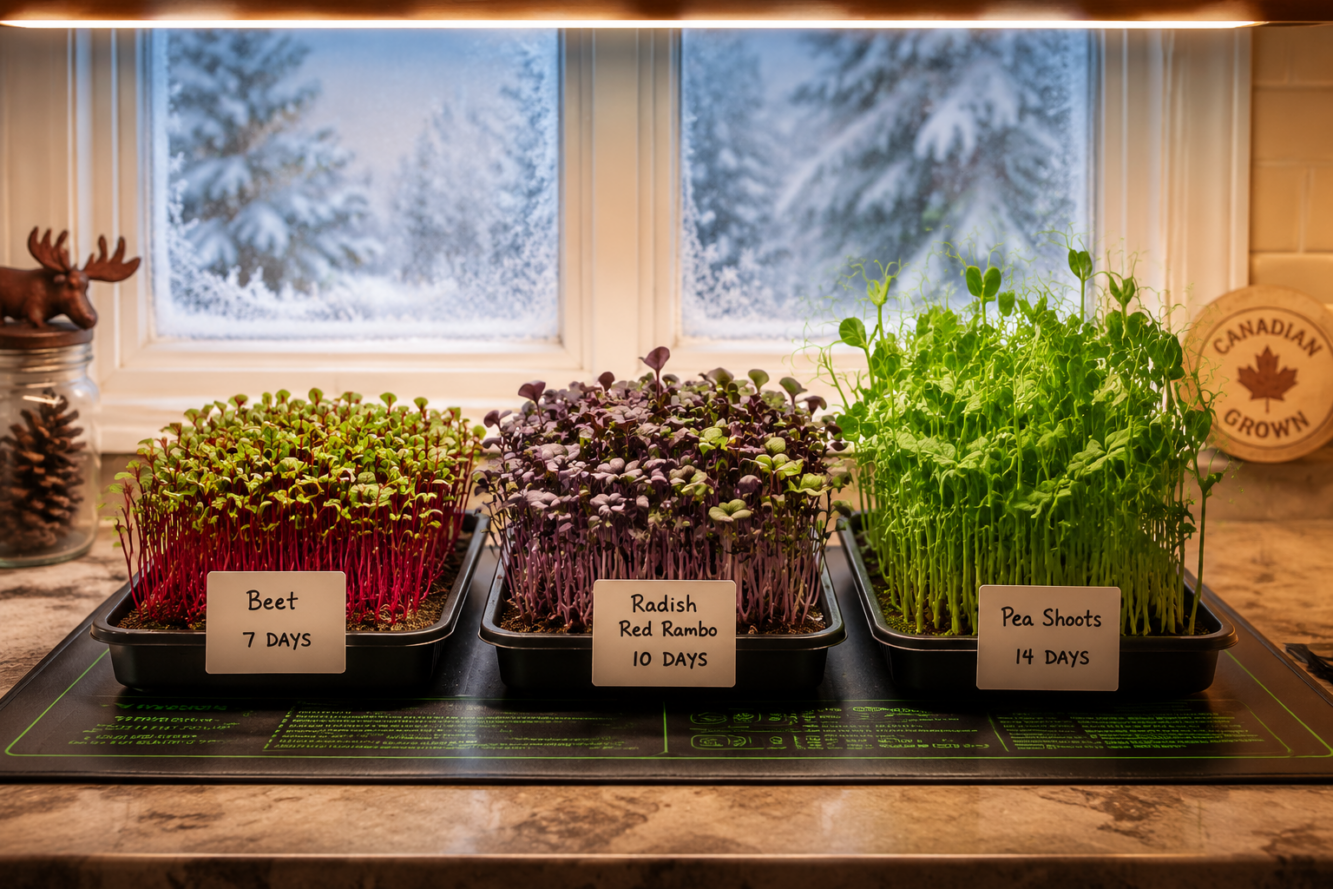
Canadian winters present a real challenge: low natural light, dry indoor air, and limited counter space. The good news is that beet, radish, and pea shoot microgreens don’t need much of any of it.
Basic setup checklist:
Trays: Standard 10×20-inch shallow trays (with and without drainage holes)
Growing medium: Hemp or jute grow mats for clean, soil-free indoor use
Light: A basic LED grow light (2,000–3,000 lux) for 12–16 hours daily — a sunny south-facing window works in spring but rarely in a Canadian January
Seeds: Source from Canadian suppliers for freshness and germination rates
Water: Mist twice daily; bottom-watering works best for beet and radish to prevent mold
Temperature: 18–22°C is ideal — standard Canadian home heating covers this easily
Common mistake: Overwatering is the top reason microgreen trays fail indoors. Beet seeds in particular are prone to mold if the grow mat stays saturated. Mist lightly; don’t soak.
For Canadians interested in sustainable food production, microgreens also connect to broader biodiversity and local food system conversations that matter in 2026.
What Are the Real Nutritional Benefits of These Three Varieties?
Microgreens from beet, radish, and pea shoots are genuinely more nutrient-dense than their mature counterparts — this isn’t marketing language. Research has shown that microgreens can contain significantly higher concentrations of vitamins and antioxidants than full-grown vegetables, though exact multipliers vary by variety and growing conditions.
Nutritional highlights (per variety):
Beet microgreens: High in folate and betalain antioxidants; the deep red pigment signals strong antioxidant content
Radish microgreens: One of the highest vitamin C concentrations among common microgreen varieties; also contains glucosinolates linked to anti-inflammatory effects
Pea shoots: A notable plant-based protein source among microgreens; also rich in vitamins A and C
For Canadians relying more on indoor-grown food during winter months — when fresh produce costs rise and quality drops — these three crops offer meaningful nutritional return per tray. Specialty producers like Goldfarm Canada grow these varieties specifically for professional chefs who prioritize nutrient density [8].
Edible Microgreens from Top 2026 Yield Crops: How the Canadian Market Is Shaping Home Growing Trends
The commercial microgreens market in Canada is directly influencing what home growers choose to cultivate. The Canada microgreens market generated USD 152.4 million in 2023 and is projected to reach USD 356.0 million by 2030, growing at a CAGR of 12.9% [2]. That growth signals strong, sustained consumer appetite — and home growers are following the same variety preferences as commercial producers.
Key market players including GoodLeaf Farms, Gotham Greens, and Goldfarm Canada have built their product lines around beet, radish, and pea varieties precisely because these crops perform consistently for both commercial and small-scale indoor growers [1][8].
Retail pricing also makes the home-growing case compelling. Specialty retailers in Canada charge approximately $6 per 65–75 grams for red radish microgreens, while micro arugula runs $4.49 per 50 grams at mainstream grocery chains [3]. A single home tray can yield 100–200 grams for under $2 in seed and grow mat costs.
For Canadians looking to reduce grocery spending — a real concern given recent food price trends — growing edible microgreens from top 2026 yield crops like beet, radish, and pea shoots is one of the most cost-effective options available. This connects naturally to Canadian food and agriculture topics gaining attention in 2026.
Harvest Cycles, Staggered Planting, and Winter Kitchen Recipes
Continuous harvest through a Canadian winter requires staggered planting — starting a new tray every 3–4 days so that one tray is always ready to cut.
Suggested 2-week rotation (3 trays):
Day 1: Sow pea shoots (Foxy variety)
Day 4: Sow beet (red variety)
Day 7: Sow radish (Red Rambo)
Day 10–11: Harvest pea shoots; sow next pea tray
Day 14: Harvest beet; harvest radish
Winter kitchen recipe ideas:
Beet microgreens: Stir into warm lentil soup just before serving; fold into cream cheese on rye bread
Radish shoots: Top avocado toast for sharp contrast; mix into winter slaws with apple and cabbage
Pea shoots: Toss with sesame oil and garlic as a quick side; layer into grain bowls with roasted squash
Pea shoots pair especially well with warming winter dishes because their mild sweetness balances heavier flavors. Radish microgreens work as a natural heat-builder in cold-weather meals where fresh chili isn’t available. For Canadians exploring local berry picking and seasonal food traditions, microgreens fill the fresh-food gap during off-seasons.
FAQ
Q: How much space do I need to grow beet, radish, and pea microgreens indoors?
A single 10×20-inch tray fits on most kitchen counters or shelves. Three trays for a staggered rotation require roughly the space of a small cutting board area.
Q: Do microgreens need soil, or can I use grow mats?
Grow mats (hemp or jute) work well for all three varieties and are cleaner for indoor kitchens. Soil works too but increases mess and mold risk in humid Canadian winter homes.
Q: How long do harvested microgreens last in the fridge?
Most last 5–7 days when stored dry in a sealed container with a paper towel to absorb moisture. Pea shoots tend to wilt faster — use within 4–5 days.
Q: Are these microgreens safe to eat raw?
Yes. Beet, radish, and pea shoot microgreens are commonly eaten raw. Rinse gently before eating, especially if grown in soil.
Q: What’s the best light source for Canadian winter growing?
A basic LED grow light set to 12–16 hours daily is the most reliable option. South-facing windows can supplement but rarely provide enough light from November through February in most Canadian cities.
Q: Can children eat microgreens safely?
Yes, microgreens are safe for children. Pea shoots and beet microgreens have mild flavors that most kids accept more readily than radish, which is peppery.
Q: Where can I buy quality seeds in Canada?
Several Canadian seed suppliers specialize in microgreen varieties. Look for untreated, non-GMO seeds labeled specifically for sprouting or microgreen use.
Q: Is growing microgreens at home actually cheaper than buying them?
Yes, significantly. Retail prices run $4.49–$6.00 for 50–75 grams [3]. Home-grown trays cost under $2 in inputs and yield 100–200 grams per tray.
Conclusion
Edible microgreens from top 2026 yield crops — specifically beet, radish, and pea shoots — are one of the smartest additions a Canadian home grower can make to their indoor kitchen setup. They’re fast, affordable, nutritious, and well-matched to Canadian winter conditions.
Actionable next steps:
Start with radish — it’s the fastest to harvest (6–10 days) and the most forgiving for first-time growers
Buy a basic LED grow light before winter hits; don’t rely on window light alone
Set up a 3-tray staggered rotation so harvest is continuous rather than all-at-once
Track your cost per gram against retail prices to see your actual savings within the first month
Experiment with recipes — radish on avocado toast, beet in soups, pea shoots in grain bowls
The Canadian microgreens market is growing fast [2][1], but the best prices and freshest product will always come from a tray on your own counter.
References
[1] Canada Microgreens Market – https://www.alliedmarketresearch.com/press-release/canada-microgreens-market.html
[2] Canada Microgreens Market Outlook – https://www.grandviewresearch.com/horizon/outlook/microgreens-market/canada
[3] Microgreens Trend Is Sprouting But The Tiny Vegetables Won’t Solve The Food Crisis – https://capitalcurrent.ca/microgreens-trend-is-sprouting-but-the-tiny-vegetables-wont-solve-the-food-crisis/
[4] Microgreens Industry Expert Video – https://www.youtube.com/watch?v=Q3irFL2YG9w
[8] Goldfarm Canada – https://www.goldfarm.ca
Content, illustrations, and third-party video appearing on GEORGIANBAYNEWS.COM may be generated or curated with AI assistance or reproduced pursuant to the fair dealing provisions of the Copyright Act, R.S.C. 1985, c. C-42. Attribution and hyperlinks to original sources are provided in acknowledgment of applicable intellectual property rights. Such referencing is intended to direct traffic to and support the original rights holders’ platforms.
Much Appreciate You Sharing This Post - It Helps MUCH!!!