

















Enshittification by Cory Doctorow: Tech Critique Bestseller Dissecting Digital Decay in Canada


Last updated: February 24, 2026
Cory Doctorow’s Enshittification is the most precise diagnosis of why the internet feels broken, and it arrives at a moment when Canadian users, businesses, and policymakers are grappling with exactly the platform monopoly problems it describes. Published October 7, 2025, by Farrar, Straus and Giroux, Enshittification by Cory Doctorow: Tech Critique Bestseller Dissecting Digital Decay in Canada has quickly become essential reading for anyone who suspects that Facebook, Amazon, Google, and TikTok got worse on purpose. The Toronto-born author doesn’t just complain. He names the mechanism, traces it across industries far beyond tech, and offers concrete policy prescriptions, including a strategy for Canadian digital sovereignty he presented to federal leaders in Ottawa in January 2026 [5].
Key Takeaways
- “Enshittification” was named Word of the Year by the American Dialect Society (2023) and Macquarie Dictionary (2024), and is now listed by both Merriam-Webster and Dictionary.com [4].
- The book documents a three-stage decay cycle that applies to platforms like Facebook, Uber, Amazon, Google, and TikTok, but also extends to healthcare, automobiles, air travel, and streaming [1].
- Doctorow delivered a keynote in Ottawa on January 29, 2026, at the Digital Government Leaders Summit, outlining a strategy for Canada’s digital sovereignty [5].
- The book is being released in twelve countries, with strong Canadian distribution and relevance given Doctorow’s Toronto roots versobooks.com.
- Policy solutions are specific, not vague: break up monopolies, enforce interoperability, strengthen tech unions, and adopt European-style regulatory models [1].
- Dan Piepenbring of Harper’s Magazine called it “a masterly polemic, its scope so sweeping that it does, finally, seem to explain every pungent odor wafting from Silicon Valley” [3].
- The concept of “chickenisation” describes how platforms trap workers in debt-driven lock-in, a pattern visible in gig economy companies operating across Canada [1].
- Approximately 250 pages are devoted to defining and analyzing the mechanics of enshittification before the book turns to solutions [1].
Quick Answer
Enshittification by Cory Doctorow (352 pages, Farrar, Straus and Giroux, 2025) explains why tech platforms deliberately degrade their services over time and what citizens and governments can do about it. The book is especially relevant to Canadian readers because Doctorow, a Toronto-born activist and Electronic Frontier Foundation fellow, has directly engaged Canadian federal policymakers on digital sovereignty. It’s part tech history, part policy manual, and part call to action, covering platforms from Amazon to Uber and extending the analysis to non-tech sectors like healthcare and air travel.
What Is Enshittification and Why Does It Matter for Canadians?
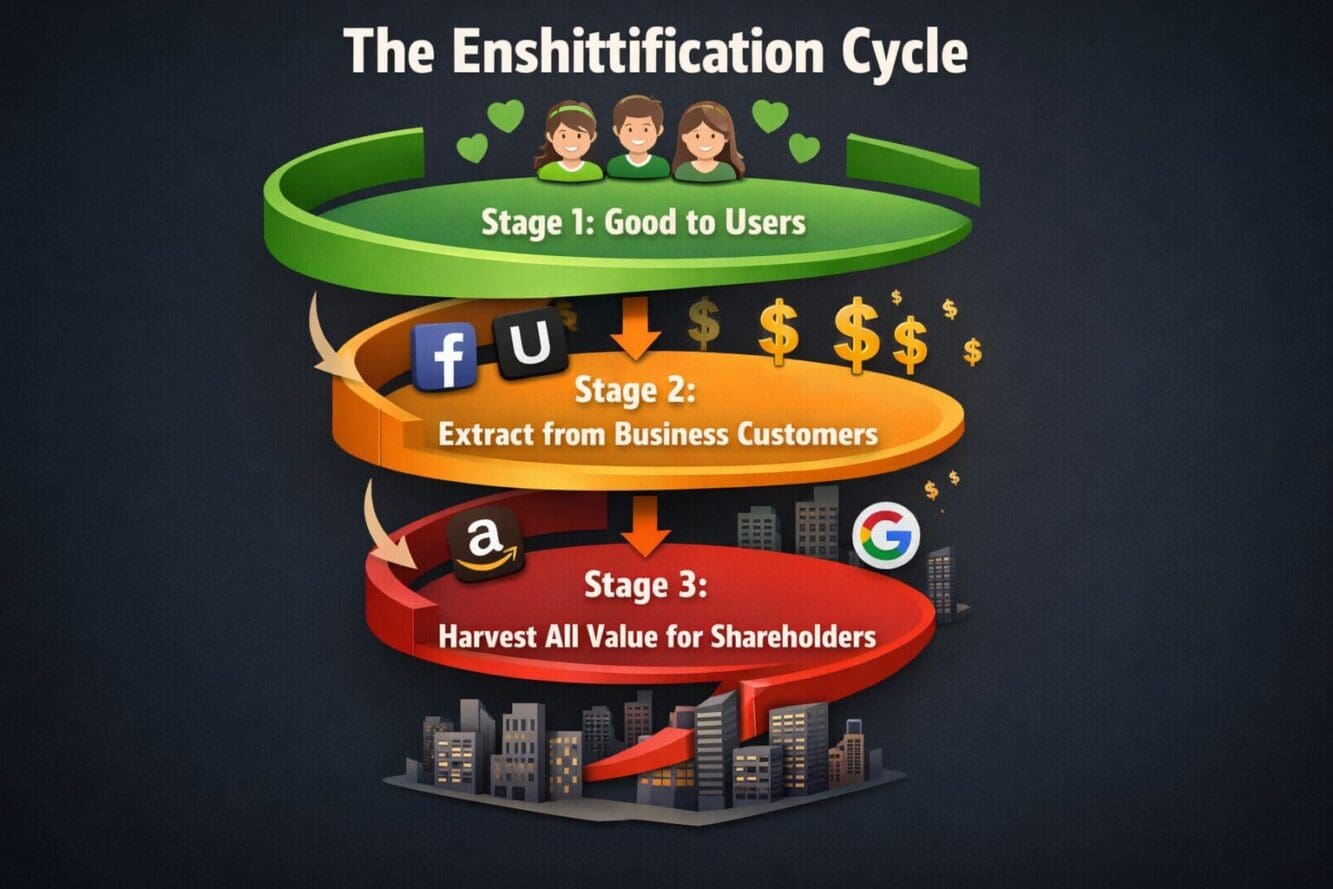
Enshittification is the specific, predictable process by which digital platforms decay. Doctorow coined the term in 2022, and it describes a three-stage cycle that Canadian users experience every day when they open Facebook, search Google, or order from Amazon.
The three stages work like this:
| Stage | What Happens | Example |
|---|---|---|
| Stage 1: Good to users | Platform spends investor money to attract users with genuinely useful, often free services | Facebook in 2006 promising never to spy on users us.macmillan.com |
| Stage 2: Extract from business customers | Once users are locked in, the platform degrades their experience to shift value to advertisers and sellers | YouTube showing more ads while paying creators less locusmag.com |
| Stage 3: Harvest everything for shareholders | Both users and business customers get squeezed so executives and shareholders capture all remaining value | Amazon customers paying more while sellers earn less locusmag.com |
For Canadians, this matters because the country’s digital economy is dominated by the same American platforms undergoing enshittification. Canadian small businesses selling on Amazon, Canadian drivers working for Uber, and Canadian creators posting on TikTok all face the same extraction cycle. The difference is that Canada has fewer regulatory tools in place than the European Union, which Doctorow points to as a proof of concept for effective intervention [1].
“Uber drivers who are more selective about which jobs they’re willing to take get paid more than their less-discriminating colleagues. This is a fully automated process.” — Cory Doctorow, describing algorithmic wage discrimination locusmag.com
The concept resonates beyond tech. Doctorow extends the analysis to medical costs, automobile quality, air travel degradation, the movie industry, home appliances, and streaming services [1]. If you’ve noticed your dishwasher breaking sooner, your streaming service raising prices while removing content, or your airline charging for carry-on bags, Doctorow argues these follow the same structural logic. For a deeper look at how capitalism and political systems shape these outcomes, the pattern becomes even clearer.
How Does Enshittification by Cory Doctorow: Tech Critique Bestseller Dissecting Digital Decay in Canada Explain Platform Monopolies?
The book’s central argument is that enshittification isn’t a bug or an accident. It’s the inevitable result of monopoly power combined with a technical capability Doctorow calls “twiddling.”
Twiddling is the ability of digital platforms to change prices, rankings, search results, and algorithmic recommendations from instant to instant, on a per-user basis locusmag.com. A brick-and-mortar store can’t charge different prices to every customer who walks through the door. But Amazon, Uber, and Google can and do adjust what each user sees and pays in real time.
Why monopoly is the key ingredient:
- Lock-in prevents switching. When all your friends are on Facebook, leaving means losing those connections. When your business depends on Amazon sales, you can’t just walk away.
- No meaningful competition. If Google degrades search results to show more ads, where do you go? Bing? Most Canadians don’t.
- Regulatory capture. Companies too big to fail become too big to regulate. They lobby against the very rules that would protect users.
Doctorow spends roughly 250 pages building this case with detailed examples before turning to solutions [1]. The depth matters because it equips readers to recognize the pattern in new contexts. Once you understand twiddling and lock-in, you can spot enshittification in Canadian telecom pricing, banking apps, and even provincial government service portals.
The related concept of “chickenisation” adds another layer. Named after the poultry industry’s practice of forcing farmers into debt by requiring them to buy specific equipment, chickenisation describes how platforms trap workers. Uber drivers who invest in vehicles, DoorDash couriers who buy insulated bags, Etsy sellers who build their entire business on one platform — all face debt-driven lock-in with autocratic wage control [1]. Canadian gig workers are particularly vulnerable, as the country’s gig economy regulations lag behind those of several European nations.
For those interested in how individuals have experienced platform exploitation firsthand, Doctorow’s analysis provides the structural framework behind those personal stories.
What Did Doctorow Tell Canadian Federal Leaders in Ottawa?
On January 29, 2026, Doctorow delivered the keynote address at the Digital Government Leaders Summit in Ottawa, an invitation-only event for federal ministry CIOs and CTOs [5]. His message was direct: Canada needs a strategy for digital sovereignty and tech sector resilience that doesn’t depend on the goodwill of American platform monopolies.
Key points from the Ottawa keynote:
- Post-American digital infrastructure. Doctorow argued that Canada cannot rely on U.S.-based platforms for critical digital services, especially as those platforms become increasingly enshittified and politically compromised.
- Interoperability mandates. Rather than building Canadian alternatives from scratch, Doctorow proposed requiring platforms to support interoperability, so Canadian users and businesses can move their data and connections to competing services.
- Regulatory models from Europe. The EU’s Digital Markets Act and Digital Services Act were cited as proof that regulation can work without destroying innovation.
- Tech worker protections. Doctorow emphasized that the workers inside tech companies are often the first to recognize harmful practices and the last to be protected when they speak up.
This keynote matters because it moved the enshittification conversation from cultural criticism to active policy discussion at the highest levels of Canadian government. The book provides the intellectual foundation, but the Ottawa address translated it into specific recommendations for a country that sits in the shadow of Silicon Valley’s monopolies.
The timing is significant. In early 2026, Canadian policymakers are debating digital regulation, AI governance, and platform accountability. Doctorow’s framework gives them a vocabulary and a diagnostic tool. For context on how wealth concentration and AI are reshaping power structures, the Ottawa keynote fits into a broader conversation about democratic control of technology.
Who Should Read This Book (and Who Might Not Need It)?

Read it if:
- You work in Canadian tech, digital marketing, or e-commerce and want to understand the structural forces degrading your industry.
- You’re a policymaker, civil servant, or municipal leader dealing with digital service procurement.
- You sell on Amazon, drive for Uber, or create content on YouTube or TikTok and want to understand why the deal keeps getting worse.
- You’re a general reader who’s frustrated by the internet and wants a clear explanation, not just a vague sense of decline.
- You’re interested in how AI is changing industries and want to understand the monopoly dynamics behind AI deployment.
You might skip it if:
- You’re already deeply familiar with Doctorow’s blog posts and Locus columns on enshittification — the book expands on those but covers similar ground.
- You’re looking for a purely technical manual on digital privacy or security. This is a political and economic analysis, not a how-to guide.
- You prefer short reads. At 352 pages, with 250 devoted to diagnosis before reaching solutions, it requires patience [1].
Common mistake: Some readers expect the book to be entirely about social media. It’s not. The analysis extends to healthcare costs, automobile quality, air travel, appliances, and the movie industry [1]. The breadth is a strength, but it means the social media sections are part of a much larger argument.
How Does the Book Compare to Other Tech Critiques?
| Feature | Enshittification (Doctorow, 2025) | The Age of Surveillance Capitalism (Zuboff, 2019) | Chokepoint Capitalism (Doctorow & Giblin, 2022) |
|---|---|---|---|
| Focus | Platform decay across all industries | Data extraction by tech companies | Creative worker exploitation |
| Tone | Sharp, funny, accessible | Academic, dense | Activist, practical |
| Solutions offered | Monopoly-breaking, interoperability, unions | Regulatory frameworks | Specific industry-by-industry fixes |
| Canadian relevance | High (Ottawa keynote, Canadian author) | Moderate | Moderate |
| Length | 352 pages | 691 pages | 384 pages |
| Readability | Grade 8–10 | Graduate level | Grade 10–12 |
Doctorow’s book is the most accessible of these three and the most directly connected to Canadian policy discussions. It also has the broadest scope, applying the enshittification framework to sectors that Zuboff and earlier Doctorow works didn’t cover.
What Are the Book’s Proposed Solutions?
Doctorow doesn’t just diagnose the problem. The final section of the book offers concrete policy ideas, and they’re more specific than the usual “regulate Big Tech” hand-waving.
Five core solutions:
Break up monopolies. Companies too big to fail, too big to jail, and too big to care must be broken into smaller, competing entities. This applies to Amazon, Google, Meta, and Apple.
Mandate interoperability. Force platforms to let users take their data, contacts, and content to competing services. If you could move your Facebook friends list to a new social network, Facebook’s lock-in would evaporate.
Strengthen tech unions. Workers inside these companies are the first line of defense against harmful practices. Protecting whistleblowers and organizing workers gives the public allies inside the machine.
Adopt European-style regulation. The EU’s Digital Markets Act proves that regulation can constrain platform power without killing the industry. Canada should learn from and build on these models [1].
End “chickenisation” of gig workers. Prohibit platforms from forcing workers into debt-driven lock-in. Require transparent, stable pricing for gig work rather than algorithmic wage discrimination.
These solutions are relevant to Canadian readers because several are already being debated in Parliament and provincial legislatures. The shift toward cleaner, more accountable systems isn’t limited to energy — it extends to digital infrastructure.
Where to Buy Enshittification by Cory Doctorow: Tech Critique Bestseller Dissecting Digital Decay in Canada
The book is available through multiple Canadian retailers:
- Hardcover (352 pages): Available at major Canadian bookstores, including Indigo/Chapters, independent bookshops, and online retailers. The Canadian edition is distributed by Verso Books versobooks.com.
- Audiobook: Available on major audiobook platforms.
- Independent bookstores: Support your local shop. Cedar Canoe Books lists the hardcover at $42.00 CAD cedarcanoebooks.com.
- ISBN: 9780374619329 [3].
The book is being released in twelve countries, so international editions are also available.
Excerpt: How Facebook’s Enshittification Began

The following passage from the book illustrates Doctorow’s style and the enshittification framework in action. It describes Facebook’s Stage 1 — the period when the platform was genuinely good to users:
“Back in 2006, Facebook made a simple and compelling pitch to those new users it was hoping to lure onto the platform: Sure, we understand that most of you already have a social media service that you enjoy using called MySpace. But has it occurred to you that MySpace is owned by an evil, crapulent, senescent Australian billionaire named Rupert Murdoch, and he spies on you with every hour that God sends? Come to Facebook, where we will never spy on you.” us.macmillan.com
That promise, of course, didn’t last. The book traces how Facebook systematically broke every commitment it made to users, shifting value first to advertisers and then to shareholders. Canadian users were part of this cycle from the beginning — Facebook expanded beyond American college students in 2006, and Canada was among the first countries to see mass adoption.
For readers interested in how corporate fraud operates at scale, the Facebook case study is a masterclass in institutional bait-and-switch.
Pros and Cons of the Book
Pros:
- Clear, funny writing that makes complex economic and technical concepts accessible
- Broadest scope of any tech critique — covers healthcare, cars, airlines, and more
- Concrete policy solutions, not just complaints
- Directly relevant to Canadian policy debates in 2026
- Longlisted for the Financial Times and Schroders Business Book of the Year 2025 versobooks.com
- Nominated for Goodreads Choice Award for Readers’ Favorite Nonfiction (2025) [1]
Cons:
- At 250 pages of diagnosis before reaching solutions, some readers may find the buildup slow [1]
- Readers already familiar with Doctorow’s blog and column writing will recognize recycled material
- The solutions section, while concrete, is shorter than the problem analysis
- Some reviewers note that the tone occasionally shifts from analytical to polemical
Frequently Asked Questions
What does “enshittification” mean?
Enshittification is the process by which digital platforms deliberately degrade their services over time. They start by being good to users, then extract value for business customers, then harvest everything for shareholders. Cory Doctorow coined the term in 2022 [4].
Is Cory Doctorow Canadian?
Yes. Doctorow was born in Toronto, Canada. He now lives in Los Angeles but maintains strong ties to Canada, including delivering the keynote at the 2026 Digital Government Leaders Summit in Ottawa [5].
How long is the book?
The hardcover edition is 352 pages, published by Farrar, Straus and Giroux on October 7, 2025 [3].
Does the book only cover social media?
No. While platforms like Facebook, TikTok, and Twitter are covered extensively, Doctorow extends the enshittification framework to medical costs, automobiles, air travel, the movie industry, appliances, and streaming services [1].
What is “twiddling” in the context of enshittification?
Twiddling is the technical ability of digital platforms to change prices, rankings, and algorithmic recommendations in real time, on a per-user basis. It’s the mechanism that makes enshittification possible locusmag.com.
What is “chickenisation”?
Chickenisation is a parallel exploitation mechanism where platforms force workers to purchase specific tools, training, or equipment, creating debt-driven lock-in with autocratic wage control. The term comes from the poultry industry [1].
Where can I buy the book in Canada?
The book is available at Indigo/Chapters, independent Canadian bookstores, and online. The Verso Books Canadian edition is priced at approximately $42.00 CAD for the hardcover cedarcanoebooks.com.
Has the book won any awards?
It was longlisted for the Financial Times and Schroders Business Book of the Year 2025 and nominated for the Goodreads Choice Award for Readers’ Favorite Nonfiction (2025) [1] versobooks.com.
What did Doctorow say at the Ottawa summit?
He argued that Canada needs a digital sovereignty strategy independent of American platform monopolies, including interoperability mandates and European-style regulation [5].
Is this book suitable for non-technical readers?
Yes. Doctorow writes at an accessible level with humor and clear examples. You don’t need a tech background to follow the argument.
How is this different from Doctorow’s earlier book Chokepoint Capitalism?
Chokepoint Capitalism (2022, co-authored with Rebecca Giblin) focused specifically on how creative workers are exploited. Enshittification is broader, covering all users and extending beyond tech into healthcare, transportation, and consumer goods.
Was the term “enshittification” really added to dictionaries?
Yes. Both Merriam-Webster and Dictionary.com have listed it as an official word, following its selection as Word of the Year by the American Dialect Society in 2023 and Macquarie Dictionary in 2024 [4].
Conclusion
Enshittification by Cory Doctorow is the clearest, most comprehensive explanation of why the internet — and much of the consumer economy — keeps getting worse. For Canadian readers, the book carries extra weight: Doctorow is a Toronto-born writer who has taken his analysis directly to Canadian federal policymakers, and the platform monopolies he describes dominate Canadian digital life just as thoroughly as they dominate American digital life.
Actionable next steps:
- Buy the book from a Canadian independent bookstore. The hardcover is available for approximately $42.00 CAD cedarcanoebooks.com.
- Learn the three-stage framework (good to users, extract from businesses, harvest for shareholders) and start applying it to the platforms and services you use daily.
- Support interoperability legislation in Canada. Contact your MP about digital platform regulation.
- Diversify your digital presence. If your business depends entirely on one platform (Amazon, Etsy, Instagram), Doctorow’s analysis is a warning to build alternatives now.
- Follow the policy conversation. Doctorow’s Ottawa keynote signals that Canadian federal leaders are listening. Stay informed about digital regulation proposals in Parliament.
The internet doesn’t have to stay broken. But fixing it requires understanding exactly how it was broken in the first place — and that’s what this book delivers.
References
[1] Enshittification – https://www.goodreads.com/book/show/222376640-enshittification
[3] Unabridged Bookstore – https://unabridgedbookstore.com/book/9780374619329
[4] The Enshittification Of Everything – https://zackarnold.substack.com/p/the-enshittification-of-everything
[5] Billionaire Solipsism – https://pluralistic.net/2026/01/19/billionaire-solipsism/
[6] Cory Doctorow Enshittification Why Everything Got Worse And What Do About It Book – https://www.wellerbookworks.com/event/2026-02-18/cory-doctorow-enshittification-why-everything-got-worse-and-what-do-about-it-book
Content, illustrations, and third-party video appearing on GEORGIANBAYNEWS.COM may be generated or curated with AI assistance or reproduced pursuant to the fair dealing provisions of the Copyright Act, R.S.C. 1985, c. C-42. Attribution and hyperlinks to original sources are provided in acknowledgment of applicable intellectual property rights. Such referencing is intended to direct traffic to and support the original rights holders’ platforms.
Much Appreciate You Sharing This Post - It Helps MUCH!!!