


















Five-Time Olympians: The Legendary Careers of Mackenzie Boyd-Clowes, Valérie Maltais, and Marie-Philip Poulin
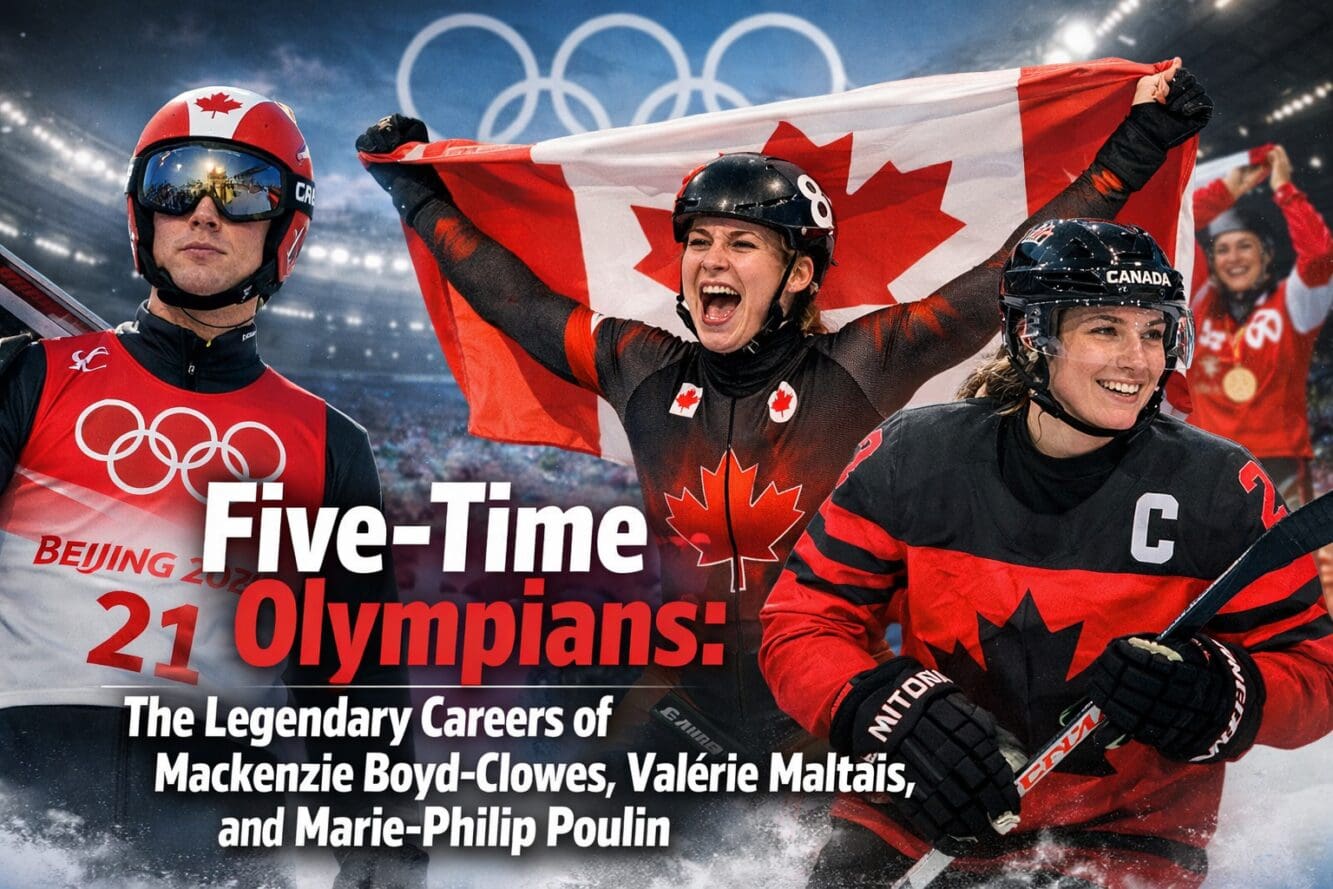
When most athletes dream of competing at the Olympic Games, reaching even one Winter Olympics represents the pinnacle of their career. But what does it take to compete at five consecutive Olympic Games across 16 years? In 2026, three remarkable Canadian athletes—Mackenzie Boyd-Clowes, Valérie Maltais, and Marie-Philip Poulin—are making history as they represent Canada at the Milano Cortina Winter Olympics, their fifth consecutive Games since Vancouver 2010. The legendary careers of these five-time Olympians showcase not just athletic excellence, but extraordinary dedication, resilience, and the ability to maintain elite performance across nearly two decades of competition.
These three athletes have witnessed the evolution of their sports, adapted to changing competition landscapes, and maintained the physical and mental fortitude required to compete at the highest level year after year. Their journeys through Vancouver 2010, Sochi 2014, PyeongChang 2018, Beijing 2022, and now Milano Cortina 2026 represent an unprecedented achievement in Winter Olympic competition[1][3].
Key Takeaways
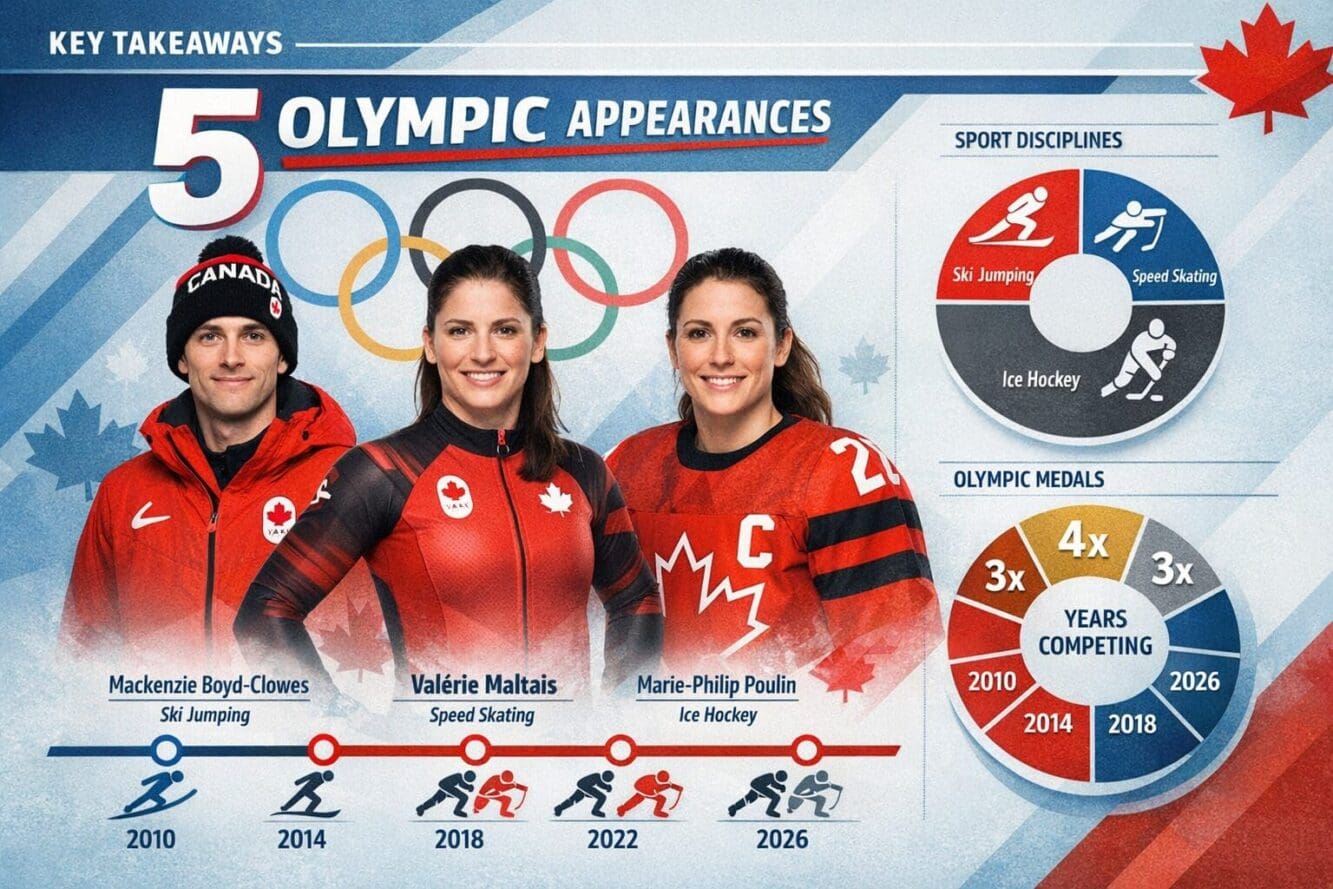
- 🏅 Historic Achievement: Mackenzie Boyd-Clowes, Valérie Maltais, and Marie-Philip Poulin are competing in their fifth consecutive Winter Olympics since 2010, representing 16 years of elite performance
- 🇨🇦 Medal Success: Both Poulin and Maltais are four-time Olympic medallists, with Poulin serving as a cornerstone of Canada’s dominant women’s hockey program[3]
- 🎿 Diverse Excellence: The three athletes compete in distinctly different disciplines—ski jumping, short track speed skating, and hockey—demonstrating Canadian winter sports depth
- 👥 Team Canada 2026: They’re part of a 207-athlete delegation that includes 47 Olympic medallists and features women outnumbering men for the first time in Winter Olympic history[3][4]
- 💪 Longevity Formula: Their sustained success reveals the importance of adaptation, injury management, mental resilience, and evolving training methodologies across multiple Olympic cycles
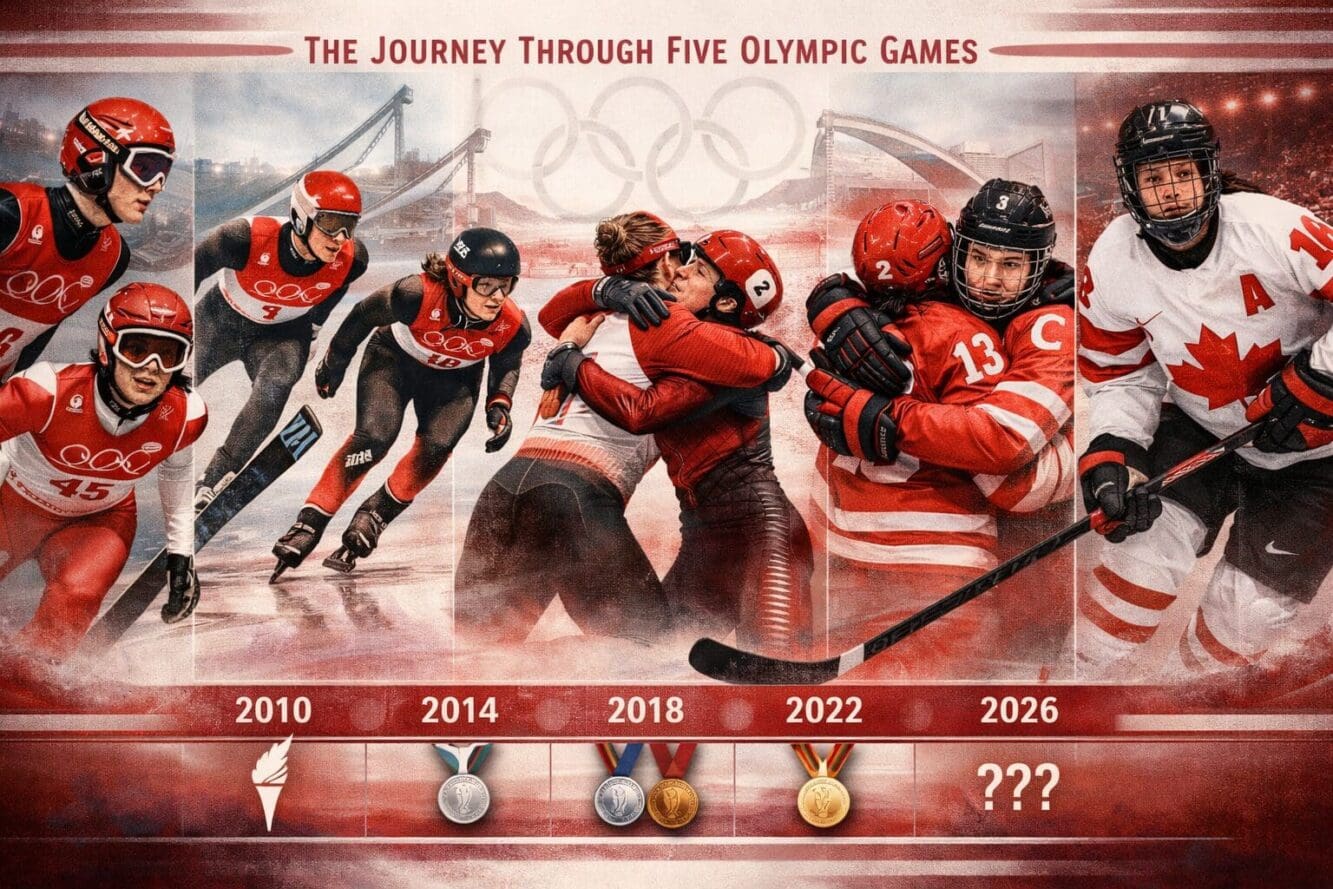
The Journey Through Five Olympic Games
Vancouver 2010: Where It All Began
The 2010 Vancouver Winter Olympics marked the beginning of an extraordinary journey for Boyd-Clowes, Maltais, and Poulin. As young athletes competing on home soil, they couldn’t have imagined they would still be representing Canada 16 years later. Vancouver provided the foundation for their Olympic careers, introducing them to the unique pressures and opportunities that come with competing at the world’s premier winter sports event.
For these athletes, Vancouver wasn’t just about results—it was about learning the Olympic experience, understanding what it takes to compete against the world’s best, and developing the mental framework necessary for sustained excellence.
Building Through Sochi, PyeongChang, and Beijing
Each subsequent Olympic Games brought new challenges and opportunities. Sochi 2014 tested their ability to compete in a different cultural environment. PyeongChang 2018 demanded adaptation to evolving competition formats and new international rivals. Beijing 2022 presented the unique challenge of competing during a global pandemic, with strict protocols and limited spectator support[4].
Through all these experiences, Boyd-Clowes, Maltais, and Poulin demonstrated remarkable consistency. Canada captured 26 medals (including four gold) at Beijing 2022[4], with these veteran athletes contributing their experience and leadership even when not on the podium themselves.
Milano Cortina 2026: The Fifth Chapter
Now, at Milano Cortina 2026, these three athletes stand as living legends within Team Canada’s 207-person delegation[4]. They compete alongside a new generation of Canadian winter sports stars while carrying the institutional knowledge of five Olympic cycles. Their presence provides invaluable mentorship and stability within their respective sports.
Understanding the Three Disciplines: Five-Time Olympians Across Different Sports
Mackenzie Boyd-Clowes: Soaring Through Ski Jumping History
Mackenzie Boyd-Clowes competes in women’s ski jumping[5], a discipline that demands extraordinary courage, technical precision, and split-second decision-making. Ski jumping requires athletes to launch themselves off massive hills at speeds exceeding 90 kilometers per hour, maintaining perfect aerodynamic position while flying through the air.
The physical demands of ski jumping are immense—explosive leg power for the takeoff, core strength for maintaining position, and the mental fortitude to overcome the natural fear response that comes with flying through the air. Boyd-Clowes has maintained this elite combination of physical and mental attributes across 16 years, adapting to equipment changes, technique evolutions, and increasingly competitive international fields.
Her longevity in such a demanding sport speaks to exceptional injury prevention, smart training periodization, and the ability to evolve her technique as her body ages. Similar to how legendary performers in other fields maintain excellence over time, Boyd-Clowes has found the formula for sustained success.
Valérie Maltais: Speed, Strategy, and Survival in Short Track
Valérie Maltais competes in women’s short track speed skating[3][5], arguably one of the most physically demanding and tactically complex Winter Olympic sports. Short track combines raw speed with strategic positioning, split-second decision-making, and the constant risk of crashes that can end medal hopes in an instant.
As a four-time Olympic medallist[3], Maltais has proven her ability to navigate the chaos of short track competition at the highest level. The sport requires explosive anaerobic capacity, incredible leg strength, razor-sharp reflexes, and the mental toughness to recover from crashes and disappointments.
Maintaining elite short track performance for 16 years requires exceptional injury management—the sport’s high crash rate means most athletes struggle to compete for more than one or two Olympic cycles. Maltais’s five consecutive Olympic appearances demonstrate not just talent, but remarkable durability and recovery capacity.
Marie-Philip Poulin: The Captain Canada Legacy
Marie-Philip Poulin has been a cornerstone of Canada’s women’s hockey program across five Olympic cycles[2], earning her reputation as one of the greatest players in international hockey history. As a four-time Olympic medallist[3], Poulin has delivered in the biggest moments, scoring crucial goals in Olympic finals and providing leadership both on and off the ice.
Women’s hockey demands a unique combination of skating speed, stick skills, tactical awareness, physical toughness, and team chemistry. The game has evolved significantly since 2010, with international competition becoming increasingly competitive and the playing style becoming faster and more skilled.
Poulin’s ability to remain at the elite level across these changes demonstrates exceptional adaptability. She’s evolved her game to match the sport’s evolution while maintaining the competitive drive and physical conditioning necessary to compete against players a decade younger.
What It Takes to Compete Across Five Olympic Cycles
Physical Longevity and Injury Management
Competing at five consecutive Winter Olympics requires extraordinary physical durability. Most Olympic athletes peak for one or two Games before injuries, declining performance, or life changes end their careers. Boyd-Clowes, Maltais, and Poulin have defied these typical career trajectories.
Key factors in their physical longevity include:
- Smart training periodization that balances intensity with recovery
- Proactive injury prevention through strength training and mobility work
- Advanced recovery techniques including nutrition, sleep optimization, and medical support
- Adaptation of training methods as their bodies age and respond differently to stimulus
- Strategic competition scheduling to peak at the right moments
Mental Resilience Across 16 Years
The mental demands of maintaining Olympic-level performance for 16 years may exceed even the physical challenges. These athletes have experienced:
- The pressure of competing on home soil in Vancouver
- The disappointment of performances that didn’t meet expectations
- The joy of Olympic medals and career-defining moments
- The challenge of watching younger competitors emerge
- The unique stress of pandemic-era competition in Beijing
Their ability to maintain motivation, handle pressure, and continue pushing themselves year after year demonstrates exceptional mental strength. This psychological resilience separates good athletes from legendary ones.
Evolution and Adaptation
Perhaps the most remarkable aspect of the five-time Olympians’ careers is their ability to evolve. The athletes competing in Milano Cortina 2026 are not the same athletes who competed in Vancouver 2010—they’ve adapted their techniques, training methods, and approaches to match both their changing bodies and their evolving sports.
Boyd-Clowes has adapted to changes in ski jumping equipment and technique. Maltais has evolved her tactical approach as short track competition has intensified. Poulin has adjusted her playing style as women’s hockey has become faster and more skilled.
This adaptability—the willingness to change what worked before in order to succeed in the present—may be the most important factor in their sustained excellence.
Team Canada Milano Cortina 2026: A Historic Delegation
The three five-time Olympians are part of a remarkable Team Canada delegation at Milano Cortina 2026. The team includes several historic elements that provide context for their achievement:
Record-Breaking Gender Representation
For the first time in Winter Olympic history, women outnumber men on Team Canada’s roster, with 108 women and 99 men among the 207 athletes[4][5]. This milestone reflects both the growth of women’s winter sports and Canada’s commitment to gender equity in athletic development.
Boyd-Clowes, Maltais, and Poulin have been part of this evolution, competing across an era that has seen dramatic increases in support, media coverage, and opportunities for women in winter sports.
Experience and Continuity
Nearly half of Canada’s delegation (90 athletes) competed at Beijing 2022[4], demonstrating significant continuity and experience. This veteran presence, led by the three five-time Olympians, provides institutional knowledge and mentorship for younger athletes experiencing their first Olympic Games.
The roster also includes 47 Olympic medallists[3], creating a team culture built on success and high expectations. Within this elite group, the five-time Olympians represent the pinnacle of longevity and sustained excellence.
Leadership Beyond Flag Bearers
While Mikaël Kingsbury and Marielle Thompson were selected as Canada’s flag bearers for the opening ceremony in Livigno[4], the three five-time Olympians provide a different kind of leadership. Their presence offers:
- Perspective from experiencing five different Olympic environments
- Mentorship for athletes competing in their first or second Games
- Stability during the inevitable ups and downs of Olympic competition
- Inspiration demonstrating that Olympic careers can extend far beyond typical expectations
Lessons from Legendary Careers
The careers of Boyd-Clowes, Maltais, and Poulin offer valuable lessons that extend beyond sports:
1. Consistency Beats Intensity
Rather than burning bright for a short period, these athletes have maintained steady excellence across 16 years. Their approach emphasizes sustainable training, smart recovery, and long-term planning over short-term heroics.
2. Adaptation Is Essential
What worked in 2010 wouldn’t work in 2026. These athletes have continuously evolved their techniques, training methods, and approaches to match both their changing bodies and their evolving sports.
3. Mental Strength Matters More Than Physical Talent
Thousands of athletes have the physical talent to compete at the Olympics. Far fewer have the mental resilience to maintain that level across five Olympic cycles, handling setbacks, pressure, and the grind of year-after-year elite competition.
4. Support Systems Enable Success
No athlete achieves five Olympic appearances alone. Boyd-Clowes, Maltais, and Poulin have benefited from world-class coaching, medical support, family encouragement, and institutional backing from Canadian sport organizations.
5. Purpose Drives Longevity
These athletes continue competing not just for medals, but because they love their sports, want to inspire the next generation, and find meaning in pursuing excellence. This deeper purpose sustains motivation when physical challenges mount.
The Legacy Beyond Milano Cortina
Regardless of results at Milano Cortina 2026, Boyd-Clowes, Maltais, and Poulin have already secured their places in Canadian Olympic history. Their five consecutive Olympic appearances since 2010 represent an achievement that may never be matched, given the physical demands of Winter Olympic sports and the increasing competitiveness of international fields.
Their legacy extends beyond their own performances:
- Inspiring younger athletes who see that Olympic careers can last far longer than traditionally expected
- Demonstrating Canadian winter sports excellence across multiple disciplines
- Contributing to the growth of women’s winter sports through sustained high-level performance
- Showing the value of experience in team environments dominated by young athletes
As Team Canada competes at Milano Cortina, these three athletes embody the Olympic values of excellence, friendship, and respect. They’ve competed against the world’s best, formed relationships with athletes from dozens of countries, and shown respect for their sports through 16 years of dedicated preparation.
Conclusion: Celebrating Sustained Excellence
The legendary careers of five-time Olympians Mackenzie Boyd-Clowes, Valérie Maltais, and Marie-Philip Poulin demonstrate what’s possible when talent meets dedication, resilience, and smart long-term planning. Their journey from Vancouver 2010 to Milano Cortina 2026 spans 16 years of evolution in their sports, their bodies, and the Olympic movement itself.
As you watch the Milano Cortina 2026 Winter Olympics, take a moment to appreciate these remarkable athletes. Whether they’re launching off a ski jump, racing around a short track oval, or battling for a hockey puck, they’re demonstrating excellence that transcends any single performance or medal.
Next Steps for Aspiring Athletes and Sports Fans
For young athletes: Study the careers of Boyd-Clowes, Maltais, and Poulin. Notice how they’ve adapted, persevered through setbacks, and maintained their passion across 16 years. Excellence is built through consistent daily choices, not single heroic efforts.
For coaches and sport administrators: Consider what support systems enable such longevity. How can you create environments that help athletes sustain excellence across multiple Olympic cycles rather than burning out after one or two?
For sports fans: Recognize and celebrate sustained excellence. In an era that often focuses on young phenoms, appreciate the extraordinary achievement of athletes who maintain elite performance across nearly two decades.
The five-time Olympians remind us that greatness isn’t just about reaching the peak—it’s about staying there, adapting, evolving, and continuing to compete at the highest level year after year. That’s the true mark of legendary careers. 🏅🇨🇦
References
[1] 207 Athletes To Represent Team Canada At The Milano Cortina 2026 Olympic Winter Games – https://sirc.ca/news/207-athletes-to-represent-team-canada-at-the-milano-cortina-2026-olympic-winter-games/
[2] Team Canada Milano Cortina 2026 – https://ellegourmet.ca/team-canada-milano-cortina-2026/
[3] Fun Facts About Team Canada Heading Into Milano Cortina 2026 Olympic Winter Games – https://olympic.ca/2026/01/29/fun-facts-about-team-canada-heading-into-milano-cortina-2026-olympic-winter-games/
[4] Milan Cortina 2026: Canada Presents A Delegation Of 207 Athletes With A Majority Of Women – https://www.francsjeux.com/en/short/Milan-Cortina-2026:-Canada-presents-a-delegation-of-207-athletes–with-a-majority-of-women/
[5] Team Canada At Milano Cortina 2026 – https://prsvre.substack.com/p/team-canada-at-milano-cortina-2026
Some content and illustrations on GEORGIANBAYNEWS.COM are created with the assistance of AI tools.
GEORGIANBAYNEWS.COM shares video content from YouTube creators under fair use principles. We respect creators’ intellectual property and include direct links to their original videos, channels, and social media platforms whenever we feature their content. This practice supports creators by driving traffic to their platforms.