




















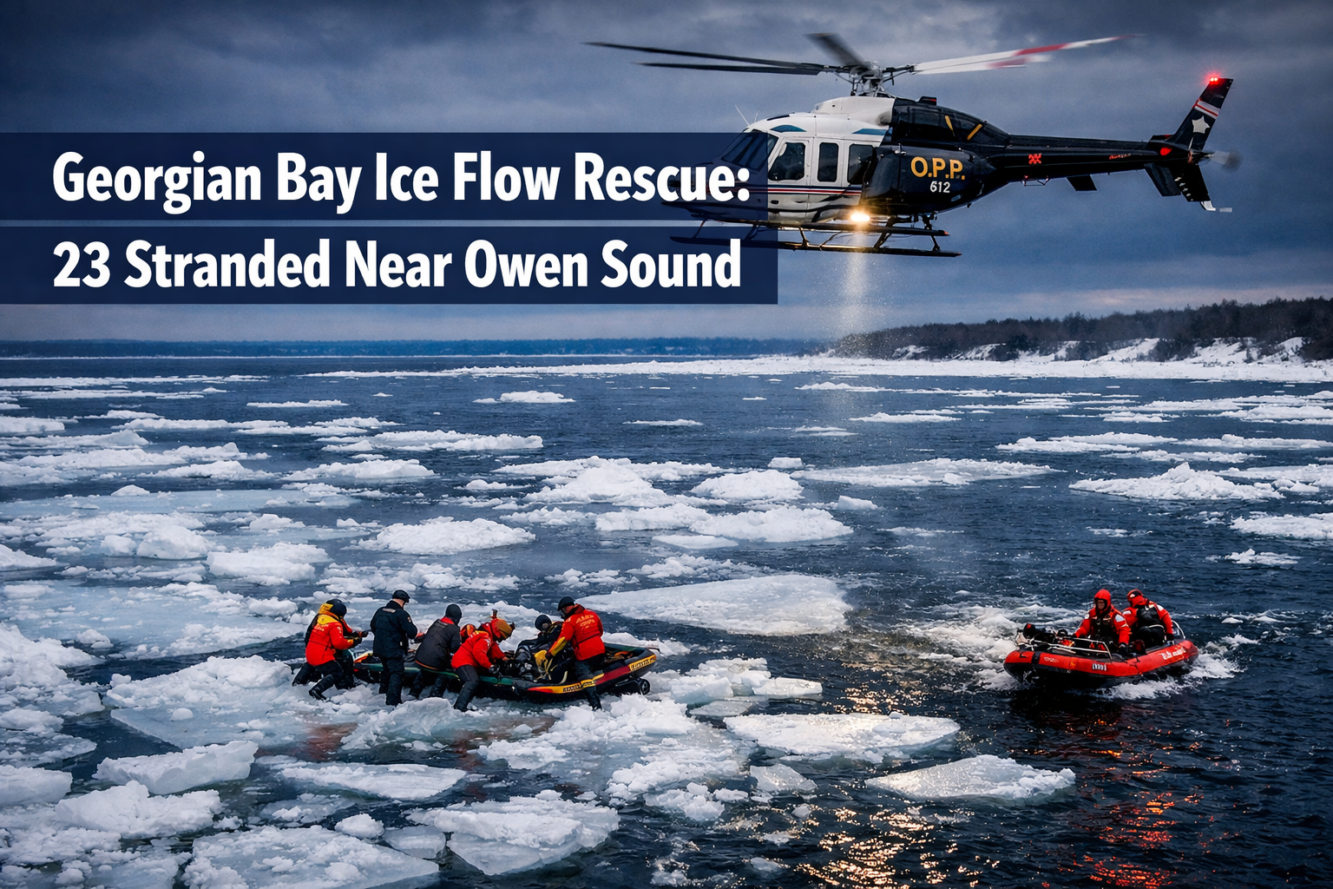
Georgian Bay Ice Flow Rescue: 23 Stranded Near Owen Sound – Dramatic OPP Helicopter Operation

Last updated: March 10, 2026
On a sunny Sunday afternoon that turned into a fight for survival, 23 ice fishermen found themselves drifting helplessly on breaking ice sheets two kilometers from shore in Georgian Bay near Owen Sound. The Georgian Bay Ice Flow Rescue: 23 Stranded Near Owen Sound – Dramatic OPP Helicopter Operation, Hypothermia Risks, and Spring Ice Safety Warnings incident unfolded rapidly on March 8, 2026, when what appeared to be stable ice suddenly fractured and began moving into open water, triggering one of the region’s most dramatic rescue operations in recent years.

Emergency responders rescued 23 fishermen near Owen Sound, Ont., Sunday after a piece of ice where they were fishing in Georgian Bay broke off and carried them nearly two kilometres away. Two of the rescued fishermen recount the ordeal. Subscribe to CBC News to watch more videos: http://bit.ly/1RreYWS
Key Takeaways
- All 23 people were successfully rescued by 2:30 p.m. on March 8, 2026, after becoming stranded when an ice shelf broke away from Georgian Bay near Owen Sound
- Ice drifted approximately 2 kilometers offshore within hours, splitting into multiple fragments with some individuals becoming partially submerged in frigid water
- OPP Aviation helicopters led the rescue, supported by a massive multi-agency response including fire departments, paramedics, marine units, and AirOrnge helicopters
- Several people suffered hypothermia with minor injuries reported, though all individuals are expected to make full recoveries
- Warm spring temperatures destabilized the ice, despite it initially appearing safe enough for fishing activities
- “No ice is safe ice, especially this time of year” – official OPP warning issued following the incident
- Eyewitnesses described harrowing moments with some stranded individuals making farewell calls to family members
- Cobble Beach Golf Course served as emergency command center with helicopters landing on the clubhouse lawn
Quick Answer
The Georgian Bay Ice Flow Rescue near Owen Sound on March 8, 2026, involved 23 ice fishermen who became stranded when an ice shelf suddenly broke away and drifted 2 kilometers offshore. OPP Aviation helicopters and multiple emergency agencies successfully rescued all individuals by 2:30 p.m., with several treated for hypothermia. The incident highlights the extreme dangers of spring ice conditions and prompted urgent safety warnings from authorities.
What Happened During the Georgian Bay Ice Flow Rescue Near Owen Sound?
Twenty-three people were stranded on breaking ice flows in Georgian Bay just before noon on March 8, 2026, when an ice shelf suddenly separated from shore near Balmy Beach, north of Owen Sound. The ice began drifting rapidly into open water, moving approximately 2 kilometers offshore due to wind and water currents.[1]
The ice shelf fractured into multiple sections during the drift. Witnesses reported the ice broke into at least two separate flows—one carrying 18 individuals and another with 5 people.[3] As the ice continued to break apart, several people became partially submerged in the frigid Georgian Bay water, with some individuals in sleds actively battling against the waves.[1]
Critical timeline:
- Just before noon: Ice shelf breaks away from shore
- Early afternoon: Ice drifts 2 kilometers offshore and fragments further
- 2:30 p.m.: All 23 people successfully rescued and brought to shore
One stranded angler, Kevin Fox, described the terrifying moment when his GPS indicated the group was moving and waves began forming behind them. Some individuals made farewell calls to family members, believing they wouldn’t survive.[4]
How Did the OPP Helicopter Operation Rescue 23 People?
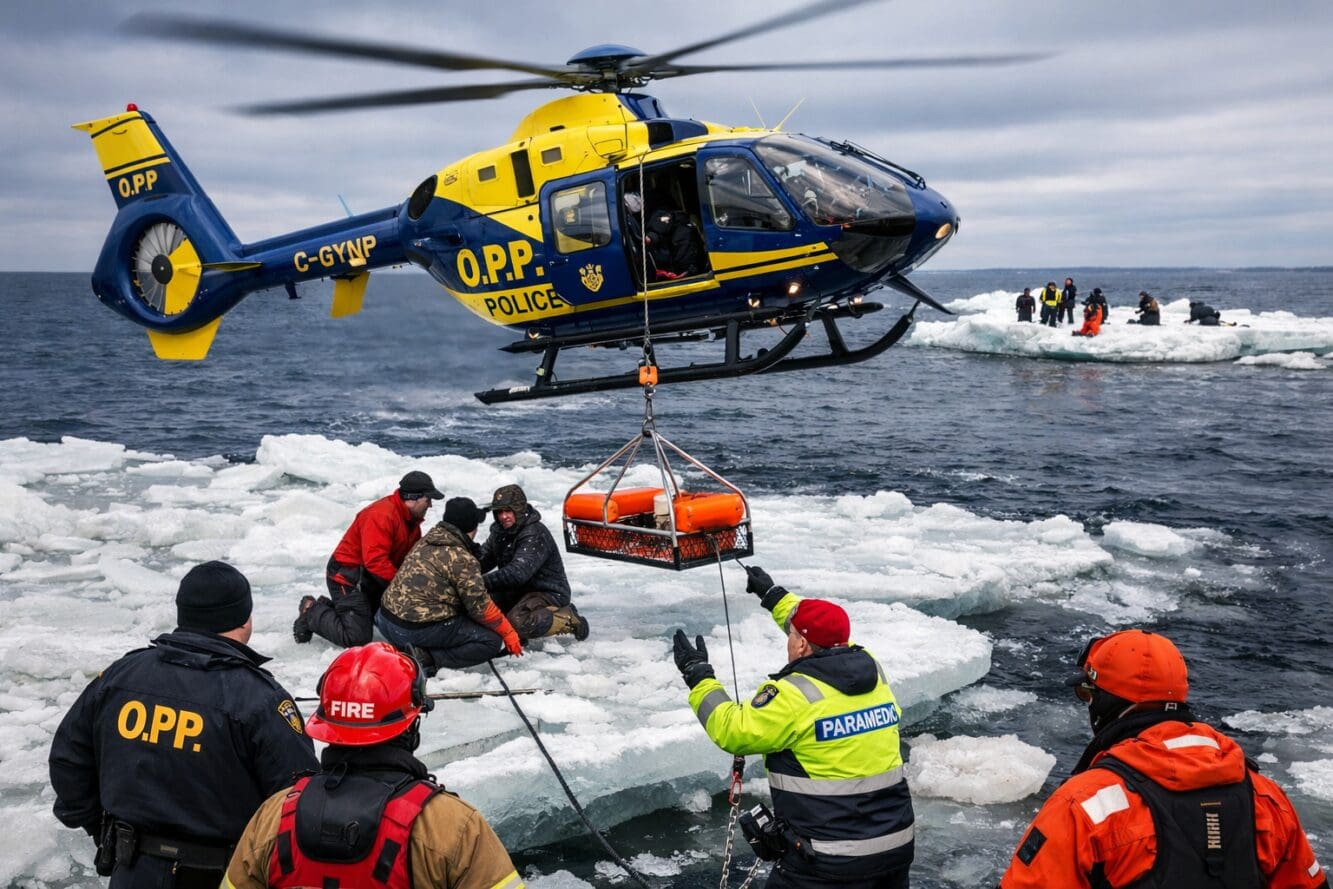
OPP Aviation Services deployed two helicopters that led the dramatic airlift operation, with witnesses describing the pilots’ response as “phenomenal.”[3] The helicopters airlifted all 23 stranded individuals from the breaking ice flows to safety on shore, completing the rescue by 2:30 p.m.[2]
Multi-agency response teams included:
- OPP Aviation (lead rescue helicopters)
- OPP Marine Unit
- AirOrnge helicopters
- Inter Township Fire Department
- Owen Sound Fire Department
- Hanover Fire Department
- North Bruce Peninsula Fire Department
- Grey County Paramedics
- Bruce County Paramedics
- Ministry of Natural Resources
- Wellington County OPP[2]
Cobble Beach Golf Course transformed into an emergency command center, with helicopters landing directly on the clubhouse lawn. First responders established a triage area with ambulances lined up in the driveway, ready to treat rescued individuals immediately upon arrival.[2]
Choose helicopter rescue when: Ice is actively breaking apart, individuals are in water, distance from shore exceeds safe boat approach, or weather conditions deteriorate rapidly. In this case, the 2-kilometer distance and fragmenting ice made helicopter extraction the only viable option.
What Are the Hypothermia Risks in Georgian Bay Ice Incidents?
Several of the 23 rescued individuals suffered hypothermia, though all injuries were classified as minor with full recovery expected.[4] Hypothermia occurs when body temperature drops below 35°C (95°F), and Georgian Bay’s frigid water temperatures in early March can cause this condition within minutes of immersion.
Hypothermia progression in cold water:
- 0-2 minutes: Cold shock response, gasping, hyperventilation
- 2-15 minutes: Loss of muscle control, inability to swim
- 15-30 minutes: Unconsciousness possible
- 30+ minutes: Life-threatening hypothermia sets in
When individuals became partially submerged as the ice broke apart, immediate exposure to near-freezing water accelerated heat loss. The rapid helicopter response prevented more severe cases, as prolonged exposure would have resulted in critical hypothermia requiring intensive medical intervention.
Common mistake: Assuming winter clothing provides adequate protection in water. Wet clothing loses 90% of its insulating value, and heavy winter gear becomes waterlogged, making it nearly impossible to climb back onto ice.
Why Did the Ice Break Away Near Owen Sound?
Unstable ice conditions caused by recent warm temperatures and high water flow led to the sudden ice shelf separation, despite the ice initially appearing safe for fishing.[2] Spring conditions create particularly dangerous ice scenarios because warming air temperatures weaken ice from above while water currents erode it from below.
Factors that destabilized the Georgian Bay ice:
- Unseasonably warm March temperatures
- Increased water flow and currents
- Sun exposure creating surface melting
- Wind pressure pushing against ice edges
- Natural ice movement in Georgian Bay
The OPP emphasized that “No ice is safe ice, especially this time of year,” noting that environmental conditions can change rapidly even when ice appears solid.[2] What seemed stable enough for 23 people to venture out for fishing transformed into a life-threatening situation within hours.
Edge case: Dark-colored ice (indicating water saturation) versus white ice (air pockets from melting) both signal dangerous conditions in spring, but many anglers mistakenly believe thick white ice remains safe.
What Spring Ice Safety Warnings Should You Follow in 2026?
The OPP issued urgent safety advisories following the rescue, strongly encouraging the public to stay off ice and away from rivers and ponds due to frigid water temperatures, high currents, and unknown hazards.[2] Spring ice conditions in 2026 present extreme risks that outweigh any recreational benefits.
Critical spring ice safety rules:
- Stay off all ice during spring months (March-April in Georgian Bay region)
- Never assume ice thickness based on visual appearance alone
- Avoid ice near moving water where currents accelerate deterioration
- Check local conditions with conservation authorities before any ice activity
- Wear a flotation device if you must be near ice (emergency personnel only)
- Carry ice picks and rope for self-rescue (though staying off ice is safest)
- Never go alone – though groups increase total risk on weak ice
Choose to stay off ice if: Temperatures have been above freezing for consecutive days, you see water on ice surface, ice appears dark or honeycomb-textured, there’s any doubt about safety, or authorities have issued warnings. All these conditions existed on March 8 near Owen Sound.
Similar weather-related emergencies require coordinated responses, as seen in other dramatic rescue operations across the region.
What Geographic Areas Near Owen Sound Are High-Risk?
The ice shelf broke away near Balmy Beach, located north of Owen Sound on Georgian Bay’s eastern shoreline. This area experiences particularly dynamic ice conditions due to its exposure to prevailing winds, water currents from the bay’s main basin, and variable depths near shore.[2]
High-risk ice areas in the Georgian Bay region:
- Balmy Beach to Presqu’ile Point: Exposed shoreline with strong currents
- Owen Sound harbor approaches: Moving water from river outflow
- Islands and channels: Current acceleration between land masses
- Deep-to-shallow transitions: Uneven ice thickness
- South-facing shores: Maximum sun exposure causing faster melting
The 2-kilometer drift distance demonstrates how quickly wind can push ice sheets into open water once they separate from shore. Georgian Bay’s size means ice flows can travel significant distances before grounding or breaking up completely.
Local emergency services, including the Collingwood OPP, regularly coordinate on safety initiatives throughout the region.
How Can You Recognize Dangerous Ice Conditions?
Visual indicators and environmental factors signal when ice has become unsafe, though the safest approach in spring is complete avoidance. The 23 individuals stranded on March 8 likely didn’t recognize subtle warning signs before the ice separated.[1]
Dangerous ice warning signs:
| Visual Indicator | What It Means | Risk Level |
|---|---|---|
| Dark/gray ice | Water-saturated, very weak | Extreme |
| White/opaque ice | Air pockets from melting | High |
| Water on surface | Active melting, structural failure | Extreme |
| Cracks or pressure ridges | Movement and stress | High |
| Shore gaps | Ice pulling away from land | Extreme |
| Slushy texture | Advanced deterioration | Extreme |
Environmental red flags:
- Consecutive days above 0°C (32°F)
- Rain on ice surface
- Visible water movement underneath
- Wind pushing toward open water
- Late season (March-April in Ontario)
Decision rule: If you can see any of these indicators, or if it’s spring season, stay off the ice entirely. No fishing opportunity justifies the risk demonstrated in this rescue operation.
What Should You Do If You’re Caught on Breaking Ice?
While prevention is paramount, understanding emergency response can save lives if you find yourself in a situation similar to the 23 stranded individuals. Immediate action in the first moments after ice breaks can determine survival outcomes.
Emergency response steps:
- Call 911 immediately – Don’t wait to see if ice stabilizes
- Move toward shore – Even if ice is breaking, head toward the nearest land
- Distribute weight – Lie flat if ice is cracking beneath you
- Avoid running – Sudden weight shifts can accelerate breaking
- Stay together – Groups can assist each other but avoid clustering
- Prepare for water entry – Remove heavy packs, prepare ice picks
- Signal for help – Wave bright clothing, use whistle if available
- Conserve energy – If in water, minimize movement to slow heat loss
If you enter the water:
- Control breathing during cold shock (first 1-2 minutes)
- Turn toward the direction you came from (ice was stronger there)
- Use ice picks or kick legs to propel onto ice surface
- Roll away from the hole rather than standing
- Get to shore and seek immediate medical attention
The individuals rescued on March 8 made the critical decision to call for help early, enabling the massive response that saved all 23 lives.[2]
What Medical Treatment Follows Ice Water Exposure?
The rescued individuals received immediate triage at Cobble Beach Golf Course, with paramedics assessing for hypothermia and other injuries. Several people required treatment for hypothermia, though all cases were manageable without long-term complications.[4]
Standard hypothermia treatment protocol:
- Remove wet clothing immediately
- Wrap in thermal blankets (emergency foil blankets retain 90% body heat)
- Provide warm, sweet drinks if conscious and alert
- Monitor core temperature continuously
- Transport to hospital for moderate to severe cases
- Rewarm gradually (rapid rewarming can cause cardiac issues)
- Assess for frostbite on extremities
Severity classification:
- Mild hypothermia (32-35°C): Shivering, confusion, fumbling hands
- Moderate hypothermia (28-32°C): Violent shivering stops, severe confusion
- Severe hypothermia (below 28°C): Unconsciousness, weak pulse, life-threatening
The quick rescue prevented any severe hypothermia cases, demonstrating why helicopter evacuation was essential. Every minute in cold water increases hypothermia severity exponentially.
How Do Multi-Agency Rescues Coordinate?
The Georgian Bay ice flow rescue involved at least 10 different emergency agencies working in synchronized coordination. Cobble Beach Golf Course served as the incident command post, centralizing communication and resource deployment.[2]
Coordination elements:
- Unified command structure: Single incident commander directs all agencies
- Designated landing zones: Golf course provided safe helicopter operations area
- Triage protocols: Paramedics prioritized patients by injury severity
- Resource staging: Ambulances, boats, and equipment pre-positioned
- Communication networks: Shared radio frequencies across all agencies
- Backup systems: Multiple helicopter services (OPP and AirOrnge) ensured redundancy
This level of coordination doesn’t happen spontaneously. Regional emergency services conduct regular joint training exercises for exactly these scenarios. The successful outcome with zero fatalities reflects years of preparation and inter-agency cooperation.
Community safety initiatives, like those coordinated by local emergency services, build the foundation for effective emergency response.
FAQ
How long did the Georgian Bay ice rescue take?
The rescue operation lasted approximately 2.5 hours, beginning just before noon when the ice broke away and concluding by 2:30 p.m. when all 23 people were safely evacuated to shore.[2]
Were there any fatalities in the Owen Sound ice incident?
No fatalities occurred. All 23 individuals were rescued successfully, with only minor injuries and several cases of hypothermia reported.[4]
How far did the ice drift from shore?
The ice shelf drifted approximately 2 kilometers (1.2 miles) into Georgian Bay before rescue helicopters reached the stranded individuals.[2]
What caused the ice to break away near Balmy Beach?
Warm spring temperatures, high water flow, and changing environmental conditions destabilized the ice despite it initially appearing safe for fishing activities.[2]
How many helicopters were used in the rescue?
At least three helicopters participated—two from OPP Aviation Services and additional support from AirOrnge helicopters.[2][3]
Is ice fishing safe in Georgian Bay during March?
No. The OPP explicitly stated “No ice is safe ice, especially this time of year” and strongly encourages the public to stay off all ice during spring months.[2]
What should you do if you see someone stranded on ice?
Call 911 immediately and do not attempt a rescue yourself. Wait for trained emergency personnel with proper equipment. Attempting untrained rescue often results in additional victims.
How cold was the water during the rescue?
While exact temperatures weren’t reported, Georgian Bay water in early March typically ranges from 0-2°C (32-36°F), cold enough to cause hypothermia within minutes of immersion.
Can you survive if you fall through ice?
Survival is possible with immediate rescue. You have approximately 1-2 minutes before losing muscle control and 15-30 minutes before unconsciousness, depending on water temperature and physical condition.
What areas near Owen Sound are most dangerous for ice?
Areas near Balmy Beach, exposed shorelines, river mouths, channels between islands, and anywhere with moving water underneath present the highest risk during spring conditions.[2]
How thick does ice need to be for safe fishing?
Minimum safe thickness is 10-15 cm (4-6 inches) for one person, but spring ice is inherently unstable regardless of thickness. Authorities recommend avoiding all ice during spring months.
What happened to the fishing equipment left on the ice?
The rescue prioritized human life. Equipment left on the ice flows was likely lost as the ice continued to drift and eventually broke apart or melted.
Conclusion
The Georgian Bay Ice Flow Rescue: 23 Stranded Near Owen Sound – Dramatic OPP Helicopter Operation, Hypothermia Risks, and Spring Ice Safety Warnings serves as a stark reminder that spring ice conditions can turn deadly within minutes. The successful rescue of all 23 individuals on March 8, 2026, resulted from rapid emergency response, exceptional coordination among multiple agencies, and skilled helicopter pilots who executed a complex airlift operation 2 kilometers offshore.
Take these actions immediately:
- Stay off all ice during spring months in the Georgian Bay region
- Share this incident with anyone who participates in ice fishing or winter recreation
- Monitor local warnings from OPP and conservation authorities
- Prepare emergency contacts and ensure your phone is charged if near water
- Educate family members about ice safety, especially children
The OPP’s message is unambiguous: “No ice is safe ice, especially this time of year.” The 23 people rescued near Owen Sound are fortunate to be alive. Their experience demonstrates that even experienced anglers can misjudge spring ice conditions, and that no recreational activity justifies risking your life on unstable ice.
As temperatures continue to fluctuate in 2026, Georgian Bay’s ice will become increasingly unpredictable. Heed the warnings from this dramatic rescue operation and make the decision that could save your life—stay off the ice this spring.
References
[1] Cp Newsalert 23 People Rescued When Ice Shelf Broke From Georgian Bay Shore Police – https://panow.com/2026/03/08/cp-newsalert-23-people-rescued-when-ice-shelf-broke-from-georgian-bay-shore-police/
[2] All 23 People Rescued Near Owen Sound – https://www.owensoundcurrent.com/p/all-23-people-rescued-near-owen-sound
[3] Watch – https://www.youtube.com/watch?v=Cx8VcFC6GyU
[4] Twenty Three People Rescued From Ice Shelf Near Owen Sound – https://www.bayshorebroadcasting.ca/2026/03/09/twenty-three-people-rescued-from-ice-shelf-near-owen-sound/
Content, illustrations, and third-party video appearing on GEORGIANBAYNEWS.COM may be generated or curated with AI assistance or reproduced pursuant to the fair dealing provisions of the Copyright Act, R.S.C. 1985, c. C-42. Attribution and hyperlinks to original sources are provided in acknowledgment of applicable intellectual property rights. Such referencing is intended to direct traffic to and support the original rights holders’ platforms.
Much Appreciate You Sharing This Post - It Helps MUCH!!!