

















Louise Arbour Named Canada’s Next Governor General: Career Highlights, Controversies, and Challenges Ahead
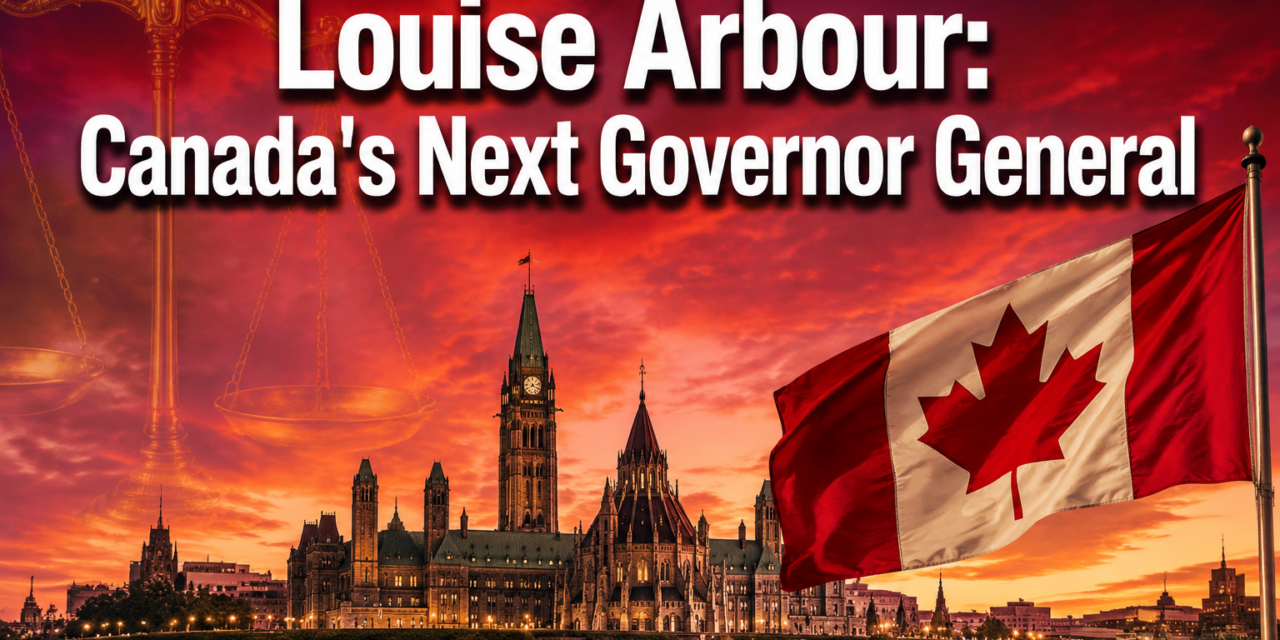
At 79 years old, Louise Arbour has already secured more historic legal firsts than most jurists achieve in multiple lifetimes—including the first-ever conviction for genocide under the 1948 Genocide Convention and the first indictment of a sitting head of state for war crimes. On May 5, 2026, Prime Minister Mark Carney announced that this trailblazing retired Supreme Court Justice would become Canada’s next governor general, with King Charles III approving the recommendation [1]. The announcement of Louise Arbour named Canada’s next governor general brings career highlights, controversies, and challenges ahead into sharp public focus as the nation prepares for a leadership transition at Rideau Hall.
Arbour will replace Mary Simon, Canada’s first Indigenous governor general, who reaches the five-year mark of her tenure in July 2026 [1]. The transition is expected sometime that month, marking a shift from one groundbreaking appointment to another.
Key Takeaways
- 📌 Historic appointment: Louise Arbour, 79, was named Canada’s next governor general on May 5, 2026, pending a July transition from Mary Simon [1].
- ⚖️ Landmark legal career: Arbour achieved the first genocide conviction and first war crimes indictment of a sitting head of state in international law [1].
- 🌍 Global human rights leader: She served as UN High Commissioner for Human Rights and UN Special Representative for International Migration [2][1].
- 🎖️ Commander-in-Chief role: As governor general, Arbour will serve as Commander-in-Chief of the Canadian Armed Forces—an institution she recently investigated for sexual misconduct [2].
- 🇨🇦 Political context: PM Carney praised her as “an embodiment of sound judgment and an unwavering upholding of Canada’s Charter of Rights and the Rule of Law” [2].
Career Highlights: From Courtrooms to the World Stage
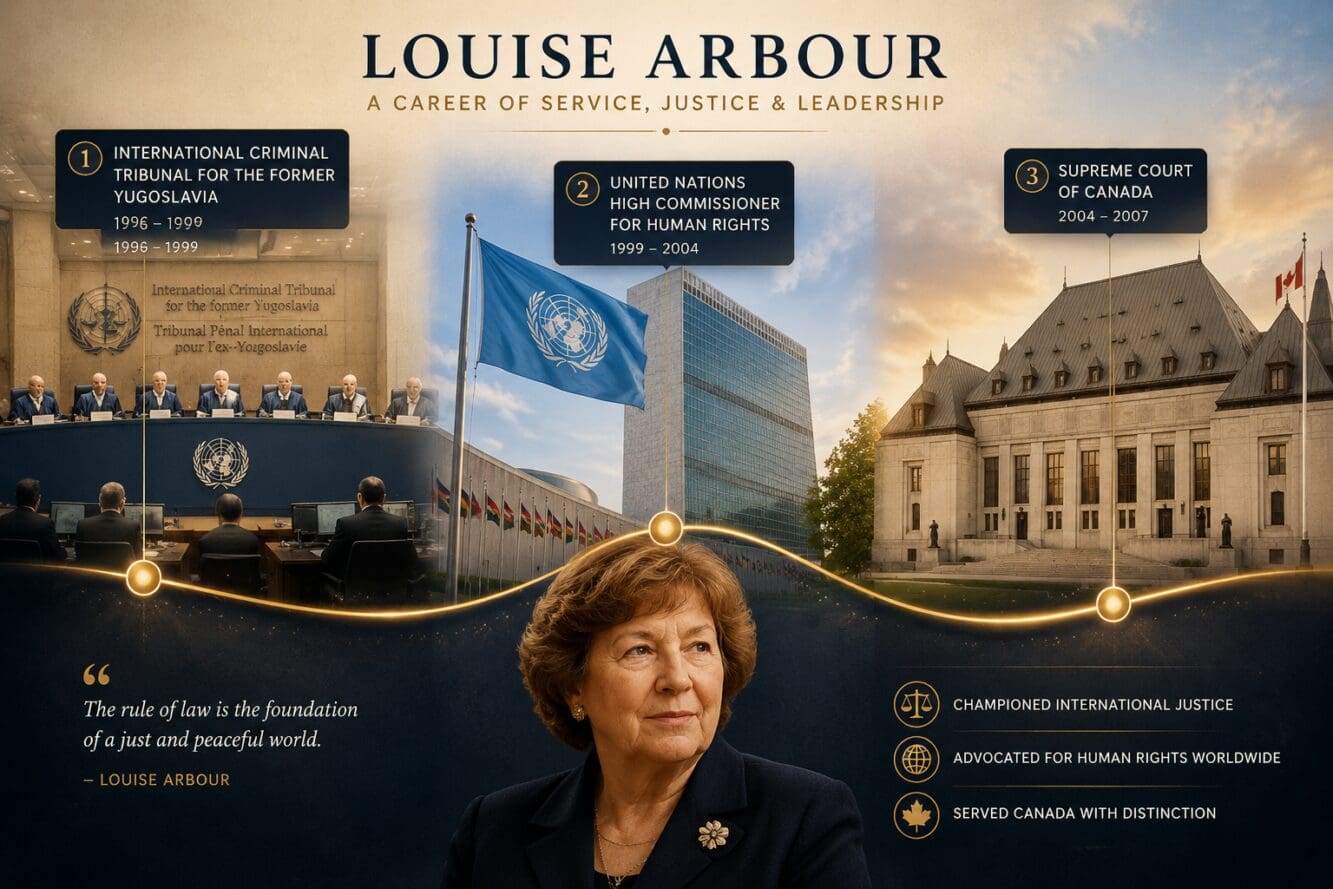
Louise Arbour’s career reads like a masterclass in legal leadership at the highest levels. Her journey from Canadian law professor to global human rights icon spans decades of consequential work.
International Criminal Tribunals (1996–1999)
Arbour served as Chief Prosecutor for the International Criminal Tribunals for both Rwanda and the former Yugoslavia [3]. During this period, she accomplished what many considered impossible:
| Achievement | Significance |
|---|---|
| First genocide conviction since 1948 | Proved the Genocide Convention could be enforced |
| First indictment of a sitting head of state | Established that no leader is above international law |
| Prosecution of crimes against humanity | Set precedents still used in international courts today |
These accomplishments fundamentally changed international criminal justice and established Arbour as one of the most important legal figures of the late 20th century [1].
UN High Commissioner for Human Rights (2004–2008)
Following her tribunal work, Arbour was appointed UN High Commissioner for Human Rights, a role that placed her at the center of global debates on torture, detention, and civil liberties [2]. Her tenure was marked by outspoken advocacy and a willingness to challenge powerful nations on their human rights records.
UN Special Representative for International Migration (2017–2018)
Arbour later returned to the UN as Special Representative for International Migration, tackling one of the most politically charged issues of the era—global migration policy [1]. This role required navigating competing national interests while advocating for the rights of displaced people.
Supreme Court of Canada
Arbour’s appointment to Canada’s highest court cemented her domestic legal legacy. Her rulings and legal reasoning contributed to Canadian jurisprudence on rights, freedoms, and the rule of law.
💬 PM Carney described Arbour as “an embodiment of sound judgment and an unwavering upholding of Canada’s Charter of Rights and the Rule of Law.” [2]
Controversies and Criticisms Surrounding the Appointment
No appointment of this magnitude comes without debate. Louise Arbour named Canada’s next governor general brings career highlights, controversies, and challenges ahead that deserve careful examination.
Age Concerns
At 79 years old, Arbour would be among the oldest individuals to assume the governor general role [1]. With a standard five-year term, she would be 84 at its conclusion [2]. Critics have raised questions about whether the demanding ceremonial and constitutional duties of the position are best suited to someone approaching her ninth decade.
Political Timing
The appointment comes during a period of significant political tension in Canada. PM Carney’s selection of a figure so closely associated with international institutions and progressive legal causes has drawn both praise and criticism along partisan lines. Some observers view the choice as a statement about Canada’s values on the world stage, while others question whether it reflects a political calculation.
The Armed Forces Connection
Perhaps the most complex aspect of Arbour’s appointment involves her recent investigation into sexual misconduct within the Canadian Armed Forces [2]. She issued a comprehensive report with multiple recommendations that the military has been implementing. As governor general, she will serve as Commander-in-Chief of the very institution she investigated—a unique and potentially awkward dynamic.
This dual role raises important questions:
- ✅ Supporters argue: Her deep knowledge of the military’s challenges makes her uniquely qualified to oversee reform as Commander-in-Chief.
- ❌ Critics counter: The investigator-turned-overseer dynamic could complicate civil-military relations.
Challenges Ahead for Canada’s New Governor General
The challenges facing Arbour as governor general extend well beyond ceremony and protocol. Louise Arbour named Canada’s next governor general faces career highlights, controversies, and challenges ahead that will test even her considerable experience.
Navigating the Constitutional Role
The governor general serves as the King’s representative in Canada [2]. This position requires:
- Granting Royal Assent to legislation
- Opening and dissolving Parliament
- Serving as Commander-in-Chief of the Canadian Armed Forces
- Representing Canada at home and abroad
- Exercising reserve powers in constitutional crises
The appointment required approval from King Charles III, following the constitutional convention that the Prime Minister recommends candidates but the Crown retains final approval authority [2].
Succeeding Mary Simon
Mary Simon’s tenure as Canada’s first Indigenous governor general was historic and symbolically powerful [1]. Arbour faces the challenge of maintaining the momentum of reconciliation efforts while bringing her own distinct identity to the role. The transition from an Indigenous leader to a francophone legal scholar represents a shift in emphasis that will be closely watched.
Political Neutrality in Polarized Times
Governor generals must remain strictly non-partisan, yet Arbour’s extensive public record on human rights, migration, and military reform means she arrives with well-known positions on politically sensitive topics. Maintaining the appearance and reality of neutrality will require careful navigation.
The Monarchy Question
Canada’s relationship with the Crown remains a subject of ongoing debate. As the sovereign’s representative, Arbour will embody an institution that some Canadians wish to reform or abolish. Her legal expertise may prove valuable in navigating any constitutional discussions that arise during her tenure.
What This Appointment Means for Canada in 2026
The selection of Louise Arbour sends several signals about Canada’s direction:
- Commitment to international law: Choosing a figure synonymous with international justice suggests Canada wants to reassert its role as a champion of rules-based order.
- Legal expertise at the top: In an era of constitutional questions, having a Supreme Court justice as governor general provides institutional knowledge.
- Francophone representation: Arbour’s appointment ensures francophone Canada sees itself reflected in the vice-regal office.
- Human rights emphasis: Her career-long focus on human rights signals the government’s priorities.
Conclusion
Louise Arbour’s appointment as Canada’s next governor general represents one of the most consequential vice-regal selections in recent memory. Her unprecedented career—spanning genocide prosecutions, UN leadership, Supreme Court service, and military investigations—brings extraordinary depth to a role that demands both ceremonial grace and constitutional wisdom.
The challenges ahead are real. Navigating political neutrality, managing the Commander-in-Chief role after investigating the military, and succeeding a historic Indigenous governor general will test Arbour’s diplomatic skills. Yet few Canadians bring a resume more suited to the complexities of the moment.
For Canadians following this transition, the coming weeks offer an opportunity to:
- 📖 Learn about the constitutional powers of the governor general
- 🔍 Review Arbour’s Armed Forces report and its implementation progress
- 🗓️ Watch for the July 2026 installation ceremony details
- 💬 Engage in informed discussion about the role of the Crown in Canadian democracy
Whether one views this appointment with enthusiasm or skepticism, there is no denying that Louise Arbour has spent a lifetime preparing for exactly this kind of responsibility.
References
[1] Carney Names Supreme Court Justice Louise Arbour As Canadas Next Governor General – https://wtop.com/world/2026/05/carney-names-supreme-court-justice-louise-arbour-as-canadas-next-governor-general/
[2] Watch – https://www.youtube.com/watch?v=6bI9_qE_rMc
[3] Watch – https://www.youtube.com/watch?v=J1_eykA_pBo
[4] Fbsenpilqf8 – https://www.youtube.com/shorts/fBSeNPilqF8
Content, illustrations, and third-party video appearing on GEORGIANBAYNEWS.COM may be generated or curated with AI assistance or reproduced pursuant to the fair dealing provisions of the Copyright Act, R.S.C. 1985, c. C-42. Attribution and hyperlinks to original sources are provided in acknowledgment of applicable intellectual property rights. Such referencing is intended to direct traffic to and support the original rights holders’ platforms.