





















Microplastics in the Human Body: What New Studies Reveal About Health Risks and Exposure


Last updated: May 24, 2026
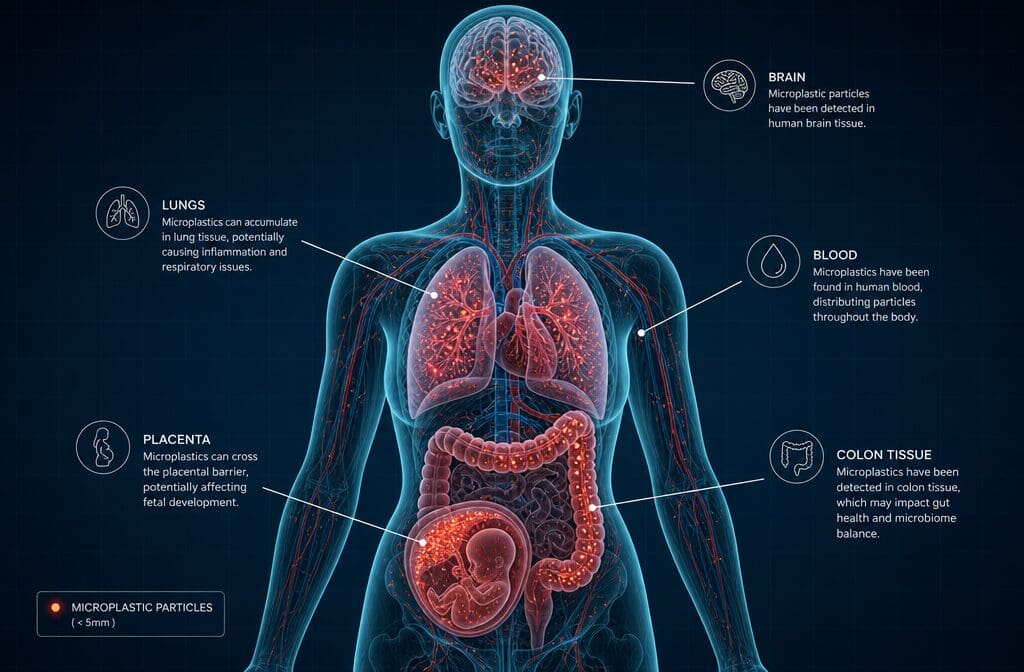
Quick Answer: Microplastics have been confirmed in human blood, lungs, brain tissue, placenta, and the colon. New studies in 2026 show concentrations are rising, but the direct health risks remain an active area of research. Reducing exposure through diet and lifestyle changes is possible and advisable, even without a definitive “safe” threshold established yet.
Key Takeaways
- Microplastics (particles smaller than 5 mm) and nanoplastics have been detected in nearly every human tissue tested, including the brain [2].
- Estimated human exposure runs into tens of thousands of particles per year through food, water, and air [5].
- Linked health concerns include inflammation, cardiovascular risk, and potential hormonal disruption, though causation is still being studied [3][8].
- No regulatory body has established a confirmed “safe” exposure level for microplastics in humans as of 2026 [7].
- Bottled water generally contains more microplastics than filtered tap water.
- Children may face higher relative exposure due to body weight and hand-to-mouth behavior.
- Practical steps — filtered water, less plastic food packaging, better ventilation — can meaningfully cut exposure.
- Nanoplastics (under 1 micron) are considered more concerning than larger microplastics because they can cross cell membranes.
What Are Microplastics, Exactly?
Microplastics are plastic fragments smaller than 5 millimeters — some invisible to the naked eye. They form when larger plastic products break down from sunlight, heat, and physical wear, or they’re manufactured at small sizes for use in cosmetics and industrial processes.
Two main categories matter for human health:
TypeSizeKey ConcernMicroplastics1 µm – 5 mmTissue accumulation, inflammationNanoplastics< 1 µmCell penetration, organ toxicity
Nanoplastics are the smaller and more worrying subset. Because of their tiny size, they can cross biological barriers — including the blood-brain barrier — that larger particles cannot [2].
How Do Microplastics Get Into Our Bodies?
Microplastics enter the body through three main routes: ingestion (eating and drinking), inhalation (breathing), and, to a lesser extent, skin contact. Food and water are the dominant sources for most people [5].
Primary exposure pathways:
- Food: Seafood, salt, honey, beer, and packaged foods all contain measurable microplastic levels.
- Drinking water: Both tap and bottled water carry particles, with bottled water typically higher.
- Air: Indoor dust is a significant and underappreciated source, especially in synthetic-fiber environments.
- Food packaging: Heating food in plastic containers accelerates particle release.
What Specific Health Problems Are Linked to Microplastics?
Research on microplastics in the human body reveals associations with inflammation, cardiovascular disease, and reproductive disruption — but most evidence is still associative rather than definitively causal [3][8].
A landmark 2024 study published in Nature Medicine found that people with microplastics detected in their arterial plaque had a significantly higher risk of heart attack and stroke compared to those without [3]. Separately, Harvard researchers have flagged potential links to fertility issues and endocrine disruption [8].
Health concerns currently under investigation:
- Chronic inflammation and oxidative stress
- Cardiovascular disease (plaque buildup)
- Hormonal and endocrine disruption
- Lung inflammation from inhaled fibers
- Potential neurotoxicity (nanoplastics crossing the blood-brain barrier) [2]
- Reproductive and placental effects
“The presence of microplastics in arterial plaque raises serious questions about long-term cardiovascular risk.” — Nature Medicine, 2024 [3]
Are There Any Safe Levels of Microplastics in the Body?
No confirmed safe threshold exists. As of 2026, no major regulatory agency — including the EPA or Health Canada — has set a maximum tolerable exposure level for microplastics in humans [7].
This doesn’t mean all exposure is equally harmful. Researchers generally agree that lower is better, and that nanoplastics likely pose greater risk than larger fragments. The U.S. government’s 2026 microplastics action plan has been criticized for not going far enough to protect public health [7].
Which Foods Contain the Most Microplastics?
Seafood, particularly shellfish and fish that feed near the ocean surface, consistently ranks among the highest sources. Salt, bottled beverages, and highly processed foods in plastic packaging also contribute significantly [5][8].
High-exposure foods to watch:
- Shellfish (mussels, oysters, shrimp) — consumed whole, including digestive tracts
- Table salt (sea salt especially)
- Canned and packaged foods with plastic liners
- Beer and carbonated drinks in plastic bottles
- Honey and other processed condiments
Choosing fresh, minimally packaged foods and avoiding heating meals in plastic containers are the most effective dietary adjustments.
Are Microplastics in Bottled Water Worse Than Tap Water?
Yes, in most cases. Studies consistently show bottled water contains more microplastic particles per liter than filtered tap water [5]. The plastic bottle itself is a source — particles leach into the water, especially when bottles are exposed to heat or stored for long periods.
Practical guidance:
- Use a quality water filter (reverse osmosis or activated carbon) for tap water.
- Avoid leaving plastic water bottles in hot cars.
- Glass or stainless steel reusable bottles are the lowest-risk option.
What’s the Difference Between Microplastics and Nanoplastics?
Nanoplastics are a subset of microplastics, defined as particles under 1 micrometer (some definitions use under 100 nanometers). The critical difference is biological behavior: nanoplastics can penetrate cell membranes, cross the blood-brain barrier, and enter individual cells in ways that larger microplastics cannot [2][9].
A 2026 study found nanoplastics present in healthy human brain tissue samples, raising new questions about neurological effects [2]. This is an emerging area — detection methods for nanoplastics are still being standardized, which is why research has lagged behind microplastic studies.
Do Microplastics Affect Children Differently Than Adults?
Children are considered more vulnerable for several reasons. Their body weight is lower, so the same particle count represents a higher relative dose. They also have more hand-to-mouth contact with plastic toys and surfaces, and their developing organ systems may be more sensitive to chemical disruption [8][9].
Crawling infants are exposed to higher concentrations of microplastic fibers from carpets and synthetic rugs than adults who spend less time at floor level. Parents can reduce risk by choosing natural-fiber rugs, vacuuming frequently, and limiting plastic toy exposure for very young children.
What New Technologies Are Being Developed to Detect Microplastics in the Body?
Detection is one of the biggest challenges in this field. Current methods include Fourier-transform infrared spectroscopy (FTIR) and Raman spectroscopy, which can identify plastic types in tissue samples [9][10]. However, these techniques are expensive, slow, and not yet suitable for routine clinical testing.
Researchers are also developing fluorescent tagging methods and AI-assisted imaging to speed up detection. As of 2026, no standard clinical test exists for measuring a person’s microplastic body burden — this remains a research tool only.

Is There a Way to Remove Microplastics From the Human Body?
No proven medical treatment exists to remove microplastics from human tissue. The body does clear some particles through normal immune and digestive processes, but particles that have migrated into organ tissue or crossed cell membranes are not easily eliminated [5][8].
Some researchers are exploring whether certain dietary fibers or antioxidants might support the body’s natural clearance mechanisms, but this is preliminary. The most effective strategy remains reducing ongoing exposure rather than trying to remove what’s already there.
Are Some People More Vulnerable to Microplastic Health Risks?
Yes. Several groups face higher exposure or greater biological sensitivity:
- Infants and young children (higher relative dose, developing systems)
- Pregnant people (microplastics detected in placental tissue; potential fetal exposure)
- People with inflammatory conditions (microplastics may worsen existing inflammation)
- Outdoor and indoor workers exposed to synthetic textiles, manufacturing dust, or plastic processing
- People who eat large amounts of seafood or rely heavily on bottled water
Those with cardiovascular disease may also face compounded risk given the arterial plaque findings [3].
What Are Some Common Misconceptions About Microplastics and Health?
Misconception 1: “Microplastics are only in ocean fish.”
False. They’ve been found in land animals, freshwater fish, tap water, indoor air, and even Arctic snow [10].
Misconception 2: “If it’s in the body, it must be causing disease.”
Not necessarily. Presence doesn’t equal harm at all concentrations. Some scientists caution against overstating current evidence while research continues [6].
Misconception 3: “Organic food is microplastic-free.”
Organic certification doesn’t address microplastic contamination. Organic produce can still be irrigated with contaminated water or grown in soil containing plastic fragments.
Misconception 4: “There’s nothing you can do.”
Practical exposure reduction is genuinely achievable and supported by evidence.
How Can I Reduce My Exposure to Microplastics?
Reducing exposure is realistic and doesn’t require dramatic lifestyle changes. Focus on the highest-impact sources first: drinking water, food packaging, and indoor air quality.
Evidence-based steps to lower exposure:
- Filter tap water with a reverse osmosis or high-quality carbon block filter.
- Store and heat food in glass, ceramic, or stainless steel — not plastic.
- Reduce consumption of shellfish and heavily packaged processed foods.
- Ventilate your home regularly and vacuum with a HEPA filter to reduce plastic dust.
- Choose natural-fiber clothing, bedding, and rugs where possible (synthetic textiles shed microfibers).
- Avoid single-use plastic bottles, especially in warm conditions.
- Use a washing machine filter bag for synthetic laundry to capture microfibers before they enter wastewater.
Concerned about environmental health in your community? Staying informed through local conservation initiatives and environmental coverage can help connect personal action to broader policy change.
What Should I Do If I’m Worried About Microplastic Exposure?
Start with the practical steps above — they’re low-cost and evidence-supported. There’s currently no clinical test to measure your personal microplastic load, so a doctor cannot give you a “microplastic count.” What a doctor can do is assess related health markers: inflammation levels, cardiovascular risk, and hormonal health [8].
Avoid panic-buying unproven detox products. No supplement or cleanse has been shown to remove microplastics from tissue. Focus energy on reducing new exposure and supporting general health through diet, exercise, and reducing other environmental toxins.
Staying current with local health and environmental news is a practical way to track how microplastic policy and research develops in your region.
Conclusion: What to Do With This Information
Microplastics in the human body are a confirmed reality, not a hypothetical concern. New studies in 2026 show particles in the brain, blood, and placenta, and early research links high exposure to cardiovascular and inflammatory risks. The science is still developing — causation isn’t fully established — but the precautionary case for reducing exposure is strong.
Actionable next steps:
- Switch to filtered tap water over bottled water.
- Store and reheat food in non-plastic containers.
- Improve home ventilation and use a HEPA vacuum.
- Follow credible sources tracking new research — this field is moving fast.
- Advocate for stronger regulatory standards, since current U.S. policy falls short of what the evidence suggests is needed [7].
The goal isn’t zero-plastic living — that’s not realistic. It’s making smart, targeted swaps that lower the highest-risk exposures while researchers work toward clearer answers.
FAQ
Q: Can microplastics be detected with a standard blood test?
No. Standard clinical blood tests do not measure microplastics. Detection currently requires specialized laboratory equipment used in research settings only.
Q: Are microplastics in sea salt dangerous?
Sea salt does contain microplastics, but the quantities from typical dietary salt use are considered low relative to other exposure sources like water and seafood. Switching to non-sea salt varieties reduces this specific source.
Q: Does cooking food in plastic containers release microplastics?
Yes. Heat accelerates the release of plastic particles and chemical additives from containers. Microwaving in plastic is one of the higher-risk food preparation habits to avoid.
Q: Are microplastics the same as BPA?
No. BPA (bisphenol A) is a chemical additive used in some plastics. Microplastics are physical fragments of plastic material. Both can leach from plastic products, and both raise health concerns, but they are distinct issues.
Q: Do air purifiers help reduce microplastic exposure?
HEPA air purifiers can capture airborne plastic fibers and particles, making them a useful tool for indoor air quality, especially in homes with synthetic carpets or furniture.
Q: Is there a link between microplastics and cancer?
Some plastic-associated chemicals are known carcinogens, and microplastics can carry these chemicals into the body. Direct evidence linking microplastic exposure to cancer in humans is not yet established, though it is an active area of research [8][9].
Q: Do children’s toys release microplastics?
Plastic toys, especially older or lower-quality ones, can shed particles through normal wear and chewing. Choosing toys made from natural materials (wood, natural rubber) reduces this exposure pathway for young children.
Q: How long have microplastics been in the human body?
Microplastic contamination has been building since mass plastic production scaled up in the mid-20th century. Tissue studies suggest accumulation has increased alongside global plastic production, which has grown dramatically since the 1950s.
References
[1] PMC11545399 – https://pmc.ncbi.nlm.nih.gov/articles/PMC11545399/
[2] Microplastics Human Brain Sample Healthy – https://medicalxpress.com/news/2026-04-microplastics-human-brain-sample-healthy.html
[3] S41591-024-03453-1 – https://www.nature.com/articles/s41591-024-03453-1
[5] Microplastics In Body Polluted Tiny Plastic Fragments – https://med.stanford.edu/news/insights/2025/01/microplastics-in-body-polluted-tiny-plastic-fragments.html
[6] Scientists Microplastics Human Health Studies – https://fortune.com/2026/02/24/scientists-microplastics-human-health-studies-joke-obesity/
[7] New U.S. Government Plan For Microplastics Falls Short – https://www.plasticpollutioncoalition.org/blog/2026/4/2/new-u-s-government-plan-for-microplastics-falls-short-of-protecting-human-health
[8] Microplastics And Human Health – https://hsph.harvard.edu/research/mahalingaiah-lab/microplastics-and-human-health/
[9] PMC12620896 – https://pmc.ncbi.nlm.nih.gov/articles/PMC12620896/
[10] S0301479725018912 – https://www.sciencedirect.com/science/article/abs/pii/S0301479725018912
Much Appreciate You Sharing This Post - It Helps MUCH!!!