




















Middle East Attacks Spike Gas Prices: Current Pump Costs Across Provinces and Driver Coping Strategies
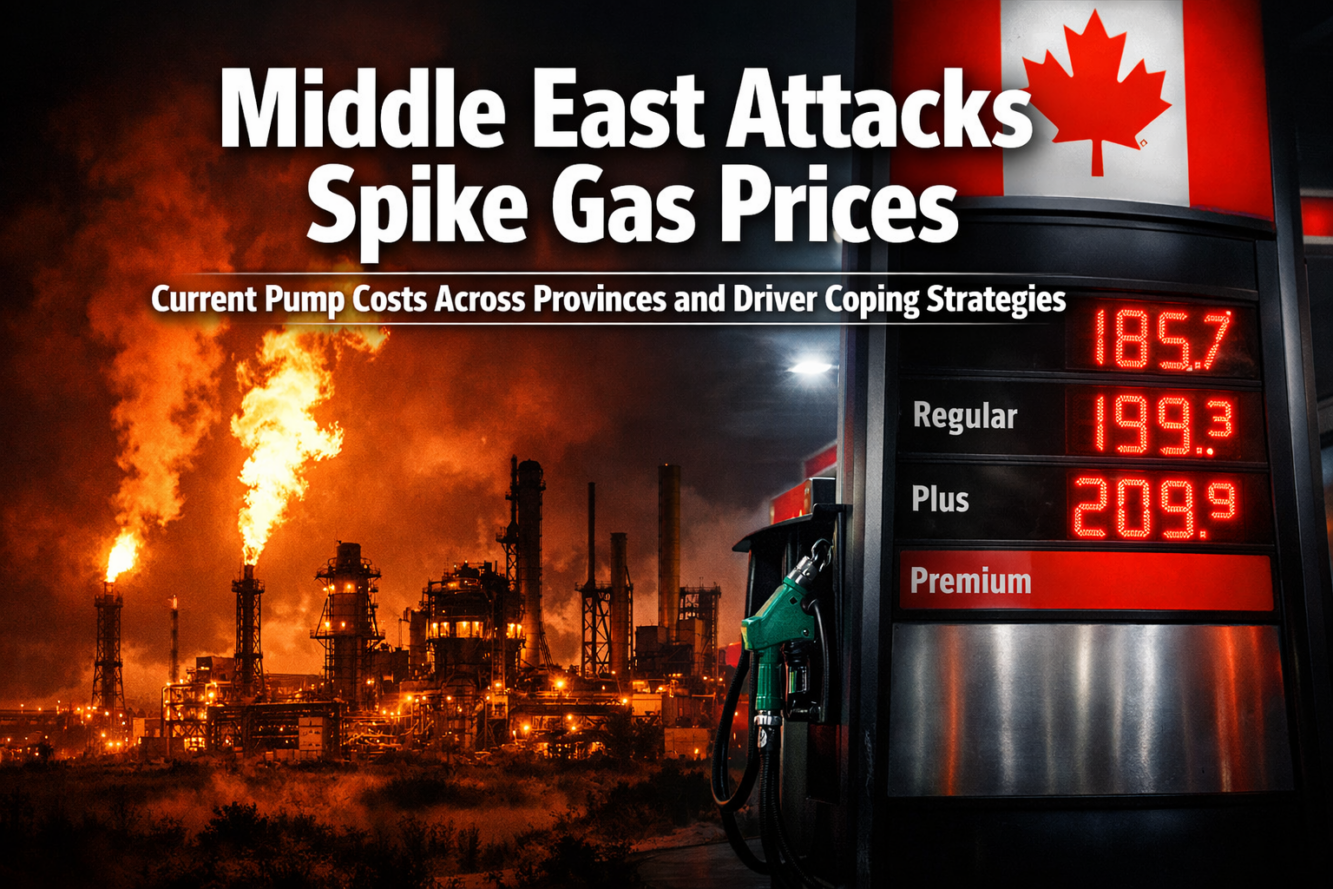
The price at the pump is climbing fast — and there’s no sign of relief. Since late February 2026, Middle East attacks spike gas prices across Canada and around the world, leaving drivers scrambling for ways to cope. Iranian strikes on critical energy infrastructure have triggered the largest oil supply shock in modern history, and Canadian provinces are feeling the pain every time they fill up. This article breaks down what’s happening, what you’re paying right now, and what you can do about it.
Key Takeaways
- ⛽ Gas prices across Canadian provinces have surged 25–35% since the Middle East conflict escalated in late February 2026.
- 💥 Iranian attacks on Qatar’s Ras Laffan facility — the world’s largest LNG production site — have fundamentally disrupted global energy supply [1].
- 📈 Brent crude has topped $114 per barrel, up more than 50% in a single month [4].
- 🚗 Drivers can take practical steps to reduce fuel costs, from route planning to vehicle maintenance.
- 🌍 The disruption is expected to last at least two months, with further attacks threatening even higher prices [2].
How Middle East Attacks Spike Gas Prices: The Global Supply Shock Explained
To understand why Canadian drivers are paying so much more, it helps to look at the source of the crisis.
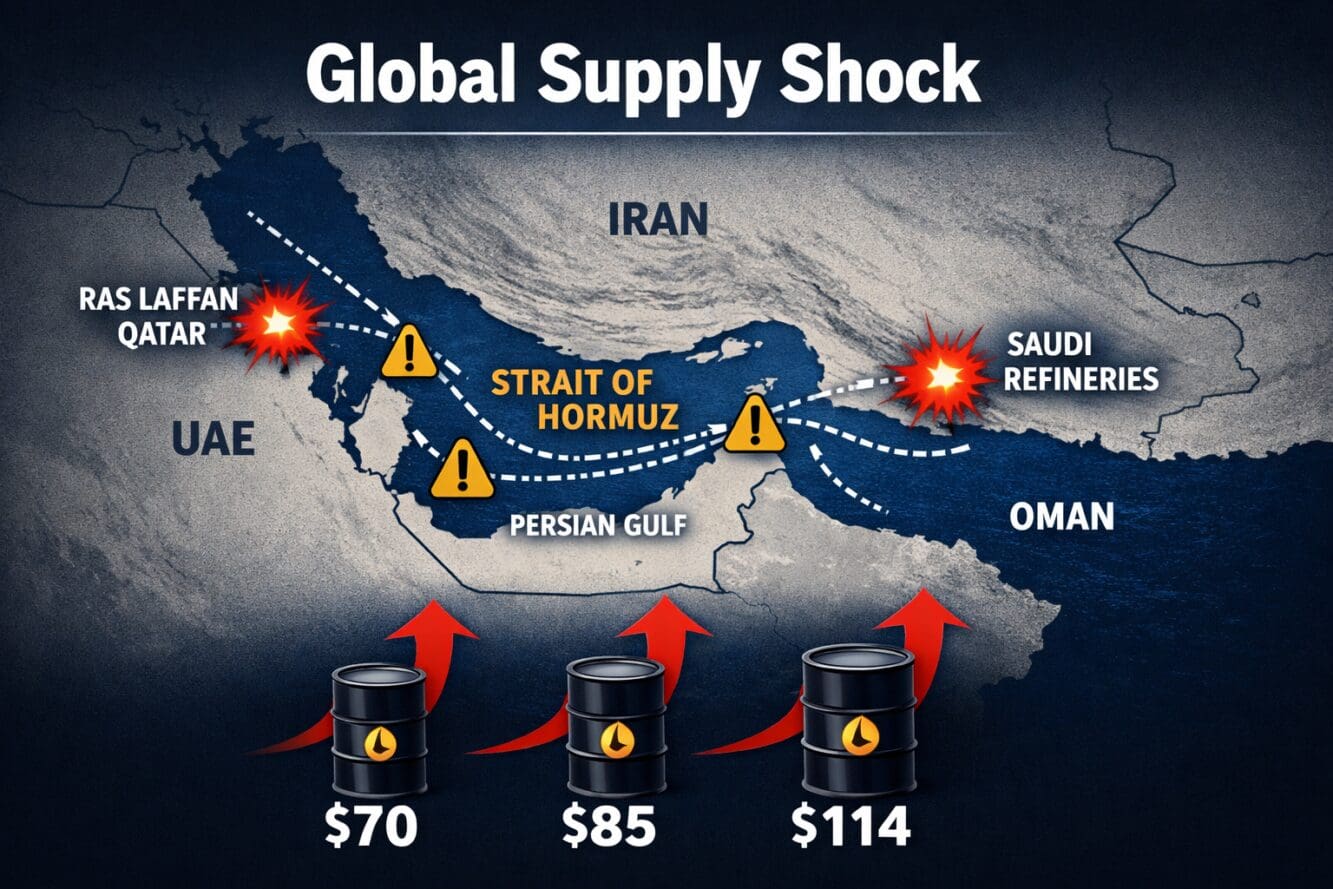
On February 28, 2026, a broader military conflict erupted in the Middle East. Iranian strikes have targeted some of the world’s most critical energy infrastructure, including Qatar’s Ras Laffan facility — the largest liquefied natural gas (LNG) production site on the planet [1]. Qatar is the world’s second-largest LNG exporter behind the United States, and the damage to Ras Laffan has been described as “considerable” [1].
The consequences have been swift and severe:
- European gas prices surged 30% on March 20 alone, with the Dutch TTF benchmark jumping to 72.45 euros per megawatt hour [1].
- Global LNG supply has shrunk by almost a fifth since QatarEnergy halted production on March 2 [2].
- The Strait of Hormuz, which normally handles roughly 20% of global oil and LNG supply, has been effectively blocked by attacks on commercial shipping [2].
- Middle East output has been slashed by 7–10 million barrels per day, representing 7–10% of world demand [3].
💬 “This fundamentally alters the global gas market outlook.” — Wood Mackenzie analysis [2]
Iran has also threatened further attacks on Saudi Arabia, the UAE, and additional Qatari targets, with two oil refineries in Riyadh already caught in the crossfire [2]. Energy analysts at Rystad Energy warn that any further strikes on infrastructure could push oil prices up by at least another $10 per barrel [2].
This crisis echoes broader concerns about how geopolitical instability strains energy systems and the urgent need to diversify energy sources.
Current Pump Costs Across Provinces: What Canadians Are Paying in 2026
The global oil shock has translated directly into higher prices at Canadian gas stations. While prices vary by province due to differences in taxes, transportation costs, and refinery access, the trend is universally upward.
Estimated Average Gas Prices by Province (March 2026)
| Province | Avg. Price per Litre (CAD) | Change Since Feb 2026 |
|---|---|---|
| British Columbia | $2.25 – $2.40 | ⬆️ +30% |
| Alberta | $1.75 – $1.90 | ⬆️ +28% |
| Saskatchewan | $1.80 – $1.95 | ⬆️ +27% |
| Manitoba | $1.85 – $2.00 | ⬆️ +26% |
| Ontario | $1.95 – $2.15 | ⬆️ +29% |
| Quebec | $2.05 – $2.20 | ⬆️ +28% |
| New Brunswick | $2.00 – $2.15 | ⬆️ +27% |
| Nova Scotia | $2.05 – $2.18 | ⬆️ +28% |
| PEI | $2.08 – $2.20 | ⬆️ +27% |
| Newfoundland & Labrador | $2.10 – $2.25 | ⬆️ +29% |
Note: Prices are approximate and fluctuate daily based on local market conditions.
British Columbia continues to lead the country in fuel costs, driven by its carbon tax and limited refinery capacity. Alberta, despite being Canada’s oil-producing heartland, has not been spared — global benchmark prices override local production advantages when international supply is this disrupted.
In the United States, fuel prices have risen approximately 30% since the conflict began, moving toward $4 per gallon as oil surged from $70 to over $100 per barrel [3]. With Brent crude recently trading between $109 and $114 per barrel [3][4] and WTI crude near $94–$95 [3], there is little reason to expect Canadian prices will drop anytime soon.
The discussion around fossil fuel dependency is more relevant than ever. As many experts argue, gas fuels the climate problem, not the solution, and events like these underscore the vulnerability of oil-dependent economies.
Driver Coping Strategies: How to Save Money at the Pump
While individual drivers can’t control global oil markets, there are proven strategies to reduce the financial hit. Here are practical steps Canadians are using right now:
🚗 1. Optimize Driving Habits
- Drive at steady speeds. Aggressive acceleration and hard braking can increase fuel consumption by up to 33% on highways.
- Use cruise control on long stretches to maintain consistent speed.
- Reduce idling. Turning off the engine during waits of more than 60 seconds saves fuel.
🛠️ 2. Maintain Your Vehicle
- Check tire pressure monthly. Under-inflated tires increase rolling resistance and waste fuel.
- Replace air filters on schedule — a clogged filter forces the engine to work harder.
- Use the recommended grade of motor oil to reduce engine friction.
📱 3. Use Gas Price Apps
Apps like GasBuddy and Waze help drivers find the cheapest fuel nearby. Price differences of 10–15 cents per litre between stations in the same city are common, especially during volatile markets.
🚌 4. Explore Alternatives
- Carpool with coworkers or neighbours to split costs.
- Use public transit where available, even for part of the commute.
- Combine errands into a single trip to reduce total kilometres driven.
⚡ 5. Consider the Long-Term Shift
This crisis is accelerating conversations about the shift to cleaner energy. Electric vehicles (EVs), hybrid models, and even e-bikes are seeing increased interest as Canadians look for ways to insulate themselves from oil price volatility. For those concerned about the broader environmental picture, understanding why protectors are prosecuted and polluters praised adds important context to the energy debate.
What Comes Next: The Outlook for Gas Prices in 2026
The situation remains deeply uncertain. According to Wood Mackenzie, the disruption to global natural gas supply is expected to last longer than two months [2]. European natural gas prices have nearly doubled since the war began on February 28 [2], and every new escalation sends prices higher.
Key factors to watch:
- Further Iranian attacks on Saudi, Qatari, or Emirati infrastructure could push Brent crude well above $120 [2].
- Strait of Hormuz access remains the single biggest variable — if shipping lanes stay blocked, the supply crunch deepens.
- OPEC+ response — whether other producers can ramp up output to offset lost Middle East barrels.
- Strategic petroleum reserve releases by the US, Canada, and other nations may offer temporary relief.
The geopolitical dimensions of this crisis are vast. Decisions by major powers — including recent shifts in U.S. military posture — add layers of complexity to an already volatile situation. Meanwhile, the economic ripple effects touch everything from food security for future generations to broader economic stability.
Conclusion
Middle East attacks spike gas prices in ways that affect every Canadian driver, from Vancouver to St. John’s. With Brent crude above $114, global LNG supply down nearly 20%, and no diplomatic resolution in sight, elevated pump costs are the reality for the foreseeable future.
Here’s what to do right now:
- ✅ Download a gas price comparison app and start tracking the cheapest stations in your area.
- ✅ Check your tire pressure and schedule basic vehicle maintenance to maximize fuel efficiency.
- ✅ Plan your trips — combine errands, carpool when possible, and avoid unnecessary driving.
- ✅ Stay informed — prices are changing daily, and further escalations could push costs even higher.
- ✅ Think long-term — consider whether an EV or hybrid makes sense for your next vehicle purchase.
The crisis is a stark reminder of how connected global events are to everyday life at the gas pump. Being proactive now can save hundreds of dollars over the coming months.
References
[1] European Gas Prices Up 30 Per Cent After Attacks On Middle East Infrastructure – https://www.belganewsagency.eu/european-gas-prices-up-30-per-cent-after-attacks-on-middle-east-infrastructure
[2] Oil And Natural Gas Prices Jump As Strikes On Middle East Production Facilities Escalate – https://krdo.com/news/2026/03/19/oil-and-natural-gas-prices-jump-as-strikes-on-middle-east-production-facilities-escalate/
[3] Middle East War Oil Prices Us Gas Stations Impact – https://www.mostedge.com/blog/middle-east-war-oil-prices-us-gas-stations-impact
[4] Watch – https://www.youtube.com/watch?v=gnuZEau5yA8
Content, illustrations, and third-party video appearing on GEORGIANBAYNEWS.COM may be generated or curated with AI assistance or reproduced pursuant to the fair dealing provisions of the Copyright Act, R.S.C. 1985, c. C-42. Attribution and hyperlinks to original sources are provided in acknowledgment of applicable intellectual property rights. Such referencing is intended to direct traffic to and support the original rights holders’ platforms.