
























MLP Trade Window #1 Winners and Losers: How Cash Deals and Player Swaps Are Reshaping 2026 Competitive Dynamics


Last updated: February 22, 2026
Key Takeaways
- Chicago Slice executed aggressive multi-trade strategy, acquiring Hunter Johnson and Zane Navratil within 48 hours while managing salary flexibility through cash receipts
- Las Vegas Night Owls filled their roster from four to six players through strategic acquisitions but face an immediate forced drop due to consolidation rules
- Texas Ranchers initiated a complete women’s roster rebuild, trading away Kaitlyn Christian and Tina Pisnik while signaling long-term restructuring
- Cash-for-player restrictions created a two-tier trading environment, benefiting Challenger-promoted teams and organizations with roster gaps
- Atlanta Bouncers emerged as clear winners, adding Jay Devilliers and Kaitlyn Christian to create exceptional depth alongside their existing core
- Dallas Flash faces critical keeper deadline pressure after trading away two players for cash, leaving difficult retention decisions
- Bay Area Breakers efficiently leveraged their Challenger promotion, acquiring three players across two trades to fill all six required roster spot.

Quick Answer

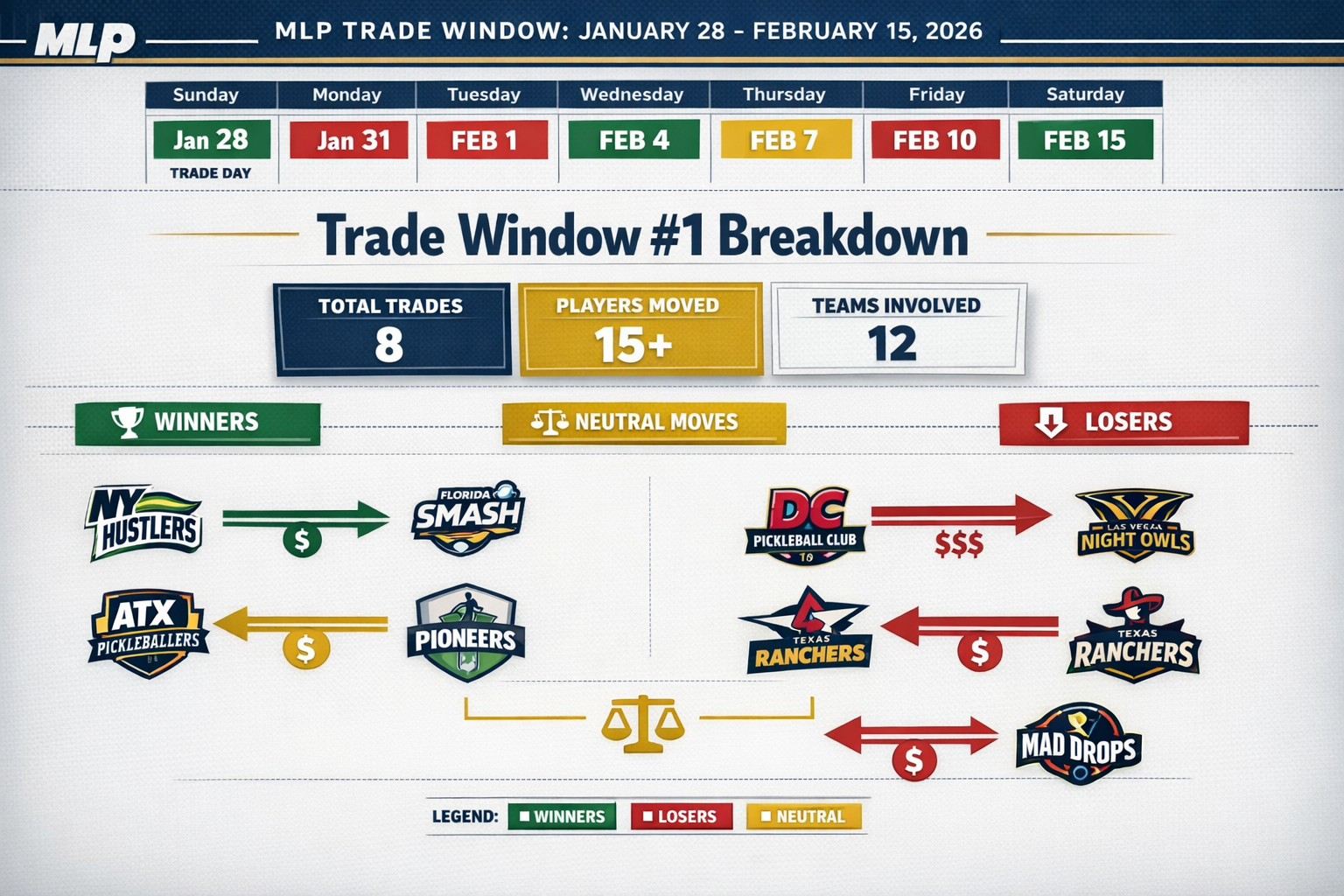
Major League Pickleball’s Trade Window #1 closed on February 15, 2026, with eight trades executed across 17 days, fundamentally reshaping competitive dynamics for the season ahead. The Atlanta Bouncers and Chicago Slice emerged as clear winners through aggressive acquisitions, while the Dallas Flash and Texas Ranchers face rebuilding challenges after trading productive players for cash. Cash-for-player restrictions created strategic advantages for Challenger-promoted teams, and keeper fee asymmetries forced difficult salary-driven roster decisions across the league.[1][2]

What Happened During MLP Trade Window #1?
Trade Window #1 ran from January 28 through February 15, 2026, producing eight confirmed trades that moved more than 15 players across 12 different teams. The window represented a measured rather than frenzied market, with teams prioritizing early roster clarity before the February 27 Free Agency Draft.[1][2]
The trading period featured several distinct patterns:
- Multi-team blockbuster trades involving three or four organizations simultaneously
- Cash-for-player deals that signaled financial constraints and rebuilding priorities
- Targeted acquisitions designed to complement existing roster cores
- Challenger team consolidation as promoted organizations filled mandatory six-player rosters
One of the most complex transactions occurred on February 10, involving four teams: Las Vegas Night Owls, Carolina Hogs, Bay Area Breakers, and a multi-player swap that included Brandon French, Liz Truluck, Angie Walker, DJ Young, James Delgado, Ivan Jakovljevic, and Samantha Parker.[1]
The compressed 17-day timeline created urgency for teams to establish their keeper strategies before the mandatory roster declaration deadline. Teams needed at least six UPA-signed players to compete in 2026, and only organizations with fewer than six players could execute cash-for-player trades during this window.[3]
Key restriction: Cash-for-player trades were limited to teams below the six-player threshold, creating a two-tier trading environment that concentrated competitive advantages among specific organizations, particularly Challenger-promoted teams like Bay Area, California, Florida, and Las Vegas.[3]

Who Were the Clear Winners in MLP Trade Window #1?
The Atlanta Bouncers dominated Trade Window #1 through strategic, back-to-back acquisitions that transformed their competitive depth. On January 31, they acquired Jay Devilliers from Miami Pickleball Club, then immediately followed up on February 1 by adding Kaitlyn Christian from Texas Ranchers.[1][2]
These moves created exceptional roster strength:
- Existing core: Jaume Martinez Vich and Rachel Rettger
- New additions: Jay Devilliers (proven singles specialist) and Kaitlyn Christian (experienced women’s doubles player)
- Strategic fit: Both acquisitions filled specific competitive gaps without creating salary cap pressure
The Bouncers paid cash in both transactions, demonstrating financial flexibility while avoiding problematic keeper fee commitments. Christian’s acquisition was particularly valuable because Texas was actively rebuilding their women’s roster, making her available at a reasonable cost.[1]
Chicago Slice also emerged as a winner through aggressive execution. They acquired Hunter Johnson with cash on January 30, then pivoted within 24 hours to add Zane Navratil from New Jersey 5s on January 31.[1][2] While their overall strategic direction remains unclear, they secured productive role players while maintaining salary flexibility.
The LA Mad Drops made a single but highly impactful move, acquiring Max Freeman on January 30. This directly addressed their winning formula by pairing Freeman with Ben Johns, though it creates roster optimization challenges around female player positioning in mixed doubles.[1][4]
“The Bouncers’ back-to-back acquisitions demonstrate how teams with existing roster strength can leverage Trade Window #1 to add depth without sacrificing future flexibility.” – Analysis from The Dink Pickleball[1]
For those interested in competitive pickleball strategy, our guide to perfecting the pickleball volley provides insights into the technical skills these elite players bring to their new teams.
Which Teams Lost Ground During Trade Window #1 Winners and Losers Analysis?
The Dallas Flash faces the most challenging position after Trade Window #1. They accepted cash for Roscoe Bellamy and Samantha Parker on February 6, leaving them with only four players: Jorja Johnson, Tyra Black, JW Johnson, and Augie Ge.[2]
This creates a critical keeper deadline dilemma:
- Problem: Must choose between the two Johnson siblings or Hurricane Tyra Black for retention
- Constraint: All three players carry significant keeper costs
- Timeline pressure: Keeper declarations due immediately after Trade Window #1 closes
- Strategic bind: Any choice weakens either their men’s or women’s competitive strength
The Texas Ranchers initiated a complete women’s roster rebuild that signals short-term competitive decline. They traded away Kaitlyn Christian (February 1) and Tina Pisnik (February 6) while receiving Victoria DiMuzio, who carries a $70,000 annual keeper cost.[1] Analysis suggests the Ranchers may struggle to retain DiMuzio due to salary constraints, making this a transitional year.
New Jersey 5s gradually depleted their roster by losing Zane Navratil to Chicago for cash considerations on January 31. This left them with only five players heading into the draft: Anna Leigh Waters, Will Howells, Meghan Dizon, Noe Khlif, and Mari Humberg.[1][2] While they still have Anna Leigh Waters as a franchise cornerstone, the loss of depth creates vulnerability.
The Miami Pickleball Club traded Jay Devilliers to Atlanta on January 31, receiving Eric Roddy and cash.[1] While this wasn’t necessarily a losing move, it represents a roster reset after a frustrating 2025 campaign, with their lineup becoming almost entirely different from the previous season.
Common mistake: Teams accepting cash for productive players often underestimate the difficulty of replacing that talent in the Free Agency Draft, where competition for remaining quality players intensifies significantly.
How Did Cash-for-Player Trades Shape MLP Trade Window #1 Winners and Losers?
Cash-for-player trades created a fundamental divide in Trade Window #1 strategy. Only teams with fewer than six UPA-signed players could trade cash for players, creating a two-tier environment that benefited specific organizations.[3]
Teams that leveraged cash-for-player rules:
| Team | Players Acquired | Strategic Advantage |
|---|---|---|
| Bay Area Breakers | Ivan Jakovljevic, Samantha Parker, Pablo Tellez | Filled all six roster spots efficiently as Challenger promotion |
| Las Vegas Night Owls | Roscoe Bellamy, Samantha Parker, Pablo Tellez | Consolidated 2025 Challenger championship roster |
| Chicago Slice | Hunter Johnson, Zane Navratil | Built depth while maintaining salary flexibility |
| Atlanta Bouncers | Jay Devilliers, Kaitlyn Christian | Added talent to existing core without cap pressure |
The restriction differentially benefited Challenger-promoted teams (Bay Area, California, Florida, Las Vegas) who entered 2026 with fewer than six players and needed to fill mandatory roster spots.[3] These teams could offer cash to acquire established talent without sacrificing draft capital or future keeper commitments.
Dallas Flash and Texas Ranchers took the opposite approach, accepting cash for productive players. This signals either:
- Financial constraints requiring immediate cash infusion
- Rebuilding priorities that value future flexibility over current competitiveness
- Keeper fee management to avoid long-term salary commitments
The Flash received cash for Bellamy and Parker, while the Ranchers received cash for Christian and Pisnik. Both teams now face challenging Free Agency Draft positions with depleted rosters.[1][2]
Edge case: Las Vegas Night Owls won the final Challenger championship in 2025 but faced forced consolidation into the unified 20-team structure. They filled a six-player roster yet must immediately drop one player, creating an awkward situation where recent acquisitions might be released.[4]
What Role Did Keeper Fees Play in Reshaping 2026 Competitive Dynamics?
Keeper fee asymmetries created dramatic strategic complexity during Trade Window #1. The cost to retain players for 2026 and beyond directly influenced which teams acquired specific talent and which teams chose to rebuild.
Notable keeper fee disparities:
- Samantha Parker: $30,000 keeper cost (exceeds combined costs of Las Vegas’s other five players)[4]
- Tina Pisnik: $69,000 keeper cost (made her difficult for Texas to retain despite productivity)[1]
- Layne Sleeth: $0 keeper cost through 2026 (making her extremely valuable for Texas’s rebuild)[1]
- Victoria DiMuzio: $70,000 annual keeper cost (creating retention doubts for Texas)[1]
- Alix Truong: $500 keeper cost through 2026 (exceptional value for Miami)[1]
These fee structures created misaligned incentives between immediate roster construction and long-term team building. Texas Ranchers acquired Layne Sleeth from California Black Bears on February 7 specifically because her $0 keeper fee provides maximum flexibility during their women’s roster rebuild.[1]
Conversely, Parker’s $30,000 keeper cost makes her a likely drop candidate for Las Vegas despite being recently acquired. The Night Owls filled their roster from four to six players but must immediately drop one player due to consolidation rules, and Parker’s salary makes her the obvious choice.[4]
Choose this approach if: You’re rebuilding and need long-term flexibility—prioritize players with low or zero keeper fees like Sleeth ($0) or Truong ($500).
Choose this approach if: You’re competing for championships now—accept higher keeper fees like DiMuzio ($70,000) or Pisnik ($69,000) if the immediate competitive value justifies the cost.
The Bay Area Breakers made a calculated decision when trading Layne Sleeth to Texas for cash. While Sleeth could have been a building block, the Breakers could only keep her for one year guaranteed. Obtaining cash to fill out their entire roster as a Challenger-promoted team made more strategic sense.[1]
How Did Multi-Team Blockbuster Trades Impact Competitive Balance?
The February 10 four-team trade represented the most complex transaction of Trade Window #1, involving Las Vegas Night Owls, Carolina Hogs, Bay Area Breakers, and multiple player movements.[1]
Trade breakdown:
- Las Vegas Night Owls received: Brandon French, Liz Truluck
- Carolina Hogs received: Angie Walker, DJ Young, James Delgado, cash
- Bay Area Breakers received: Samantha Parker, Ivan Jakovljevic, cash
This transaction accomplished several strategic objectives simultaneously:
- Las Vegas consolidated talent from their Challenger championship roster
- Carolina rebuilt their competitive core with three productive players
- Bay Area efficiently filled roster spots as a promoted team
The complexity of multi-team trades creates opportunities for organizations to solve multiple roster challenges in a single transaction. Carolina acquired three players in one move, accelerating their rebuild significantly compared to piecemeal Free Agency Draft selections.
However, multi-team trades also create coordination challenges:
- Salary cap implications must work for all parties simultaneously
- Keeper fee structures need to align with each team’s long-term strategy
- Competitive balance concerns when one team appears to gain disproportionate value
Bay Area Breakers leveraged their Challenger promotion status exceptionally well. They acquired three players across two trades (Ivan Jakovljevic, Samantha Parker, Pablo Tellez), efficiently filling all six roster spots required for 2026.[2] This positioned them competitively without sacrificing future draft capital.
Common mistake: Teams involved in multi-team trades sometimes focus too heavily on immediate roster fills without considering how keeper fees will constrain future flexibility, as Las Vegas discovered with Parker’s $30,000 cost.
What Strategic Patterns Emerged From MLP Trade Window #1 Winners and Losers?
Trade Window #1 revealed several distinct strategic approaches that will shape the 2026 season:
Aggressive Acquisition Strategy
Teams like Chicago Slice and Atlanta Bouncers executed rapid, back-to-back trades to build depth quickly. Chicago acquired Hunter Johnson and Zane Navratil within 48 hours, while Atlanta added Devilliers and Christian in consecutive days.[1][2]
Advantages:
- ✅ Secures talent before Free Agency Draft competition intensifies
- ✅ Demonstrates organizational decisiveness to remaining free agents
- ✅ Creates roster flexibility for keeper deadline decisions
Disadvantages:
- ❌ May overpay in cash or keeper fees due to urgency
- ❌ Limits ability to assess how initial acquisitions fit before adding more
- ❌ Reduces cash reserves for later opportunities
Rebuilding Through Cash Accumulation
Dallas Flash and Texas Ranchers prioritized cash receipts over immediate competitiveness, trading productive players to accumulate resources for future roster construction.[1][2]
Advantages:
- ✅ Eliminates problematic keeper fee commitments
- ✅ Provides financial flexibility for Free Agency Draft
- ✅ Signals clear rebuilding timeline to remaining players
Disadvantages:
- ❌ Creates short-term competitive weakness
- ❌ Risks losing fan engagement during rebuilding year
- ❌ Depends on successful Free Agency Draft execution to replace talent
Challenger Consolidation Strategy
Las Vegas Night Owls and Bay Area Breakers used their Challenger promotion status to rapidly fill mandatory six-player rosters through cash-for-player trades.[1][2][4]
Advantages:
- ✅ Exploits cash-for-player trading rules unavailable to established teams
- ✅ Quickly establishes competitive baseline roster
- ✅ Preserves draft capital for targeted Free Agency selections
Disadvantages:
- ❌ May acquire players with misaligned keeper fee structures
- ❌ Forces immediate drop decisions due to consolidation rules
- ❌ Limits ability to build cohesive team chemistry before season
For insights into how professional pickleball teams build competitive rosters, explore our coverage of local pickleball community development.
How Will Trade Window #1 Decisions Impact the February 27 Free Agency Draft?
The February 27 Free Agency Draft will directly reflect the strategic decisions made during Trade Window #1. Teams that aggressively acquired talent now face different draft priorities than rebuilding organizations.
Teams entering draft with strong positions:
- Atlanta Bouncers: Four roster spots filled, can target specific skill gaps
- Chicago Slice: Four roster spots filled, flexibility to add complementary talent
- Las Vegas Night Owls: Six roster spots filled (must drop one), minimal draft needs
Teams entering draft with urgent needs:
- Dallas Flash: Four roster spots filled, must add two quality players immediately
- Texas Ranchers: Rebuilding women’s roster, need multiple draft selections
- New Jersey 5s: Five roster spots filled, one critical addition needed
The draft will also reveal which teams successfully managed keeper fees during Trade Window #1. Organizations that accumulated cash through player sales (Dallas, Texas, Miami) can now deploy those resources to acquire remaining free agents, but they’ll face intense competition from teams with unfilled roster spots.
Challenger-promoted teams (Bay Area, California, Florida, Las Vegas) have largely completed their roster construction through Trade Window #1, giving them draft flexibility to target high-upside players rather than filling mandatory spots.[2][3]
Strategic consideration: Teams that traded for players with high keeper fees (like Texas acquiring DiMuzio at $70,000) may need to drop those acquisitions before the draft if they cannot justify the long-term salary commitment, creating unexpected free agent availability.[1]
What Are the Biggest Roster Questions Heading Into 2026?
Several critical roster questions emerged from Trade Window #1 that will define the 2026 competitive landscape:
Will Las Vegas Night Owls drop Samantha Parker?
Parker’s $30,000 keeper cost exceeds the combined costs of Las Vegas’s other five players, making her the obvious drop candidate despite being recently acquired. However, her competitive value might justify the expense if the Night Owls are serious about championship contention.[4]
Can Texas Ranchers successfully rebuild their women’s roster?
The Ranchers traded away Christian and Pisnik while acquiring DiMuzio ($70,000 keeper) and Sleeth ($0 keeper). The dramatic difference in keeper fees suggests they may drop DiMuzio and build around Sleeth, but this creates immediate competitive weakness.[1]
How will Dallas Flash resolve their keeper deadline dilemma?
With only four players (Jorja Johnson, Tyra Black, JW Johnson, Augie Ge), the Flash must choose between retaining both Johnson siblings or keeping Hurricane Tyra Black. Either choice weakens a critical roster component.[2]
Did Miami Pickleball Club improve through their roster reset?
Miami’s lineup will be almost entirely different from 2025 to 2026 after trading Devilliers and acquiring Truong. While Truong’s $500 keeper fee provides exceptional value, the team must prove this reset improves competitive outcomes.[1]
Can Bay Area Breakers compete immediately after Challenger promotion?
The Breakers efficiently filled all six roster spots through strategic trades, but their ability to compete against established teams with championship experience remains uncertain. Their success will test whether efficient roster construction translates to on-court performance.[2]
Edge case: California Black Bears came up from Challenger with only four players and traded Sleeth for cash rather than building around her. This suggests they’re prioritizing financial stability over immediate competitiveness, which may create a multi-year rebuilding timeline.[1]
What Lessons Can Teams Learn From Trade Window #1 Winners and Losers?
Trade Window #1 provided several clear lessons for MLP organizations approaching future trading periods:
Lesson 1: Keeper Fee Management Is Critical
Teams that ignored keeper fee implications (like Las Vegas with Parker) created immediate roster problems despite successful player acquisitions. Organizations must evaluate not just player quality but long-term salary commitments.[4]
Action step: Before acquiring any player, calculate total keeper fees across your entire roster through 2027-2028 to ensure sustainable salary structure.
Lesson 2: Cash-for-Player Rules Create Temporary Advantages
Challenger-promoted teams exploited cash-for-player trading rules to fill rosters efficiently, but this advantage disappears once they reach six players. Organizations should maximize this window aggressively.[3]
Action step: If you’re below six players, prioritize cash-for-player trades during Trade Window #1 before this option becomes unavailable.
Lesson 3: Rebuilding Requires Clear Communication
Texas Ranchers and Dallas Flash both initiated rebuilds through cash accumulation, but the success of this strategy depends on effective Free Agency Draft execution and clear messaging to fans about competitive timelines.[1][2]
Action step: Teams accepting cash for productive players should publicly articulate their rebuilding vision to maintain fan engagement during transitional seasons.
Lesson 4: Multi-Team Trades Solve Multiple Problems Simultaneously
The February 10 four-team trade demonstrated how complex transactions can address roster needs for multiple organizations efficiently, though coordination challenges increase with each additional party.[1]
Action step: Consider multi-team trade structures when you have assets another team values but don’t receive direct value from their roster—a third team might complete the transaction.
Lesson 5: Aggressive Early Action Creates Competitive Advantage
Atlanta Bouncers and Chicago Slice secured quality talent through rapid execution before Free Agency Draft competition intensified, demonstrating the value of decisive early moves.[1][2]
Action step: Identify your top three trade targets before Trade Window #1 opens and execute immediately rather than waiting to see how the market develops.
For more insights into competitive sports strategy and community building, check out our coverage of local sports events and competitions.
Conclusion
MLP Trade Window #1 fundamentally reshaped the competitive landscape for the 2026 season through eight strategic trades executed across 17 days. The Atlanta Bouncers and Chicago Slice emerged as clear winners through aggressive talent acquisition, while the Dallas Flash and Texas Ranchers face rebuilding challenges after trading productive players for cash. Cash-for-player restrictions created a two-tier trading environment that benefited Challenger-promoted teams, and keeper fee asymmetries forced difficult salary-driven roster decisions across the league.
The February 27 Free Agency Draft will reveal whether teams that accumulated cash through player sales can successfully deploy those resources to rebuild competitive rosters. Organizations that managed keeper fees effectively during Trade Window #1 will have greater flexibility to add talent without creating unsustainable salary commitments.
Next steps for MLP teams:
- Declare keepers by the February 20 deadline (dropping at least one player)
- Prepare Free Agency Draft strategy based on remaining roster needs
- Evaluate keeper fee structures to ensure long-term salary sustainability
- Communicate rebuilding timelines clearly to fans if pursuing multi-year roster reconstruction
The 2026 MLP season begins in Dallas, TX, on May 22-25, giving teams three months to finalize rosters and build chemistry before competitive play begins.[6] Trade Window #1 winners like Atlanta and Chicago will enter the season with immediate championship expectations, while rebuilding organizations like Dallas and Texas must execute flawlessly in the Free Agency Draft to remain competitive.
FAQ
When did MLP Trade Window #1 close?
Trade Window #1 closed on February 15, 2026, at 10:00 a.m. ET. Teams had from January 28 through February 15 to execute trades, resulting in eight confirmed transactions across 17 days.[1][2]
Which team made the best trades during Trade Window #1?
The Atlanta Bouncers made the best trades by acquiring Jay Devilliers and Kaitlyn Christian in back-to-back moves on January 31 and February 1. These additions created exceptional roster depth alongside their existing core of Jaume Martinez Vich and Rachel Rettger without creating problematic keeper fee commitments.[1][2]
Can teams still make trades after Trade Window #1 closes?
No, teams cannot make trades after Trade Window #1 closes until a future trading window opens. The next opportunity for roster changes will be the Free Agency Draft on February 27, 2026, where teams will fill remaining roster spots.[6]
What is the keeper deadline for MLP teams?
The keeper deadline is February 20, 2026, at 8:00 p.m. ET. All teams must declare their keepers by this date, dropping at least one player from their current roster.[1][2]
Why did Las Vegas Night Owls acquire Samantha Parker if they might drop her?
Las Vegas acquired Parker as part of a multi-team trade to fill their mandatory six-player roster after being promoted from Challenger. However, her $30,000 keeper cost exceeds the combined costs of their other five players, making her a likely drop candidate despite her competitive value.[4]
How many players must each MLP team have for 2026?
Each MLP team must have exactly six UPA-signed players for the 2026 season. Teams can have fewer during Trade Window #1 but must reach six players through the Free Agency Draft by the start of the season.[3][6]
What are cash-for-player trades in MLP?
Cash-for-player trades allow teams with fewer than six UPA-signed players to trade cash considerations to acquire players from other teams. This restriction created a two-tier trading environment during Trade Window #1 that benefited Challenger-promoted teams and organizations with roster gaps.[3]
When is the 2026 MLP Free Agency Draft?
The 2026 MLP Free Agency Draft is scheduled for Friday, February 27, 2026. Teams will use this draft to fill remaining roster spots after declaring their keepers on February 20.[6]
Why did Texas Ranchers trade away Kaitlyn Christian and Tina Pisnik?
Texas Ranchers initiated a complete women’s roster rebuild by trading Christian and Pisnik for cash and Victoria DiMuzio. This signals a strategic overhaul prioritizing long-term flexibility over immediate competitiveness, though DiMuzio’s $70,000 keeper fee creates retention questions.[1]
Which teams were promoted from Challenger for 2026?
Bay Area Breakers, California Black Bears, Florida, and Las Vegas Night Owls were promoted from Challenger for the 2026 season as part of MLP’s consolidation into a unified 20-team format.[3][4]
What happens if a team doesn’t have six players by the season start?
Teams must have six UPA-signed players by the start of the 2026 season or they cannot compete. The Free Agency Draft on February 27 provides the final opportunity for teams to reach the mandatory six-player roster requirement.[6]
How do keeper fees work in MLP?
Keeper fees represent the annual cost to retain a player on your roster for the following season. These fees vary dramatically by player (from $0 for Layne Sleeth to $70,000 for Victoria DiMuzio) and directly impact teams’ salary cap management and long-term roster construction strategies.[1][4]
References
[1] 2026 Major League Pickleball Trade Tracker – https://www.thedinkpickleball.com/2026-major-league-pickleball-trade-tracker/
[2] MLP 2026 Trade Window #1 Updates – https://majorleaguepickleball.co/news/mlp-2026-trade-window-1-updates/
[3] Summary Of 2026 Competition Updates – https://majorleaguepickleball.co/news/summary-of-2026-competition-updates/
[4] One Key Insight For Each MLP Transaction Of 2026 So Far – https://www.nmlpickleball.com/opinion/one-key-insight-for-each-mlp-transaction-of-2026-so-far/
[6] Major League Pickleball – https://majorleaguepickleball.co
Content, illustrations, and third-party video appearing on GEORGIANBAYNEWS.COM may be generated or curated with AI assistance or reproduced pursuant to the fair dealing provisions of the Copyright Act, R.S.C. 1985, c. C-42. Attribution and hyperlinks to original sources are provided in acknowledgment of applicable intellectual property rights. Such referencing is intended to direct traffic to and support the original rights holders’ platforms.
Much Appreciate You Sharing This Post - It Helps MUCH!!!