










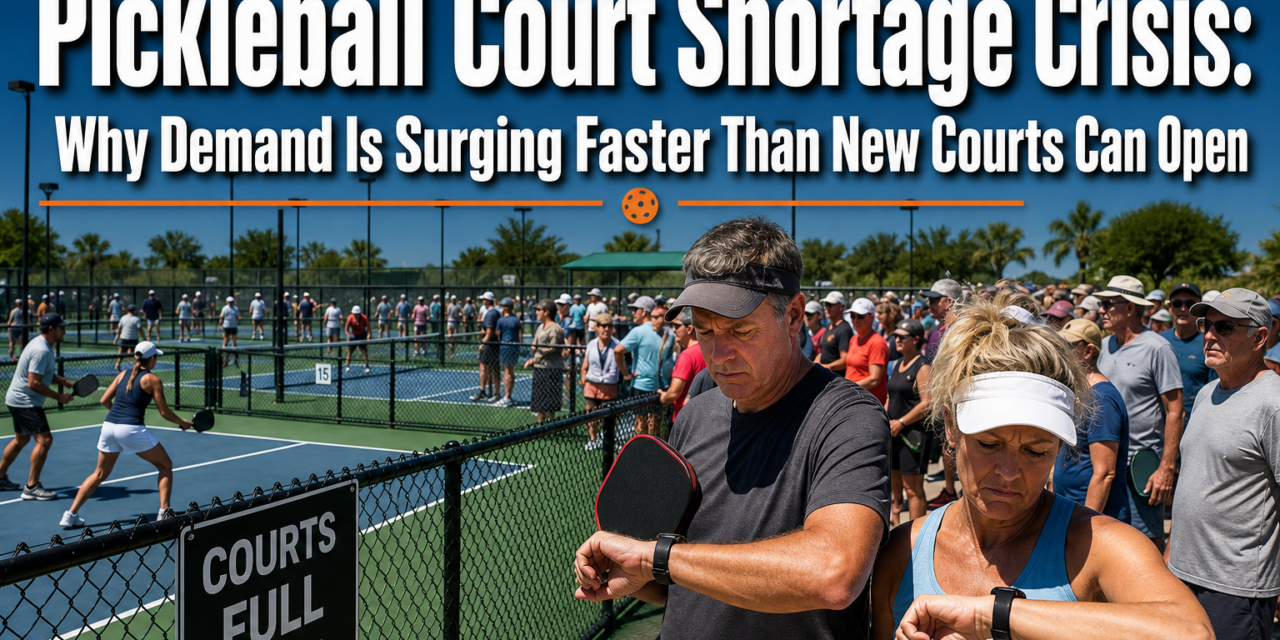
Pickleball Court Shortage Crisis: Why Demand Is Surging Faster Than New Courts Can Open
Estimated reading time: 17 minutes
Last updated: June 12, 2026
Quick Answer
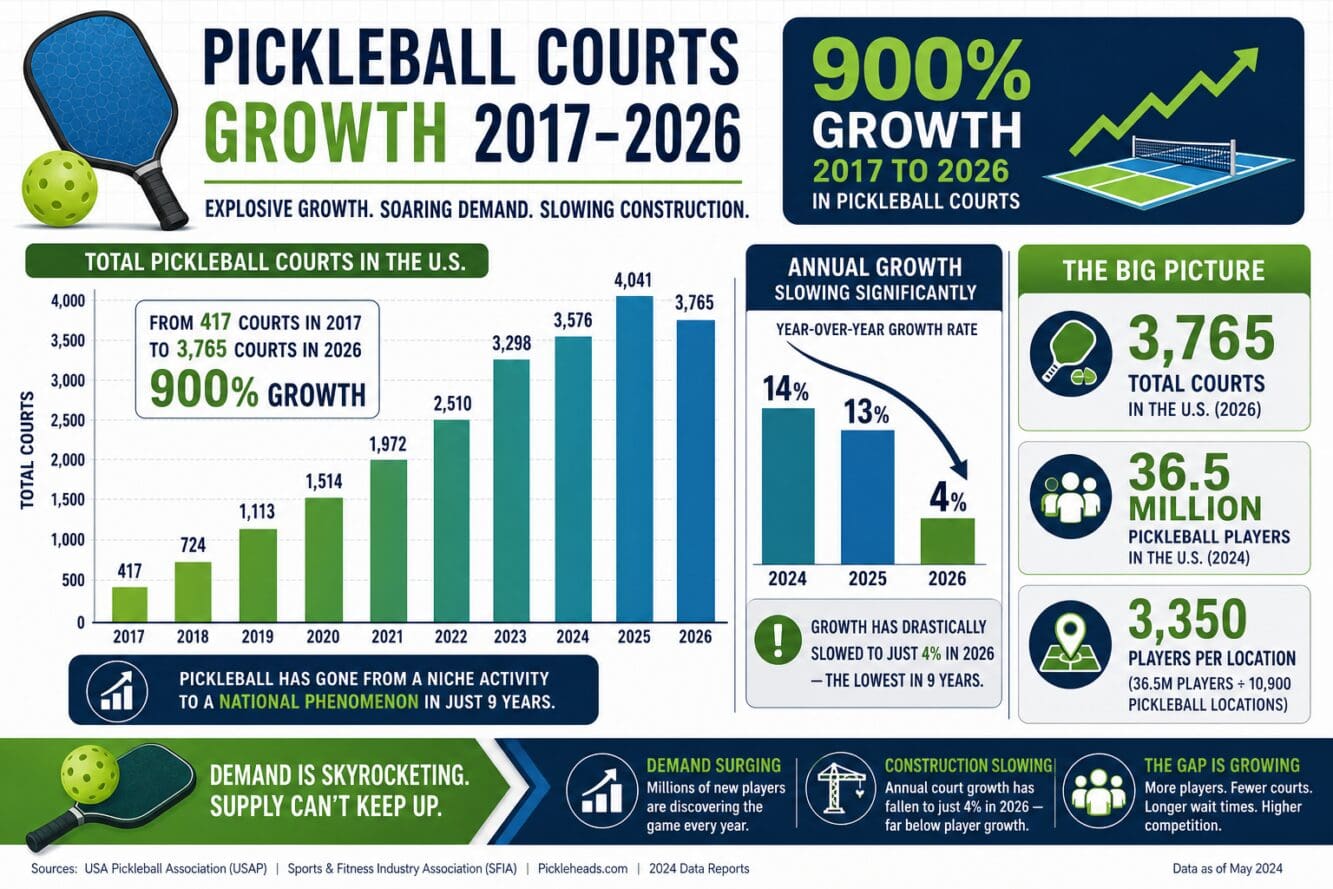
The pickleball court shortage crisis stems from explosive player growth colliding with slow construction timelines, limited public funding, and community pushback. With 36.5 million Americans playing pickleball in 2023 but only about 10,900 court locations nationwide, the player-to-court ratio has reached roughly 3,350 players per location—more than 12 times worse than tennis.[2] Court construction has slowed dramatically to just 4% growth in 2026, down from 13-14% in previous years, even as demand continues surging.[1]
Key Takeaways
- Court construction growth dropped to only 4% in 2026, down from 13% in 2025 and 14% in 2024, despite continued player demand.[1]
- The United States has approximately 3,350 pickleball players per court location compared to just 270 tennis players per court.[2]
- Building a dedicated pickleball court costs between $50,000 and $150,000, with permitting and construction timelines averaging 12-24 months.[2]
- The fastest-growing demographic is now 18-34-year-olds, surpassing the traditional 55+ segment that dominated the sport.[2]
- The U.S. needs an additional 25,000-40,000 pickleball courts by 2028 to meet current demand.[6]
- Average city parks budgets allocate just $98 per resident annually, severely limiting new court construction.[2]
- Noise complaints have led to court closures in some communities, including eight courts permanently shut down in Martinez, California.[4]
- Innovative LED projection systems can create temporary courts in under 30 seconds at 70% lower cost than permanent construction.[2]
What Is the Pickleball Court Shortage Crisis and Why Is It Happening
The pickleball court shortage crisis occurs when player demand vastly outpaces the availability of courts, creating wait times, scheduling conflicts, and access barriers. Between 2017 and 2026, pickleball courts increased by nearly 900%, reaching 3,765 courts in the 100 most populous U.S. cities.[1] However, this growth has not kept pace with participation rates, which saw 36.5 million Americans playing the sport by 2023.[2]
Three primary factors drive this shortage:
Limited public land and zoning restrictions prevent municipalities from quickly adding courts. Most cities face constraints on available park space, and converting existing facilities often triggers community opposition.
Budget limitations severely restrict construction. With average municipal parks budgets of only $98 per resident annually, most cities cannot afford the $50,000-$150,000 per court required for new construction.[2]
Slow approval and construction timelines mean that even when funding exists, permitting and building take 12-24 months on average, making it impossible to respond quickly to surging demand.[2]
The result is a national shortage that experts project will require 25,000-40,000 additional courts by 2028 just to meet current demand levels.[6]
What Exactly Is Pickleball and Why Is It Suddenly So Popular
Pickleball combines elements of tennis, badminton, and ping-pong on a smaller court measuring 44 feet by 20 feet. Players use solid paddles to hit a perforated polymer ball over a 36-inch net, with a unique “kitchen” or non-volley zone extending seven feet from the net on both sides.
The sport’s explosive popularity stems from several advantages:
- Low barrier to entry: Beginners can learn basic gameplay in 15-30 minutes, unlike tennis which requires months of practice.
- Multigenerational appeal: The smaller court and slower ball speed accommodate all ages and fitness levels.
- Social atmosphere: Doubles play is standard, fostering community and conversation between points.
- Affordability: Startup costs are minimal—a quality paddle costs $50-$120, and balls are $2-$3 each.
The fastest-growing demographic is now 18-34-year-olds, who are drawn to the competitive yet accessible nature of the game.[2] This demographic shift increases demand for courts during peak evening and weekend hours, intensifying the shortage.
How Much Does It Cost to Build a New Pickleball Court
Building a dedicated pickleball court costs between $50,000 and $150,000 depending on specifications and location.[2] The cost breakdown typically includes:
- Surface preparation: $15,000-$30,000 for grading, drainage, and base installation
- Court surface: $20,000-$50,000 for asphalt, concrete, or specialized sport surfacing
- Fencing: $8,000-$25,000 for 10-foot perimeter fencing with gates
- Lighting: $12,000-$35,000 for LED sports lighting systems
- Line striping and nets: $2,000-$5,000 for professional court marking and net systems
- Permits and engineering: $3,000-$10,000 for approvals and site plans
Construction timelines average 12-24 months from initial planning to ribbon cutting, with permit approval often consuming 6-9 months of that timeline.[2] These long lead times mean that even well-funded projects cannot quickly address immediate shortages.
Choose permanent construction if you have dedicated space, long-term funding, and community support. Consider temporary or convertible solutions if facing budget constraints, space limitations, or community opposition.
What Age Groups Are Driving Pickleball’s Growth in 2026
The 18-34 age group now represents the fastest-growing pickleball demographic, overtaking the 55+ segment that traditionally dominated the sport.[2] This demographic shift fundamentally changes court demand patterns and intensifies the shortage crisis.
Why younger players are flocking to pickleball:
- Social media exposure has made the sport trendy and visible
- Professional pickleball leagues and tournaments offer competitive pathways
- Younger players seek lower-impact alternatives to basketball and tennis
- The sport fits well into busy schedules with shorter game times
- Corporate and college recreational programs are adding pickleball
Why the 55+ demographic remains strong:
- Joint-friendly gameplay with less running than tennis
- Strong social community and organized leagues
- Retirement communities increasingly include courts as amenities
- Lower injury risk compared to other racquet sports
This multigenerational appeal creates peak demand during all daylight hours, unlike tennis which sees more concentrated usage patterns. The result is that courts remain fully booked from early morning through evening, with many locations maintaining waiting lists.
Where Are the Best Cities for Pickleball Right Now
The best cities for pickleball in 2026 balance high court availability with strong player communities and year-round playability. Regional variations remain significant, with some areas experiencing sustained growth while national construction has slowed.[3]
Top regions for court access:
- Northeast Ohio: Lists over 300 indoor and outdoor pickleball facilities, indicating sustained regional investment despite national slowdown.[3]
- Pacific Northwest: Seattle and Portland maintain strong court-to-player ratios with continued municipal investment.
- Southwest: Phoenix, Las Vegas, and Southern California offer year-round outdoor play with extensive public and private facilities.
- Florida: Naples, Sarasota, and The Villages feature some of the highest court densities per capita.
Factors that make a city pickleball-friendly:
- Court-to-player ratio below 2,000 players per location
- Mix of indoor and outdoor facilities for year-round play
- Active parks departments with dedicated pickleball coordinators
- Strong club infrastructure with organized leagues and tournaments
- Multiple court clusters (4+ courts) rather than isolated single courts
Choose cities with established infrastructure if relocating specifically for pickleball access. The shortage is less severe in regions that invested early in dedicated facilities rather than relying solely on tennis court conversions.
Are Neighborhood Conflicts Happening Over Pickleball Court Space
Yes, neighborhood conflicts over pickleball courts have become increasingly common, with noise complaints and parking issues leading to court closures in several communities. In Martinez, California, the city council voted to permanently close eight pickleball courts due to persistent noise and parking complaints from residents.[4]
Common sources of conflict:
- Noise levels: The distinctive “pop” of paddle hitting ball carries farther than tennis, with some measurements exceeding 70 decibels.
- Extended play hours: Popular courts see continuous use from dawn to dusk, creating sustained noise.
- Parking overflow: Court clusters attract 20-40 players simultaneously, overwhelming nearby street parking.
- Converted tennis courts: Tennis players who lost court access often oppose conversions.
How communities are addressing conflicts:
- Installing sound-dampening fencing and barriers around courts
- Implementing restricted hours (typically 8 AM to 8 PM)
- Requiring advance reservations to manage parking and noise
- Placing courts farther from residential areas in new construction
- Using quieter foam balls during early morning and evening hours
The Martinez closure represents an extreme case, but it highlights the importance of community engagement and proper site selection. Courts placed within 150 feet of residential properties face the highest complaint rates.
How Are Local Parks and Recreation Departments Handling the Demand
Parks and recreation departments face a difficult balancing act between surging pickleball demand, limited budgets, and competing community needs. With average municipal parks budgets of just $98 per resident annually, most departments cannot afford rapid expansion.[2]
Strategies departments are using:
Tennis court conversions: Converting one tennis court creates four pickleball courts, but this triggers opposition from tennis players and requires careful scheduling.
Shared-use scheduling: Implementing time-block reservations allows different user groups to share converted courts throughout the day.
Public-private partnerships: Some cities partner with private clubs or developers to build courts on public land with shared maintenance costs.
Grant applications: Departments pursue state and federal recreation grants, though competition is intense and awards are limited.
Phased construction: Building 2-4 courts initially, then expanding based on usage data and community feedback.
Temporary solutions: Some forward-thinking departments are piloting LED projection systems and portable nets to create courts on multi-use surfaces.[2]
The most successful departments prioritize community input, conduct usage studies before major investments, and plan for long-term maintenance costs rather than just initial construction.
Why Are Tennis Courts Getting Converted to Pickleball Courts
Tennis courts are converting to pickleball courts because one standard tennis court (78 feet by 36 feet) can accommodate four regulation pickleball courts (44 feet by 20 feet each), dramatically increasing capacity on the same footprint. This conversion addresses the court shortage without requiring new land acquisition.
Advantages of conversion:
- Cost-effective: Restriping and adding nets costs $5,000-$15,000 versus $50,000-$150,000 for new construction.[2]
- Fast implementation: Conversions take 1-2 weeks versus 12-24 months for new builds.
- Existing infrastructure: Fencing, lighting, and parking already exist.
- Immediate capacity increase: Four pickleball courts serve 16 players versus four tennis players.
Disadvantages and conflicts:
- Tennis players lose court access, creating community opposition
- Surface quality may not be optimal for pickleball
- Shared scheduling becomes complex and contentious
- Noise complaints increase with four times the activity
Choose conversion when tennis court utilization is below 60% during peak hours, community input supports the change, and you can implement fair scheduling systems. Avoid conversion of heavily-used tennis courts or those adjacent to residential areas without sound mitigation.
What Innovative Solutions Are Emerging to Address the Court Shortage
Innovative temporary and convertible court solutions are emerging as alternatives to expensive permanent construction. Companies like KourtLit have developed LED projection systems that create regulation pickleball courts in under 30 seconds at 70% lower cost than permanent construction.[2]
Emerging solutions:
LED projection courts: Project regulation lines onto any flat surface using LED technology, allowing gymnasiums and multi-purpose spaces to convert instantly between sports.
Modular court surfaces: Interlocking tiles create temporary courts that can be installed, removed, and relocated as needed.
Portable net systems: Professional-grade nets with weighted bases allow any appropriately-sized space to become a court.
Scheduling software: Advanced reservation systems maximize existing court utilization by managing bookings, waitlists, and fair-access policies.
Private membership clubs: Indoor facilities with 8-12 courts are opening in urban areas, offering year-round play for monthly fees.
Corporate facilities: Companies are adding courts as employee amenities, reducing pressure on public facilities.
These solutions work best for organizations facing immediate demand, budget constraints, or uncertain long-term needs. A gymnasium with LED projection can host pickleball in the morning, basketball at noon, and volleyball in the evening—maximizing facility value.
What Equipment Do You Need to Start Playing Pickleball
Starting pickleball requires minimal equipment investment compared to most racquet sports. New players need a paddle, balls, and appropriate athletic wear—total startup costs typically range from $75-$200.
Essential equipment:
- Paddle: $50-$120 for quality beginner to intermediate paddles (graphite or composite)
- Balls: $2-$3 each; buy 3-6 to start (outdoor balls differ from indoor)
- Athletic shoes: Court shoes with lateral support; running shoes work initially
- Comfortable athletic wear: Moisture-wicking clothing suitable for active play
Optional but helpful:
- Paddle cover to protect your investment
- Sports sunglasses for outdoor play
- Sweatbands or headbands
- Water bottle and towel
What you don’t need:
- Expensive professional paddles until you develop your playing style
- Specialized pickleball clothing (regular athletic wear works fine)
- Your own net (courts provide these)
Most recreational centers and clubs offer paddle rentals for $5-$10, allowing you to try the sport before investing. Many beginners start with mid-range paddles ($60-$80) rather than budget options, as quality paddles improve the learning experience and last longer.
What Makes Pickleball Different From Tennis
Pickleball differs from tennis in court size, equipment, rules, and physical demands. The pickleball court measures 44 feet by 20 feet—roughly one-quarter the size of a tennis court—and uses a perforated polymer ball that travels slower than a tennis ball.
Key differences:
The “kitchen” rule: Players cannot volley the ball while standing in the seven-foot non-volley zone adjacent to the net, eliminating tennis-style net rushing and creating strategic positioning challenges.
Underhand serving: All serves must be struck below waist level with an upward arc, making serves more accessible for beginners and reducing the advantage of powerful servers.
Double-bounce rule: The ball must bounce once on each side after the serve before players can volley, extending rallies and emphasizing placement over power.
Smaller court: Less running required, making the game accessible to players with limited mobility while still providing competitive play.
Lighter equipment: Pickleball paddles weigh 7-9 ounces versus tennis racquets at 9-12 ounces, reducing arm strain.
Choose pickleball if you want faster skill development, more social interaction, and lower physical demands. Choose tennis if you prefer individual play, longer rallies, and more emphasis on power and athleticism. Many players enjoy both sports for different reasons.
Are Professional Athletes Switching to Pickleball
Some professional athletes from tennis, ping-pong, and other racquet sports are transitioning to professional pickleball as the sport develops competitive leagues and prize money. The Professional Pickleball Association (PPA) and Major League Pickleball (MLP) now offer tournaments with significant purses, attracting athletes seeking competitive opportunities.
Notable athlete transitions:
- Former tennis professionals competing in senior divisions
- Collegiate tennis players choosing pickleball for professional careers
- Table tennis champions leveraging similar paddle skills
- Retired professional athletes joining celebrity tournaments
Why some athletes are switching:
- Lower physical demands extend competitive careers
- Growing prize money and sponsorship opportunities
- Earlier stage of sport development offers competitive advantages
- Media coverage and professional leagues are expanding
- Faster path to professional status than established sports
However, the majority of professional tennis players remain in tennis, where prize money and sponsorship opportunities still far exceed pickleball. The pickleball professional scene attracts athletes seeking alternatives rather than draining established sports of top talent.
How Loud Is Pickleball and Why Are Communities Complaining
Pickleball generates distinctive noise from the paddle striking the perforated ball, creating a sharp “pop” that can reach 70 decibels and carries farther than the sound of tennis. The noise becomes particularly problematic when multiple courts operate simultaneously near residential areas.
Why pickleball is louder than tennis:
- Solid paddle face creates sharper impact sound versus tennis strings
- Plastic ball produces higher-frequency noise that carries farther
- Smaller courts mean more frequent ball strikes per minute
- Four pickleball courts replace one tennis court, quadrupling noise sources
Why communities are complaining:
- Continuous play from dawn to dusk creates sustained noise
- High-frequency sounds penetrate windows and walls more effectively
- Multiple courts amplify the problem exponentially
- Retirement communities and residential areas are most affected
Mitigation strategies:
- Sound-dampening fencing reduces noise by 10-15 decibels
- Restricting hours to 8 AM-8 PM addresses early morning and evening concerns
- Using foam balls during sensitive hours cuts noise by 30-40%
- Placing courts 200+ feet from residential properties minimizes impact
- Limiting court clusters to 4-6 courts reduces cumulative noise
The Martinez, California court closure demonstrates that noise concerns can override recreational benefits when communities feel unheard.[4] Successful court projects incorporate sound studies and community input during planning phases.
What Are the Most Common Beginner Mistakes in Pickleball
The most common beginner mistakes in pickleball involve the kitchen rule, court positioning, and paddle technique. New players coming from tennis often struggle with pickleball’s unique rules and slower-paced strategic gameplay.
Top beginner mistakes:
Stepping in the kitchen during volleys: The seven-foot non-volley zone prohibits volleying while standing inside or touching the line. Violating this rule costs the point and is the most frequent beginner error.
Standing too far back: New players often position themselves near the baseline like tennis, but effective pickleball requires moving to the kitchen line after the serve return.
Hitting too hard: Power is less important than placement in pickleball. Beginners who try to overpower opponents make more errors than those who focus on consistent placement.
Improper paddle grip: Using a tennis grip instead of a continental or eastern grip reduces control and limits shot variety.
Ignoring the double-bounce rule: After the serve, the ball must bounce once on each side before players can volley. Forgetting this rule is common in the first few games.
Poor communication in doubles: Not calling “mine” or “yours” leads to confusion and missed balls in doubles play.
Watching the ball after hitting: Players should return to ready position immediately after hitting rather than admiring their shot.
Take a beginner clinic or lesson before playing competitively. Most mistakes disappear after 3-5 hours of play once the unique rules become automatic.
Frequently Asked Questions
How many pickleball courts does the United States currently have?
The United States has approximately 3,765 pickleball courts in the 100 most populous cities as of 2026, with about 10,900 known court locations nationwide.[1][2] This represents nearly 900% growth since 2017, though construction has slowed significantly.
Why has pickleball court construction slowed down in 2026?
Court construction growth dropped to just 4% in 2026, down from 13% in 2025 and 14% in 2024, due to limited municipal budgets, community pushback over noise, zoning restrictions, and the high cost of construction averaging $50,000-$150,000 per court.[1][2]
How many players share each pickleball court location?
Approximately 3,350 pickleball players share each court location nationwide, compared to just 270 tennis players per tennis court.[2] This dramatic disparity creates long wait times and scheduling difficulties.
Can you play pickleball on a tennis court?
Yes, one standard tennis court can accommodate four regulation pickleball courts. Many facilities use temporary nets and tape or chalk lines to convert tennis courts for pickleball play, though permanent conversions with painted lines work better.
How long does it take to learn pickleball?
Most beginners grasp basic pickleball gameplay in 15-30 minutes and can play recreational games after 2-3 hours of practice. Developing intermediate skills typically requires 10-20 hours of play over several weeks.
What is the kitchen in pickleball?
The kitchen is the seven-foot non-volley zone extending from the net on both sides of the court. Players cannot volley the ball (hit it before it bounces) while standing in this zone or touching the line, though they can enter to play balls that have bounced.
How much does it cost to join a pickleball club?
Pickleball club memberships range from $30-$150 per month depending on location and amenities. Many public courts remain free to use, while indoor facilities with climate control and multiple courts charge higher fees.
Is pickleball easier on joints than tennis?
Yes, pickleball requires less running due to the smaller court size and features a slower ball speed, reducing impact on knees, hips, and ankles. This makes it popular among players with joint concerns or those recovering from injuries.
What are quiet pickleball balls?
Quiet or foam pickleball balls produce 30-40% less noise than standard plastic balls. Some communities require their use during early morning or evening hours to reduce noise complaints from nearby residents.
How many additional courts does the U.S. need?
The United States is projected to need an additional 25,000-40,000 pickleball courts by 2028 to adequately serve the current player base and anticipated growth.[6]
Why are some cities closing pickleball courts?
Cities like Martinez, California have closed courts due to persistent noise and parking complaints from nearby residents.[4] These closures remain rare but highlight the importance of proper site selection and community engagement.
What is the best surface for pickleball courts?
Concrete and asphalt are the most common and durable surfaces for outdoor courts, while cushioned acrylic surfaces provide better joint protection. Indoor courts typically use sport court tiles or hardwood with appropriate markings.
Conclusion
The pickleball court shortage crisis represents a collision between explosive recreational demand and the practical realities of public infrastructure development. With 36.5 million Americans playing pickleball but only 10,900 court locations nationwide, the player-to-court ratio has reached unsustainable levels.[2] Construction growth has slowed to just 4% in 2026, creating a widening gap between supply and demand.[1]
The path forward requires multiple approaches. Municipalities must prioritize pickleball in parks budgets, pursue public-private partnerships, and implement sound mitigation strategies to address community concerns. Innovative temporary court solutions like LED projection systems offer immediate relief at lower costs.[2] Tennis court conversions, when done with community input and fair scheduling, can quadruple capacity on existing footprints.
For players, the shortage means adapting expectations: booking courts in advance, playing during off-peak hours, considering membership at private facilities, or advocating for new construction in your community. The sport’s continued growth depends on solving this infrastructure challenge through creative funding, smart site selection, and community collaboration.
The United States needs 25,000-40,000 additional courts by 2028.[6] Whether through traditional construction, innovative temporary solutions, or facility conversions, addressing this shortage will determine whether pickleball’s remarkable growth continues or stalls due to access barriers.
SEO Meta Title: Pickleball Court Shortage Crisis: Demand vs Supply 2026
Meta Description: Why pickleball court construction can’t keep pace with 36.5M players. Explore the shortage crisis, costs, solutions, and what cities are doing to meet demand.
Tags: pickleball court shortage, pickleball growth, court construction costs, tennis court conversion, pickleball demand, recreational facility planning, municipal parks budget, pickleball demographics, community sports facilities, pickleball 2026, court availability, sports infrastructure
References
[1] Pickleball Courts Building Decline – https://www.axios.com/2026/05/26/pickleball-courts-building-decline?utm_source=openai
[2] The Pickleball Court Shortage Is Getting Worse The Numbers Prove It – https://www.kourtlit.com/blog/the-pickleball-court-shortage-is-getting-worse-the-numbers-prove-it?utm_source=openai
[3] Pickleball Growth Northeast Ohio – https://www.axios.com/local/cleveland/2026/06/03/pickleball-growth-northeast-ohio?utm_source=openai
[4] Martinez Pickleball Courts Closure Hidden Valley Noise Complaints – https://localnewsmatters.org/2026/03/19/martinez-pickleball-courts-closure-hidden-valley-noise-complaints/?utm_source=openai
[5] Pickleball Statistics In Us – https://theworlddata.com/pickleball-statistics-in-us/?utm_source=openai
[6] Report – https://www.courtsource.us/report?utm_source=openai
Content, illustrations, and third-party video appearing on GEORGIANBAYNEWS.COM may be generated or curated with AI assistance or reproduced pursuant to the fair dealing provisions of the Copyright Act, R.S.C. 1985, c. C-42. Attribution and hyperlinks to original sources are provided in acknowledgment of applicable intellectual property rights. Such referencing is intended to direct traffic to and support the original rights holders’ platforms.