




















Proudly Canadian: Ontario Wineries Surge as U.S. Alcohol Boycotts Boost Local Sales – Tasting Tours, Economic Wins, and Buy-Local Guide

Sharing is SO MUCH APPRECIATED!


Last updated: March 10, 2026
Key Takeaways
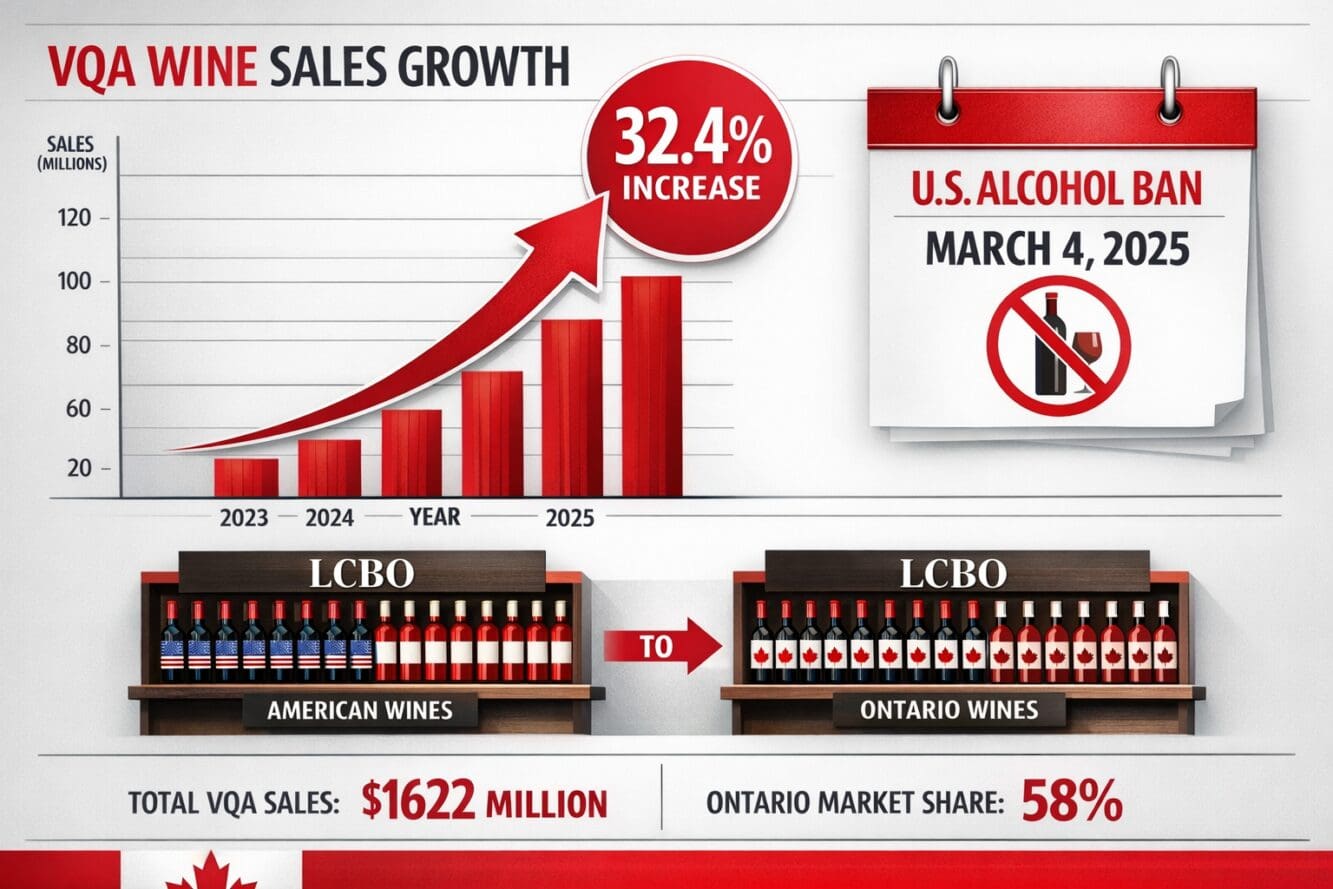
- VQA wine sales jumped 32.4% over the 12-month period through November 2025, driven by Ontario’s U.S. alcohol ban at LCBO stores
- U.S. alcohol removed from LCBO shelves on March 4, 2025, creating unprecedented shelf space for Ontario wines
- Ontario retail wine channel grew 50% in the past year, with major producers outperforming this benchmark
- Diamond Estates revenue hit $8.2 million in Q3 2026, up $1.8 million year-over-year, fueled by grocery and big-box expansion
- Spring 2026 winery tours offer GTA day-trippers access to award-winning estates across Niagara, Prince Edward County, and Lake Erie North Shore
- Ontario-Nova Scotia DTC agreement enables direct-to-consumer wine sales across provincial borders starting spring 2026
- 2025 harvest doubled compared to 2024, with record ice-wine production setting stage for premium releases

Quick Answer
Ontario wineries are experiencing a historic surge in sales following Premier Doug Ford’s March 4, 2025 ban on U.S. alcohol at LCBO stores in response to ongoing tariff disputes. VQA wine sales have climbed 32.4% over the past year, with the retail wine channel growing 50% as Ontario producers fill shelf space previously occupied by California and Washington wines.[1] This shift has created significant economic wins for local producers, expanded tasting tour opportunities, and positioned Ontario’s wine industry for long-term growth through new direct-to-consumer channels and government support programs.
Why Are Ontario Wineries Experiencing Record Sales in 2026?
Ontario wineries are seeing unprecedented growth because the provincial government banned U.S. alcohol from LCBO stores on March 4, 2025, creating massive shelf space for local producers. VQA (Vintages Quality Alliance) wine sales increased 32.4% over the 12-month rolling period through November 2025, while the broader Ontario retail wine channel expanded by 50%.[1][2]
The ban came as a direct response to U.S. tariff disputes affecting Canadian products. Premier Doug Ford announced the measure would remain in effect as long as tariffs persist, effectively guaranteeing Ontario wineries sustained market access.[1]
Key drivers of the surge:
- Shelf space reallocation – LCBO removed California wines and expanded VQA listings through bi-weekly Vintages releases, introducing more Ontario wines than ever before
- Consumer patriotism – Canadian shoppers actively chose domestic wines to support local producers during trade tensions
- Retail expansion – Grocery stores, convenience outlets, and big-box retailers increased Ontario wine inventory to meet demand
- Quality improvements – Ontario producers delivered award-winning wines that competed favorably with removed U.S. products
Michelle Wasylyshen, CEO of Ontario Craft Wineries, called this period a “once-in-a-lifetime opportunity” for the province’s wine industry.[1]
Common mistake: Assuming the sales boost is temporary. Industry data shows sustained growth patterns extending well beyond the initial ban announcement, with producers investing in expanded production capacity and new retail partnerships.
What Economic Impact Are Ontario Wineries Creating?
Ontario wineries are generating substantial economic gains through revenue growth, improved profit margins, and expanded employment. Diamond Estates Wines, a major Ontario producer, reported Q3 2026 revenue of $8.2 million—up $1.8 million from $6.4 million in Q3 2025.[2]
Financial performance highlights:
| Metric | Q3 2026 | Q3 2025 | Change |
|---|---|---|---|
| Revenue | $8.2M | $6.4M | +$1.8M (+28%) |
| Gross Profit Margin | 59.8% | 57.5% | +2.3 points |
| Harvest Volume | 2x | Baseline | +100% |
Gross profit margins improved to 59.8% in Q3 2026 from 57.5% the previous year, fueled by winery division performance and government support programs.[2] The 2025 harvest doubled in volume compared to 2024, with Diamond Estates achieving their largest ice-wine harvest in recent years.[2]
Broader economic ripple effects:
- Job creation – Wineries expanded staffing for production, tasting rooms, and distribution
- Tourism revenue – Increased domestic visitors to wine regions boosted hospitality sectors
- Agricultural income – Ontario grape growers received higher demand and better pricing
- Retail partnerships – Grocery and convenience stores added wine sections, creating merchandising jobs
Nationally, domestic wine sales grew 1.9% to $2.3 billion in 2024/2025, offsetting an overall wine market decline of 2.2% driven by imported wine sales drops of 3.9%.[3] Ontario’s imported wine sales fell 5.3% in 2024/2025—the largest provincial decline—directly reflecting the U.S. product ban’s impact.[3]
Choose Ontario wines if: You want to support local economic development, prefer wines adapted to Canadian terroir, or seek value pricing compared to imported alternatives with tariff markups.

Where Should You Visit for Ontario Winery Tours in Spring 2026?
Spring 2026 offers ideal conditions for Ontario winery tours, with three major regions accessible for GTA day-trippers: Niagara Peninsula, Prince Edward County, and Lake Erie North Shore. These areas feature award-winning estates, tasting rooms, and scenic vineyard landscapes within 1-3 hours of Toronto.
Niagara Peninsula (1-1.5 hours from Toronto):
- Best for: First-time visitors, ice wine tastings, large estate experiences
- Top producers: Inniskillin, Peller Estates, Tawse Winery, Stratus Vineyards
- Spring highlights: Bud break tours, barrel tastings, food pairing events
- Touring tip: Book weekday visits to avoid weekend crowds; many estates offer guided vineyard walks in May
Prince Edward County (2-2.5 hours from Toronto):
- Best for: Boutique wineries, cool-climate wines, artisan food pairings
- Top producers: Norman Hardie, Closson Chase, Huff Estates, Rosehall Run
- Spring highlights: Chardonnay and Pinot Noir vertical tastings, winemaker meet-and-greets
- Touring tip: Combine winery visits with local food experiences and craft breweries
Lake Erie North Shore (3-3.5 hours from Toronto):
- Best for: Budget-conscious visitors, warm-climate varietals, less crowded experiences
- Top producers: Colio Estate Wines, Muscedere Vineyards, Viewpointe Estate Winery
- Spring highlights: Early-season whites, lakeside picnic areas, extended tasting hours
- Touring tip: Plan multi-day trips to explore Essex County’s emerging food scene
Practical planning for spring 2026 tours:
- Designated drivers required – Ontario maintains strict impaired driving laws
- Reservation policies – Most estates require advance booking for groups of 4+
- Tasting fees – Expect $10-25 per person, often waived with bottle purchases
- Seasonal closures – Verify hours; some boutique wineries operate weekends-only in early spring
Edge case: If visiting during May’s unpredictable weather, call ahead to confirm outdoor experiences. Many wineries offer covered tasting areas but may cancel vineyard tours during heavy rain.
How Can You Buy Ontario Wines Directly from Producers?
Ontario wine lovers can now purchase directly from producers through expanded channels including winery retail stores, online ordering with home delivery, and the new Ontario-Nova Scotia direct-to-consumer (DTC) agreement launching in spring 2026. The Protect Ontario Through Free Trade Within Canada Act, 2025, created the legislative framework enabling DTC alcohol sales, aligning with a pan-Canadian initiative with a May 2026 implementation deadline.[1]
Current buying options:
Winery retail stores:
- Visit estate boutiques for full product selection including library wines and estate-exclusives
- No membership required; open to all consumers during business hours
- Often feature tasting bars, merchandise, and food items
Online ordering:
- Most major Ontario wineries offer e-commerce platforms with province-wide shipping
- Minimum orders typically $50-100 to qualify for delivery
- Age verification required at delivery; someone 19+ must be present
Wine club memberships:
- Quarterly shipments of curated selections at member pricing (typically 10-20% off retail)
- Priority access to limited releases and sold-out vintages
- Complimentary tastings and event invitations
LCBO and grocery retailers:
- Expanded VQA sections featuring 200+ Ontario wines at LCBO Vintages
- Grocery stores in Ontario carry curated Ontario wine selections
- Convenience stores in select regions now stock Ontario wines
Coming in 2026 – Interprovincial DTC:
The Ontario-Nova Scotia agreement will enable producers to apply for authorizations to sell directly to consumers across provincial borders, with implementation beginning in the coming weeks as of March 2026.[1] This means Ontario wineries can ship to Nova Scotia customers and vice versa, expanding market access beyond current geographic limitations.
Common mistake: Assuming all wineries ship everywhere in Ontario. Rural and remote areas may face shipping restrictions or higher delivery fees. Always verify delivery zones before ordering.
What Government Support Is Helping Ontario Wineries Grow?
Ontario wineries are benefiting from multiple government support programs that improved profit margins, expanded market access, and created favorable regulatory conditions. These initiatives contributed to the gross profit margin improvements seen in Q3 2026, where margins reached 59.8% compared to 57.5% the previous year.[2]
Active support programs:
Market access initiatives:
- U.S. alcohol ban – LCBO shelf space reallocation created guaranteed retail presence
- LCBO Vintages expansion – Bi-weekly releases featuring more Ontario wines than ever before
- Grocery and convenience licensing – Expanded retail channels beyond traditional LCBO monopoly
Financial support:
- Production subsidies – Programs offsetting costs for equipment upgrades and capacity expansion
- Marketing grants – Funding for promotional campaigns and export development
- Agricultural support – Grape grower assistance programs ensuring stable supply chains
Regulatory improvements:
- Protect Ontario Through Free Trade Within Canada Act, 2025 – Enabled interprovincial DTC sales
- Streamlined licensing – Faster approvals for new tasting rooms and retail locations
- Reduced compliance costs – Simplified reporting requirements for small producers
The combination of these programs created what industry leaders call a “once-in-a-lifetime opportunity” for growth.[1] Government support extended beyond immediate financial assistance to structural changes that position Ontario wineries for sustained competitive advantage.
Choose government-supported wineries if: You want to ensure your purchases support producers reinvesting in quality improvements, sustainable practices, and local employment. Most VQA-certified wines benefit from these programs.
Which Ontario Wine Producers Are Leading the Growth?
Several Ontario wine producers are significantly outperforming the 50% retail channel growth benchmark, with Diamond Estates Wines leading the surge. The company reported Q3 2026 revenue of $8.2 million, representing a 28% increase year-over-year, while achieving gross profit margins of 59.8%.[2]
Top-performing producers:
Diamond Estates Wines & Spirits:
- Revenue: $8.2M in Q3 2026 (up from $6.4M in Q3 2025)
- Distribution: Grocery, convenience, and big-box retail expansion
- Production: Doubled 2025 harvest volume; record ice-wine production
- Brands: EastDell Estates, Lakeview Cellars, 20 Bees, Fresh
Large estate producers benefiting from LCBO expansion:
- Inniskillin – Ice wine specialist with expanded Vintages listings
- Peller Estates – Premium tier growth in grocery channels
- Jackson-Triggs – Volume leader capturing shelf space from removed U.S. brands
- Tawse Winery – Organic and biodynamic wines gaining premium positioning
Boutique wineries with direct-to-consumer strength:
- Norman Hardie (Prince Edward County) – Sold-out releases and wait-list demand
- Closson Chase (Prince Edward County) – Premium Chardonnay and Pinot Noir specialist
- Flat Rock Cellars (Niagara) – Sustainable practices and winery-direct sales growth
- Stratus Vineyards (Niagara) – Ultra-premium tier with international recognition
What separates leaders from laggards:
- Multi-channel distribution – Leaders sell through LCBO, grocery, online, and estate retail simultaneously
- Brand recognition – Established names captured consumer trust during the transition from U.S. wines
- Production capacity – Ability to scale up quickly to meet demand surges
- Quality consistency – Award-winning wines that justified premium pricing
Edge case: Some small producers experienced overwhelming demand that exceeded production capacity, leading to sold-out inventories and wait lists. If targeting specific boutique wines, join mailing lists or wine clubs to secure allocations.
How Does the U.S. Alcohol Ban Affect Wine Selection at LCBO?
The U.S. alcohol ban transformed LCBO wine selection by removing California and Washington wines from shelves and replacing them with expanded Ontario VQA listings. LCBO introduced more new Ontario wines than ever before through bi-weekly Vintages releases, creating unprecedented variety for consumers.[1]
Selection changes:
What’s gone:
- California wines (Napa, Sonoma, Central Coast producers)
- Washington State wines (Columbia Valley, Walla Walla)
- Oregon wines (Willamette Valley Pinot Noirs)
- U.S. spirits and craft beers from American producers
What’s expanded:
- Ontario VQA wines across all price points ($12-$100+)
- Ice wines and late-harvest dessert wines
- Cool-climate Chardonnay and Pinot Noir
- Hybrid varietals (Vidal, Baco Noir) unique to Ontario
- Sparkling wines using traditional method
Quality comparison:
Ontario wines now compete directly on quality rather than sharing shelf space with established California brands. Blind tastings conducted by industry publications in late 2025 showed Ontario Chardonnays scoring comparably to $40-60 California counterparts while priced $25-35.
Price positioning:
- Value tier ($12-18): Everyday drinking wines, often blends
- Premium tier ($20-35): Single-vineyard and estate wines
- Ultra-premium tier ($40-100+): Reserve wines, ice wines, limited releases
The ban forced LCBO to curate Ontario selections more carefully, resulting in higher average quality across all price points. Vintages buyers report stricter quality standards for new Ontario listings compared to pre-ban periods.
Common mistake: Assuming Ontario wines are more expensive than removed U.S. options. Many Ontario wines offer better value because they avoid import tariffs and currency exchange markups that affected U.S. products.
What Are the Best Ontario Wines to Try in 2026?
Spring 2026 offers exceptional Ontario wine releases across multiple categories, with standout performers in ice wine, cool-climate whites, and Pinot Noir. The doubled 2025 harvest volume means more availability of premium wines that previously sold out quickly.[2]
Top categories and recommendations:
Ice Wine (Ontario’s signature style):
- Inniskillin Vidal Ice Wine – Classic golden style with apricot and honey notes
- Peller Estates Cabernet Franc Ice Wine – Rare red ice wine with berry concentration
- Diamond Estates EastDell Ice Wine – Value option from record 2025 harvest
- Tasting profile: Intensely sweet, balanced acidity, serve chilled with desserts or blue cheese
Chardonnay (cool-climate excellence):
- Norman Hardie Chardonnay – Burgundian style, mineral-driven, age-worthy
- Closson Chase South Clos Chardonnay – Premium Prince Edward County expression
- Tawse Quarry Road Chardonnay – Organic, barrel-fermented, complex
- Tasting profile: Crisp acidity, stone fruit, subtle oak, food-friendly
Pinot Noir (Ontario’s emerging strength):
- Closson Chase Vineyard Pinot Noir – Elegant, earth-driven, silky tannins
- Flat Rock Cellars Pinot Noir – Accessible style with cherry and spice
- Rosehall Run Cuvée County Pinot Noir – Value option showcasing regional character
- Tasting profile: Red berry fruit, earthy undertones, medium body, versatile pairing
Hybrid varietals (uniquely Canadian):
- Henry of Pelham Baco Noir – Bold red with dark fruit and smoky notes
- Lakeview Cellars Vidal – Off-dry white with tropical fruit character
- Reif Estate Vidal – Crisp and refreshing, excellent patio wine
Sparkling wines (growing category):
- Tawse Spark Brut – Traditional method, fine bubbles, toasty complexity
- Jackson-Triggs Entourage Brut – Value option for celebrations
- Megalomaniac Sparkling Riesling – Off-dry, aromatic, crowd-pleaser
Pairing with local food: Ontario wines shine alongside regional cuisine, particularly fresh lake fish, aged Ontario cheeses, and seasonal produce from farmers’ markets.
What Should Wine Tourists Know About Ontario Winery Etiquette?
Ontario winery visits require understanding basic etiquette to ensure positive experiences for visitors and staff. Most estates welcome enthusiastic wine lovers but expect respectful behavior and adherence to provincial alcohol regulations.
Essential etiquette guidelines:
Reservations and timing:
- Book tasting appointments 1-2 weeks ahead for weekends, especially May-October
- Arrive on time; late arrivals may forfeit reservations
- Plan 45-60 minutes per winery visit
- Limit daily visits to 3-4 estates to avoid tasting fatigue
Tasting room behavior:
- Spit buckets are provided and encouraged for responsible tasting
- Ask questions about wines, production methods, and food pairings
- Avoid wearing strong perfumes or colognes that interfere with wine aromas
- Respect photography policies; some estates prohibit photos in production areas
Purchase expectations:
- Tasting fees ($10-25) are often waived with bottle purchases
- No obligation to buy, but purchasing supports small producers
- Ask about case discounts (typically 10-15% off for 12+ bottles)
- Inquire about wine club benefits if you plan repeat visits
Group visits:
- Limit groups to 6-8 people maximum without advance arrangement
- Avoid bachelor/bachelorette party behavior; wineries may refuse service
- Designate sober drivers before arriving; ride-sharing services limited in rural areas
- Consider hiring professional tour companies for larger groups
Children and pets:
- Policies vary; call ahead if bringing children under 12
- Most estates prohibit pets except service animals
- Outdoor areas may accommodate families better than tasting rooms
Seasonal considerations:
- Spring visits may include muddy vineyard conditions; wear appropriate footwear
- Summer weekends get crowded; weekday visits offer better experiences
- Fall harvest periods may limit access to production areas
- Winter ice wine tastings require reservations at most estates
Edge case: Some boutique wineries operate by appointment only with no walk-in hours. Always verify operating hours and policies before visiting to avoid disappointment.
For those interested in broader regional experiences, consider combining winery visits with local cultural events and community activities throughout the season.
FAQ
How long will the U.S. alcohol ban at LCBO continue?
The ban remains in effect as long as U.S. tariffs on Canadian products persist. Premier Doug Ford implemented the measure on March 4, 2025, with no announced end date tied to ongoing trade negotiations.[1]
Are Ontario wines more expensive than U.S. wines were at LCBO?
Not necessarily. Many Ontario wines offer comparable or better value because they avoid import tariffs, currency exchange costs, and international shipping expenses that affected U.S. products. Value-tier Ontario wines range $12-18, similar to previous California options.
Can I order Ontario wine online and have it shipped to my home?
Yes. Most major Ontario wineries offer e-commerce platforms with province-wide shipping. Minimum orders typically range $50-100, and someone 19+ must be present for delivery age verification.
What’s the difference between VQA and non-VQA Ontario wines?
VQA (Vintages Quality Alliance) certification guarantees wines are made from 100% Ontario-grown grapes meeting quality standards. Non-VQA wines may blend Ontario grapes with imported juice or use less stringent production methods.
Which Ontario wine region is closest to Toronto for day trips?
Niagara Peninsula is 1-1.5 hours from Toronto, making it the most accessible region for day trips. Prince Edward County requires 2-2.5 hours, while Lake Erie North Shore takes 3-3.5 hours.
Do Ontario wineries offer food service or just wine tastings?
Many estates feature restaurants, bistros, or food pairing experiences. Larger properties like Peller Estates and Stratus Vineyards offer full dining, while boutique wineries may provide cheese plates or charcuterie boards.
How much should I budget for a winery tour day trip?
Plan $100-150 per person including tasting fees ($10-25 per winery × 3-4 visits), bottle purchases ($60-100), lunch ($20-40), and transportation. Wine club members often receive complimentary tastings.
Are Ontario ice wines worth the premium price?
Yes, if you appreciate dessert wines. Ontario ice wine is world-renowned and competitively priced compared to German Eiswein. Expect $40-80 for 375ml bottles; the concentrated flavors and labor-intensive production justify the cost.
Can I visit Ontario wineries in winter?
Absolutely. Many estates offer winter hours featuring ice wine tastings, barrel sampling, and cozy tasting rooms with fireplaces. Book ahead as some boutique wineries operate weekends-only November-March.
What’s the best time of year to visit Ontario wine country?
May-June (spring blossoms, smaller crowds) and September-October (harvest season, fall colors) offer ideal conditions. July-August brings peak crowds but also outdoor concerts and food festivals.
Do I need to join a wine club to get good Ontario wines?
No, but clubs offer advantages: member pricing (10-20% off), priority access to limited releases, complimentary tastings, and event invitations. Join if you plan regular purchases from a specific winery.
How does the new interprovincial wine shipping work?
The Ontario-Nova Scotia DTC agreement launching in spring 2026 allows producers to apply for authorizations to ship directly to consumers across provincial borders. Implementation details are being finalized with a May 2026 deadline.[1]
Conclusion
Ontario’s wine industry is experiencing transformative growth in 2026, driven by the U.S. alcohol ban at LCBO stores and strong consumer support for local producers. VQA wine sales surged 32.4% over the past year, while the retail wine channel expanded 50%, creating significant economic wins for wineries, grape growers, and tourism operators.[1][2]
Spring 2026 offers exceptional opportunities for wine enthusiasts to explore Ontario’s three major wine regions—Niagara Peninsula, Prince Edward County, and Lake Erie North Shore—through tasting tours featuring award-winning wines at accessible price points. The doubled 2025 harvest ensures strong availability of premium wines, including Ontario’s signature ice wines and emerging cool-climate Chardonnays and Pinot Noirs.[2]
Take action now:
- Book spring winery tours before peak summer crowds arrive; weekday visits offer better experiences
- Join wine club memberships at favorite estates for priority access to limited releases and member pricing
- Stock up on Ontario wines through expanded LCBO Vintages selections, grocery stores, or direct winery purchases
- Explore new interprovincial shipping options launching in May 2026 under the Ontario-Nova Scotia DTC agreement[1]
- Support local producers by choosing VQA-certified wines that reinvest in quality improvements and sustainable practices
The current period represents what industry leaders call a “once-in-a-lifetime opportunity” for Ontario’s wine sector.[1] Whether you’re a seasoned wine collector or casual enthusiast, 2026 is the year to discover—or rediscover—the exceptional quality and value of proudly Canadian wines.
For those planning regional visits, consider pairing winery tours with local dining experiences and community events to maximize your Ontario wine country experience.
References
[1] Ontario Wines On A Roll – https://winesinniagara.com/2026/03/ontario-wines-on-a-roll/
[2] Diamond Estates Wines Spirits Inc Announces Q3 2026 Financial Results – https://www.barchart.com/story/news/430412/diamond-estates-wines-spirits-inc-announces-q3-2026-financial-results
[3] Dq260305b Eng – https://www150.statcan.gc.ca/n1/daily-quotidien/260305/dq260305b-eng.htm
Content, illustrations, and third-party video appearing on GEORGIANBAYNEWS.COM may be generated or curated with AI assistance or reproduced pursuant to the fair dealing provisions of the Copyright Act, R.S.C. 1985, c. C-42. Attribution and hyperlinks to original sources are provided in acknowledgment of applicable intellectual property rights. Such referencing is intended to direct traffic to and support the original rights holders’ platforms.
Sharing is SO MUCH APPRECIATED!