

























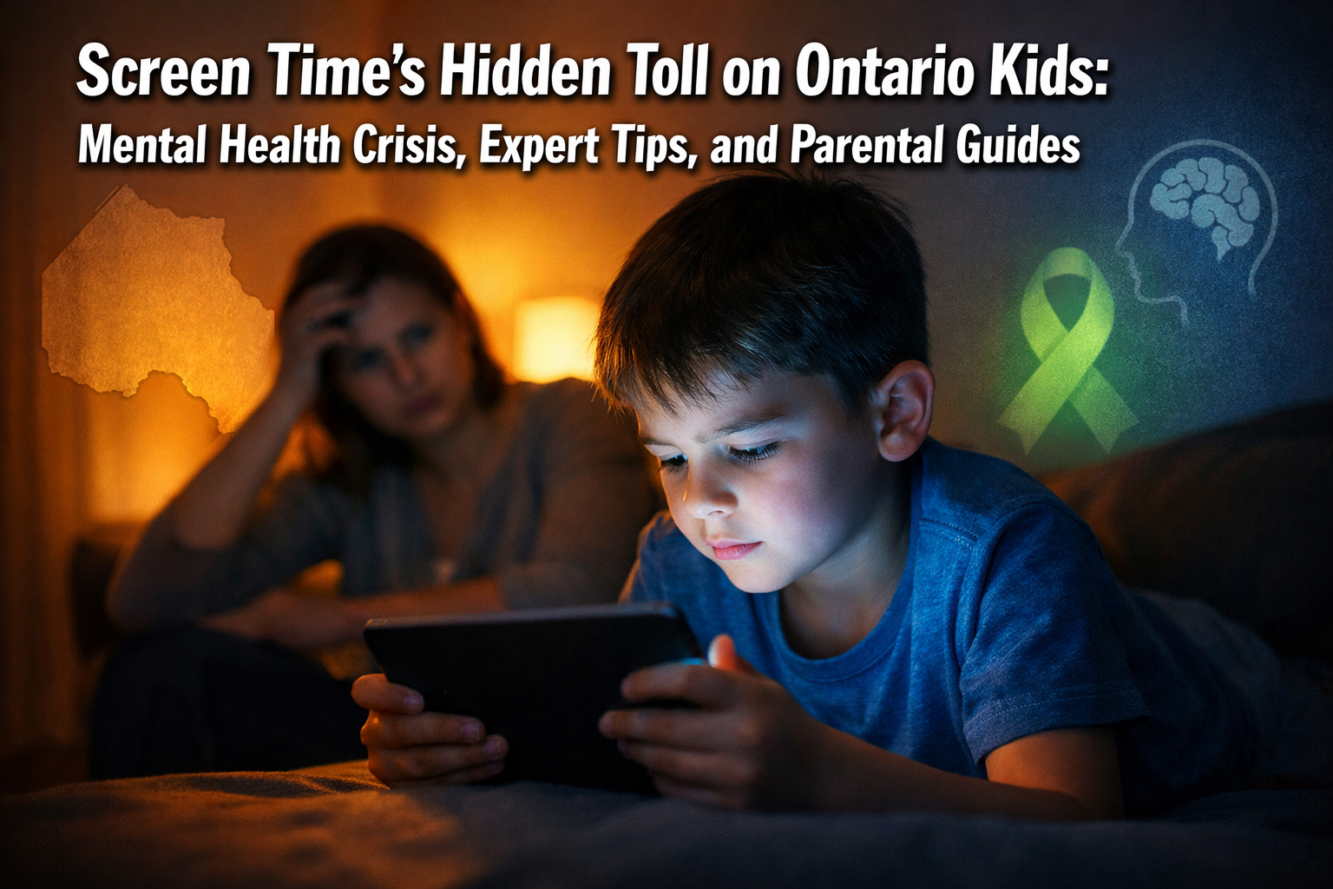
Screen Time’s Hidden Toll on Ontario Kids: Mental Health Crisis, Expert Tips, and Parental Guides
Last updated: March 16, 2026
Quick Answer
Screen time’s hidden toll on Ontario kids manifests as measurable academic decline, increased anxiety and depression, and long-term developmental risks. Recent 2025 research tracking 3,322 Ontario children found that each additional hour of daily screen time reduces the likelihood of achieving higher academic levels by 10% in reading and math.[1] Parents can mitigate these risks by following age-appropriate limits, co-viewing content with children, and implementing structured screen-free routines.

Key Takeaways
- Each hour of screen time reduces academic achievement by 10% in reading and math for Ontario elementary students, based on 15-year longitudinal study[1]
- Pandemic screen time more than doubled from 2.6 to 5.9 hours daily during initial school closures, far exceeding health guidelines[3]
- Only 25.6% of Canadian children adhered to screen time recommendations six months into the pandemic[5]
- Internalizing behaviors increase significantly with higher screen use, including anxiety and depression symptoms[3]
- Children under 2 should have zero screen time (except video chatting), ages 2-5 less than one hour, ages 5+ less than two hours daily[6]
- Content type and viewing context matter as much as duration—co-viewing with caregivers reduces negative impacts[1]
- Writing skills show limited impact from screen time compared to reading and math, suggesting domain-specific effects[1]
- Multi-stakeholder interventions work best when healthcare providers, educators, policymakers, and families collaborate[1]

What Does Screen Time’s Hidden Toll on Ontario Kids Actually Mean?
Screen time’s hidden toll refers to the measurable but often overlooked consequences of excessive digital device use on children’s cognitive development, academic performance, and mental health. Unlike obvious physical injuries, these effects accumulate gradually and manifest as declining test scores, increased anxiety, and impaired social development.
A groundbreaking 2025 study from SickKids and Unity Health Toronto tracked Ontario children from 2008 to 2023, linking parent-reported screen time during early childhood to standardized EQAO test results.[1] The research measured screen exposure at average ages of 5.5 years (1.6 hours daily) and 7.5 years (1.8 hours daily), then correlated this data with Grade 3 reading and math scores and Grade 6 math performance.
The findings were stark: for every additional hour of daily screen time, children showed a 10% decrease in the likelihood of reaching higher academic achievement levels.[1] This relationship held consistent across reading and mathematics, though writing skills appeared less affected.
Key factors that amplify the hidden toll:
- Solitary viewing without caregiver interaction or discussion
- Passive consumption of entertainment content versus educational material
- Screen use replacing physical activity, sleep, or face-to-face social interaction
- Exposure during critical developmental windows in early childhood
Choose active, co-viewed educational content if screen time is unavoidable—the research shows context matters as much as duration.
How Does Screen Time Impact Mental Health in Ontario Children?
Increased screen time directly correlates with higher rates of internalizing behaviors in school-aged children, including anxiety, depression, and social withdrawal. A longitudinal study found statistically significant associations (p = .03) between screen time increases and greater incidence of these mental health symptoms.[3]
The mechanism works through multiple pathways. Excessive screen use displaces activities essential for healthy development: physical exercise, quality sleep, in-person social interaction, and unstructured creative play. Research on mental health factors shows that lifestyle disruptions compound stress responses in developing brains.
Mental health impacts by age group:
- Preschoolers (2-5 years): Delayed language development, reduced attention span, sleep disruption
- Elementary students (6-11 years): Increased anxiety, academic stress, peer relationship difficulties
- Adolescents (12-17 years): Depression symptoms, body image issues, cyberbullying exposure, social comparison stress
During the COVID-19 pandemic, Ontario children’s screen time surged from 2.6 to 5.9 hours daily—more than triple the recommended limits.[3] This dramatic increase coincided with reported spikes in pediatric mental health crises and emergency department visits for anxiety and depression.
Common mistake: Assuming all screen time affects mental health equally. Educational content viewed with parental discussion causes less harm than unsupervised social media scrolling or violent gaming. The type of content and social context matter significantly.
What Are the Current Screen Time Guidelines for Ontario Families?
The Canadian Paediatric Society establishes clear age-based recommendations that most Ontario families struggle to follow. Current compliance rates reveal the scope of the challenge: only 54.1% of children aged 3-4, 65.9% aged 5-11, and 51.5% of youth aged 12-17 meet these guidelines.[5]
Official screen time limits by age:
| Age Group | Daily Screen Time Limit | Exception |
|---|---|---|
| Under 2 years | Zero screen time | Video chatting with family allowed |
| Ages 2-5 years | Less than 1 hour | High-quality educational programming preferred |
| Ages 5+ years | Less than 2 hours | Excludes homework-related computer use |
These guidelines apply to recreational screen time and exclude educational requirements. With many Ontario schools now issuing tablets or requiring online homework platforms, parents must distinguish between necessary academic use and optional entertainment.
During the pandemic, only 25.6% of Canadian children and youth adhered to screen time guidelines six months after initial lockdowns, representing a massive departure from health recommendations.[5] This suggests that crisis conditions, remote learning mandates, and reduced recreational options create environments where guideline compliance becomes extremely difficult.
Choose the stricter limit (1 hour for ages 2-5, 2 hours for 5+) if your child shows signs of screen dependency: irritability when devices are removed, declining interest in non-screen activities, or sleep disruption.
What Expert Tips Help Manage Screen Time’s Impact on Kids?
Effective screen time management requires addressing not just duration but also content quality, viewing context, and displacement of other activities. Experts emphasize that interventions should consider what children watch, whether they watch alone or with others, and what activities screen time replaces.[1]
Evidence-based strategies for parents:
Establish screen-free zones and times
- No devices in bedrooms (protects sleep quality)
- Screen-free family meals (supports conversation and connection)
- One hour before bedtime without screens (improves sleep onset)
Practice co-viewing and active mediation
- Watch content together and discuss what you see
- Ask questions that promote critical thinking about media messages
- Connect screen content to real-world experiences and learning
Model healthy screen habits
- Children imitate parental behavior more than they follow rules
- Put your own phone away during family time
- Demonstrate that adults also need screen-free activities
Prioritize content quality over convenience
- Choose interactive educational apps over passive entertainment
- Select age-appropriate content with positive messages
- Avoid content with violence, commercialism, or age-inappropriate themes
Create structured daily routines
- Schedule specific screen time windows rather than allowing all-day access
- Use timers and parental controls to enforce limits
- Offer appealing alternatives: outdoor play, arts and crafts, reading, sports
Common mistake: Implementing sudden, strict bans without explanation or alternatives. This approach typically triggers resistance and power struggles. Instead, gradually reduce screen time while simultaneously increasing appealing non-screen activities and explaining the health reasons for changes.
For additional wellness strategies that support child development, see our guide to mental health and lifestyle factors.
How Are Ontario Schools Responding to the Screen Time Crisis?
Ontario schools face a complex challenge: they must integrate educational technology while protecting students from excessive screen exposure. Many school boards now implement device-free policies during lunch and recess, recognizing that even brief screen breaks support social development and physical activity.
The research showing academic decline from early childhood screen time has prompted some elementary schools to limit device use in primary grades, reserving tablets and computers for specific learning activities rather than all-day access.[1] This targeted approach aims to harness technology’s educational benefits without the developmental costs of constant exposure.
School-based interventions gaining traction:
- Phone-free classrooms with designated collection areas during instruction
- Mandatory outdoor recess time without device access
- Digital citizenship curriculum teaching healthy technology habits
- Parent education workshops on screen time management
- Collaboration with public health units on screen time awareness campaigns
However, the shift to online learning platforms, digital homework submission, and educational apps means students now require screens for academic success. This creates tension between limiting recreational use and supporting educational needs.
Edge case: Students with learning disabilities or special needs may benefit from assistive technology apps that require screen time beyond typical limits. In these situations, prioritize educational and therapeutic screen use while still limiting recreational exposure.
Effective solutions require co-development with healthcare providers, educators, policymakers, and families to support healthy habits while maintaining academic standards.[1]
What Practical Steps Can Parents Take Starting Today?
Immediate action matters more than perfect planning. Parents can implement several evidence-based strategies within 24 hours that begin reducing screen time’s hidden toll on their children.
Day-one action checklist:
✓ Conduct a screen time audit
- Track actual daily screen hours for each child for 2-3 days
- Note what devices, apps, and content consume the most time
- Identify patterns: when, where, and why screens get used
✓ Set up physical boundaries
- Remove TVs and devices from children’s bedrooms tonight
- Create a central charging station where all devices sleep overnight
- Designate screen-free zones (dining room, car during short trips)
✓ Establish one screen-free routine
- Start with the easiest win: screen-free family dinners or bedtime routines
- Announce the change, explain the health reasons simply
- Prepare alternative activities (conversation starters, books, games)
✓ Install parental controls and monitoring
- Use built-in iOS Screen Time or Android Digital Wellbeing features
- Set app-specific time limits for games and social media
- Enable content filters appropriate for your child’s age
✓ Schedule appealing alternatives
- Book a library visit, park outing, or sports activity for this week
- Stock art supplies, board games, or outdoor equipment
- Invite friends over for screen-free play dates
✓ Create a family media plan
- Sit down together and discuss screen time goals
- Let older children participate in setting reasonable limits
- Write down agreements and post them visibly
Common mistake: Trying to eliminate all screens immediately. This approach usually fails and creates family conflict. Instead, reduce gradually (cut 30 minutes per week) while increasing attractive alternatives. Sustainable change beats perfect implementation.
For more guidance on creating healthy family routines, explore our wellness and lifestyle resources.
What Are the Long-Term Consequences of Ignoring Screen Time Limits?
The longitudinal nature of the Ontario research reveals that early childhood screen exposure predicts academic outcomes years later.[1] Children with higher screen time at ages 5-7 showed measurably lower test scores in Grade 3 and Grade 6, suggesting that developmental windows matter and early habits create lasting trajectories.
Documented long-term impacts:
- Academic trajectory: Lower reading and math achievement persisting through elementary school, potentially affecting high school placement and post-secondary opportunities
- Mental health patterns: Internalizing behaviors established in childhood often continue into adolescence and adulthood without intervention[3]
- Social skill deficits: Reduced face-to-face interaction during critical developmental periods impairs emotional regulation and relationship skills
- Physical health risks: Sedentary screen time contributes to childhood obesity, poor cardiovascular fitness, and postural problems
- Sleep architecture disruption: Blue light exposure and stimulating content create chronic sleep deficits affecting growth, learning, and emotional regulation
The academic impact proves particularly concerning because it compounds over time. A child who falls behind in Grade 3 reading faces increasing difficulty with content-area learning in later grades, where reading comprehension becomes essential for science, history, and mathematics success.
Choose intervention now if: Your child shows declining grades, increased anxiety or withdrawal, sleep problems, or resistance to non-screen activities. Early intervention prevents these patterns from becoming entrenched.
The research emphasizes that solutions must address content type and viewing context, not just duration.[1] A child watching educational documentaries with parental discussion faces different outcomes than one scrolling social media alone for the same duration.
FAQ
How much screen time is too much for my 7-year-old?
More than two hours of recreational screen time daily exceeds Canadian Paediatric Society guidelines for children over age 5.[6] The Ontario research shows each hour beyond this increases academic risk by 10%.[1]
Does homework on a computer count toward screen time limits?
No. Educational screen use required for schoolwork sits outside recreational limits, but parents should still monitor total daily exposure and ensure homework doesn’t extend unnecessarily.
Can educational apps offset the negative effects of screen time?
Partially. High-quality educational content causes less harm than entertainment media, especially when parents co-view and discuss the material.[1] However, even educational screens still displace physical activity and sleep.
What if my child’s school requires a tablet all day?
Advocate for balanced policies with your school board. Share research showing academic impacts of excessive screen time.[1] At home, strictly limit recreational screens to compensate for required educational use.
How do I reduce screen time without constant battles?
Implement changes gradually, offer appealing alternatives, involve children in setting limits, and model healthy habits yourself. Sudden strict bans typically backfire, while collaborative planning succeeds.
Are all types of screen time equally harmful?
No. Passive entertainment viewing, especially alone, causes more harm than interactive educational content viewed with caregivers.[1] Social context and content quality significantly affect outcomes.
What signs indicate my child has a screen time problem?
Watch for irritability when devices are removed, declining interest in non-screen activities, falling grades, sleep problems, social withdrawal, or anxiety symptoms. These suggest intervention is needed.
Should teenagers have the same limits as younger children?
Teenagers need slightly more flexibility for social connection and homework, but the under-two-hours guideline still applies to recreational use.[6] Focus on content quality, sleep protection, and balanced activities.
How did the pandemic affect Ontario children’s screen habits?
Screen time more than doubled from 2.6 to 5.9 hours daily during initial school closures,[3] and many families haven’t returned to pre-pandemic limits despite schools reopening.
Can screen time limits really improve my child’s grades?
Yes. The research shows a direct dose-response relationship: reducing screen time by one hour increases the likelihood of higher academic achievement by 10% in reading and math.[1]
What should I do if other parents don’t enforce limits?
Stand firm on your family’s rules even if peers have unlimited access. Explain health reasons to your child and offer compelling alternatives. Your child’s wellbeing matters more than fitting in.
Where can I find support for managing my child’s screen time?
Consult your pediatrician, school counselor, or local public health unit. Many Ontario communities offer parent workshops on digital wellness and healthy technology habits.
Conclusion
Screen time’s hidden toll on Ontario kids represents a measurable public health crisis with documented impacts on academic achievement, mental health, and long-term development. The 2025 longitudinal research tracking 3,322 Ontario children provides clear evidence: each additional hour of daily screen time reduces the likelihood of higher academic achievement by 10% in reading and mathematics.[1] With pandemic-era screen use more than doubling and compliance with guidelines dropping to just 25.6%,[5] Ontario families face an urgent need for intervention.
The path forward requires action at multiple levels. Parents can implement evidence-based strategies starting today: establishing screen-free zones and times, co-viewing content, modeling healthy habits, and prioritizing appealing alternatives. Schools must balance educational technology benefits against developmental risks through thoughtful policies and digital citizenship education. Healthcare providers, educators, and policymakers need to collaborate on community-wide solutions that support families in creating sustainable healthy screen habits.[1]
Take action this week: Conduct a screen time audit, set up one screen-free routine, install parental controls, and schedule appealing non-screen activities. Small consistent changes create lasting improvements in children’s academic performance, mental health, and overall wellbeing. The research shows that early intervention matters—developmental windows in childhood shape trajectories that persist for years.
Ontario kids deserve the chance to develop without the hidden toll of excessive screen exposure undermining their potential. With informed parents, supportive schools, and evidence-based guidelines, families can harness technology’s benefits while protecting children’s health and futures.
References
[1] Screen Time Linked To Lower Academic Achievement Among Ontario Elementary Students – https://www.sickkids.ca/en/news/archive/2025/screen-time-linked-to-lower-academic-achievement-among-ontario-elementary-students/
[3] Pmc10332035 – https://pmc.ncbi.nlm.nih.gov/articles/PMC10332035/
[4] Info Sheet Helping Your Child Manage Digital Technology – https://smho-smso.ca/online-resources/info-sheet-helping-your-child-manage-digital-technology/
[5] Screens And Digital Behaviour – https://www.publichealthgreybruce.on.ca/Your-Health/Active-Living/Screens-and-Digital-Behaviour
[6] The Impact Of Screen Time On Mental Health What Pa – https://www.psych.on.ca/Public/Blog/2024/The-Impact-of-Screen-Time-on-Mental-Health-What-Pa
Content, illustrations, and third-party video appearing on GEORGIANBAYNEWS.COM may be generated or curated with AI assistance or reproduced pursuant to the fair dealing provisions of the Copyright Act, R.S.C. 1985, c. C-42. Attribution and hyperlinks to original sources are provided in acknowledgment of applicable intellectual property rights. Such referencing is intended to direct traffic to and support the original rights holders’ platforms.
Much Appreciate You Sharing This Post - It Helps MUCH!!!