






















CRTC Ditches Cell Plan Cancellation Fees: Ontario Consumers Win Big on Switching Providers


Last updated: March 16, 2026
Quick Answer
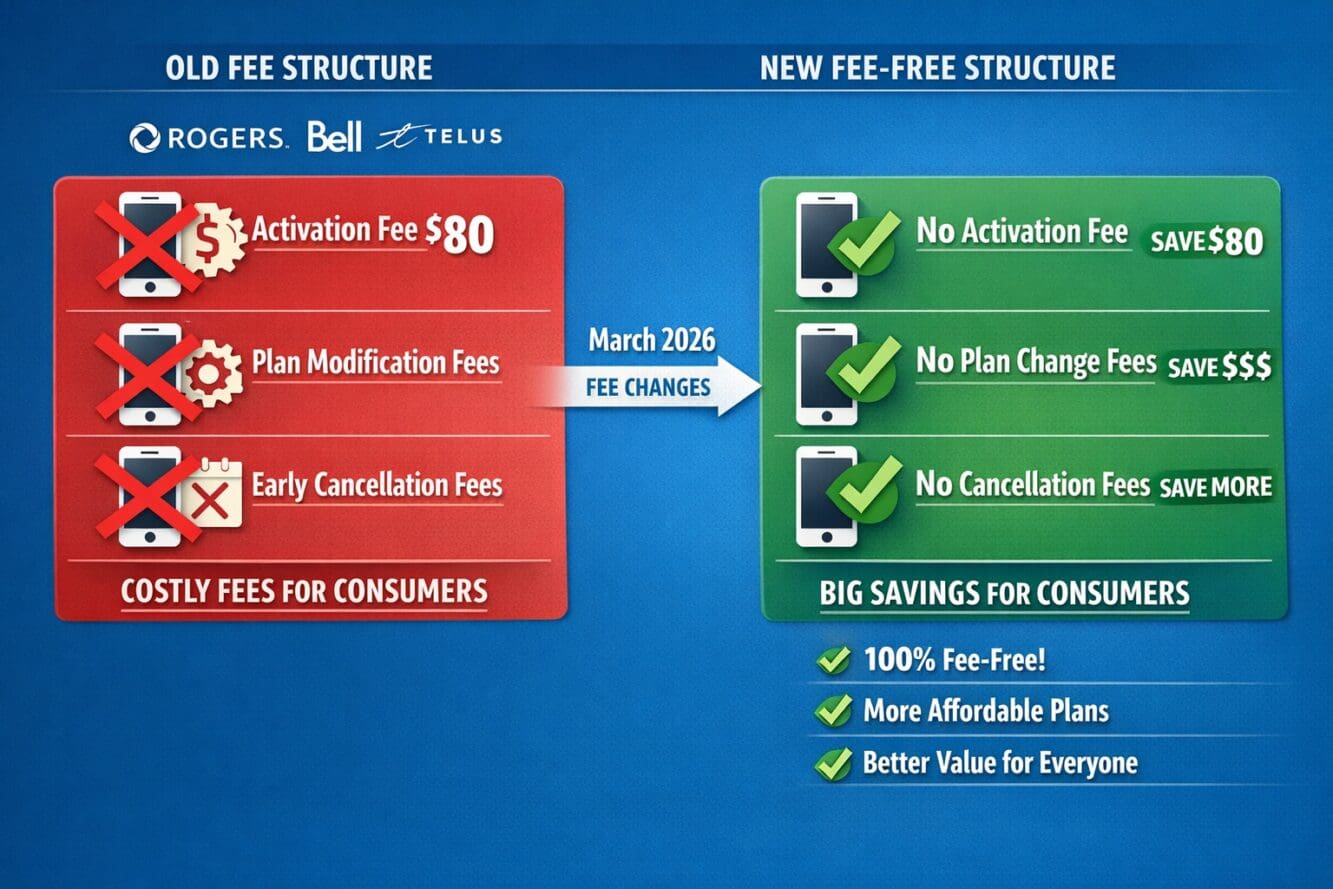
The CRTC officially banned cell plan cancellation fees, activation fees, and plan modification charges on March 12, 2026, eliminating the $80 connection fees that Rogers, Bell, and Telus made standard. The new rules take effect June 12, 2026, but carriers must start waiving fees immediately while updating their systems. Ontario consumers can now switch wireless and internet providers without penalty, saving hundreds of dollars annually and increasing competition among carriers.
Key Takeaways
- Three fee types eliminated: Activation fees, plan modification fees, and early cancellation fees (when no device financing exists)
- $80 standard fee gone: Major carriers like Rogers, Bell, and Telus can no longer charge connection fees that became industry standard
- Immediate compliance required: Carriers must manually waive fees now, even though the official deadline is June 12, 2026
- Both wireless and internet covered: The ban applies to cellphone plans and home internet services across Ontario and Canada
- Device financing unchanged: If you financed a phone, you still owe the remaining balance when cancelling
- Consumer oversight strengthened: The CCTS will track complaints about activation and modification fees in annual reports
- Saves Ontario families money: Eliminating these “junk fees” removes barriers to switching providers and finding better deals
What Fees Did the CRTC Eliminate for Ontario Cell Phone Users?
The CRTC banned three specific fee categories that carriers charged Ontario consumers. Activation fees (typically $80 at Rogers, Bell, and Telus) disappear entirely, meaning you won’t pay to start new service. Plan modification fees are gone, so changing your data allowance or switching between plans with the same carrier costs nothing. Early cancellation fees vanish when no device financing is involved—if you own your phone outright or bring your own device, leaving your carrier is free.
The decision targets what regulators and consumer advocates call “junk fees”—charges that create artificial barriers to competition without reflecting real service costs. For Ontario families managing budgets amid rising costs from inflation and economic pressures, these savings matter.
What Fees Still Apply?
- Device financing balances: If you’re paying off a subsidized phone, you still owe the remaining amount when cancelling
- Physical installation costs: Technician visits for fibre internet installation or equipment setup remain billable
- Optional add-on services: Features you explicitly chose to purchase may carry separate charges
The CRTC preserved these fees because they reflect actual service delivery costs, unlike activation fees that carriers can process automatically through existing systems.
When Do Ontario Carriers Have to Stop Charging These Fees?
Ontario carriers must comply immediately, even though the official enforcement date is June 12, 2026. The CRTC issued Telecom Decision CRTC 2026-43 on March 12, 2026, and explicitly requested that Rogers, Bell, Telus, and other providers start waiving fees manually while updating their billing systems.
Timeline breakdown:
- March 12, 2026: CRTC announces decision
- March 16, 2026 onward: Carriers should waive fees manually
- June 12, 2026: Official compliance deadline; billing systems must be updated
If an Ontario carrier charges you an activation, modification, or cancellation fee after March 16, 2026, ask for an immediate waiver. Reference CRTC Decision 2026-43 and request a supervisor if frontline staff resist. Document the interaction and file a complaint with the Commission for Complaints for Telecom-television Services (CCTS) if the carrier refuses.
How Much Money Will Ontario Consumers Save by Switching Providers?
Ontario consumers save $80 immediately by avoiding activation fees when switching carriers or starting new service. Over a typical two-year contract cycle, eliminating modification fees (often $25-50 per change) and cancellation penalties (ranging from $50-200) can save families $150-330 per service line.
For a household with two cellphone lines and one internet connection, the total savings from fee elimination reaches $450-990 over two years. This calculation assumes one provider switch per service and two plan modifications during that period.
Additional savings from increased competition:
- Carriers may offer better retention deals when customers can switch freely
- New promotional pricing becomes more accessible without fee barriers
- Smaller carriers and discount brands compete more effectively
Choose to review your plan twice yearly now that modification fees are gone. Many Ontario consumers stay on outdated plans paying 20-40% more than current market rates because changing plans carried fees. That barrier no longer exists.
Which Ontario Cell Phone Carriers Are Affected by This CRTC Decision?
All wireless and internet service providers operating in Ontario must comply with the CRTC decision. This includes the three major carriers—Rogers, Bell, and Telus—plus their discount brands like Fido, Virgin Plus, and Koodo. Regional providers, smaller carriers, and resellers must also eliminate these fees.
Carriers confirmed affected:
- Rogers, Fido, Chatr
- Bell, Virgin Plus, Lucky Mobile
- Telus, Koodo, Public Mobile
- Freedom Mobile (now owned by Québecor)
- Regional providers serving Ontario markets
- Internet service providers offering home broadband
The decision applies nationally, so carriers cannot charge these fees in any Canadian province or territory. Ontario consumers benefit equally whether they choose a Toronto-based provider or a national carrier.
Can Ontario Consumers Still Get Charged When Cancelling a Cell Phone Contract?
Yes, but only if you owe money on a financed device. The CRTC decision eliminates early cancellation fees when you own your phone outright or bring your own device. However, if you received a subsidized phone (like getting an iPhone for $0 upfront by signing a two-year agreement), you still owe the remaining device balance when cancelling early.
Example scenario:
- You financed a $1,200 phone over 24 months ($50/month)
- After 12 months, you want to switch carriers
- You owe $600 (12 months × $50) as a device balance, not a cancellation penalty
- Your carrier cannot charge additional early termination fees beyond the device balance
This distinction matters because device financing reflects a real debt you agreed to pay, while cancellation fees were penalties designed to discourage switching. Check your contract or online account to see your current device balance before switching.
Pro tip: Buy phones outright or bring your own device to maintain maximum flexibility. Ontario consumers who own their devices can now switch carriers monthly if better deals appear, without any financial penalty.
How Does the CRTC Fee Ban Help Ontario Families Facing Rising Costs?
Ontario families face mounting financial pressure from inflation, rising housing costs, and economic uncertainty tied to global events like trade disputes and international conflicts affecting supply chains. Eliminating cell phone and internet fees removes one barrier to managing household budgets effectively.
Direct budget benefits:
- Immediate savings: $80-160 saved per year per service line from eliminated activation fees
- Flexibility to downgrade: Modification fees previously discouraged reducing data plans during tight months
- Competitive shopping: Consumers can switch to lower-cost providers without penalty, especially important as some analysts predict plan prices may rise to offset lost fee revenue
The decision also creates psychological relief. Many Ontario consumers stayed with expensive providers because the hassle and cost of switching felt overwhelming. That friction disappears when fees vanish, empowering families to actively manage their telecom spending.
Timing Matters for Ontario Households
With economic pressures mounting in 2026—including potential impacts from trade tensions and rising costs across sectors—the ability to reduce monthly expenses by $20-50 per service line helps families maintain financial stability. The CRTC decision arrives as consumer advocacy groups report increased complaints about affordability.
What Should Ontario Consumers Do Right Now to Take Advantage of These Changes?
Immediate action steps:
- Review your current plan costs: Log into your Rogers, Bell, or Telus account and compare your monthly charges to current market rates
- Check device financing balance: Confirm whether you owe money on your phone before planning a switch
- Research competitor offers: Compare plans from all carriers now that switching is free
- Request plan modifications: Downgrade to a cheaper plan with your current carrier if it saves money—no fee applies
- Document any fee charges: If your carrier charges activation, modification, or cancellation fees after March 16, 2026, screenshot the bill and file a CCTS complaint
Switching strategy for maximum savings:
- Call your current carrier first and mention you’re considering switching due to better competitor pricing
- Retention departments often match or beat competitor offers to keep customers
- If they won’t negotiate, switch freely knowing no penalties apply
- Consider discount brands from major carriers (Fido, Koodo, Virgin Plus) for lower monthly costs
Common mistake to avoid: Don’t assume your carrier automatically applied the new rules. Some billing systems lag behind regulatory changes. Verify that no activation or modification fees appear on your first bill after making changes.
What Are the Exceptions to the CRTC Cell Phone Fee Ban?
The CRTC preserved certain fees that reflect actual service delivery costs rather than arbitrary penalties. Physical installation fees remain valid when a technician must visit your home to install fibre internet, set up equipment, or perform network configuration that requires specialized labor.
Fees that carriers can still charge:
- Technician visits for home internet installation
- Equipment rental (modems, routers, set-top boxes)
- Optional services you explicitly requested (premium voicemail, international calling packages)
- Device financing balances when cancelling contracts early
- Late payment penalties and NSF fees (though these face separate regulatory scrutiny)
Fees that are now illegal:
- eSIM transfer fees (the decision may eliminate these since iOS and Android support eSIM transfers without carrier involvement)
- Activation fees for new service
- Fees to change plan features or data allowances
- Early cancellation penalties when no device financing exists
Choose to ask for itemized explanations of any fees that appear on your bill. Carriers must justify charges under the new rules, and the CCTS will investigate complaints where fees seem questionable.
How Will the CRTC Monitor Carrier Compliance in Ontario?
The Commission for Complaints for Telecom-television Services (CCTS) administers the new rules and tracks carrier compliance. The CRTC mandated that the CCTS include data about activation and modification fee complaints in both its annual reports and mid-year updates, creating public accountability.
Oversight mechanisms:
- Consumer complaints: File complaints with the CCTS when carriers charge banned fees
- Public reporting: The CCTS publishes complaint statistics, creating pressure on non-compliant carriers
- CRTC enforcement: The regulator can impose penalties on carriers that violate the decision
- Media scrutiny: Consumer advocacy groups monitor major carriers for compliance issues
Ontario consumers serve as the primary enforcement mechanism. When you report fee violations, you help regulators identify carriers that aren’t complying. The CCTS investigates individual complaints and can order refunds when carriers charge illegal fees.
How to file a CCTS complaint:
- Contact your carrier first and request fee removal
- Document the interaction (date, representative name, outcome)
- If the carrier refuses, visit the CCTS website and file a formal complaint
- The CCTS investigates and can order the carrier to refund illegal charges
Will Ontario Cell Phone Plan Prices Increase to Offset Lost Fee Revenue?
Some consumer analysts predict that carriers may adjust base plan pricing or add new charges to offset revenue lost from eliminated fees. Rogers, Bell, and Telus collectively earned hundreds of millions annually from activation, modification, and cancellation fees before the CRTC decision.
Possible carrier responses:
- Higher base plan prices: Monthly service costs might increase $3-8 per line to compensate
- Reduced promotional offers: Carriers may offer smaller discounts or shorter promotional periods
- New “service fees”: Watch for creative fee structures that attempt to replace banned charges
- Stricter device financing terms: Carriers might increase device payment amounts or shorten payment periods
However, increased competition should counterbalance these pressures. With switching barriers removed, carriers that raise prices excessively will lose customers to competitors. Discount brands and regional carriers gain opportunities to capture market share from the big three.
What this means for Ontario consumers: Monitor your bill carefully over the next 12 months. If your carrier raises prices significantly, compare competitor offers and switch if better deals exist. The elimination of switching fees means you have leverage that didn’t exist before 2026.
Frequently Asked Questions
Do I have to wait until June 12, 2026, to switch carriers without fees?
No. The CRTC requested that carriers begin waiving fees immediately while updating their billing systems. If your carrier charges activation, modification, or cancellation fees after March 16, 2026, request an immediate waiver and cite CRTC Decision 2026-43.
Can I cancel my Rogers/Bell/Telus contract right now without penalty?
Yes, if you own your phone outright or bring your own device. If you’re financing a phone, you still owe the remaining device balance. Check your online account or call your carrier to confirm your device financing status before cancelling.
Does this apply to business cell phone plans in Ontario?
The CRTC decision primarily targets consumer services, but many provisions apply to small business plans as well. Contact your carrier to confirm whether your specific business plan falls under the new rules.
Will I get refunds for activation fees I paid in 2025?
The CRTC decision applies to fees charged after March 12, 2026. Fees paid before the decision date are not eligible for refunds unless your carrier voluntarily offers them as a goodwill gesture.
Can I change my plan multiple times per month now?
Technically yes, since modification fees are eliminated. However, carriers may implement reasonable limits to prevent system abuse. Most Ontario consumers will find that reviewing plans quarterly or semi-annually provides optimal savings without excessive changes.
Does this eliminate data overage charges?
No. Data overage fees remain separate from activation, modification, and cancellation fees. The CRTC decision doesn’t change how carriers bill for data usage beyond your plan allowance.
What happens if my carrier charges me a banned fee?
Request immediate removal and document the interaction. If the carrier refuses, file a complaint with the CCTS. The regulator can investigate and order refunds for illegal charges.
Are prepaid cell phone plans affected by this decision?
Prepaid plans typically didn’t charge activation or cancellation fees, so the impact is minimal. However, if a prepaid carrier charged these fees, they must eliminate them under the new rules.
Can I switch carriers in the middle of my billing cycle?
Yes. You may receive a prorated final bill from your old carrier and a prorated first bill from your new carrier, but no switching penalties apply.
Do internet providers have to follow these rules too?
Yes. The CRTC amended both the Wireless Code and the Internet Code, so home internet providers must eliminate activation, modification, and cancellation fees just like wireless carriers.
Will this make smaller carriers more competitive in Ontario?
Absolutely. Discount brands and regional carriers benefit significantly because consumers can now try their services without financial risk. This should increase competition and potentially lower prices across the market.
What if I’m locked into a contract signed before March 2026?
The new rules apply to all contracts, regardless of when you signed them. You can cancel without penalty (except device financing balances) even if your contract predates the CRTC decision.
Conclusion
The CRTC’s decision to eliminate cell plan cancellation fees marks a major victory for Ontario consumers navigating rising costs and economic uncertainty in 2026. By banning activation fees, plan modification charges, and early cancellation penalties, the regulator removed financial barriers that kept families locked into expensive plans and discouraged competitive shopping.
Ontario consumers should act immediately to review their current plans, compare competitor pricing, and switch providers if better deals exist. The elimination of $80 activation fees and modification charges creates genuine savings—potentially $150-330 per service line over two years—while empowering families to manage telecom spending actively rather than passively accepting whatever their current carrier charges.
Take these steps this week:
- Log into your carrier account and review your monthly charges
- Compare your current plan to competitor offers from all major carriers
- Request plan modifications if a cheaper option exists with your current provider
- Consider switching if competitors offer significantly better value
- Document any banned fees that appear on your bill and file CCTS complaints when necessary
The regulatory landscape has shifted in favor of consumers. Ontario families who take advantage of these changes can reduce household expenses meaningfully during a period when every dollar matters. The power to switch providers freely, modify plans without penalty, and avoid arbitrary activation fees represents real financial flexibility that didn’t exist before March 2026.
Content, illustrations, and third-party video appearing on GEORGIANBAYNEWS.COM may be generated or curated with AI assistance or reproduced pursuant to the fair dealing provisions of the Copyright Act, R.S.C. 1985, c. C-42. Attribution and hyperlinks to original sources are provided in acknowledgment of applicable intellectual property rights. Such referencing is intended to direct traffic to and support the original rights holders’ platforms.
Much Appreciate You Sharing This Post - It Helps MUCH!!!