




















Ontario’s Six Major Law Changes in March 2026: What Residents Need to Know About Housing, Employment, and Consumer Rights


Last updated: March 2, 2026
Key Takeaways
- Rent increases capped at 2.1% for 2026, the lowest guideline in four years, with stricter enforcement against illegal increases
- Gig workers gain new protections with clearer employee classification rules and minimum employment standards
- Consumer fee transparency becomes mandatory, with easier subscription cancellations and limits on automatic renewals
- Income support programs updated with inflation-adjusted benefits and better federal coordination
- Driver license renewals require enhanced verification for seniors aged 70+, replacing automatic age-based renewal
- Distracted driving penalties increase with stricter fines, more demerit points, and expanded automated enforcement
Quick Answer
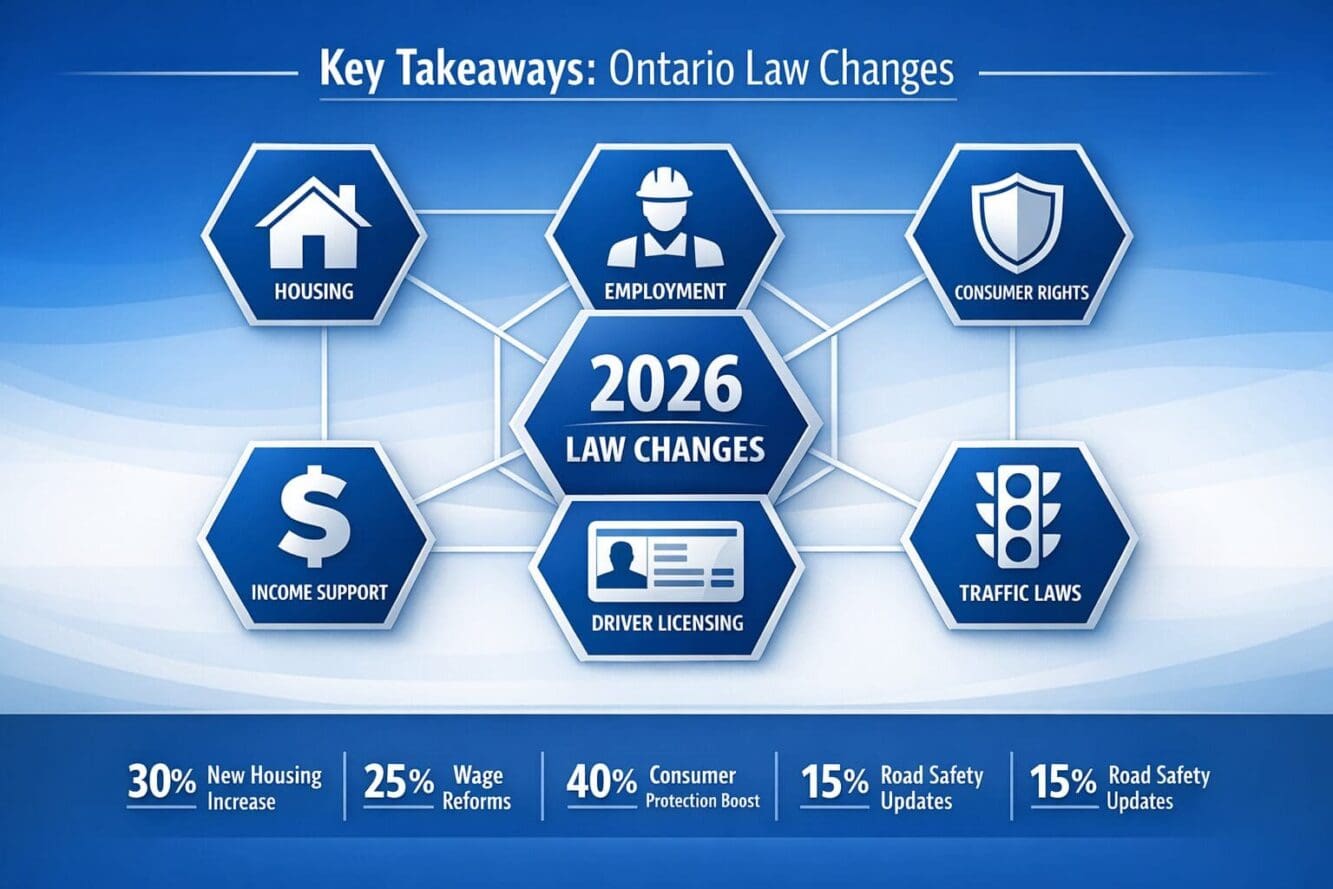
Ontario’s six major law changes in March 2026 introduce stronger tenant protections with a 2.1% rent cap, new employment standards for gig workers, mandatory consumer fee disclosure, updated income support eligibility, enhanced driver renewal requirements for seniors, and tougher distracted driving penalties. These changes affect housing, employment, consumer rights, and road safety across the province.
What Are Ontario’s Six Major Law Changes Taking Effect in March 2026?
Ontario’s six major law changes in March 2026 represent the most comprehensive regulatory update affecting residents in years. The changes target housing affordability, worker protections, consumer rights, income support, and road safety.
The new regulations address long-standing complaints about unfair rent increases, unclear employment relationships in the gig economy, hidden fees in consumer contracts, outdated benefit calculations, and road safety concerns. Each change includes specific enforcement mechanisms and penalties for non-compliance.
The six major changes include:
- Housing: 2.1% rent increase cap with anti-renoviction measures
- Employment: Gig worker classification and minimum protections
- Consumer rights: Fee transparency and cancellation reforms
- Income support: Inflation-adjusted benefits and eligibility updates
- Driver licensing: Enhanced renewal checks for seniors
- Road safety: Stricter distracted driving enforcement
These updates reflect Ontario’s response to economic pressures, changing work patterns, and safety priorities heading into 2026. Understanding how these changes affect daily life helps residents protect their rights and avoid penalties.
How Does the 2.1% Rent Increase Cap Protect Ontario Tenants in 2026?
The 2026 Ontario rent increase guideline is capped at 2.1%, down from 2.5% in 2025, representing the lowest increase in four years[3]. Landlords must provide at least 90 days’ written notice using Form N1 before implementing any rent increase[3].
This cap applies to most residential rental units covered by the Residential Tenancies Act. Landlords cannot increase rent more frequently than once every 12 months, and increases without proper notice or the correct form may be invalid[3].
Key tenant protections include:
- Above-guideline increases (AGI) require Landlord and Tenant Board approval and are typically capped at 3% above the guideline (5.1% total)[3]
- AGI applications are limited to specific circumstances like major capital repairs or significant tax increases[3]
- New anti-renoviction rules require landlords to provide written proof of renovation necessity
- Illegal rent increase penalties include potential fines and mandatory rent rollbacks
“Rent increases beyond the guideline are only permitted with Landlord and Tenant Board approval through AGI applications, limited to specific circumstances.”
Common mistake: Tenants often accept rent increases above the guideline without questioning whether proper LTB approval was obtained. Always request documentation showing board approval for any increase exceeding 2.1%.
For more information on housing affordability initiatives, see our coverage of affordable housing seed funding opportunities.
What New Employment Protections Apply to Gig and Contract Workers?
New employment standards rules establish clearer definitions of employee versus contractor status and provide minimum protections for gig workers starting March 2026[2]. These changes address the growing gig economy where workers often lack basic employment protections.
The regulations introduce a multi-factor test to determine employment status, considering control over work, financial dependency, and the nature of the working relationship. Misclassification can result in significant penalties for employers.
Gig worker protections now include:
- Minimum wage guarantees for active work time
- Basic health and safety protections
- Right to refuse unsafe work
- Protection against arbitrary termination
- Access to certain employment standards benefits
Pay transparency requirements mandate employers to disclose salary ranges in job postings and limit unpaid work during trial periods[2]. Employers cannot require candidates to disclose previous salary information or conduct extensive unpaid “trial shifts.”
Choose gig work if: You value schedule flexibility and have multiple income sources. Choose traditional employment if: You need consistent hours, benefits, and job security.
Edge case: Workers who perform services through digital platforms but have significant control over when and how they work may still be classified as independent contractors, depending on the specific arrangement.
How Do New Consumer Fee Transparency Rules Protect Ontarians?
New consumer protection regulations require businesses to clearly state all required fees upfront, make subscriptions and services easier to cancel, and limit automatic contract renewals without explicit permission[2]. These rules target industries with histories of hidden fees and difficult cancellation processes.
Businesses must display the total price including all mandatory fees before purchase confirmation. “Drip pricing” (adding fees during checkout) is now prohibited for most consumer transactions.
Key consumer protections:
| Protection | Requirement | Penalty for Non-Compliance |
|---|---|---|
| Fee disclosure | All mandatory fees shown upfront | Fines up to $50,000 |
| Easy cancellation | Cancel subscriptions in 3 clicks or less | Mandatory refunds |
| Auto-renewal limits | Explicit consent required annually | Contract voidable |
| Contract clarity | Plain language, minimum 12pt font | Unenforceable terms |
Enhanced penalties include tougher punishments for dishonest business practices, with repeat offenders facing business license suspension[2].
Common mistake: Consumers often overlook the difference between “promotional price” and “regular price” in subscription services. Always confirm the post-promotional rate and cancellation deadline.
Businesses must provide cancellation options that are at least as easy as the signup process. If you signed up online, you must be able to cancel online without calling customer service.
What Changes Affect Ontario Income Support and Benefits Programs?
Ontario is updating income support rules with changed income qualification levels, new rules for reporting part-time or gig income, and automatic benefit adjustments based on inflation[2]. These updates aim to reduce administrative burden and ensure benefits keep pace with living costs.
The changes improve coordination with federal government payments to reduce delays, overpayments, and unexpected benefit interruptions[2]. Integrated systems now share information between provincial and federal programs more efficiently.
Updated eligibility and reporting requirements:
- Income thresholds adjusted quarterly based on Statistics Canada inflation data
- Simplified reporting for gig economy and irregular income
- Automatic recalculation of benefits when federal payments change
- Reduced documentation requirements for routine renewals
- Extended grace periods for reporting changes
Who benefits most: Low-income workers with variable hours, seniors receiving multiple government benefits, and families transitioning between employment and assistance.
Important: Report income changes within 30 days to avoid overpayments that must be repaid. The new system is more forgiving of minor delays but still requires timely updates for significant changes.
Edge case: Workers who receive both federal and provincial benefits may see temporary adjustments during the transition period as systems synchronize. Contact Service Ontario if benefits decrease unexpectedly.
How Do Enhanced Driver License Renewal Requirements Affect Seniors?
Drivers aged 70 and older will undergo more thorough renewal checks instead of automatic renewal based on age, with additional steps to verify identity and driving capability[2]. The changes replace the previous system that relied primarily on self-reporting.
Enhanced renewal requirements include updated vision testing, knowledge assessment options, and in some cases, road testing for drivers showing potential capability concerns. The goal is individualized assessment rather than blanket age-based restrictions.
New renewal process for seniors:
- Vision screening with stricter standards for peripheral vision and night vision
- Identity verification using enhanced document checks to prevent fraud
- Medical questionnaire completed by family physician if applicable
- Optional knowledge test for drivers who haven’t renewed in several years
- Road test only if specific concerns are identified through screening
The changes aim to balance road safety with senior mobility and independence. Most drivers aged 70+ will continue renewing normally with minimal additional requirements.
Common concern: Many seniors worry about losing their license automatically at a certain age. The new system actually provides more individualized assessment and opportunities to demonstrate capability.
Choose to prepare by: Scheduling a comprehensive eye exam before your renewal date, reviewing the Ontario Driver’s Handbook, and discussing any health concerns with your physician proactively.
What Are the New Distracted Driving Penalties and Enforcement Measures?
Stricter distracted driving enforcement includes increased fines for repeat offenders, more use of automated enforcement tools, and new limits on demerit points[2]. The changes respond to persistent distracted driving problems despite previous penalties.
First-time offenders face fines starting at $615, while repeat offenders within five years can face fines exceeding $3,000, license suspensions up to 30 days, and six demerit points. Commercial drivers face additional penalties including potential CDL suspension.
Enhanced enforcement tools:
- Expanded use of automated cameras detecting phone use while driving
- Increased police training to identify distracted driving from greater distances
- Roadside device inspection authority in specific circumstances
- Coordination with insurance companies for premium impacts
What counts as distracted driving:
- Holding or using a phone, even at red lights
- Texting, emailing, or browsing while driving
- Programming GPS while the vehicle is in motion
- Any screen interaction beyond single-touch activation
Legal alternatives: Hands-free devices with voice activation, mounted phones used only with voice commands, and pulling over completely to use devices.
Edge case: Emergency calls to 911 are exempt from distracted driving penalties, but you should still pull over safely when possible.
The new automated enforcement cameras can detect phone use through vehicle windows and will mail tickets to registered owners, similar to red-light cameras. You cannot avoid penalties by having a passenger claim they were using the phone.
How Do These Law Changes Work Together to Protect Ontario Residents?
Ontario’s six major law changes in March 2026 create an integrated protection framework addressing housing stability, employment fairness, consumer rights, income security, and public safety. The changes reflect coordinated policy responses to economic and social challenges facing residents.
Interconnected protections:
- Housing + income support: Rent caps paired with inflation-adjusted benefits help low-income residents maintain housing stability
- Employment + consumer rights: Gig worker protections combined with fee transparency support workers in the platform economy
- Driver safety + senior support: Enhanced renewals protect all road users while maintaining senior independence and mobility
The enforcement mechanisms share common features including graduated penalties, emphasis on education before punishment, and coordination between government agencies. Compliance support resources are available through Service Ontario and online portals.
Implementation timeline: Most changes took effect March 1, 2026, with transition periods for businesses and institutions to update systems and processes. Full enforcement begins April 1, 2026.
Where to get help: Service Ontario offices provide information on all six changes, with specialized support for tenants (Landlord and Tenant Board), workers (Ministry of Labour), and consumers (Consumer Protection Ontario).
For broader context on community living and housing alternatives, explore our article on why cohousing communities are the future of living.
Who Is Most Affected by Ontario’s Six Major Law Changes in March 2026?
The law changes affect different Ontario residents in specific ways based on housing status, employment type, age, and income level. Understanding which changes apply to your situation helps you take advantage of new protections.
Impact by resident group:
| Group | Primary Benefits | Action Required |
|---|---|---|
| Renters | 2.1% rent cap, anti-renoviction protection | Review rent increase notices for compliance |
| Gig workers | Employment classification, minimum protections | Verify proper classification with platforms |
| Consumers | Fee transparency, easy cancellations | Review subscription services and contracts |
| Low-income residents | Inflation-adjusted benefits, simplified reporting | Update income reporting methods |
| Senior drivers (70+) | Individualized assessment vs. age limits | Prepare for enhanced renewal process |
| All drivers | Safer roads through distracted driving enforcement | Ensure hands-free device compliance |
Multiple benefits apply if you: Rent your home, work in the gig economy, and receive income support. These changes provide layered protections across different aspects of your life.
Least affected: Homeowners with traditional employment and no government benefits will primarily notice the distracted driving enforcement changes.
Common question: “Do these changes apply in my municipality?” Yes, all six changes apply province-wide, though some municipalities may have additional local regulations.
What Should Ontario Residents Do to Prepare for These Changes?
Preparation varies based on which law changes affect your specific situation. Taking proactive steps now prevents problems and helps you benefit from new protections.
Immediate action steps:
For renters:
- Review your current rent and calculate the maximum legal increase (2.1%)
- Save all rent increase notices and verify they use Form N1
- Document your unit’s condition with photos in case of renoviction claims
- Know your rights through the Landlord and Tenant Board website
For gig and contract workers:
- Request written confirmation of your employment classification
- Track all hours worked and compensation received
- Review platform terms of service for changes
- Consider whether reclassification as an employee benefits you
For all consumers:
- Audit current subscriptions and recurring charges
- Test cancellation processes for services you might discontinue
- Save confirmation emails showing total prices including all fees
- Report businesses using hidden fees or difficult cancellations
For income support recipients:
- Update your contact information with Service Ontario
- Understand new income reporting requirements for gig work
- Set calendar reminders for reporting deadlines
- Monitor benefit amounts for automatic inflation adjustments
For senior drivers:
- Schedule eye exams before renewal dates
- Discuss any health concerns with your physician
- Review the Ontario Driver’s Handbook
- Practice defensive driving techniques
For all drivers:
- Ensure hands-free devices are properly installed and functional
- Remove phone mounts that block windshield visibility
- Inform household members that you cannot respond to calls/texts while driving
- Budget for potential insurance increases if you have previous distracted driving tickets
Long-term strategy: Bookmark official government resources, sign up for updates from relevant agencies, and review your rights annually as regulations continue evolving.
Frequently Asked Questions
Can my landlord increase rent by more than 2.1% in 2026?
Only with Landlord and Tenant Board approval through an Above Guideline Increase (AGI) application, typically capped at 5.1% total (2.1% guideline plus 3% AGI)[3]. Your landlord must prove major capital repairs or significant tax increases justify the higher amount.
Do gig worker protections apply if I only work a few hours per week?
Yes, the new employment standards apply regardless of hours worked. Minimum wage guarantees and basic protections cover all gig workers, though some benefits may have minimum hour thresholds.
What happens if a business doesn’t show all fees upfront?
The business faces fines up to $50,000, and you may be entitled to a refund of hidden fees. Report violations to Consumer Protection Ontario with documentation of the pricing you saw versus what you were charged.
Will my Ontario Disability Support Program (ODSP) benefits automatically increase with inflation?
Yes, automatic inflation adjustments are part of the new income support rules[2]. You don’t need to apply for the adjustment, but verify the increase appears in your payment.
Do I need to take a road test when I turn 70?
Not automatically. Enhanced renewal checks are individualized[2]. Most seniors will complete vision screening and paperwork without road testing unless specific concerns are identified.
Can I still use my phone’s GPS while driving?
Yes, but only if the phone is mounted and you use voice commands or single-touch activation. Programming destinations while driving is illegal. Set your route before starting your trip.
How do I know if my rent increase notice is valid?
Valid notices must use Form N1, provide at least 90 days’ notice, not exceed 2.1% (unless AGI-approved), and take effect on the anniversary of your tenancy or first day of a month[3]. Missing any element may invalidate the notice.
What if my employer misclassifies me as a contractor instead of an employee?
Contact the Ministry of Labour to request a classification review. If reclassified as an employee, you may be entitled to back pay for benefits and protections you should have received.
Are there exceptions to the fee transparency rules?
Limited exceptions exist for regulated industries like utilities and government fees, but most consumer transactions must show total prices upfront. When in doubt, businesses must disclose rather than hide fees.
Can I cancel a gym membership or phone contract more easily now?
Yes, if you signed up online, you must be able to cancel online in three clicks or less[2]. Businesses cannot require phone calls or in-person visits if you enrolled digitally.
Do the distracted driving penalties apply in parking lots?
Yes, Ontario’s distracted driving laws apply anywhere the Highway Traffic Act applies, including parking lots, driveways, and private roads open to public traffic.
Where can I get help understanding how these changes affect me?
Service Ontario offices provide in-person assistance, or visit ontario.ca for online resources. Specific agencies include the Landlord and Tenant Board (housing), Ministry of Labour (employment), and Consumer Protection Ontario (consumer rights).
Conclusion
Ontario’s six major law changes in March 2026 provide stronger protections for renters, gig workers, consumers, income support recipients, and all road users. The 2.1% rent increase cap, gig worker employment standards, consumer fee transparency, inflation-adjusted benefits, enhanced driver renewals, and stricter distracted driving penalties address key challenges facing residents.
Understanding these changes helps you protect your rights, avoid penalties, and benefit from new protections. Renters should verify rent increase notices comply with the 2.1% cap and Form N1 requirements. Gig workers should confirm proper employment classification. Consumers should audit subscriptions and test cancellation processes. Income support recipients should update reporting methods. Senior drivers should prepare for enhanced renewals. All drivers must ensure hands-free device compliance.
Take action today: Review which changes affect your situation, bookmark relevant government resources, and document your current circumstances (rent amount, employment classification, subscription services, benefit levels). Proactive preparation prevents problems and ensures you receive all protections these new laws provide.
For additional resources on community development and housing solutions, visit our coverage of thriving in simplicity through tiny house communities.
References
[1] New Canada Laws And Rules In March 2026 – https://immigrationnewscanada.ca/new-canada-laws-and-rules-in-march-2026/
[2] 6 New Ontario Laws And Rules – https://www.mediterraneanliving.ca/6-new-ontario-laws-and-rules/
[3] Ontario Rent Increase 2026 – https://www.neobanc.com/articles/ontario-rent-increase-2026
[4] Regulations And Statutes In Force As Of January 1 2026 – https://news.ontario.ca/en/backgrounder/1006892/regulations-and-statutes-in-force-as-of-january-1-2026
Content, illustrations, and third-party video appearing on GEORGIANBAYNEWS.COM may be generated or curated with AI assistance or reproduced pursuant to the fair dealing provisions of the Copyright Act, R.S.C. 1985, c. C-42. Attribution and hyperlinks to original sources are provided in acknowledgment of applicable intellectual property rights. Such referencing is intended to direct traffic to and support the original rights holders’ platforms.
Much Appreciate You Sharing This Post - It Helps MUCH!!!