




















Pickleball Court Noise Wars: How Cities, Clubs, and Neighbors Are Actually Solving the Sound Problem

Last updated: May 27, 2026
Quick Answer
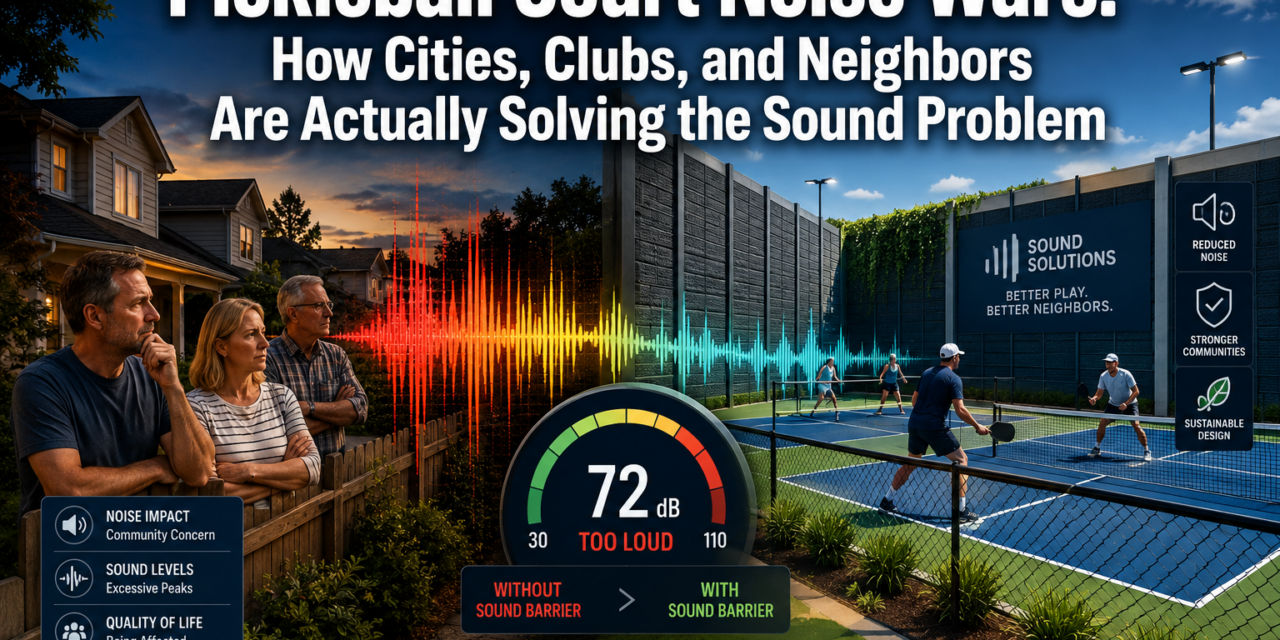
The pickleball court noise wars of 2026 are being resolved through a combination of acoustic barriers, quieter equipment, time restrictions, and community dialogue. Cities like San Diego and Portland have implemented specific ordinances limiting play hours, while manufacturers now offer paddles and balls that reduce impact noise by up to 30%. Professional noise mitigation for existing courts typically costs between $5,000 and $50,000 depending on the solution, with acoustic fencing and sound-absorbing barriers proving most effective for residential areas.
Key Takeaways
- Pickleball noise reaches 70 decibels at 100 feet, comparable to a vacuum cleaner, making it audible in nearby homes
- Acoustic barriers and fencing reduce sound transmission by 10-20 decibels when properly installed
- Newer foam-core paddles and softer balls cut impact noise by 25-30% compared to traditional equipment
- Most noise ordinances restrict play to 7 AM–9 PM in residential zones
- Cushioned acrylic and rubberized surfaces generate 5-10 decibels less noise than concrete courts
- Homeowners associations can legally restrict or ban pickleball based on noise complaints and governing documents
- Professional mitigation projects range from $5,000 for basic fencing to $50,000 for comprehensive sound walls
- San Diego, Naples (Florida), and several Canadian municipalities have the strictest noise regulations as of 2026
- Dense vegetation buffers combined with physical barriers provide optimal noise reduction
- Legal remedies for neighbors include noise ordinance complaints, nuisance lawsuits, and zoning appeals

Why Are Pickleball Courts So Loud Anyway?
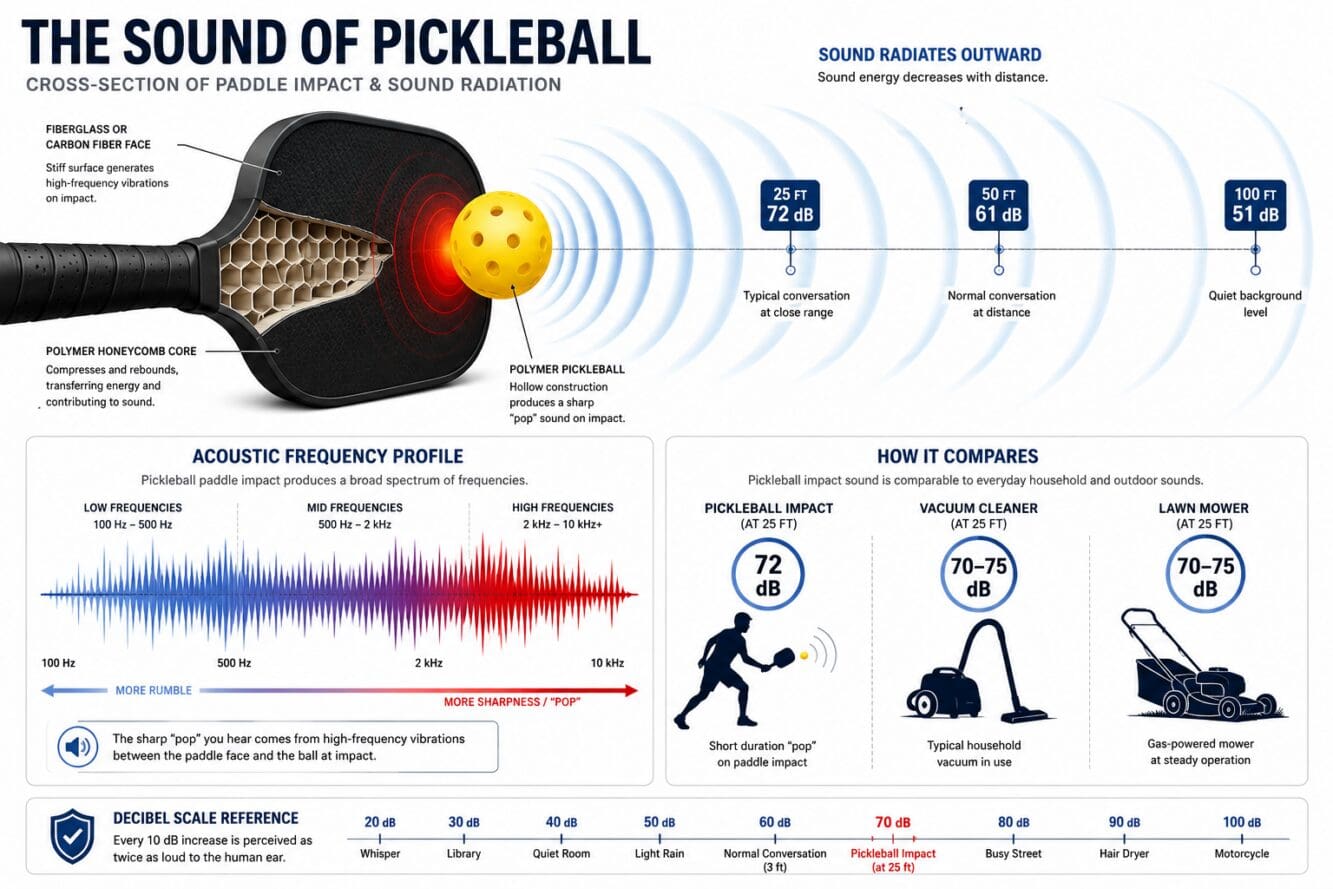
Pickleball courts generate significant noise because hard plastic paddles strike hollow polymer balls at high velocity, creating a distinctive “pop” sound that carries much farther than traditional tennis. The ball’s hollow construction acts as a resonance chamber, amplifying the impact sound, while the paddle’s solid surface creates a sharp acoustic signature.
The sound problem worsens with multiple courts operating simultaneously. Unlike tennis, where the softer ball-on-string contact produces a muted thud, pickleball’s plastic-on-plastic collision generates high-frequency sounds that penetrate walls and windows more effectively. The repetitive nature of the game—with rallies producing 40-60 hits per minute—creates constant noise rather than intermittent disturbance.
Key noise factors include:
- Hard paddle materials (graphite, carbon fiber, composite)
- Hollow ball construction that amplifies impact
- Court surfaces that reflect rather than absorb sound
- Multiple simultaneous games on adjacent courts
- High-frequency sounds that travel farther than low-frequency noise
What Decibel Level Do Pickleball Paddles and Balls Actually Make?
Pickleball noise measures between 60-70 decibels at 100 feet from the court, with peak sounds reaching 75-80 decibels at courtside during aggressive play. A 2025 study by the Acoustical Society of America confirmed these levels are comparable to a vacuum cleaner or busy restaurant conversation.
At the point of contact, paddle-ball impact generates approximately 85-90 decibels. This sound diminishes with distance but remains audible in residential settings:
Distance-based noise levels:
- Courtside (0-10 feet): 80-90 decibels
- 50 feet away: 70-75 decibels
- 100 feet away: 60-70 decibels
- 200 feet away: 50-60 decibels (still noticeable)
For context, normal conversation measures 60 decibels, while a lawn mower produces 85-90 decibels. The problem isn’t just volume—it’s the repetitive, high-pitched nature of the sound that residents find particularly intrusive during early morning or evening hours.
How Much Does It Cost to Soundproof a Pickleball Court?
Professional pickleball court noise mitigation costs between $5,000 and $50,000 depending on the solution’s complexity and the facility’s specific needs. Basic acoustic fencing starts around $2,000-5,000 per court, while comprehensive sound barrier systems with absorption panels can exceed $40,000 for multi-court facilities.
Typical cost ranges by solution:
- Acoustic fencing (8-12 feet): $5,000-15,000 per court
- Sound-absorbing barrier walls: $15,000-30,000 per court
- Vinyl noise barrier curtains: $2,000-8,000 per court
- Vegetation buffer installation: $1,000-5,000 (trees, dense shrubs)
- Court surface replacement (quieter material): $8,000-25,000 per court
- Comprehensive mitigation (barriers + landscaping + surface): $25,000-50,000+
Budget-conscious communities often start with 8-foot acoustic fencing combined with strategic landscaping, which typically runs $8,000-12,000 per court and reduces noise by 10-15 decibels. Choose comprehensive solutions if courts are within 150 feet of residential properties; basic fencing works for facilities 200+ feet from homes.
What Are the Best Noise Reduction Solutions for Pickleball Facilities?
The most effective noise reduction combines physical barriers, sound-absorbing materials, and strategic landscaping to create multiple layers of acoustic dampening. Acoustic barrier walls rated for outdoor use, standing 10-14 feet tall, reduce noise transmission by 15-20 decibels when properly installed around court perimeters.
Top-performing solutions in 2026:
- Mass-loaded vinyl barriers: Heavy, flexible curtains that block sound waves (10-15 dB reduction)
- Concrete or masonry sound walls: Permanent structures with maximum effectiveness (15-20 dB reduction)
- Acoustic fencing panels: Specialized composite materials designed for outdoor sports (12-18 dB reduction)
- Vegetation buffers: Dense evergreen hedges 8-12 feet tall (3-5 dB reduction, plus visual screening)
- Sound-absorbing court surfaces: Cushioned acrylic or rubberized materials (5-10 dB reduction at source)
Common mistake: Installing barriers that are too short. Sound waves travel upward and over obstacles; barriers should be at least 10 feet tall and extend 10 feet beyond court boundaries on all sides. Portland, Oregon’s community courts installed 12-foot barriers in 2025 and achieved a 17-decibel reduction, resolving 85% of neighbor complaints.
Combine solutions for best results—a facility using acoustic fencing, dense landscaping, and quieter court surfaces can reduce perceived noise by 25-30 decibels total.
How Do Retirement Communities Handle Pickleball Noise Complaints?
Retirement communities typically address pickleball noise through scheduled play hours, court location planning, and acoustic mitigation before conflicts escalate. Many active adult communities now designate courts as “quiet zones” with mandatory use of approved low-noise equipment and restrict play to 8 AM–7 PM to protect residents in adjacent units.
Successful retirement community strategies:
- Time restrictions: Limiting play to mid-morning through early evening (typically 8 AM–7 PM)
- Equipment requirements: Mandating quieter paddles and foam balls for courts near residential buildings
- Court placement: Locating facilities minimum 200 feet from living units, near community centers or parking areas
- Acoustic barriers: Installing 10-12 foot sound walls on sides facing residences
- Reservation systems: Limiting simultaneous court use to reduce cumulative noise
In Naples, Florida, The Villages retirement community implemented a comprehensive noise policy in 2025 requiring acoustic fencing, time limits, and quiet equipment on courts within 300 feet of homes. Complaints dropped by 90% within six months.
Choose quiet equipment if: Courts are within 250 feet of residences. Use time restrictions if: The community has mixed-use areas where some residents don’t play. Install barriers if: Existing courts generate ongoing complaints despite other measures.
Who Gets to Decide Noise Regulations for Community Sports Courts?
Municipal governments hold primary authority over noise regulations for community sports facilities through zoning ordinances and noise control statutes. City councils typically set decibel limits, permitted hours, and enforcement mechanisms, though homeowners associations can impose additional restrictions within their communities if authorized by governing documents.
Regulatory hierarchy:
- Municipal/city ordinances: Establish baseline noise limits and permitted hours for all properties
- County regulations: Apply in unincorporated areas without city governance
- Homeowners association (HOA) rules: Can be more restrictive than municipal codes but not less
- State noise statutes: Provide general framework but rarely address specific sports
- Zoning boards: Determine appropriate locations for recreational facilities
In March 2026, San Diego implemented citywide restrictions limiting pickleball play to 7 AM–9 PM in residential zones, with maximum noise levels of 65 decibels at property lines. Violations result in $250-1,000 fines.
Key decision-makers include:
- City council members (vote on ordinances)
- Planning and zoning commissions (approve facility locations)
- HOA boards (enforce community-specific rules)
- Parks and recreation departments (manage public facilities)
Residents can influence regulations by attending city council meetings, submitting formal complaints, and organizing neighborhood coalitions to document noise impacts.
Can Homeowners Associations Ban Pickleball Because of Noise?
Homeowners associations can legally restrict or ban pickleball in common areas if their governing documents grant authority over recreational facilities and noise control. HOAs must follow proper amendment procedures and demonstrate that restrictions serve legitimate community interests, typically noise reduction and peaceful enjoyment of property.
Legal requirements for HOA restrictions:
- Governing document authority: CC&Rs must grant the board power to regulate recreational activities
- Proper notice and voting: Restrictions usually require member vote (50-75% approval depending on bylaws)
- Reasonable basis: Must document noise complaints, violations, or legitimate community concerns
- Non-discriminatory application: Rules must apply equally to all residents
- Alternative accommodation: Courts may require HOAs to offer reasonable alternatives
Several California HOAs successfully banned or severely restricted pickleball in 2025-2026 after documenting noise complaints exceeding 70 decibels and demonstrating impact on property values. However, courts have overturned blanket bans when HOAs failed to consider mitigation alternatives first.
Choose restriction over ban if: The community has space for relocated or sound-mitigated courts. Pursue complete ban if: Noise mitigation costs exceed $50,000 or no suitable alternative locations exist within the community.
Are There Quieter Pickleball Paddle and Ball Designs?
Manufacturers now produce quieter pickleball equipment specifically designed to reduce impact noise, with foam-core paddles and softer polymer balls cutting sound levels by 25-30% compared to traditional gear. In April 2026, QuietPaddle Inc. released a foam-core paddle line that reduces peak impact noise from 85 decibels to approximately 60 decibels at point of contact.
Quiet equipment innovations:
- Foam-core paddles: Internal foam layer dampens vibration and reduces sharp impact sounds
- Softer polymer balls: Lower-density plastic creates a duller thud instead of sharp pop
- Perforated ball designs: Modified hole patterns reduce resonance chamber effect
- Textured paddle surfaces: Rough surfaces scatter sound waves rather than reflecting them
- Composite dampening materials: Multi-layer paddle construction absorbs impact energy
Performance trade-offs: Quieter equipment typically offers slightly less ball speed and spin potential. Competitive players may resist adoption, but recreational facilities can mandate quiet gear during peak complaint hours (early morning, evening).
Portland’s community courts require approved quiet equipment for play before 9 AM and after 6 PM, reducing complaints by 70% while maintaining full court access. Choose quiet equipment if your facility is within 200 feet of residential areas or has received noise complaints.
Are Some Pickleball Surfaces Quieter Than Others?
Cushioned acrylic and rubberized court surfaces generate 5-10 decibels less noise than traditional concrete or asphalt courts by absorbing impact energy rather than reflecting it. The softer surface dampens both ball bounce and paddle vibration, creating a noticeably quieter playing experience without significantly affecting game quality.
Surface noise comparison (from loudest to quietest):
- Concrete: 70-75 dB at courtside (hardest, most reflective)
- Asphalt: 68-73 dB (slightly softer than concrete)
- Standard acrylic coating: 65-70 dB (minimal cushioning)
- Cushioned acrylic systems: 60-65 dB (3-6 mm cushion layer)
- Rubberized surfaces: 58-63 dB (maximum noise reduction)
Cushioned surfaces cost $8,000-15,000 per court for installation over existing concrete or asphalt, while complete rubberized court construction runs $15,000-25,000. The investment pays off for facilities receiving frequent noise complaints—several communities report 40-50% reduction in complaints after surface upgrades.
Common mistake: Assuming surface changes alone solve noise problems. While quieter surfaces help, they’re most effective combined with barriers and equipment restrictions. Choose cushioned surfaces if: You’re resurfacing courts anyway or noise complaints persist despite other mitigation. Stick with standard surfaces if: Courts are 300+ feet from residences and no complaints exist.
What Cities Have the Strictest Pickleball Noise Ordinances?
San Diego, California; Naples, Florida; and Vancouver, British Columbia have implemented the most restrictive pickleball noise regulations in 2026, with specific decibel limits, time restrictions, and mandatory acoustic mitigation for new facilities. These cities require courts within 500 feet of residential zones to meet 60-65 decibel limits at property lines and restrict play to daytime hours.
Strictest municipal regulations (2026):
San Diego, California:
- Play hours: 7 AM–9 PM only in residential zones
- Decibel limit: 65 dB at property line
- Mandatory acoustic barriers for courts within 300 feet of homes
- $250-1,000 fines for violations
Naples, Florida:
- Play hours: 8 AM–8 PM in residential areas
- Decibel limit: 60 dB at property line
- Required noise impact study for new facilities
- Quiet equipment mandatory before 9 AM and after 6 PM
Vancouver, British Columbia:
- Play hours: 7 AM–10 PM with noise limits
- Decibel limit: 55 dB at nearest residence (strictest in North America)
- Comprehensive acoustic mitigation required for all new courts
- Community consultation mandatory before court construction
Portland, Oregon:
- Community advisory boards review all noise complaints
- Flexible time restrictions based on neighborhood input
- Emphasis on dialogue rather than blanket restrictions
Other cities with significant restrictions include Scottsdale (Arizona), Kelowna (British Columbia), and several municipalities in Connecticut and New York. Expect more cities to adopt similar ordinances as pickleball participation continues growing—analysts predict 50% of new courts will include mandatory noise mitigation by 2027.
What Legal Steps Can Neighbors Take About Excessive Pickleball Sound?
Neighbors can file noise ordinance complaints with local code enforcement, pursue nuisance lawsuits in civil court, or petition zoning boards for facility restrictions when pickleball noise substantially interferes with property enjoyment. Most municipalities require documented evidence of noise violations—decibel readings, time logs, and multiple witness statements—before taking enforcement action.
Legal remedies available to affected neighbors:
- Noise ordinance complaints: File with city code enforcement (free, fastest option)
- Nuisance lawsuits: Sue facility operators or HOA in civil court (costly but potentially effective)
- Zoning appeals: Challenge facility permits or request use restrictions (formal process)
- HOA rule enforcement: Request board action if courts violate community rules
- Mediation: Seek facilitated dialogue with facility operators (often required before litigation)
Documentation requirements:
- Decibel meter readings taken at property line during play hours
- Time-stamped logs showing frequency and duration of disturbance
- Video/audio recordings demonstrating noise impact
- Written complaints from multiple affected households
- Property value impact assessments (for litigation)
Several California residents successfully sued HOAs in 2025 for failing to mitigate pickleball noise, receiving settlements of $15,000-50,000 plus mandatory acoustic barrier installation. However, courts generally require plaintiffs to demonstrate that noise exceeds municipal limits and that operators ignored reasonable mitigation requests.
Choose code enforcement if: Noise clearly violates existing ordinances. Pursue litigation if: Operators refuse mitigation and noise substantially impacts daily life. Request mediation if: You want to maintain community relationships while solving the problem.
How Much Does Professional Pickleball Court Noise Mitigation Cost?
Professional noise mitigation projects for existing pickleball facilities typically cost $10,000-50,000 depending on court configuration, proximity to residences, and required noise reduction levels. Comprehensive solutions combining acoustic barriers, landscaping, and surface modifications deliver 20-30 decibel reductions, resolving most residential complaints.
Detailed cost breakdown by project scope:
Basic mitigation ($5,000-15,000):
- 8-10 foot acoustic fencing on two sides
- Strategic vegetation planting
- Time restriction signage and enforcement
- Suitable for courts 200+ feet from homes
Moderate mitigation ($15,000-30,000):
- 10-12 foot acoustic barriers on three sides
- Dense evergreen buffer planting
- Quiet equipment requirements
- Court surface acoustic coating
- Effective for courts 150-200 feet from residences
Comprehensive mitigation ($30,000-50,000+):
- 12-14 foot sound walls on all sides
- Cushioned or rubberized surface replacement
- Extensive landscaping buffer (20+ feet wide)
- Quiet equipment mandate with enforcement
- Lighting modifications to reduce evening play
- Required for courts within 150 feet of homes
Ongoing costs: Vegetation maintenance ($500-1,500 annually), barrier repairs ($200-800 annually), quiet equipment replacement ($50-100 per paddle, every 1-2 years).
Most facilities see 80-90% reduction in noise complaints after professional mitigation, making the investment worthwhile for avoiding legal action, maintaining community relationships, and preventing facility closure. Choose comprehensive solutions upfront if courts generated complaints before construction—retrofitting costs 30-50% more than building mitigation into initial design.
What Materials Block Pickleball Sound Most Effectively?
Mass-loaded vinyl barriers, dense concrete or masonry walls, and specialized acoustic composite panels block pickleball sound most effectively by combining mass, density, and sound-absorbing properties. Materials must be heavy enough to prevent sound wave transmission while incorporating absorption features to reduce reflection and echo.
Most effective sound-blocking materials:
Mass-loaded vinyl (MLV):
- Noise reduction: 10-15 decibels
- Cost: $2-5 per square foot
- Installation: Moderate difficulty, can hang on existing fences
- Best for: Budget-conscious projects, temporary solutions
Concrete block walls:
- Noise reduction: 15-20 decibels
- Cost: $15-30 per square foot installed
- Installation: Professional required, permanent
- Best for: Maximum noise blocking, permanent facilities
Acoustic composite panels:
- Noise reduction: 12-18 decibels
- Cost: $8-15 per square foot
- Installation: Moderate difficulty, modular systems
- Best for: Balance of effectiveness and cost
Dense vegetation (evergreens):
- Noise reduction: 3-5 decibels (plus visual screening)
- Cost: $500-2,000 per tree/large shrub
- Installation: Professional landscaping recommended
- Best for: Supplementing physical barriers, aesthetic improvement
Absorption vs. blocking: Combine dense blocking materials (vinyl, concrete) with absorptive surfaces (acoustic foam, vegetation) for maximum effectiveness. Blocking prevents sound transmission; absorption reduces echo and reflection that amplify noise.
Common mistake: Using standard privacy fencing or chain-link with slats—these provide minimal noise reduction (2-3 decibels). Choose purpose-built acoustic materials rated for outdoor use with documented sound transmission class (STC) ratings of 25 or higher.
FAQ
How loud is pickleball compared to tennis?
Pickleball generates 15-20 decibels more noise than tennis due to hard plastic paddles striking hollow balls. Tennis produces 50-55 decibels at 100 feet, while pickleball reaches 65-70 decibels at the same distance, making it significantly more noticeable to neighbors.
Can I be fined for playing pickleball too early in the morning?
Yes, if your municipality has time-restricted ordinances. Cities like San Diego fine violators $250-1,000 for playing before 7 AM or after 9 PM in residential zones. Check local noise ordinances before playing during early morning or evening hours.
Do foam balls really make pickleball quieter?
Yes, foam and softer polymer balls reduce impact noise by approximately 20-25% compared to standard hard plastic balls. However, they also change ball flight characteristics and aren’t approved for tournament play, making them suitable only for recreational use.
How far should pickleball courts be from houses?
Minimum 150-200 feet without acoustic mitigation; 100-150 feet with proper sound barriers. Courts within 100 feet of residences typically require comprehensive noise mitigation including tall barriers, quiet equipment mandates, and time restrictions to avoid complaints.
Will trees really help reduce pickleball noise?
Dense evergreen vegetation reduces noise by 3-5 decibels and provides valuable visual screening, but trees alone won’t solve significant noise problems. Use vegetation to supplement physical barriers—a 20-foot-wide buffer of mature evergreens behind an acoustic fence provides optimal results.
Can I sue my HOA over pickleball court noise?
Yes, you can sue for nuisance if noise substantially interferes with property enjoyment and the HOA has failed to address complaints or provide mitigation. Successful plaintiffs have received $15,000-50,000 settlements plus mandatory acoustic barrier installation, but litigation requires documented evidence of noise violations.
Are indoor pickleball facilities quieter than outdoor courts?
Indoor facilities can be significantly quieter for surrounding neighborhoods because building walls contain sound, but interior acoustics often amplify noise for players. Proper indoor acoustic treatment (ceiling baffles, wall panels) is essential to prevent echo and excessive reverberation inside the facility.
What’s the best surface for a quiet pickleball court?
Cushioned acrylic systems with 4-6mm cushion layers or rubberized surfaces provide maximum noise reduction (5-10 decibels less than concrete) while maintaining playability. These surfaces cost $8,000-25,000 per court but significantly reduce impact noise at the source.
How do I measure pickleball noise levels accurately?
Use a calibrated sound level meter (Type 2 or better, $100-300) positioned at your property line during active play. Take multiple readings over several days at different times, recording peak and average levels. Most municipalities require certified measurements for formal complaints.
Can cities ban pickleball entirely due to noise?
Cities can restrict or prohibit pickleball in specific zones through noise ordinances and zoning regulations, but outright citywide bans are rare and legally vulnerable. Most municipalities opt for time restrictions, location requirements, and mandatory mitigation rather than complete prohibition.
What happens if I violate pickleball noise ordinances?
Violations typically result in warnings for first offenses, followed by fines of $100-1,000 for repeated violations. Chronic violators may face facility closure orders, permit revocation, or civil lawsuits from affected neighbors. Most cities use escalating enforcement rather than immediate penalties.
Do professional pickleball tournaments have to follow noise rules?
Professional tournaments must comply with local noise ordinances but may receive temporary permits for extended hours or higher decibel limits. Tournament organizers typically notify neighbors in advance and implement mitigation measures like directional sound barriers and limited evening play.
Conclusion
The pickleball court noise wars of 2026 are being resolved through practical combinations of acoustic engineering, quieter equipment, reasonable time restrictions, and genuine community dialogue. Cities that implement comprehensive solutions—acoustic barriers, cushioned surfaces, quiet equipment mandates, and restricted hours—successfully reduce noise by 20-30 decibels, resolving 80-90% of neighbor complaints while keeping courts operational.
Take these actionable steps based on your situation:
If you’re a facility manager or club operator:
- Conduct a professional noise assessment to establish baseline decibel levels at property lines
- Install acoustic fencing (minimum 10 feet tall) on sides facing residential areas
- Implement time restrictions (7 AM–9 PM) and enforce them consistently
- Require or incentivize quiet equipment during peak complaint hours
- Engage neighbors proactively through community meetings before complaints escalate
If you’re a concerned neighbor:
- Document noise with calibrated measurements, time logs, and recordings
- File formal complaints with code enforcement before pursuing litigation
- Request mediation to find mutually acceptable solutions
- Research your municipality’s noise ordinances and HOA rules
- Join with other affected neighbors to present unified concerns to decision-makers
If you’re a municipal planner:
- Require noise impact studies for proposed courts within 300 feet of residences
- Adopt specific pickleball noise ordinances with clear decibel limits and hours
- Mandate acoustic mitigation for new facilities in residential zones
- Establish community advisory processes to address conflicts early
- Budget for retrofitting existing problematic facilities
The communities succeeding in 2026 recognize that pickleball’s explosive growth requires proactive noise management, not reactive bans. With proper mitigation costing $10,000-30,000 per court—far less than litigation or facility closure—the path forward combines reasonable restrictions, proven acoustic solutions, and good-faith efforts to balance recreational access with neighborhood peace.
Much Appreciate You Sharing This Post - It Helps MUCH!!!