



















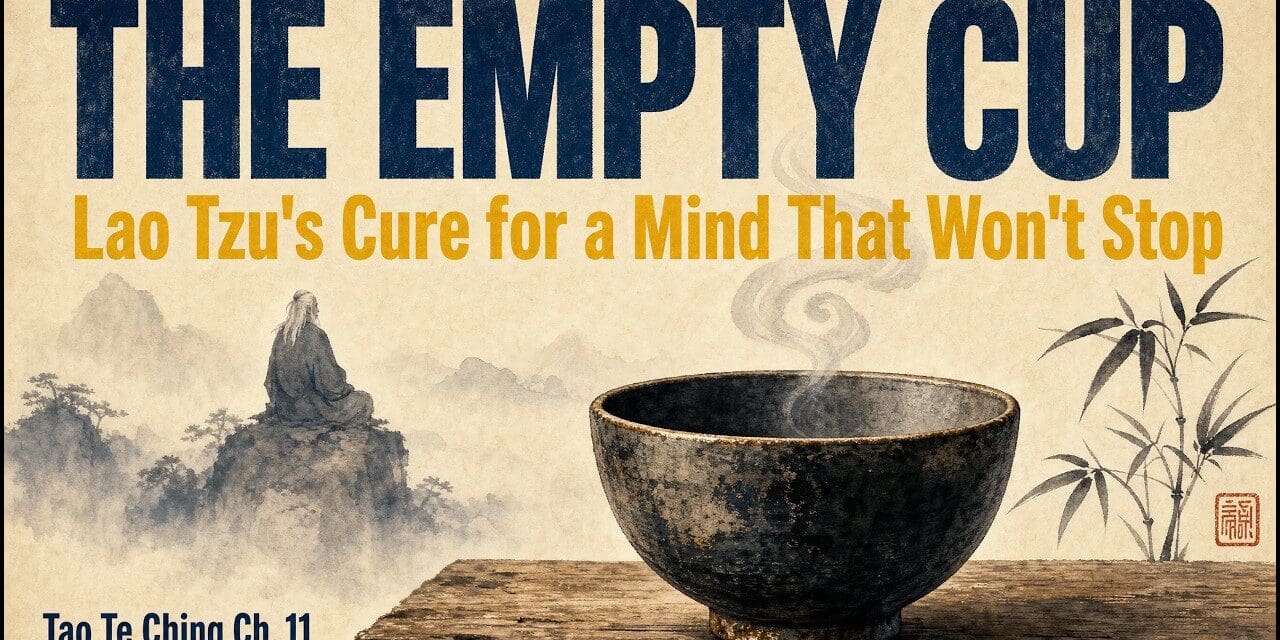
This is the central observation of one of the most visual, most direct, and most ignored chapters in everyday practice. In this contemplative essay, we analyze the three metaphors of Tao Te Ching Chapter 11 — the wheel, the bowl, the room — verse by verse, with the original Chinese text and cross-references across four major English translations. Not as an academic exercise. As a tool for understanding why Taoist philosophy proposes the exact opposite of what our culture teaches about time, the mind, and relationships.
The question that drives the episode: when was the last time you let an empty space stay empty — without filling it? Not a meditation app prompt. A genuine pause. Lao Tzu has a clear answer about what happens when we don’t. And it isn’t mystical. It’s mechanical.
The episode includes a 60-second somatic practice called “The Bowl” — no rituals, no ceremony — drawn directly from the teaching of the chapter. We also explore the Japanese concept of Ma (間), the space between things, as a visual parallel to what Lao Tzu describes, and why most English commentaries on this chapter miss the final paradox of the text.
This is not spiritual coaching or self-help. It is Taoist philosophy applied to everyday experience.

📚 Sources and concepts: · Tao Te Ching, Chapter 11 — Lao Tzu (attributed). Original classical Chinese text. English translations referenced: Ursula K. Le Guin (Shambhala, 1998 — chapter titled “The Uses of Not”), D.C. Lau (Penguin Classics, 1963), Stephen Mitchell (Harper Perennial, 1988), Ellen M. Chen (Paragon House, 1989). · Ma (間) — Japanese aesthetic concept of the space between things, present in architecture, music, and traditional visual arts. A natural parallel to Lao Tzu’s emptiness. · Modern neuroscience research on rest, mind-wandering, and creative insight — referenced in general terms. 📖 The translations we read on this channel: · D.C. Lau (Penguin Classics) — the base text for every episode: https://amzn.to/4q1X2vs · Stephen Mitchell (Harper Perennial): https://amzn.to/4hmr4Ii · Victor H. Mair (from the Ma-wang-tui manuscripts): https://amzn.to/4fUKy5H · Arthur Waley (The Way and Its Power): https://amzn.to/4g08pzG · Robert G. Henricks (Te-Tao Ching): https://amzn.to/4fWvAuv ·
Ursula K. Le Guin (Shambhala): https://amzn.to/4weT7go As an Amazon Associate I earn from qualifying purchases.
🔑 About this channel: The Tao Within explores Taoist philosophy as a lens for everyday life. No rituals, no transformation promises: honest reflection on Tao Te Ching, Lao Tzu’s teachings, Wu Wei, emptiness, and Eastern philosophy applied to modern experience. The creator is a Western practitioner, not an academic. That distinction matters.
📌 If this analysis was useful, subscribing is the most direct way to support the Tao Te Ching series. Sharing it with someone whose calendar is always full is the best way for this teaching to reach the people who need it. This content is philosophical reflection, not therapeutic advice. If you’re going through a difficult time, please seek professional support.
Content, illustrations, and third-party video appearing on GEORGIANBAYNEWS.COM may be generated or curated with AI assistance or reproduced pursuant to the fair dealing provisions of the Copyright Act, R.S.C. 1985, c. C-42. Attribution and hyperlinks to original sources are provided in acknowledgment of applicable intellectual property rights. Such referencing is intended to direct traffic to and support the original rights holders’ platforms.