




















The Wealthy Barber by David Chilton: Timeless Financial Wisdom Updated for 2026 Canadians
Last updated: February 23, 2026
David Chilton’s The Wealthy Barber sold over two million copies in Canada since 1989, making it the bestselling Canadian personal finance book of all time thewealthybarber.com. In November 2025, Chilton released a fully rewritten edition that addresses the financial realities facing Millennials and Gen Z — from TFSAs and FHSAs to the affordability crisis in Canadian housing [1]. This article breaks down everything in The Wealthy Barber by David Chilton: Timeless Financial Wisdom Updated for 2026 Canadians, including the new tools covered, the core principles that haven’t changed, and practical steps readers can take right now.
Key Takeaways
- The 2025 updated edition is a complete rewrite, not a minor refresh. Chilton rebuilt the book from scratch for a new generation [3].
- New financial tools covered: TFSAs, FHSAs, ETFs, and RDSPs are all explained in plain language [1][2].
- “Pay yourself first” remains the #1 strategy. Chilton says roughly 90% of successful savers used this approach [1].
- The book now recommends saving 10–15% of income and investing in passive ETFs rather than actively managed mutual funds thestar.com.
- Homeownership gets a more nuanced treatment. The updated edition acknowledges that real estate won’t generate the same returns younger Canadians might expect [4].
- Permanent life insurance and “infinite banking” are strongly criticized as schemes marketed by what Chilton calls charlatans [2].
- Estate planning, wills, and powers of attorney receive detailed coverage for the first time [2].
- The story features a new cast including a 22-year-old immigrant character named Sourov, reflecting the diversity of modern Canada [2].
Quick Answer

The Wealthy Barber updated edition (November 2025) is a complete rewrite of David Chilton’s 1989 classic, now tailored for Canadians under 45 who are dealing with high housing costs, new registered accounts like TFSAs and FHSAs, and an investment landscape dominated by ETFs rather than mutual funds. The core message — automate your savings by paying yourself first — hasn’t changed, but the tools, examples, and financial products are fully modernized for 2026.
What Changed in the Updated Edition of The Wealthy Barber?
Nearly everything. Chilton didn’t just swap a few paragraphs and update interest rates. He rewrote the entire book from the ground up [3]. The fictional barbershop setting and the wise barber Roy remain, but the cast of characters visiting the shop is entirely new.
New characters include:
- Matt, a teacher, and his wife Maddie
- Matt’s sister Jess
- Their friend Kyle
- Sourov, a 22-year-old immigrant who represents the struggles young Canadians face with affordability and starting from scratch [2]
The contemporary setting references TikTok, ChatGPT, and current cultural touchpoints, making the conversations feel natural for readers in their 20s and 30s [2]. The narrative is set in 2025 Canada and directly addresses the gap between what previous generations paid for homes and what younger Canadians face today [4].
What stayed the same: Roy the barber still dispenses wisdom. The conversational, story-driven format still makes financial concepts accessible. And the foundational principle — pay yourself first — is still the beating heart of the book.
Common mistake: Assuming the updated edition is just a cosmetic refresh. Readers who own the 1989 or 2011 versions will find substantially different content, including entire chapters on financial products that didn’t exist when the original was published.
Why Does The Wealthy Barber by David Chilton Remain Relevant for 2026 Canadians?
Because the core financial behaviours that build wealth haven’t changed, even though the tools and economic conditions have shifted dramatically. Chilton’s central argument — that ordinary Canadians can build significant wealth through consistent, automated saving and sensible investing — is arguably more important now than it was in 1989.
Here’s why the book still matters in 2026:
- The affordability crisis demands better financial literacy. With housing costs at historic highs in many Canadian cities, young people need to understand every available tool to get ahead. The book addresses this head-on [1].
- New registered accounts are underused. Many Canadians still don’t fully understand TFSAs or FHSAs, and the book explains both in conversational, jargon-free language [1][2].
- Investment costs have dropped dramatically. The shift from expensive actively managed mutual funds to low-cost passive ETFs is one of the biggest changes in Canadian investing over the past 36 years. The updated edition covers this transition clearly thestar.com.
- Financial misinformation is everywhere. Social media is full of get-rich-quick schemes and dubious financial advice. Chilton’s grounded, evidence-based approach serves as an antidote.
For Canadians concerned about how an idyllic retirement plan can turn into a financial trap, the book’s emphasis on planning early and understanding what you’re buying is especially relevant.
What Are TFSAs, FHSAs, and ETFs — and How Does the Book Explain Them?
These three tools form the backbone of the updated edition’s investment strategy. Here’s a quick breakdown of each, as Chilton presents them:
Tax-Free Savings Account (TFSA)
A TFSA lets Canadians over 18 contribute after-tax dollars into an account where all investment growth — interest, dividends, and capital gains — is completely tax-free, both inside the account and on withdrawal. Chilton emphasizes that a TFSA is not a savings account in the traditional sense; it’s a registered account that can hold stocks, bonds, ETFs, and other investments thewealthybarber.com.
Choose a TFSA if: You’re in a lower tax bracket now and expect to earn more later, or you want flexible access to your money without tax consequences on withdrawal.
First Home Savings Account (FHSA)
The FHSA, introduced in 2023, combines the best features of an RRSP and a TFSA. Contributions are tax-deductible (like an RRSP), and withdrawals for a qualifying first home purchase are tax-free (like a TFSA). Chilton calls FHSAs “a true no-brainer” for anyone planning to buy their first home [1][2].
Choose an FHSA if: You’re a first-time homebuyer in Canada. There’s almost no scenario where opening one doesn’t make sense, even if you’re unsure about buying — unused FHSA funds can be transferred to an RRSP.
Exchange-Traded Funds (ETFs)
The updated edition recommends passive, broadly diversified ETFs over actively managed mutual funds. ETFs trade on stock exchanges like individual stocks but hold baskets of securities, offering instant diversification at a fraction of the cost of traditional mutual funds thestar.com.
| Feature | TFSA | FHSA | RRSP |
|---|---|---|---|
| Tax on contributions | No deduction | Tax-deductible | Tax-deductible |
| Tax on growth | Tax-free | Tax-free | Tax-deferred |
| Tax on withdrawal | Tax-free | Tax-free (for home purchase) | Taxed as income |
| Annual contribution limit (2026) | $7,000 | $8,000 | 18% of income (max ~$32,490) |
| Best for | Flexible savings/investing | First home purchase | Higher-income earners saving for retirement |
Edge case: If you’re a first-time homebuyer AND in a high tax bracket, you may want to maximize both your FHSA and RRSP contributions before your TFSA. The book walks through this decision in detail [2].
How Does “Pay Yourself First” Actually Work in Practice?
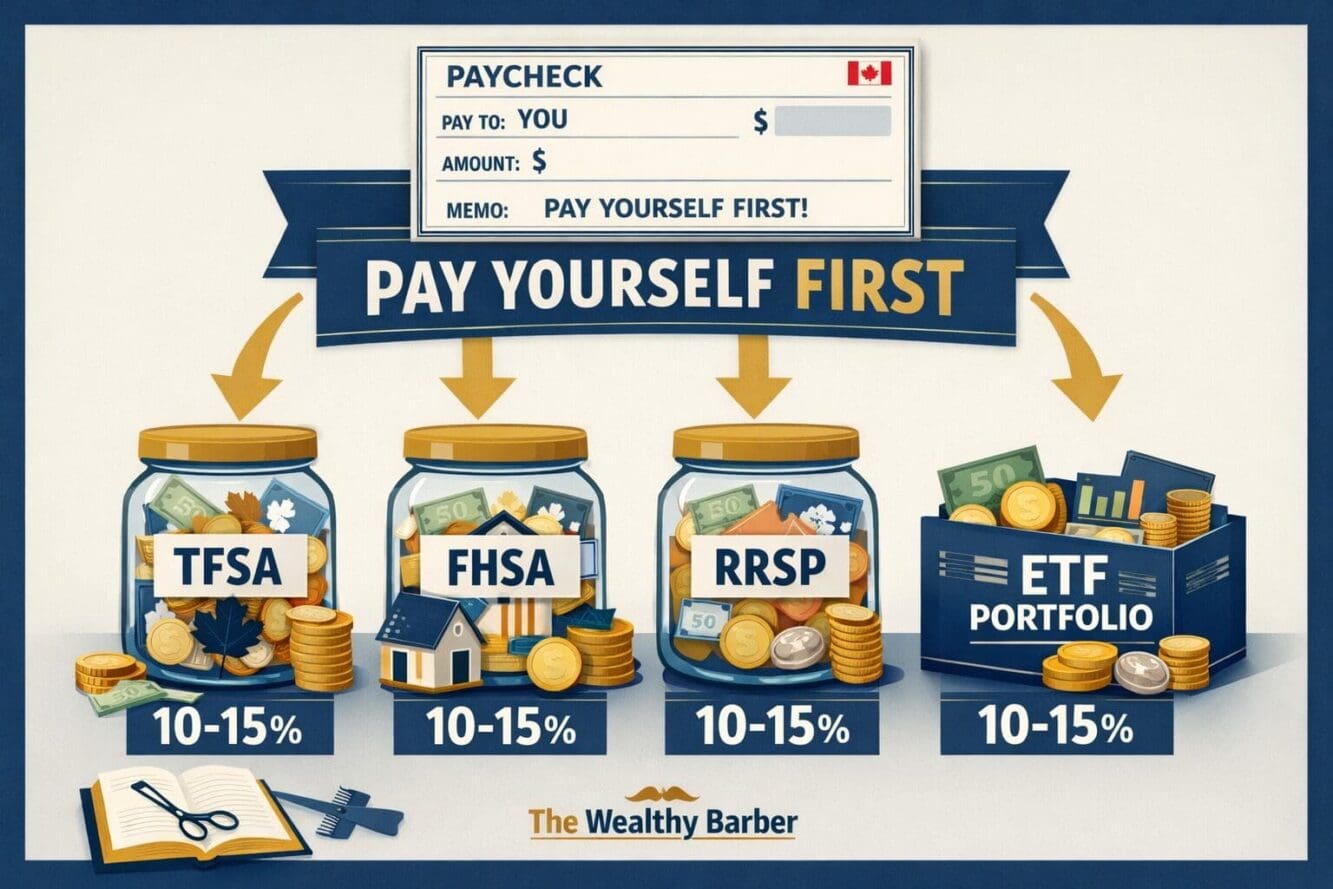
It means setting up automatic transfers from your paycheque to your savings and investment accounts before you pay any other bills or discretionary expenses. Chilton has spent 36 years analyzing personal financial plans and reports that approximately 90% of people who successfully built wealth used this single strategy [1].
Step-by-Step Implementation
- Determine your savings rate. The updated edition recommends 10–15% of gross income. If that’s not possible right now, start with whatever you can and increase by 1% every six months.
- Open the right accounts. For most young Canadians, that means a TFSA and (if applicable) an FHSA. Higher earners should also consider an RRSP.
- Set up automatic transfers. Schedule them for the day after payday. If the money never hits your chequing account, you won’t miss it.
- Invest in low-cost passive ETFs. A simple balanced ETF (like an all-in-one fund) can serve as your entire portfolio when you’re starting out.
- Leave it alone. Don’t check your portfolio daily. Don’t react to market drops. Compound growth does the heavy lifting over decades.
Common mistake: Treating “pay yourself first” as optional or aspirational. Chilton is emphatic that this must be non-negotiable, like rent or a utility bill. People who save “whatever is left over” almost never build meaningful wealth [1].
Understanding how innovation can strain existing systems applies to personal finance too — if you don’t build the infrastructure (automated savings) first, the system breaks down.
What Does the Updated Edition Say About Buying a Home in Canada?
This is one of the most significant changes from the original. In 1989, Chilton could confidently recommend homeownership as a wealth-building strategy for most Canadians. In the 2026 reality, that advice requires major caveats [4].
The updated edition acknowledges that:
- Real estate prices in many Canadian markets have outpaced income growth to a degree that makes the traditional “buy as soon as you can” advice potentially harmful.
- Renting and investing the difference can be a financially sound alternative in high-cost markets like Toronto and Vancouver.
- The FHSA is a powerful tool for those who do plan to buy, and the book provides detailed strategies for maximizing it [2].
- Homeownership is still worthwhile for many Canadians, but the decision should be based on personal circumstances, not social pressure or fear of missing out.
Rob Carrick, personal finance columnist at The Globe and Mail, called the updated edition “worth reading for the section on homeownership alone” thewealthybarber.com.
Decision rule: If buying a home would require you to spend more than 35% of your gross household income on housing costs (mortgage, taxes, insurance, maintenance), the book suggests seriously considering whether renting might leave you in a stronger financial position long-term.
What Financial Traps Does Chilton Warn Against?
The updated edition doesn’t just tell readers what to do — it’s equally clear about what to avoid. Chilton reserves his strongest criticism for two areas:
Permanent Life Insurance and “Infinite Banking”
Chilton strongly criticizes permanent and universal life insurance products being marketed as investment vehicles, particularly the “infinite banking” concept. He describes the people selling these products as charlatans and argues that term life insurance is the right choice for the vast majority of Canadians [2].
Choose term life insurance if: You have dependents who rely on your income. Buy enough to replace your income for the years your family would need support, and invest the premium savings separately.
High-Fee Actively Managed Mutual Funds
The original 1989 edition recommended mutual funds because ETFs barely existed. The updated edition reverses course and recommends low-cost passive ETFs instead. The reason is straightforward: decades of data show that most actively managed funds underperform their benchmark indexes after fees thestar.com.
Get-Rich-Quick Schemes on Social Media
While not a single chapter, the book’s overall message serves as a counterweight to the meme stock culture, crypto hype, and financial influencer content that dominates platforms like TikTok and Instagram. Chilton’s approach is decidedly unglamorous: save consistently, invest in diversified low-cost funds, and let time do the work.
For readers interested in how problems with high-profile figures can affect investment decisions, maintaining a disciplined, diversified approach — as Chilton recommends — protects against the volatility that comes with personality-driven investing.
Who Should Read The Wealthy Barber Updated Edition — and Who Shouldn’t?
This book is ideal for:
- Canadians under 45 who haven’t started investing or saving seriously
- Anyone confused by TFSAs, RRSPs, FHSAs, or ETFs
- Parents who want to give their adult children a financial education foundation
- New immigrants to Canada learning the financial system (the Sourov character directly addresses this) [2]
- Anyone who read the original and wants to understand what’s changed
This book may not be for you if:
- You’re already an experienced investor with a solid financial plan
- You’re looking for advanced tax strategies or portfolio optimization techniques
- You want a purely data-driven, textbook-style resource (the story format won’t appeal to everyone)
One Goodreads reviewer noted: “The number of bad jokes borders on insufferable, but the financial advice is tea” goodreads.com. The humour is a feature, not a bug — it’s what made the original accessible to millions — but readers who prefer dry, factual presentation may find it grating.
What About Estate Planning and Insurance?

The updated edition covers two topics the original barely touched: estate planning and the Registered Disability Savings Plan (RDSP).
Wills and Powers of Attorney
Chilton provides detailed guidance on:
- Why every Canadian adult needs a will, regardless of age or wealth
- The difference between a will and a power of attorney (and why you need both)
- The considerable work and personal risk involved in serving as an executor [2]
- How to choose the right executor and what to discuss with them before naming them
Registered Disability Savings Plan (RDSP)
The RDSP receives significantly more attention in the updated edition. This account, available to Canadians eligible for the Disability Tax Credit, offers generous government matching grants and bonds. Chilton argues it’s one of the most underused financial tools in Canada [2].
For those thinking about long-term financial security and the challenges that can arise in retirement communities, the estate planning sections provide a practical starting point.
Where to Get the Book and Supporting Resources
The updated edition of The Wealthy Barber is available in print and digital formats:
- Print: Available through major Canadian bookstores and online retailers thewealthybarber.com
- Audiobook and ebook: Available through BookFunnel thewealthybarber.com
- Podcast: Chilton also hosts The Wealthy Barber Podcast, which expands on topics from the book [5]
- Website: thewealthybarber.com offers free articles and videos on saving, investing, retirement planning, and more
The website includes video content on specific topics like TFSA mistakes to avoid, what happens to your TFSA when you die, and why “RRSPs are not a scam” thewealthybarber.com.
Conclusion: Practical Next Steps for 2026
The updated Wealthy Barber isn’t a magic formula. It’s a straightforward, well-explained system for building wealth over time. Here’s what to do after reading it:
- Open a TFSA this week if you don’t already have one. Fund it with whatever you can, even $50/month.
- Open an FHSA if you’re a first-time homebuyer. Even if you’re not sure you’ll buy, the tax deduction and potential RRSP transfer make it worth opening.
- Automate your savings. Set up a recurring transfer on payday. Make it non-negotiable.
- Buy a simple, low-cost all-in-one ETF inside your registered accounts. You can refine your strategy later.
- Get a will and power of attorney. This is especially important if you have dependents, property, or any assets at all.
- Listen to The Wealthy Barber Podcast [5] for ongoing education between book reads.
The financial landscape facing Canadians in 2026 is more complex than what Baby Boomers encountered in 1989. But the core principles — spend less than you earn, save automatically, invest in diversified low-cost funds, and protect your family with proper insurance and estate planning — remain as powerful as ever. Chilton’s updated edition is the best single starting point for any Canadian who wants to take control of their money.
As Canadians face concerns about a tougher road to retirement and the rising cost of everything from groceries to housing, the simple discipline Chilton teaches has never been more necessary. The best time to start was 20 years ago. The second-best time is today.
Frequently Asked Questions
Is the updated Wealthy Barber worth buying if I already own the original?
Yes. The book was completely rewritten with new characters, new financial products (TFSAs, FHSAs, ETFs), and updated advice on homeownership and insurance [3]. It’s essentially a new book that shares a title and setting with the original.
What reading level is The Wealthy Barber written at?
The book is intentionally written for people with no financial background. Chilton uses a fictional story format with humour to explain concepts that textbooks make unnecessarily complicated [4].
Does the book cover cryptocurrency or alternative investments?
No. Chilton focuses on proven, mainstream financial tools: registered accounts, low-cost ETFs, term life insurance, and real estate. The book does not endorse speculative investments.
How much does Chilton recommend saving?
The updated edition recommends saving 10–15% of gross income, with the understanding that many young Canadians on tight budgets may need to start lower and increase over time thestar.com.
Is the book only useful for Canadians?
Largely, yes. The specific financial products discussed (TFSAs, FHSAs, RRSPs, RDSPs) are Canadian registered accounts. The behavioural principles apply universally, but the tactical advice is Canada-specific.
What does Chilton think about renting vs. buying?
The updated edition takes a more balanced view than the original. In high-cost markets, renting and investing the difference can be a sound strategy. The book walks through how to evaluate the decision based on your specific circumstances [4].
Does the book address debt management?
Yes, though it’s not the primary focus. Chilton discusses the importance of paying off high-interest debt before investing and provides guidance on managing student loans and credit card balances.
How long is the updated edition?
264 pages in paperback goodreads.com. Most readers report finishing it in a few sittings due to the conversational style.
What is “infinite banking” and why does Chilton criticize it?
Infinite banking is a strategy that uses permanent life insurance policies as a personal banking system. Chilton argues the fees are excessive, the complexity benefits the seller rather than the buyer, and term insurance combined with separate investing produces better results for the vast majority of people [2].
Is there a French edition available?
Yes. The book is available in both English and French thewealthybarber.com.
References
[1] Bookshelf The Wealthy Barber David Chilton – https://vancouver.citynews.ca/2026/01/11/bookshelf-the-wealthy-barber-david-chilton/
[2] New Wealthy Barber Book Review – https://milliondollarjourney.com/new-wealthy-barber-book-review.htm
[3] Watch – https://www.youtube.com/watch?v=tahi-Gwo88o
[4] 243629503 The Wealthy Barber – https://www.goodreads.com/book/show/243629503-the-wealthy-barber
[5] Id1762856638 – https://podcasts.apple.com/ca/podcast/the-wealthy-barber-podcast/id1762856638
Content, illustrations, and third-party video appearing on GEORGIANBAYNEWS.COM may be generated or curated with AI assistance or reproduced pursuant to the fair dealing provisions of the Copyright Act, R.S.C. 1985, c. C-42. Attribution and hyperlinks to original sources are provided in acknowledgment of applicable intellectual property rights. Such referencing is intended to direct traffic to and support the original rights holders’ platforms.