
















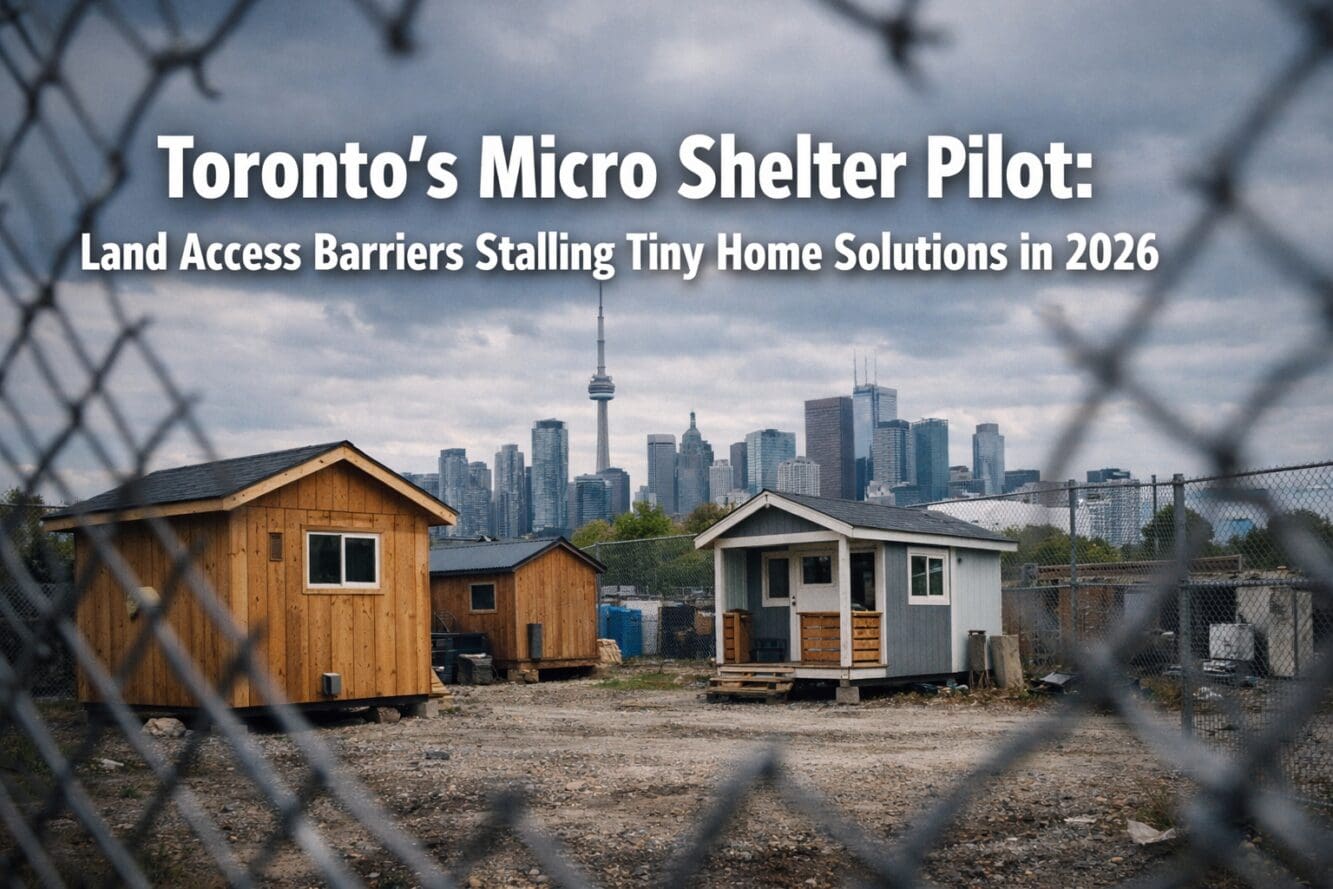
Toronto’s Micro Shelter Pilot: How Land Access Barriers Are Stalling Tiny Home Solutions for Homelessness in 2026
Last updated: February 25, 2026
Key Takeaways
✅ Toronto’s two-year Micro Shelter Pilot Project closed applications on February 5, 2026, but requires non-profits to provide their own land—a major barrier for most organizations
✅ City staff evaluated 44 municipal sites but found none suitable for micro shelter communities due to size and location constraints
✅ Ryan Donais of Tiny Tiny Homes and other builders face significant hurdles because they lack land ownership or long-term lease agreements
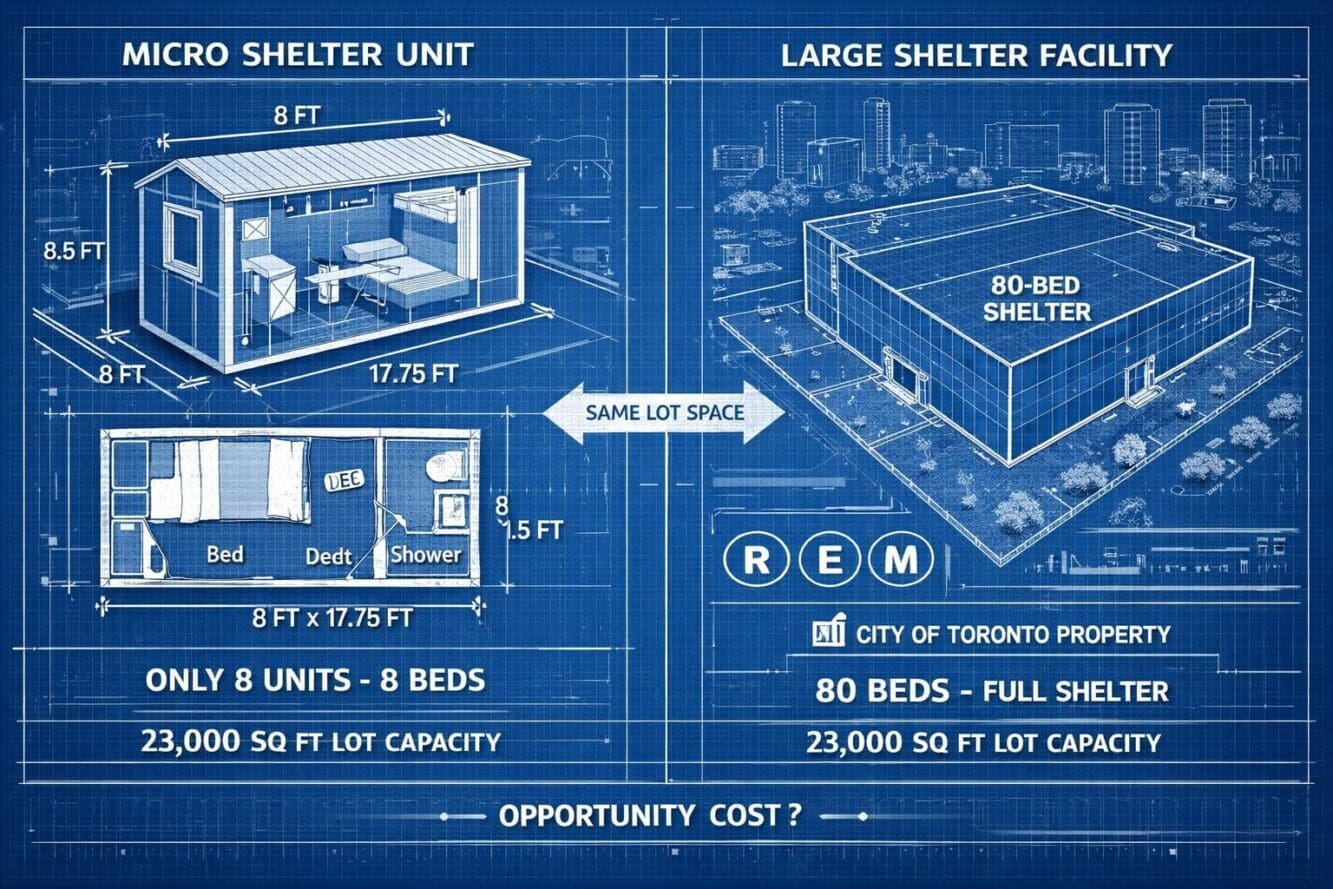
✅ One city lot could fit only 20 micro shelters versus 80 beds in a traditional shelter, raising questions about opportunity cost
✅ Underutilized TTC parking lots are being explored as potential alternative sites following City Council direction
✅ Successful applicants must commit to a maximum two-year operating term and adopt harm reduction approaches aligned with Toronto Shelter & Support Services standards
✅ Evaluation timeline spans 1-3 months from the February deadline, with final selection requiring land assessment, zoning compliance, and financial review
✅ Monthly costs tell a compelling story: traditional shelter beds now cost $6,000 (hotel leasing), while supportive housing averages just $2,000
Quick Answer
Toronto’s Micro Shelter Pilot: How Land Access Barriers Are Stalling Tiny Home Solutions for Homelessness in 2026 reveals a critical challenge: while the city launched a two-year pilot program to establish tiny home communities for unhoused residents, the requirement that non-profit applicants secure their own land has created an insurmountable barrier for most builders. City staff examined 44 municipal properties but found none suitable, leaving organizations like Tiny Tiny Homes struggling to move forward despite having construction expertise and community support.[1][2]
What Is Toronto’s Micro Shelter Pilot Project and Why Was It Created?
Toronto’s Micro Shelter Pilot Project is a two-year initiative designed to establish tiny home communities for people experiencing homelessness, with applications closing on February 5, 2026. The program emerged from City Council’s June 2024 direction to prioritize rapid shelter models for individuals living in encampments.[1]
The pilot addresses a growing crisis: more than 10,000 people experienced homelessness each month throughout 2024, while traditional shelter costs skyrocketed during the pandemic. The city was forced to lease hotel rooms to space out cramped shelters, driving monthly costs from $3,000 per bed to $6,000.[2]
Key program requirements include:
- Non-profit operators with proven experience serving unhoused populations
- Land secured through ownership, lease, or landowner permission
- Compliance with emergency shelter standards and zoning regulations
- Maximum two-year operating commitment
- Use of the city’s Shelter Management Information System (SMIS)
- Harm reduction approach aligned with Toronto Shelter & Support Services standards[1]
The pilot represents a shift in thinking. Just one year ago, the city sent cease and desist orders to Ryan Donais when he placed micro shelters in St. James Park. Now, Toronto is actively seeking proposals—but with conditions that may prove impossible to meet.
How Does the Land Requirement Create Barriers for Toronto’s Micro Shelter Pilot?
The land requirement is the single biggest obstacle preventing Toronto’s Micro Shelter Pilot from moving forward. Non-profit organizations must bring their own land option—either owning it, leasing it, or securing permission from a property owner—before the city will consider their application.[1][2]
Ryan Donais, founder of Tiny Tiny Homes, put it bluntly: “If we had land, there would be tiny homes on them right now.” He argues the city should utilize municipal property rather than requiring applicants to source land independently.[2]
Why This Requirement Fails
Municipal land shortage: City staff examined 44 potential city-owned sites and found none met the size and location criteria needed for viable micro shelter communities.[2] The largest identified lot measured just under 23,000 square feet—enough for only 20 micro shelters when accounting for outdoor amenities, fire routes, and bike storage.
Private land challenges: Non-profits rarely own suitable properties in Toronto’s expensive real estate market. Leasing requires landlords willing to commit to a two-year social housing project, which most private owners avoid. Donais noted that without specific timelines for project start and end dates, approaching property owners becomes nearly impossible.[2]
Verification complexity: Any proposed land undergoes rigorous review by Toronto Shelter & Support Services, Corporate Real Estate Management, and CreateTO. The process includes zoning compliance verification, emergency shelter standards assessment, site visits, and lease or deed confirmation.[1]
Choose the land requirement approach if you’re a well-funded organization with existing property holdings. For grassroots builders and smaller non-profits, this barrier effectively excludes participation.
What Opportunity Costs Emerge from Toronto’s Micro Shelter Pilot Land Constraints?
The numbers reveal a difficult trade-off: the city’s largest available lot could accommodate 20 micro shelters or an 80-bed traditional shelter. Staff estimate each micro shelter at 142 square feet (4 metres by 3.3 metres), requiring additional space for support services, fire routes, and storage.[2]
Cost Comparison Reality
| Housing Type | Monthly Cost per Person | Capacity on 23,000 sq ft Lot |
|---|---|---|
| Hotel shelter bed (pandemic) | $6,000 | Variable |
| Traditional shelter | $3,000-$6,000 | 80 beds |
| Supportive housing studio | $2,000 | 20-30 units |
| Micro shelter (estimated) | $2,000-$3,000 | 20 units |
The financial case for micro shelters is strong when compared to hotel leasing, but weaker when measured against purpose-built supportive housing. Mayor John Tory emphasized that supportive housing—accommodations with built-in mental health and addiction services—costs just $2,000 monthly while saving lives and creating economic activity.[3]
Common mistake: Viewing micro shelters as permanent housing solutions. They function best as transitional shelter that’s superior to tents but inferior to dedicated supportive housing developments. The two-year operating limit reflects this transitional purpose.[1]
In other jurisdictions, micro shelter pilots typically deploy on at least one acre (44,000 square feet), accommodating up to 50 units. Toronto’s land constraints cut that capacity in half, raising questions about program viability.
Who Can Apply to Toronto’s Micro Shelter Pilot and What Are the Requirements?
Only non-profit organizations with demonstrated experience providing direct services to people experiencing homelessness can apply to Toronto’s Micro Shelter Pilot. The city closed applications on February 5, 2026, and is now conducting evaluations expected to take 1-3 months.[1]
Eligibility Criteria
Organizational requirements:
- Non-profit legal status
- Proven track record serving unhoused populations
- Capacity to meet all Expression of Interest guidelines
- Financial stability for two-year commitment
- Ability to secure land through ownership, lease, or permission[1]
Operational commitments:
- Maximum two-year operating term (subject to funding and Council approval)
- Harm reduction framework aligned with TSSS standards
- Pet-friendly policies with developed protocols
- Regular case management meetings for residents
- Participation in peer support and skills development programs
- Use of city’s Shelter Management Information System (SMIS)[1]
Joint applications are welcomed: Multiple non-profits can partner on a single proposal, provided one organization serves as lead and takes responsibility for agreements with the city.[1]
What Happens After Application?
Organizations that pass initial screening enter a second-stage application process involving:
- Due diligence review
- Comprehensive land assessment
- Financial capacity evaluation
- Zoning compliance verification
- Site visits by multiple city divisions
The General Manager of Toronto Shelter & Support Services makes final recommendations to City Council for approval.[1]
Edge case: Faith-based organizations with available land (churches, temples, mosques) may have advantages in this process, as they often own suitable properties and have experience providing community services. However, they still need shelter operations expertise or must partner with experienced non-profits.
What Alternative Solutions Are Being Explored for Toronto’s Micro Shelter Pilot?
Underutilized TTC parking lots represent the most promising alternative for Toronto’s Micro Shelter Pilot land shortage. Following City Council direction, staff are exploring the feasibility of placing micro shelters at transit authority properties that see limited use.[2]
Councillor Chris Moise previously asked city staff to specifically examine TTC parking lots as potential sites. These locations offer several advantages:
TTC parking lot benefits:
- Municipal ownership eliminates private landlord negotiations
- Existing infrastructure (water, electricity, access roads)
- Transit connectivity for residents seeking employment or services
- Larger lot sizes than typical city parcels
- Underutilized space that generates minimal current value
Partnership models gaining traction:
🤝 Faith community collaborations – Religious institutions with available land partnering with experienced shelter operators
🤝 Corporate real estate partnerships – Businesses offering vacant lots for two-year community benefit programs
🤝 Community land trusts – Non-profit land holding organizations providing long-term site security
🤝 Provincial land contributions – Ontario government properties made available for municipal homelessness initiatives
Kitchener, Ontario successfully deployed modular housing villages using similar partnership approaches, demonstrating that creative land solutions can work when multiple stakeholders commit to collaboration.
Common mistake: Waiting for perfect municipal sites to become available. Successful programs in other cities moved forward by cobbling together multiple smaller sites and diverse partnership arrangements rather than seeking single ideal locations.
How Do Toronto’s Micro Shelter Pilot Requirements Compare to Other Cities?
Toronto’s land requirement stands out as uniquely restrictive when compared to micro shelter programs in other Canadian cities. Most successful initiatives involve municipal governments providing land as part of the program structure rather than requiring applicants to source it independently.
Cross-City Comparison
Kitchener, Ontario:
- City provided land for modular housing villages
- Faster deployment timeline (6-12 months)
- Municipal staff handled zoning and permitting
- Non-profits focused on operations, not real estate
Vancouver, British Columbia:
- Modular housing on city-owned sites
- Provincial funding supported land acquisition
- Streamlined approval process for temporary structures
- 50-60 unit communities versus Toronto’s 20-unit capacity
London, Ontario:
- Micro-modular shelter sites on municipal property
- City managed land preparation and infrastructure
- Operators selected through RFP process after sites secured
- First residents moved in within 8 months of program announcement
Toronto’s approach:
- Applicants must secure land independently
- 44 municipal sites evaluated, none suitable
- Two-year maximum operating term
- 1-3 month evaluation period after application deadline[1][2]
Choose Toronto’s model if you want to minimize municipal liability and encourage private sector involvement. Choose the Kitchener/Vancouver model if you want rapid deployment and maximum program participation.
The evaluation timeline of 1-3 months adds further delay to an already slow process. By the time successful proponents are selected, complete second-stage applications, and begin construction, winter 2026-2027 will likely arrive before residents can move in.
What Are the Financial Realities Behind Toronto’s Micro Shelter Pilot?
The business case for micro shelters is compelling when compared to pandemic-era hotel shelter costs, but the financial picture becomes complex when examining long-term supportive housing alternatives. Toronto’s experience with hotel leasing during COVID-19 drove monthly shelter costs to $6,000 per bed, double the traditional $3,000 rate.[2][3]
Cost Analysis Breakdown
Traditional shelter bed (pre-pandemic): $3,000/month
- Shared sleeping spaces
- Limited privacy
- Basic services
- High turnover
Hotel shelter bed (pandemic response): $6,000/month
- Private rooms for physical distancing
- Leasing costs from private hotels
- Temporary solution
- Unsustainable long-term expense
Supportive housing studio: $2,000/month
- Private unit with built-in services
- Mental health and addiction support
- Permanent or long-term placement
- Most cost-effective per person
Micro shelter (estimated): $2,000-$3,000/month
- Private temporary structure
- Basic amenities
- Transitional housing model
- Two-year maximum stay[1][2]
Mayor John Tory emphasized the financial logic: “What you have here is a clear moral case to act together with a solid business case for doing it in this way, both because it saves lives and makes quality of life better and because it saves governments money and creates jobs and economic activity.”[3]
Hidden costs often overlooked:
- Land acquisition or leasing fees
- Site preparation and infrastructure
- Ongoing maintenance and repairs
- Staffing for case management and support services
- Utilities and operational expenses
- Decommissioning costs after two-year term
The requirement that applicants secure funding for these elements creates another barrier beyond land access. Organizations need comprehensive budgets spanning the full two-year operating period, with contingency plans if city funding becomes unavailable.
What Happens Next for Toronto’s Micro Shelter Pilot in 2026?
The evaluation process is underway following the February 5, 2026 application deadline, with city staff expected to take 1-3 months reviewing proposals before making recommendations.[1] Organizations that submitted applications now wait while Toronto Shelter & Support Services, Corporate Real Estate Management, and CreateTO conduct comprehensive assessments.
Timeline and Next Steps
February-April 2026: Application evaluation period
- Initial screening of non-profit eligibility
- Land assessment and zoning verification
- Financial capacity review
- Site visits to proposed locations
Spring 2026: Second-stage applications
- Detailed due diligence for shortlisted organizations
- Lease or deed documentation review
- Final recommendations prepared
Summer 2026: City Council decision
- General Manager recommendations presented
- Council approval or rejection
- Funding allocation confirmed
Fall 2026-Winter 2027: Potential implementation
- Construction or installation of micro shelters
- Staff hiring and training
- Community engagement and preparation
- First residents move in (optimistic scenario)
Common pitfall: Even if the pilot receives approval, construction timelines, permitting delays, and community consultations could push actual implementation into 2027. The two-year operating term would then expire in 2029, creating questions about what happens to residents and structures afterward.
What to Watch For
🔍 TTC parking lot feasibility study results – Will transit authority properties prove viable?
🔍 Alternative land partnerships – Which organizations secured creative solutions?
🔍 Funding commitments – Will provincial or federal governments contribute?
🔍 Community opposition – How will neighborhoods respond to proposed sites?
🔍 Regulatory changes – Will the city modify zoning or approval processes?
Ryan Donais and Tiny Tiny Homes submitted an application despite the land barriers, hoping the city will reconsider its approach. “I think the only way this works is when the city uses their land,” Donais stated, arguing that renting land is completely unreasonable when the city has vacant properties available.[2]
The pilot’s success or failure will likely depend less on the quality of applications and more on whether Toronto can solve its fundamental land access problem. Without municipal property commitments or significant private sector partnerships, even the best-designed micro shelter proposals may remain on paper indefinitely.
Frequently Asked Questions
What is a micro shelter and how is it different from a tiny home?
A micro shelter is a small, temporary structure (typically 100-150 square feet) designed to provide basic shelter with minimal amenities like a bed, heat, and lockable door. Tiny homes are usually larger (200-400 square feet), more permanent, and include full kitchens and bathrooms. Toronto’s pilot focuses on micro shelters as transitional housing, not permanent residences.[1][2]
Why did Toronto reject 44 potential city-owned sites for micro shelters?
City staff found none of the 44 evaluated municipal properties met the size and location criteria needed for viable micro shelter communities. The largest lot could accommodate only 20 units, and staff determined the same space could serve more people as traditional shelter or supportive housing.[2]
Can individuals or for-profit companies apply to Toronto’s Micro Shelter Pilot?
No. Only non-profit organizations with demonstrated experience providing direct services to people experiencing homelessness are eligible to apply. For-profit companies and individuals cannot participate as primary applicants, though they could potentially partner with qualified non-profits.[1]
How much does it cost to build one micro shelter unit?
Construction costs vary widely based on materials, design, and features, typically ranging from $5,000-$15,000 per unit for basic structures. However, total program costs including land, site preparation, utilities, staffing, and ongoing operations are significantly higher—often $2,000-$3,000 per person monthly.[2][3]
What happens to micro shelter residents after the two-year pilot ends?
The program requires a maximum two-year operating term, but the city hasn’t clearly outlined transition plans for residents. Ideally, they would move into permanent supportive housing or other long-term accommodations, but this depends on housing availability and individual circumstances.[1]
Are micro shelters better than traditional homeless shelters?
Micro shelters offer more privacy, security, and dignity than congregate shelters, with individual lockable units versus shared sleeping spaces. However, they serve fewer people per square foot and cost more to operate than traditional shelters while providing less comprehensive services than permanent supportive housing.[2][3]
Can micro shelters be placed in residential neighborhoods?
Zoning regulations and community acceptance vary by location. Any proposed site must undergo zoning compliance verification, and neighborhood opposition has derailed similar projects in other cities. The city’s evaluation process includes assessing community impact and local bylaws.[1]
What services are provided to micro shelter residents?
Operators must provide case management, harm reduction support, pet-friendly policies, peer support programs, and skills development opportunities. Residents also receive connections to mental health services, addiction support, employment assistance, and pathways to permanent housing.[1]
How does Toronto’s approach compare to buying hotels for homeless housing?
Purchasing hotels to convert into permanent supportive housing costs more upfront but provides long-term accommodations with comprehensive services at approximately $2,000 per person monthly. Micro shelters are faster to deploy but temporary, while hotel conversions create lasting housing infrastructure.[3]
What can community members do to support micro shelter initiatives?
Advocate for municipal land allocation, support non-profit organizations working on homelessness, attend city council meetings to voice support, offer private land for consideration, donate to organizations like Tiny Tiny Homes, and combat NIMBYism (Not In My Backyard) attitudes in your neighborhood.
Will the city reconsider providing municipal land for the pilot?
City Council is exploring underutilized TTC parking lots as potential sites following Councillor Chris Moise’s direction. Whether this leads to policy changes allowing municipal land for the pilot remains uncertain, but advocacy and successful examples from other cities may influence future decisions.[2]
How long will it take to know which organizations were selected?
The city estimates 1-3 months for evaluation from the February 5, 2026 deadline, meaning announcements could come between March and May 2026. Selected organizations then complete second-stage applications before receiving final approval, potentially pushing implementation to late 2026 or early 2027.[1]
Conclusion
Toronto’s Micro Shelter Pilot: How Land Access Barriers Are Stalling Tiny Home Solutions for Homelessness in 2026 reveals a frustrating paradox: the city recognizes the value of micro shelters and launched a formal pilot program, yet the requirement that non-profits provide their own land creates an insurmountable barrier for most applicants. With more than 10,000 people experiencing homelessness monthly and shelter costs reaching $6,000 per bed during the pandemic, the need for innovative solutions has never been more urgent.[1][2]
The evaluation of 44 municipal sites that yielded zero suitable properties demonstrates the core problem. Ryan Donais and builders like him possess the expertise, community support, and construction capability to deploy micro shelters rapidly—but without land access, their skills remain untapped. The city’s exploration of underutilized TTC parking lots offers hope, but concrete action is needed to transform possibility into reality.[2]
Actionable next steps for stakeholders:
For non-profit organizations:
- Form partnerships with faith communities, corporations, or landowners who control suitable properties
- Prepare comprehensive two-year operational budgets demonstrating financial sustainability
- Develop detailed harm reduction and case management protocols aligned with TSSS standards
- Consider joint applications with complementary organizations to strengthen proposals
For city officials:
- Accelerate TTC parking lot feasibility assessments and make properties available for the pilot
- Consider modifying the program to allow city-provided land with operator selection through RFP
- Study successful models from Kitchener, Vancouver, and London that deployed faster through municipal land provision
- Establish clear transition plans for residents when the two-year pilot term expires
For community members:
- Attend city council meetings to advocate for municipal land allocation
- Support organizations working on homelessness solutions through donations or volunteering
- Combat NIMBY attitudes and educate neighbors about micro shelter benefits
- Contact councillors to express support for innovative approaches to the housing crisis
For potential private sector partners:
- Identify underutilized properties suitable for two-year micro shelter communities
- Approach qualified non-profits about partnership opportunities
- Consider tax benefits and corporate social responsibility advantages of land contributions
- Engage early with city planning departments to understand zoning and approval requirements
The path forward requires collaboration, creativity, and political will. Toronto has the resources, expertise, and motivation to make micro shelters work—but only if land access barriers are removed. The next few months will determine whether this pilot becomes a meaningful response to homelessness or another well-intentioned program stalled by bureaucratic constraints. The people sleeping in tents across the city cannot afford to wait much longer.
References
[1] Expression Of Interest Micro Shelter Pilot Project – https://www.toronto.ca/community-people/community-partners/emergency-shelter-operators/expressions-of-interest/expression-of-interest-micro-shelter-pilot-project/
[2] Toronto Considering Micro Shelter Pilot Project To Address Homelessness – https://toronto.citynews.ca/2026/02/21/toronto-considering-micro-shelter-pilot-project-to-address-homelessness/
[3] Toronto Considering Micro Shelter Pilot Project To Address Homelessness – https://www.seekyoursounds.com/news/toronto/toronto-considering-micro-shelter-pilot-project-to-address-homelessness
Content, illustrations, and third-party video appearing on GEORGIANBAYNEWS.COM may be generated or curated with AI assistance or reproduced pursuant to the fair dealing provisions of the Copyright Act, R.S.C. 1985, c. C-42. Attribution and hyperlinks to original sources are provided in acknowledgment of applicable intellectual property rights. Such referencing is intended to direct traffic to and support the original rights holders’ platforms.