

















Trump’s High-Stakes China Summit: Trade Deals, Tech Rivalries, and Business Winners and Losers
Last updated: May 13, 2026
Quick Answer: Trump’s high-stakes China summit — trade deals, tech rivalries, and business winners and losers — is the defining geopolitical and economic event of 2026. President Trump and President Xi Jinping are meeting in Beijing to negotiate on tariffs, rare earth exports, semiconductors, Taiwan, and AI controls. The outcome will directly reshape supply chains, stock markets, and U.S. manufacturing jobs for years ahead.
🔑 Key Takeaways
- Trump and Xi are meeting in Beijing to settle disputes spanning trade, technology, Taiwan, and the Iran conflict [5]
- China has halted rare earth exports, directly disrupting automotive supply chains across Europe, Japan, and South Korea [5]
- Semiconductor export restrictions on Nexperia China are creating cascading economic consequences globally [5]
- Taiwan remains the most politically sensitive issue, with Beijing pressing Washington to reduce security commitments [5]
- AI export controls and tech rivalry are central to negotiations, not just tariffs
- U.S. manufacturers, farmers, and tech firms all face different risk-reward scenarios depending on deal outcomes
- Markets are on edge: analysts expect significant volatility in semiconductor, EV, and rare earth stocks regardless of outcome
- World leaders from Singapore to Brussels are watching closely — the summit’s ripple effects are genuinely global [5]
What Is Actually on the Table at the Trump-Xi Beijing Summit?
Trump’s high-stakes China summit covers far more than tariffs. The agenda includes trade policy, rare earth export controls, semiconductor restrictions, Taiwan security commitments, the Iran conflict, and artificial intelligence governance [5][6].
This breadth is unusual. Most bilateral summits focus on one or two issues. Beijing and Washington are trying to resolve a cluster of disputes simultaneously, which raises both the potential gains and the risk of collapse.
Core agenda items:
| Issue | U.S. Priority | China’s Priority |
|---|---|---|
| Tariff reductions | Lower costs for U.S. importers | Market access for Chinese goods |
| Rare earth exports | Resume supply to automakers | Leverage for broader concessions |
| Semiconductors | Protect U.S. chip dominance | Lift Nexperia export ban |
| Taiwan | Maintain security commitments | Reduce U.S. military support |
| AI controls | Limit China’s AI military use | Equal access to global AI markets |
| Iran conflict | Regional stability | Protect energy trade routes |
How Did Rare Earths and Semiconductors Become the Summit’s Biggest Flashpoints?
China’s decision to halt rare earth exports and restrict Nexperia semiconductor sales turned a trade dispute into a supply chain emergency. These two moves gave Beijing enormous leverage heading into the summit [5].
Rare earth materials — used in electric vehicle motors, wind turbines, and defense systems — are overwhelmingly sourced from China. When exports stopped, automotive manufacturers in Europe, Japan, and South Korea faced production slowdowns almost immediately [5]. There’s no quick substitute supplier at scale.
The Nexperia semiconductor ban added a second pressure point, hitting European chipmakers and their downstream customers in consumer electronics and industrial equipment [5].
“China’s export controls on rare earths and semiconductors aren’t just trade tactics — they’re a demonstration that supply chain dependency is a geopolitical weapon.”
Common mistake: Assuming tariff cuts alone will fix these disruptions. Rare earth and semiconductor restrictions are separate policy levers that require their own negotiated agreements.
Who Are the Business Winners and Losers From Trump’s High-Stakes China Summit?
The summit’s outcome will create clear winners and losers across sectors. Here’s a realistic breakdown based on what’s being negotiated.
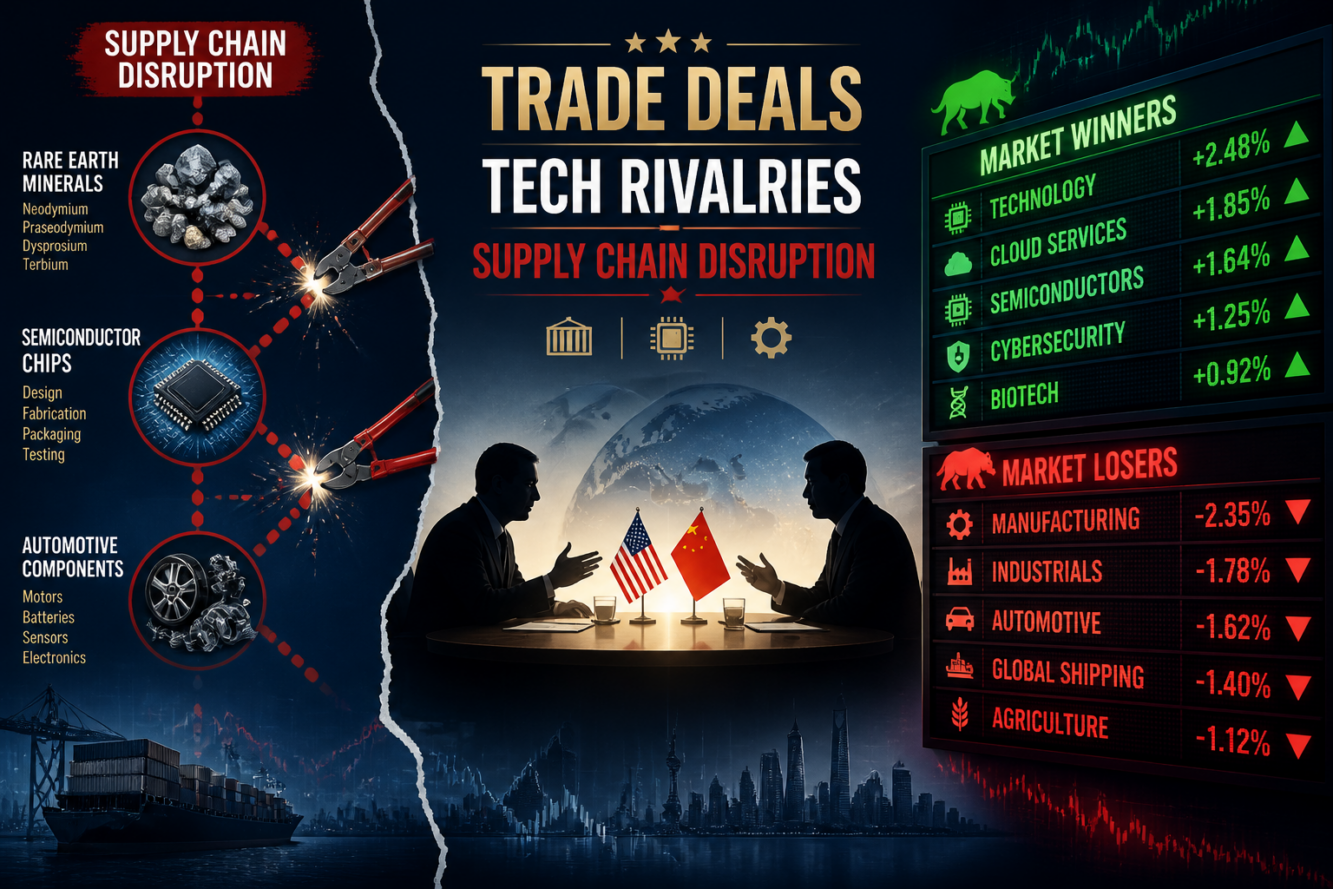
Likely winners if a broad deal is reached:
- U.S. soybean and agricultural exporters — China is the largest buyer; tariff reductions would restore demand quickly
- U.S. automakers — restored rare earth supply reduces production costs and delays
- Semiconductor equipment firms — eased export controls could reopen Chinese customers
- Retail importers — lower tariffs on consumer goods reduce shelf prices
Likely losers or at-risk sectors:
- Domestic rare earth mining startups — a China supply resumption undercuts their investment case
- U.S. defense contractors — any reduction in Taiwan security commitments creates uncertainty in procurement
- Domestic semiconductor fabs — if restrictions ease, competitive pressure from Chinese producers increases
- Companies that reshored manufacturing — a trade reset could make their capital investment look premature
For broader context on how billionaires and major investors are positioning ahead of the summit, market sentiment has been notably cautious since early May 2026.
What Do Expert Predictions Say About Stock Market Reactions?
Markets are pricing in significant uncertainty. Analysts broadly expect three scenarios, each with distinct market implications.
Scenario 1 — Comprehensive deal: Semiconductor and rare earth stocks rally; EV supply chain equities recover; agricultural commodities rise. Estimated probability: low-to-moderate.
Scenario 2 — Partial agreement: Targeted tariff reductions on specific goods; rare earth exports partially resume; Taiwan and AI issues deferred. Markets respond positively but with limited upside. Most likely outcome, according to analyst consensus tracked by CNBC [6].
Scenario 3 — Summit breakdown: Rare earth restrictions tighten; new semiconductor bans follow; equity markets in Seoul, Tokyo, and Frankfurt sell off sharply. Tail risk, but not negligible.
Investors tracking Bitcoin and alternative assets have also noted increased inflows during summit uncertainty, consistent with historical patterns during U.S.-China tension spikes.
How Does Taiwan Factor Into the Trade and Tech Negotiations?
Taiwan is the summit’s most politically charged issue, and both governments have confirmed it will be a primary focus [5]. Beijing has formally asked the Trump administration to reduce security commitments to Taiwan and revise longstanding U.S. policy toward the island [5].
This matters for business because Taiwan produces roughly 90% of the world’s most advanced semiconductors (per industry estimates). Any shift in U.S. security posture affects investor confidence in Taiwanese chipmakers and their global customers.
Decision rule: If you’re invested in semiconductor supply chains, watch Taiwan policy language in the summit communiqué more closely than tariff headlines. Vague or softened U.S. commitments signal higher long-term supply risk.
The Chinese Vice President Han Zeng has been involved in pre-summit diplomatic groundwork, signaling that Beijing is treating this as a top-tier strategic engagement.
What Are the Implications for U.S. Manufacturing Jobs?
The summit’s trade outcomes will directly affect U.S. manufacturing employment, though the direction depends heavily on which sectors get relief and which face new competition.
If tariffs are cut broadly: Import competition increases for U.S. manufacturers of steel, aluminum, and electronics. Job pressure in those sectors rises. Simultaneously, exporters in agriculture and aerospace gain.
If rare earth supply resumes: U.S. automakers reduce production costs, potentially protecting assembly line jobs. But domestic rare earth mining projects — some backed by federal subsidies — lose their economic rationale.
If AI export controls are eased: U.S. cloud and AI firms gain Chinese market access, adding high-wage tech jobs. Defense-adjacent AI firms face a more complex competitive landscape.
The carbon capture and storage and clean energy sectors are also watching closely, since rare earth supply directly affects wind turbine and EV battery production timelines in the U.S.
Conclusion: What Should Businesses and Investors Do Right Now?
Trump’s high-stakes China summit — trade deals, tech rivalries, and business winners and losers — will produce outcomes that move markets, reshape supply chains, and redefine U.S.-China competition for the next decade. The summit is not a single event; it’s the opening of a new negotiating phase [6][7].
Actionable steps for businesses and investors:
- Audit your rare earth and semiconductor exposure — know exactly which suppliers sit inside the China supply chain and model a 6-month disruption scenario
- Watch the Taiwan communiqué language — softened U.S. commitments signal higher long-term chip supply risk
- Don’t assume a deal means stability — partial agreements leave most structural tensions unresolved
- Hedge sector concentration — agricultural exporters and semiconductor firms face opposite outcomes; balance accordingly
- Track follow-up negotiations — the summit sets direction, but specific tariff schedules and export control lists will be finalized in subsequent rounds [6]
World leaders from Singapore to Brussels are watching this summit for good reason [5]. The decisions made in Beijing this week will echo through earnings reports, hiring plans, and supply chain maps well into 2027.
For ongoing coverage of global trade and economic developments, follow the Business in Motion Speaker Series and related analysis at Georgian Bay News.
❓ FAQ
Q: When is the Trump-Xi summit taking place? Trump and Xi are meeting in Beijing on Thursday, May 2026, to finalize decisions on trade, technology, Taiwan, and the Iran conflict [5].
Q: Why did China halt rare earth exports? China halted rare earth exports as a leverage tool in trade negotiations, directly disrupting automotive supply chains in Europe, Japan, and South Korea [5].
Q: What is the Nexperia semiconductor ban? China prohibited semiconductor exports from Nexperia China, creating economic and political repercussions across Europe, Japan, and South Korea [5].
Q: Is Taiwan a trade issue or a security issue at this summit? Both. Taiwan is listed as a primary focus by both governments [5]. Beijing wants reduced U.S. security commitments; Washington wants to protect its semiconductor supply chain, which runs through Taiwan.
Q: How will U.S. farmers be affected? If tariffs are reduced, U.S. agricultural exporters — especially soybean producers — stand to benefit significantly, as China is their largest export market.
Q: What sectors are most at risk if the summit fails? Automotive manufacturers, semiconductor equipment firms, and agricultural exporters face the most immediate downside if talks break down without agreements on rare earths and tariffs.
Q: Are AI export controls part of the summit agenda? Yes. Artificial intelligence governance and export controls are explicitly on the agenda alongside trade and Taiwan [5][6].
Q: How are global markets likely to react? Analysts expect a partial agreement as the most probable outcome, which would produce a moderate market rally. A full breakdown would trigger sharp selloffs in Seoul, Tokyo, and Frankfurt [6].
References
[5] Trump Xi Summit Beijing Global Leaders Iran War Taiwan Strait Of Hormuz – https://www.cnbc.com/2026/05/11/trump-xi-summit-beijing-global-leaders-iran-war-taiwan-strait-of-hormuz-.html
[6] Trump Xi China Trade Iran Taiwan – https://www.cnbc.com/2026/05/12/trump-xi-china-trade-iran-taiwan.html
[7] 2026 Xi Trump Summit – https://www.scmp.com/topics/2026-xi-trump-summit?module=top_story&pgtype=subsection
[8] 2026 Trump Xi Summit – https://www.scmp.com/topics/2026-trump-xi-summit?module=breadcrumb&pgtype=article
[2] Trump Heads To High Stakes Summit In China – https://www.nbcnews.com/nightly-news/video/trump-heads-to-high-stakes-summit-in-china-263200837587