




















Trump’s March 2026 China Visit: Trade Truce Renewal After Supreme Court Tariff Blow
Updated Sunday, February 22, 2026
The timing couldn’t be more dramatic. Just as President Donald Trump prepares for his first visit to China since 2017, the U.S. Supreme Court delivered a crushing blow to his signature trade policy, striking down the legal foundation for most of his sweeping tariffs. Now, as Trump heads to Beijing from March 31 to April 2, 2026, the question looms large: Will the Supreme Court’s decision weaken his negotiating hand with Chinese President Xi Jinping, or will it force both leaders toward a more sustainable trade agreement?
The high-stakes summit comes at a pivotal moment for U.S.-China relations. Trump’s March 2026 China visit follows months of careful diplomacy after the two nations reached an uneasy truce in October 2025. But the Supreme Court’s February 20 ruling invalidating tariffs imposed under the International Emergency Economic Powers Act (IEEPA) has fundamentally altered the landscape. With his primary tariff weapon stripped away, Trump must now navigate complex negotiations over soybeans, rare earth minerals, and fentanyl enforcement—all while seeking to extend the fragile trade peace between the world’s two largest economies.
Key Takeaways
- 🏛️ Supreme Court struck down Trump’s IEEPA-based tariffs on February 20, 2026, eliminating the legal basis for 20% duties on Chinese goods and most “reciprocal” tariffs
- 🤝 Trump visits Beijing March 31-April 2, 2026 for his first presidential trip to China since 2017, meeting with President Xi Jinping
- 📊 New 10% temporary global tariff imposed for 150 days under Section 122, requiring Congressional approval for extension beyond that period
- 🌾 Trade truce extension expected focusing on Chinese purchases of U.S. soybeans, rare earth mineral exports, and fentanyl crackdown commitments
- ⚖️ Weakened negotiating position for Trump as analysts debate whether the court ruling gives China leverage or pushes both sides toward compromise
The Supreme Court Bombshell: Trump’s Tariff Strategy Unravels
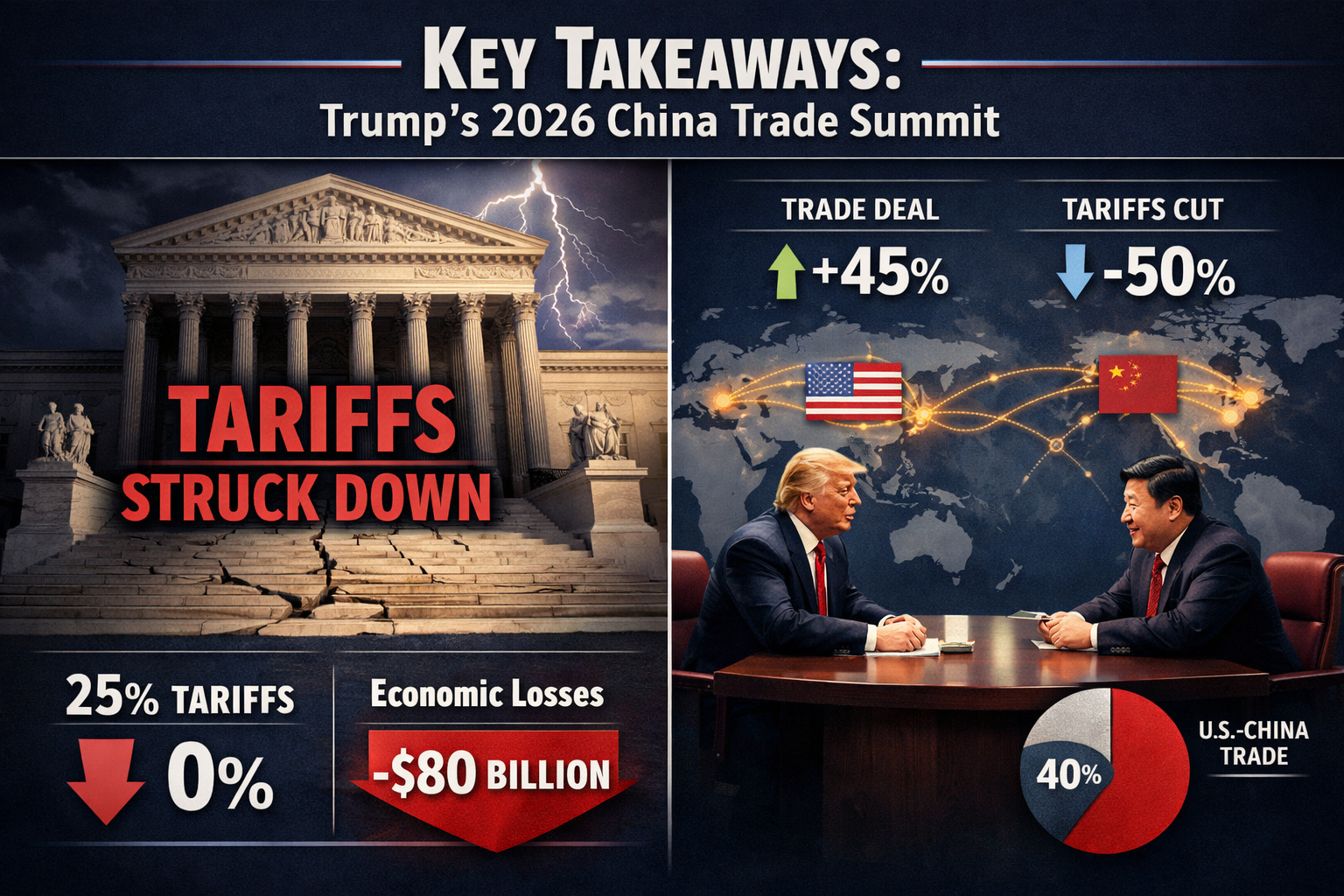
On February 20, 2026, the U.S. Supreme Court delivered a 6-3 decision that fundamentally reshaped Trump’s trade war arsenal. Chief Justice John Roberts declared unequivocally: “We hold that IEEPA does not authorize the president to impose tariffs.”[1]
This ruling struck down the legal foundation Trump had used to justify:
- 20% tariffs on Chinese exports tied to national emergencies related to fentanyl distribution and trade imbalances
- “Reciprocal” tariffs on nearly every country imposed on Liberation Day
- One-off tariffs threatened or imposed on Brazil, India, Europe, and Canada
The court went beyond merely limiting how IEEPA could be used—it ruled the 1977 law simply doesn’t grant tariff authority at all. Lower courts had previously suggested IEEPA might allow some tariffs under truly extraordinary circumstances, but the Supreme Court closed that door entirely.
What Survived the Ruling
Not all of Trump’s tariff regime collapsed. Industry-specific tariffs imposed under separate legal authorities remain intact:
| Tariff Type | Legal Authority | Status After Ruling |
|---|---|---|
| Steel & Aluminum | Section 232 (National Security) | ✅ Still in effect |
| China Tech Products | Section 301 (Unfair Trade) | ✅ Still in effect |
| IEEPA-based tariffs | Emergency Powers Act | ❌ Struck down |
| Reciprocal tariffs | IEEPA | ❌ Struck down |
The distinction matters enormously. While Trump lost his most flexible tariff tool, he retained authorities that, though more limited, still carry significant weight in trade negotiations.
Trump’s Emergency Response: The 10% Temporary Solution
Faced with the Supreme Court’s rejection, Trump moved quickly. On February 21, 2026, he signed executive orders imposing a temporary 10% global import duty for 150 days starting February 24, 2026.[2]
This new approach invokes Section 122 of the Trade Act of 1974, which allows duties of up to 15% for up to 150 days to address “large and serious” balance-of-payments issues. The White House justified this action by citing that the 2024 current account deficit represented the largest annual deficit as a share of GDP since 2008.[2]
Key Features of the New Tariff Structure
Exemptions include:[2]
- ⛏️ Critical minerals and rare earth elements not produced domestically
- ⚡ Energy products and natural resources
- 🌾 Certain agricultural products (beef, tomatoes, oranges)
- 💊 Pharmaceuticals and medical supplies
- 📱 Certain electronics
- 🚗 Passenger vehicles and light trucks
- ✈️ Certain aerospace products
- 🇨🇦🇲🇽 Goods from Canada and Mexico compliant with USMCA
The 150-day clock creates urgency. After that period expires, Congress must approve any extension—a significant constraint on presidential power that didn’t exist under Trump’s IEEPA approach.
Treasury Secretary Scott Bessent acknowledged the workaround nature of this strategy, stating the new approach would result in “virtually unchanged tariff revenue in 2026” and that “we will get back to the same tariff level for the countries. It will just be in a less direct and slightly more convoluted manner.”
For those interested in how America’s political landscape has evolved, this legal constraint represents a significant shift in executive power.
Trump’s March 2026 China Visit: High Stakes in Beijing
Against this backdrop of legal setbacks and policy pivots, Trump’s March 2026 China visit takes on heightened significance. The March 31 to April 2 trip will mark Trump’s first face-to-face meeting with Xi Jinping since their October 2025 summit in South Korea.[1]
What’s on the Negotiating Table
The visit is expected to focus on extending the trade truce established last October. That agreement saw Trump reduce tariffs by 10 percentage points in exchange for Chinese commitments on three key areas:
- 🌾 Agricultural Purchases: China resumed buying U.S. soybeans after a politically damaging boycott throughout much of 2025
- ⚗️ Rare Earth Minerals: Beijing agreed to continue allowing exports of critical minerals essential to U.S. manufacturing
- 💊 Fentanyl Enforcement: China committed to cracking down on the illicit fentanyl trade
Wall Street analysts project a high probability that both leaders will discuss extending this framework for up to one year, providing economic stability and short-term wins both can present domestically.
The Taiwan Wild Card
Taiwan is expected to figure prominently in discussions, though it remains the most sensitive topic for both nations. The U.S. announced its largest-ever arms sales deal with Taiwan in December 2025, totaling $11.1 billion in weapons—a move that infuriated Beijing.
Cross-strait relations could prove difficult to negotiate directly, but they form an unavoidable backdrop to any comprehensive U.S.-China agreement. Any trade deal that doesn’t address Taiwan risks being incomplete, yet any discussion of Taiwan risks derailing the entire summit.
Does the Supreme Court Ruling Weaken Trump’s Hand?
Chinese analysts and exporters believe the Supreme Court decision has fundamentally altered the power dynamics heading into the Beijing summit. Professor Shi Yinhong of Renmin University in Beijing noted that “the ruling of the Supreme Court weakened, of course, Trump’s trade leverage vis-a-vis the Chinese side.”
However, Shi cautioned this doesn’t automatically translate into Chinese advantage. Given Trump’s transactional approach, Beijing would need both the capacity and willingness to make concessions that Trump could present as a “success story” to his domestic audience.
The Chinese Perspective
From Beijing’s viewpoint, the ruling creates several opportunities:
- 📉 Reduced tariff threat: With IEEPA off the table, Trump has fewer tools to suddenly escalate tariffs
- ⏰ Time constraints: The 150-day limit on Section 122 tariffs means Trump needs deals, not delays
- 🎯 Congressional involvement: Future tariff extensions require Congress, limiting Trump’s unilateral power
Yet China also faces pressures. Chinese exporters with U.S. market exposure have expressed cautious optimism about the court ruling potentially offering short-term good news, but they remain wary of Trump’s ability to find alternative tariff authorities.
Trump’s Remaining Leverage
Despite the setback, Trump retains significant negotiating power:
- Section 301 investigations: The U.S. Trade Representative has been directed to investigate “unreasonable and discriminatory acts” under Section 301 authority[2]
- Section 232 expansion: Enhanced tariffs under the national security statute remain an option
- Market access: The U.S. market remains crucial to Chinese manufacturers
- Technology restrictions: Export controls on semiconductors and AI technology don’t require tariff authority
Treasury Secretary Bessent’s comment about achieving “virtually unchanged tariff revenue” through “a less direct and slightly more convoluted manner” suggests the administration has mapped out alternative pathways that don’t rely on IEEPA.
Understanding these complex economic dynamics requires recognizing both the constraints and opportunities created by the court ruling.
The Economics of a Trade Truce Extension
What would a successful Trump’s March 2026 China visit look like in concrete economic terms? Analysts expect negotiations to center on quantifiable commitments both sides can verify and tout as victories.
Soybean Diplomacy Returns
U.S. soybean exports to China have long served as a political barometer of bilateral relations. During the 2025 boycott, American farmers—a key Trump constituency—suffered significant losses. China’s October 2025 commitment to resume purchases provided immediate relief.
An extended agreement would likely include:
- 📊 Specific purchase targets for U.S. agricultural products
- 📅 Timeline commitments spread across 2026-2027
- 🔍 Verification mechanisms to ensure compliance
These purchases serve dual purposes: they address the U.S. trade deficit Trump frequently criticizes while providing China with needed food supplies amid its own agricultural challenges.
Rare Earth Minerals: The Strategic Commodity
China controls approximately 70% of global rare earth production and an even larger share of processing capacity. These minerals are essential for:
- 📱 Electronics manufacturing
- 🔋 Electric vehicle batteries
- 🎖️ Defense systems
- 🌬️ Wind turbines
During periods of heightened tension, Beijing has weaponized rare earth exports. The October 2025 agreement to maintain exports represented a significant Chinese concession. Extending this commitment would be a major U.S. priority in Beijing.
Fentanyl: The Domestic Political Imperative
For Trump, demonstrating progress on fentanyl enforcement carries enormous domestic political weight. The opioid crisis remains a top concern for American voters, and Trump has repeatedly blamed China for allowing precursor chemicals to flow to Mexican cartels.
China’s October commitment to crack down on fentanyl production and trafficking gave Trump a talking point. Measurable results—such as seizure statistics, factory closures, and arrests—would strengthen his case for extending the trade truce.
Alternative Tariff Pathways: Trump’s Backup Plans
The Supreme Court may have closed one door, but the Trump administration has been preparing alternative routes for months. These backup plans could reshape how Trump’s March 2026 China visit unfolds.
Section 301: The Trade Investigation Route
Section 301 of the Trade Act of 1974 authorizes the U.S. Trade Representative to investigate and respond to foreign trade practices that are “unreasonable or discriminatory” and burden U.S. commerce.
The administration has directed new Section 301 investigations that could justify tariffs based on:
- 🏭 Intellectual property theft
- 💼 Forced technology transfer
- 🏛️ State subsidies distorting markets
- 🚫 Market access restrictions
Unlike IEEPA, Section 301 has withstood legal challenges and provides a well-established legal foundation for tariffs. However, the process is slower and requires detailed investigations and public comment periods.
Section 232: The National Security Angle
Section 232 of the Trade Expansion Act of 1962 allows tariffs on imports that threaten national security. Trump successfully used this authority for steel and aluminum tariffs, which survived the Supreme Court ruling.
The administration could expand Section 232 to cover:
- 🔌 Critical technology components
- ⚡ Energy infrastructure equipment
- 🏥 Pharmaceutical ingredients
- 🌾 Food security concerns
The broad interpretation of “national security” gives this authority significant flexibility, though it also invites legal challenges if applied too expansively.
The Congressional Factor
Unlike IEEPA, both Section 301 and Section 232 have been legislated by Congress with specific parameters. Additionally, the new Section 122 temporary tariff requires Congressional approval after 150 days.[2]
This creates a new dynamic where Trump must work with lawmakers—potentially including opposition Democrats—to maintain his tariff regime. This constraint could actually strengthen Trump’s negotiating position in Beijing by allowing him to cite Congressional pressure as justification for demanding Chinese concessions.
Those following American political developments will recognize this as a significant shift in how trade policy is formulated.
What Success Looks Like: Possible Outcomes from Beijing
As Trump prepares for his March 2026 China visit, several potential outcomes appear most likely based on current dynamics and historical precedent.
Scenario 1: The One-Year Extension (Most Likely)
Probability: 65-70%
Both sides agree to extend the October 2025 framework for 12 months with enhanced commitments:
✅ China agrees to:
- Increase U.S. agricultural purchases by 25-30%
- Maintain rare earth mineral exports with quarterly verification
- Provide quarterly fentanyl enforcement reports with measurable metrics
- Reduce certain non-tariff barriers to U.S. goods
✅ U.S. agrees to:
- Maintain current reduced tariff levels on Chinese goods
- Pause new Section 301 investigations for the agreement period
- Not impose additional technology export restrictions beyond current levels
- Resume high-level economic dialogue meetings
This scenario provides both leaders with domestic political wins while deferring harder structural issues.
Scenario 2: The Limited Deal (Moderate Probability)
Probability: 20-25%
A shorter 6-month extension with fewer commitments, essentially kicking the can down the road:
- 📅 Six-month pause on new tariffs
- 🌾 Modest agricultural purchase commitments
- 🤝 Agreement to continue talking
This outcome might result if the Supreme Court ruling creates too much uncertainty about what Trump can actually deliver, or if China decides to wait and see how U.S. Congressional dynamics play out.
Scenario 3: The Breakthrough (Low Probability)
Probability: 5-10%
A comprehensive multi-year agreement addressing structural issues:
- 📜 Formal intellectual property protections
- 🏛️ State subsidy reforms
- 🌐 Market access improvements
- ⚖️ Dispute resolution mechanisms
While this would represent the most significant progress, the current political climate and Trump’s weakened tariff position make such an ambitious outcome unlikely.
Scenario 4: The Breakdown (Low but Rising Probability)
Probability: 5-10%
Negotiations fail and the trade war reignites:
- ❌ No agreement reached
- 📈 Trump imposes maximum Section 301 and Section 232 tariffs
- 🇨🇳 China retaliates with its own measures
- 📉 Global markets react negatively
The Supreme Court ruling actually makes this scenario less likely by limiting Trump’s ability to quickly escalate, but miscalculation or domestic political pressures could still derail talks.
The Refund Question: Billions in Limbo
An often-overlooked consequence of the Supreme Court ruling involves the billions of dollars in tariffs already collected under the now-invalidated IEEPA authority.
Treasury Secretary Bessent acknowledged that refunds could take years to process. This creates several complications:
For Importers and Businesses
- 💰 Cash flow impacts: Businesses that paid tariffs may not see refunds for years
- 📊 Accounting uncertainty: How to book potential refunds on financial statements
- ⚖️ Legal costs: Pursuing refund claims may require expensive legal representation
For the Federal Budget
- 📉 Revenue holes: Refunding billions could impact federal finances
- 🏛️ Congressional appropriations: Large refunds may require specific Congressional action
- 📅 Multi-year process: Spreading refunds over time to minimize budget impact
The complexity of processing refunds for thousands of importers across hundreds of product categories means this issue will persist long after Trump’s March 2026 China visit concludes.
Global Implications: How the World is Watching
Trump’s March 2026 China visit carries implications far beyond bilateral U.S.-China relations. Global markets, allied nations, and developing economies are all watching closely to see how the world’s two largest economies navigate this critical juncture.
For U.S. Allies
Countries like Japan, South Korea, and European nations face a dilemma:
- 🤝 Trade policy coordination: Should they align with U.S. positions on China?
- 📊 Market access: Will a U.S.-China deal affect their own trade relationships?
- 🎯 Strategic positioning: How to balance economic interests with security alliances?
The Supreme Court’s limitation on presidential tariff authority may actually reassure allies that U.S. trade policy will be more predictable and less subject to sudden presidential whims.
For Developing Economies
Nations in Southeast Asia, Africa, and Latin America watch U.S.-China dynamics to understand:
- 🌏 Supply chain shifts: Will production move from China to their countries?
- 💼 Investment flows: How will Chinese and American companies adjust strategies?
- 🤝 Diplomatic space: Can they maintain good relations with both powers?
A successful trade truce extension could stabilize global supply chains and provide developing nations with greater certainty for economic planning.
For Global Markets
Financial markets have reacted to every twist in the U.S.-China trade saga:
- 📈 Equity markets: Reduced trade war risk typically boosts stocks
- 💱 Currency markets: Trade stability affects dollar and yuan valuations
- 📊 Commodity markets: Agricultural and mineral prices respond to trade flows
The period leading up to and immediately following Trump’s Beijing visit will likely see significant market volatility as investors try to anticipate outcomes.
Expert Perspectives: What Analysts Are Saying
Trade experts, economists, and political analysts have offered varied assessments of how the Supreme Court ruling affects Trump’s negotiating position.
“The court decision fundamentally changes the calculus. Trump now needs China more than China needs him in the short term. But Xi also recognizes that a stable trade relationship serves Chinese economic interests.” — Dr. Sarah Chen, International Trade Institute
“Don’t underestimate Trump’s ability to find alternative pathways. Section 301 and Section 232 provide plenty of room for tariff actions, they just take longer to implement.” — Michael Roberts, Former USTR Official
“The real winner here might be American consumers. With Trump’s tariff authority constrained, we may see more rational trade policy that doesn’t treat tariffs as the solution to every problem.” — Professor James Martinez, Economics Department, Georgetown University
These diverse perspectives highlight the complexity and uncertainty surrounding Trump’s March 2026 China visit and its potential outcomes.
Preparing for the Summit: What to Watch
As the March 31 date approaches, several indicators will signal how negotiations are progressing:
Pre-Summit Signals
- 📞 Frequency of working-level talks: More meetings suggest serious negotiations
- 📰 Media messaging: Positive or negative rhetoric from both sides
- 📊 Market movements: Investor confidence in a deal
- 🎤 Public statements: What Trump and Xi say before meeting
During the Visit
- ⏰ Meeting duration: Longer sessions suggest substantive discussions
- 👥 Who attends: Presence of trade officials vs. just diplomatic staff
- 📸 Photo opportunities: Symbolic gestures matter in diplomacy
- 📝 Joint statements: Language reveals agreement details
Post-Summit Indicators
- 📋 Specific commitments: Vague promises vs. concrete numbers
- 📅 Implementation timelines: When actions begin
- 🔍 Verification mechanisms: How compliance will be monitored
- 🗓️ Follow-up meetings: Scheduled future engagements
For those interested in how diplomatic relationships evolve, these indicators provide valuable insights into the state of U.S.-China relations.
The Domestic Political Context
Trump’s March 2026 China visit doesn’t occur in a vacuum—it happens amid complex U.S. domestic political dynamics that shape his negotiating priorities and constraints.
The 2026 Midterm Factor
With Congressional midterm elections approaching in November 2026, Trump faces pressure to deliver results:
- 🌾 Farm state senators: Agricultural states demand soybean sales
- 🏭 Manufacturing districts: Rust Belt representatives want factory jobs
- 💊 Opioid-affected areas: Fentanyl progress resonates across regions
A successful Beijing summit would provide campaign talking points for Republican candidates, while failure could energize Democratic criticism.
Congressional Oversight
The Supreme Court ruling has empowered Congress in trade policy:
- ⚖️ Section 122 approval: Congress must extend tariffs beyond 150 days
- 🔍 Investigation oversight: Lawmakers scrutinize Section 301 and 232 processes
- 💰 Appropriations power: Funding for trade enforcement requires Congressional action
This means Trump must build bipartisan support for his China strategy—a new dynamic compared to his first term’s more unilateral approach.
Public Opinion
American public opinion on China remains complex:
- 👎 Negative views of China: Polling shows majority unfavorable opinions
- 💼 Economic concerns: Worries about job losses to Chinese competition
- 🛡️ Security anxieties: Concerns about Chinese technology and military power
- 🛒 Consumer interests: Desire for affordable goods
Trump must balance tough-on-China rhetoric with delivering economic benefits that voters can feel in their daily lives.
Conclusion: A Pivotal Moment for U.S.-China Relations
Trump’s March 2026 China visit represents a critical inflection point in the relationship between the world’s two largest economies. The Supreme Court’s February 20 ruling striking down IEEPA-based tariffs has fundamentally altered the negotiating landscape, constraining Trump’s tariff authority while potentially creating space for a more sustainable trade framework.
The stakes couldn’t be higher. Success in Beijing could:
✅ Extend trade stability for up to a year
✅ Deliver measurable wins on soybeans, rare earths, and fentanyl
✅ Provide both leaders with domestic political victories
✅ Stabilize global supply chains and markets
Failure could:
❌ Reignite the trade war through Section 301 and 232 tariffs
❌ Damage both economies amid global uncertainty
❌ Destabilize financial markets worldwide
❌ Complicate other issues like Taiwan and regional security
What Happens Next
In the immediate term (February-March 2026):
- Working-level negotiations intensify
- Trump finalizes alternative tariff strategies
- Markets watch for signals from both capitals
- Congress begins positioning on trade policy
During the summit (March 31-April 2):
- Trump and Xi meet for extended discussions
- Trade teams negotiate specific commitments
- Joint statements reveal agreement framework
- Global markets react to outcomes
After Beijing (April-June 2026):
- Implementation of any agreements begins
- Section 122 temporary tariffs approach expiration
- Congressional debates on trade policy heat up
- Both sides assess compliance and next steps
Actionable Insights for Stakeholders
For Businesses:
- 📊 Scenario plan for multiple outcomes
- 💰 Prepare for potential tariff changes
- 🌐 Diversify supply chains where possible
- ⚖️ Consult legal counsel on tariff refund claims
For Investors:
- 📈 Monitor pre-summit signals closely
- 🎯 Consider sector-specific impacts (agriculture, tech, manufacturing)
- 💱 Watch currency markets for trade deal indicators
- 📊 Maintain diversified portfolios amid uncertainty
For Policymakers:
- 🤝 Build bipartisan consensus on trade priorities
- 🔍 Enhance Congressional oversight mechanisms
- 📋 Prepare for various post-summit scenarios
- 🌐 Coordinate with allies on China strategy
The coming weeks will reveal whether the Supreme Court’s constraint on presidential tariff authority proves to be a blessing in disguise—forcing both nations toward more sustainable trade policies—or merely a temporary setback in an ongoing economic conflict. What’s certain is that Trump’s March 2026 China visit will shape U.S.-China relations and the global economy for years to come.
References
[1] Trump to travel to China March 31-April 2: White House official – https://www.aa.com.tr/en/americas/trump-to-travel-to-china-march-31-april-2-white-house-official/3836033
[2] FACT SHEET: President Donald J. Trump Imposes A Temporary Import Duty To Address Fundamental International Payment Problems – https://www.whitehouse.gov/fact-sheets/2026/02/fact-sheet-president-donald-j-trump-imposes-a-temporary-import-duty-to-address-fundamental-international-payment-problems/
Some content and illustrations on GEORGIANBAYNEWS.COM are created with the assistance of AI tools.
GEORGIANBAYNEWS.COM shares video content from YouTube creators under fair use principles. We respect creators’ intellectual property and include direct links to their original videos, channels, and social media platforms whenever we feature their content. This practice supports creators by driving traffic to their platforms.