






















U of T Supercomputer Launch: Canada-Wide Research Boost and Ontario Innovation Impacts
Last updated: March 12, 2026
Quick Answer
The University of Toronto’s expanded supercomputer infrastructure, backed by $42.5 million in federal funding and partnerships with AMD, is transforming Canadian research capabilities in 2026. This computing powerhouse serves researchers nationwide—from small universities to Indigenous communities—while positioning Ontario as a global AI innovation hub. The infrastructure expansion triples U of T’s computing capacity and supports 100 research projects focused on energy-efficient AI, enterprise data intelligence, and distributed machine learning.
Key Takeaways
- Federal investment of $42.5 million is tripling U of T’s Trillium supercomputer capacity, with completion targeted for spring 2026
- AMD partnership brings 100 research projects over three years plus state-of-the-art AI server donations to the new dedicated lab
- National research access extends computing resources to small universities, research hospitals, northern communities, and industry partners across Canada
- Ontario economic boost strengthens the province’s position as a G7 leader in AI innovation and tech sector competitiveness
- Three focus areas drive research: energy-efficient AI systems, enterprise-scale data intelligence, and decentralized AI model training
- Spring 2026 timeline aligns infrastructure expansion completion with growing demand from Canadian researchers
- Vaughan data center houses the Trillium system, launched in August 2025 and now undergoing major capacity expansion
What Is the U of T Supercomputer Launch and Why Does It Matter?
The U of T Supercomputer Launch refers to a major expansion of computing infrastructure at the University of Toronto, combining federal investment, corporate partnership, and institutional resources to create a national AI research powerhouse. The initiative centers on the Trillium system—a high-performance computing cluster owned by U of T and operated by SciNet at a Vaughan, Ontario data center.[2]
This matters because Canada has historically lagged behind other nations in sovereign AI computing capacity. The expansion addresses this gap by:
- Tripling existing GPU capacity to support computationally intensive AI research
- Providing nationwide access to researchers who previously lacked adequate computing resources
- Accelerating breakthrough research in climate science, healthcare, and economic modeling
- Strengthening Canada’s AI sovereignty by reducing dependence on foreign computing infrastructure
The federal government committed $42.5 million through the Canadian Sovereign AI Compute Strategy, delivered via the Digital Research Alliance of Canada’s National AI Compute – Rapid Deployment initiative.[3] U of T added $100,000 of institutional funding to support operations and staffing.[2]
Choose this infrastructure if you’re a Canadian researcher needing high-performance computing for AI model training, large-scale data analysis, or complex simulations. The system serves academic researchers, hospital-based scientists, and industry partners of all sizes.
How Does the AMD Partnership Enhance Research Capabilities?
AMD and U of T’s Department of Computer Science launched a dedicated research and development lab in March 2026, creating a focused environment for next-generation AI and computing innovation.[1] This partnership goes beyond typical corporate-academic relationships by embedding AMD technology and expertise directly into the research process.
The partnership delivers:
- 100 research projects funded over three years across critical AI domains
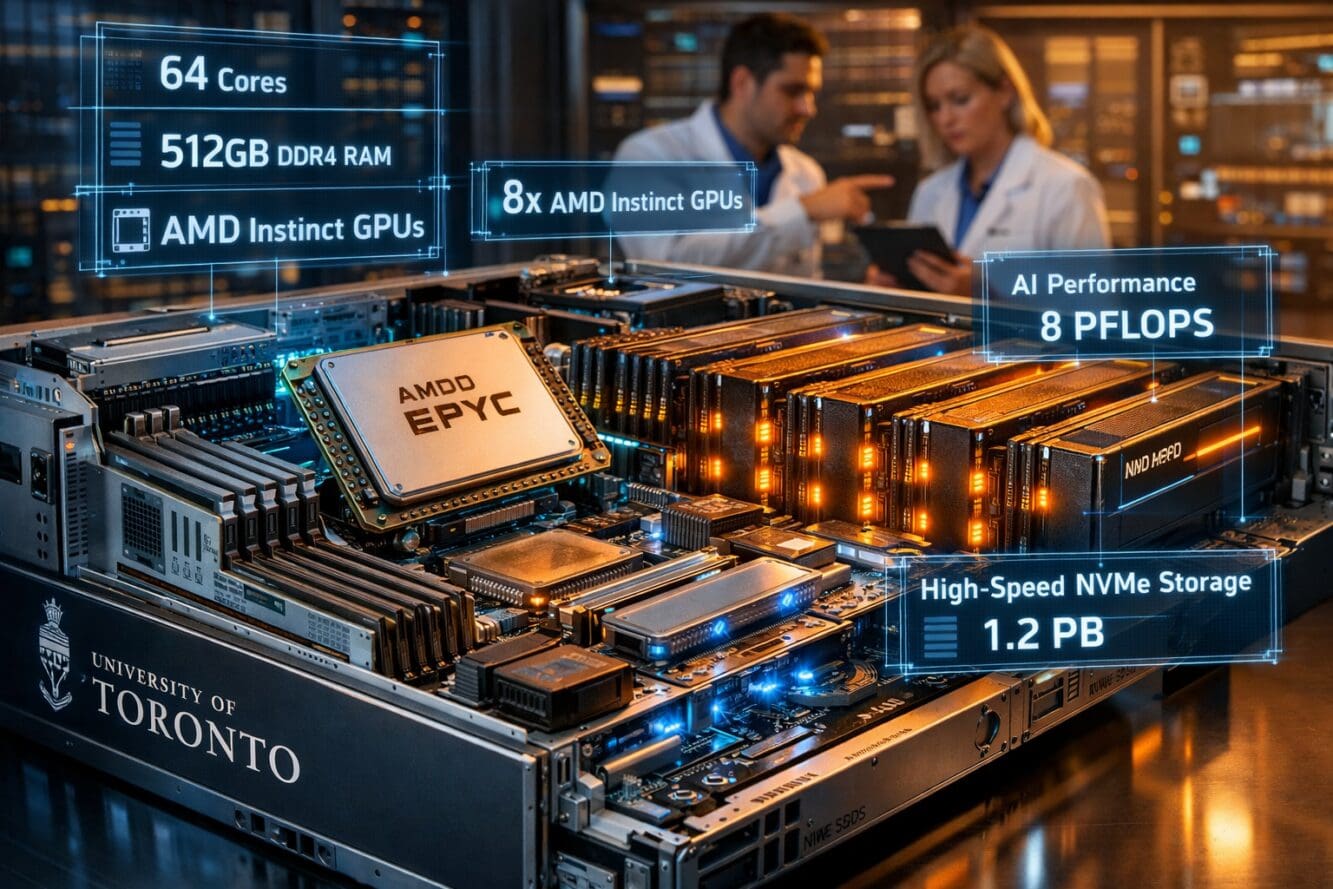
- Two state-of-the-art AI servers donated to expand the AMD-U of T Research Lab’s computing resources
- Three research pillars: energy-efficient AI systems, enterprise-scale data intelligence, and distributed AI model training
- Direct hardware access for researchers testing cutting-edge AMD processors and GPUs
The energy-efficiency focus addresses a critical challenge: AI model training consumes massive amounts of electricity. Researchers can now develop algorithms and hardware configurations that reduce power consumption while maintaining performance—essential for sustainable AI development.
Enterprise-scale data intelligence projects help businesses and institutions extract insights from massive datasets more effectively. This has practical applications in healthcare (analyzing patient records), finance (risk modeling), and climate science (processing satellite data).
Decentralized training methods allow researchers to train enormous AI models across distributed computing clusters rather than requiring single massive supercomputers. This approach makes advanced AI research more accessible and cost-effective.
Common mistake: Assuming corporate partnerships limit academic freedom. The AMD-U of T lab maintains research independence while benefiting from hardware donations and funding—researchers publish openly and pursue questions driven by scientific merit, not commercial interests.
What Are the Canada-Wide Research Boost Benefits?
The U of T supercomputer infrastructure serves researchers across Canada, not just Toronto-based scientists. This national access model democratizes high-performance computing, particularly benefiting institutions that couldn’t afford their own supercomputers.[3]
Who benefits from national access:
- Small universities without dedicated computing facilities can run complex simulations and AI experiments
- Research hospitals gain capacity for medical imaging analysis, drug discovery, and genomics research
- Northern and Indigenous communities access computing power for climate research, resource management, and cultural preservation projects
- Industry partners of all sizes can collaborate on applied research without building private infrastructure
- Graduate students and postdocs at any Canadian institution can pursue computationally intensive dissertation research
The infrastructure operates through the Digital Research Alliance of Canada, which manages allocation and ensures equitable access. Researchers apply for computing time based on project merit and computational requirements.
This model contrasts with the U.S. approach, where computing resources often concentrate at a few elite institutions. Canada’s distributed access strategy builds research capacity nationwide and supports regional economic development.
Choose this infrastructure if: You’re at a smaller institution, need computing power for a specific project duration, or want to test whether high-performance computing would benefit your research before investing in dedicated resources.
Edge case: Researchers requiring extremely specialized hardware configurations may still need to build custom systems, but the U of T infrastructure handles 90% of typical AI and scientific computing needs.
How Does This Impact Ontario’s Innovation Economy?
Ontario’s government views the U of T supercomputer expansion as economic infrastructure, not just academic investment. Victor Fedeli, Ontario’s Minister of Economic Development, Job Creation and Trade, emphasized the province’s goal to become “the most attractive and competitive jurisdiction in the G7 to do business” through AI leadership.[1]
Economic impacts for Ontario:
| Impact Area | Specific Benefits |
|---|---|
| Talent retention | Top AI researchers and students stay in Ontario rather than moving to U.S. tech hubs |
| Startup ecosystem | New companies spin out from research projects, creating jobs and attracting venture capital |
| Industry partnerships | Established companies locate R&D operations near computing resources and university talent |
| Supply chain development | Demand for data center services, hardware maintenance, and specialized software creates local business opportunities |
| International reputation | Global recognition as AI research center attracts foreign investment and collaboration |
The Vaughan data center location provides strategic advantages: proximity to Toronto’s tech talent pool, excellent connectivity infrastructure, and available power capacity for energy-intensive computing operations.
Ontario already hosts major AI research institutes, including the Vector Institute and the Schwartz Reisman Institute for Technology and Society. The expanded supercomputer infrastructure strengthens this ecosystem by providing the computational foundation these organizations need.
Common mistake: Expecting immediate economic returns. Infrastructure investments typically show measurable economic impact over 5-10 years as research translates into patents, startups, and industry adoption. Early indicators include increased research publications, patent filings, and industry partnership agreements.
What Research Applications Will the Supercomputer Enable?
The expanded computing capacity enables research that was previously impossible or impractically slow for Canadian scientists. Three application areas show particular promise: AI development, climate modeling, and healthcare innovation.
AI and machine learning research:
- Training large language models and multimodal AI systems
- Developing more efficient neural network architectures
- Testing AI safety and alignment approaches
- Creating specialized models for Canadian languages and contexts (including Indigenous languages)
Climate and environmental science:
- High-resolution climate modeling for Canadian regions
- Predicting extreme weather events and their economic impacts
- Modeling Arctic ice dynamics and permafrost changes
- Simulating ecosystem responses to climate change
Healthcare and biomedical research:
- Analyzing medical imaging data to detect diseases earlier
- Drug discovery through molecular simulation
- Genomics research for personalized medicine
- Modeling disease spread and healthcare system capacity
Additional applications:
- Materials science and engineering simulations
- Economic modeling and financial risk analysis
- Quantum computing algorithm development
- Natural language processing for multilingual Canada
Researchers can now run experiments that previously required months in days or weeks. This acceleration speeds up the entire research cycle—from hypothesis to publication to real-world application.
Choose climate modeling if: You’re studying regional Canadian impacts, need high spatial resolution, or want to model long-term scenarios (50-100 years). The computing power handles the massive data sets and complex calculations these models require.
How Does This Compare to Other National Supercomputing Initiatives?
Canada’s approach combines infrastructure expansion at existing institutions with plans for a new large-scale supercomputer. The federal government is establishing the AI Sovereign Compute Infrastructure Program (SCIP) with up to $705 million in funding, with a request for proposals expected in 2026.[2]
Competitive landscape:
Multiple Canadian institutions are preparing proposals for the federal supercomputer program:
- Queen’s University is developing a comprehensive proposal
- Simon Fraser University already operates supercomputing infrastructure and may expand
- Laval University in Quebec is likely to submit a proposal, ensuring French-language research capacity
This competitive process differs from simply expanding U of T’s infrastructure further. The government wants multiple computing centers to provide redundancy, serve different regions, and foster innovation through healthy competition.
International comparison:
- United States: Operates multiple national labs with supercomputers, but academic access varies widely
- European Union: Coordinates supercomputing through EuroHPC Joint Undertaking, providing access across member states
- China: Heavily invests in supercomputing but restricts international collaboration
- United Kingdom: Concentrates resources at specific institutions with national access programs
Canada’s distributed model with national access resembles the EU approach more than the U.S. system. This strategy builds capacity across the country rather than creating a single dominant center.
Edge case: Researchers needing the absolute fastest supercomputers globally may still need to apply for time on U.S. or European systems. However, the expanded Canadian infrastructure handles most research needs and keeps sensitive data within national borders—important for healthcare and security research.
What Are the Next Steps for Researchers and Institutions?
The spring 2026 completion timeline means the expanded infrastructure is becoming available now. Researchers should take specific actions to access these resources and maximize their impact.
For individual researchers:
- Apply for computing time through the Digital Research Alliance of Canada’s resource allocation competition
- Attend training workshops on high-performance computing and parallel programming techniques
- Develop computational research plans that specify hardware requirements and expected outcomes
- Form collaborative teams that combine domain expertise with computing skills
- Explore AMD-U of T lab opportunities if your research aligns with the three focus areas
For institutions:
- Establish support infrastructure to help researchers prepare competitive allocation applications
- Hire research computing facilitators who can bridge between researchers and technical infrastructure
- Develop partnerships with U of T and other institutions to share expertise and resources
- Consider SCIP proposals if your institution has the capacity to host major computing infrastructure
- Integrate computing literacy into graduate programs so students can leverage these resources
For industry partners:
- Explore collaboration opportunities through the Digital Research Alliance’s industry partnership programs
- Co-fund research projects that address business challenges while advancing scientific knowledge
- Provide internship opportunities for students working on computationally intensive research
- Consider data sharing agreements that allow researchers to work with real-world datasets
Common mistake: Waiting until you have a fully developed research plan before engaging with computing resources. Start with exploratory projects to understand capabilities and limitations, then design larger studies based on that experience.
The University of Guelph’s smart door access system study demonstrates how Ontario universities are increasingly adopting advanced technology for research applications, creating opportunities for cross-institutional collaboration.
Frequently Asked Questions
Who can access the U of T supercomputer infrastructure?
Any Canadian researcher affiliated with a university, research hospital, or eligible institution can apply for computing time through the Digital Research Alliance of Canada. Industry partners can access resources through collaboration agreements with academic researchers.
How much does it cost to use the supercomputer?
Academic researchers typically access the infrastructure at no direct cost through merit-based allocation competitions. Researchers compete for computing time based on project quality and feasibility rather than ability to pay.
What technical skills do researchers need?
Basic programming skills and understanding of parallel computing concepts help, but the Digital Research Alliance provides training and support. Many researchers work with research computing facilitators who handle technical implementation.
How long does the allocation application process take?
The Digital Research Alliance runs regular allocation competitions with typical review periods of 6-8 weeks. Researchers should plan ahead and apply well before they need computing resources.
Can international collaborators use the infrastructure?
Yes, if they’re working with Canadian researchers as part of an approved project. The primary investigator must be affiliated with a Canadian institution, but international team members can participate.
What happens if my research needs exceed available capacity?
The Digital Research Alliance helps researchers optimize their code for efficiency and may provide access to additional resources. For extremely large projects, researchers might use multiple computing centers or apply for special allocations.
How does this compare to cloud computing services?
The supercomputer provides much more cost-effective access for academic research than commercial cloud services. For large-scale AI training, cloud costs could reach hundreds of thousands of dollars, while academic allocation is free based on merit.
What data security measures are in place?
The infrastructure includes robust security protocols, encryption, and access controls. Researchers working with sensitive data (like patient health information) receive additional security support and must follow institutional ethics requirements.
Will this infrastructure support quantum computing research?
The current infrastructure focuses on classical computing with GPUs optimized for AI workloads. However, researchers can use it to develop and test quantum algorithms through simulation before running them on actual quantum computers.
How often is the hardware updated?
High-performance computing infrastructure typically undergoes major upgrades every 3-5 years as technology advances. The AMD partnership provides access to newer hardware generations as they become available.
Can undergraduate students access the supercomputer?
Undergraduates can access resources as part of faculty-supervised research projects or advanced courses that incorporate computational research. Direct independent access typically requires graduate student or faculty status.
What support is available for researchers new to supercomputing?
The Digital Research Alliance and U of T provide documentation, training workshops, online tutorials, and direct consulting support. Many institutions also employ local research computing facilitators who help researchers get started.
Conclusion
The U of T Supercomputer Launch represents a pivotal moment for Canadian research infrastructure and Ontario’s innovation economy. With $42.5 million in federal investment tripling computing capacity, the AMD partnership funding 100 research projects, and national access democratizing high-performance computing, Canada is building the computational foundation for AI sovereignty and scientific leadership.[1][2][3]
The spring 2026 completion timeline means these resources are available now for researchers across Canada—from major universities to small institutions, from southern Ontario to northern communities. The infrastructure supports breakthrough research in AI development, climate modeling, healthcare innovation, and countless other fields that require massive computational power.
For Ontario specifically, this investment strengthens the province’s position as a global AI hub, attracts talent and investment, and creates economic opportunities that extend far beyond the university campus. The strategic location in Vaughan, combined with Toronto’s existing AI ecosystem, positions the region for sustained growth in the technology sector.
Take action now:
- Researchers: Apply for computing time through the Digital Research Alliance and explore AMD-U of T lab opportunities
- Institutions: Develop support infrastructure and consider proposals for the upcoming SCIP competition
- Industry partners: Explore collaboration opportunities that leverage this national resource
- Policy makers: Monitor outcomes and support continued investment in computational research infrastructure
The convergence of federal funding, corporate partnership, and institutional commitment creates unprecedented opportunities for Canadian researchers. Those who engage early with these resources will shape the next generation of AI innovation, scientific discovery, and economic development.
For more information on how artificial intelligence is transforming various sectors, including healthcare applications, explore the growing ecosystem of AI research and development across Ontario and Canada.
References
[1] U T And Amd Launch Dedicated Ai And Computing Research Lab – https://www.utoronto.ca/news/u-t-and-amd-launch-dedicated-ai-and-computing-research-lab
[2] Feds Commit 42 5 Million To Expand Ai Compute Infrastructure At University Of Toronto – https://betakit.com/feds-commit-42-5-million-to-expand-ai-compute-infrastructure-at-university-of-toronto/
[3] U Of T Ai Infrastructure Gets 42 5m Federal 1580102 – https://www.miragenews.com/u-of-t-ai-infrastructure-gets-42-5m-federal-1580102/
[4] Canada Ready To Build Its Own World Class Supercomputer But Needs To Couple It With An Advanced Technology Program – https://researchmoneyinc.com/article/canada-ready-to-build-its-own-world-class-supercomputer-but-needs-to-couple-it-with-an-advanced-technology-program
Content, illustrations, and third-party video appearing on GEORGIANBAYNEWS.COM may be generated or curated with AI assistance or reproduced pursuant to the fair dealing provisions of the Copyright Act, R.S.C. 1985, c. C-42. Attribution and hyperlinks to original sources are provided in acknowledgment of applicable intellectual property rights. Such referencing is intended to direct traffic to and support the original rights holders’ platforms.