





















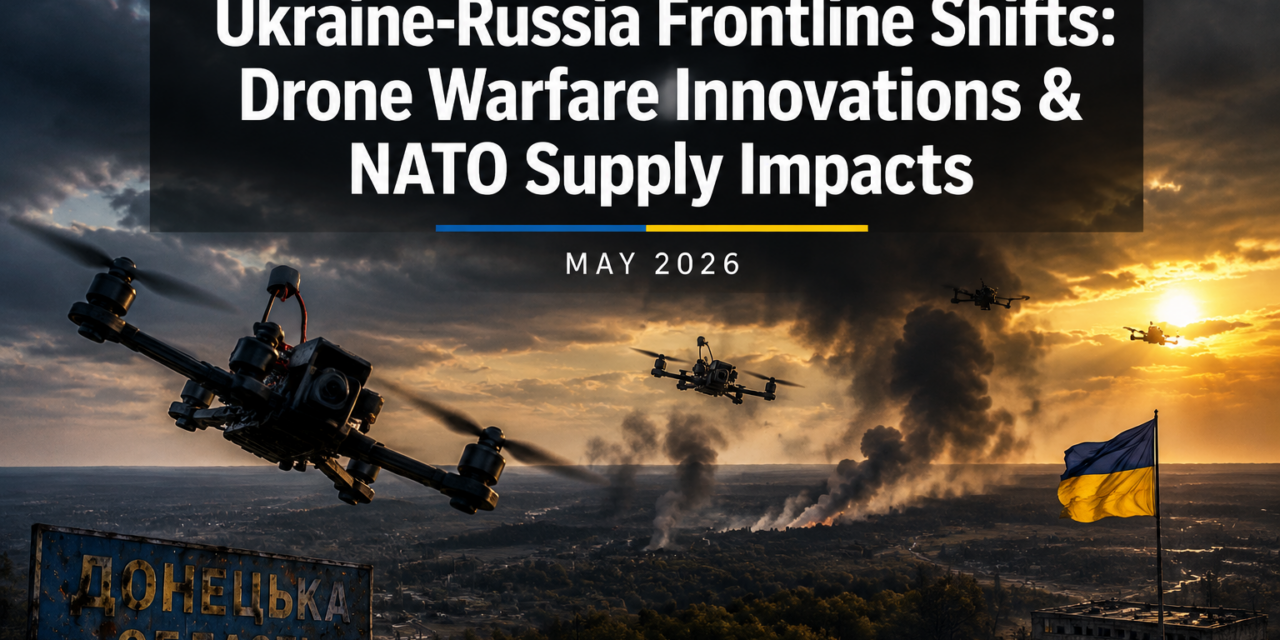
Ukraine-Russia Frontline Shifts: Drone Warfare Innovations and NATO Supply Impacts May 13, 2026
Last updated: May 13, 2026
Quick Answer: As of May 13, 2026, the Ukraine-Russia contact line has been reshaped more by drone technology than by any traditional ground offensive. Ukraine’s expanding robotic kill zone now reaches well beyond 15 km from the front, Russia’s planned naval drone campaign collapsed after losing Starlink access, and delayed NATO arms deliveries continue to create measurable gaps in Ukrainian defensive momentum.
Key Takeaways
- 🎯 Ukraine’s frontline “robotic kill zone” has expanded many times beyond the 3–5 km range seen in 2023–24, making massed troop movements near the contact line extremely costly for Russian forces [7]
- 🚁 Drones now replace infantry and conventional vehicles for frontline logistics, supply drops, and strike missions [7]
- 🌊 Russia’s 2026 naval drone offensive collapsed after SpaceX blocked Russian Starlink access at Kyiv’s request, exposing critical dependence on Western satellite technology [4]
- 🤖 Ukrainian-British start-up UFORCE has deployed air, land, and sea drones in active combat, with President Zelensky publicly showcasing new robotic weapons systems [1]
- ⚠️ Drone-to-drone combat is already occurring in the air domain and analysts consider its extension to land and sea “extremely likely, if not inevitable” [1]
- 📦 Delayed NATO supply chains are forcing Ukrainian units to adapt logistics underground and distribute resupply across the battlefield [7]
- 🛰️ Russia cannot develop a reliable domestic alternative to Starlink for naval drone communications, leaving its maritime unmanned program effectively grounded [4]
- 📊 Military analysts predict unmanned systems will outnumber human soldiers on Ukrainian battlefields in the near future [1]
How Have Ukraine-Russia Frontline Shifts Changed the Battlefield in May 2026?
The frontline in eastern Ukraine no longer resembles the attritional trench warfare of 2023. By May 2026, drone systems dominate engagement at distances that make traditional infantry assaults nearly obsolete.
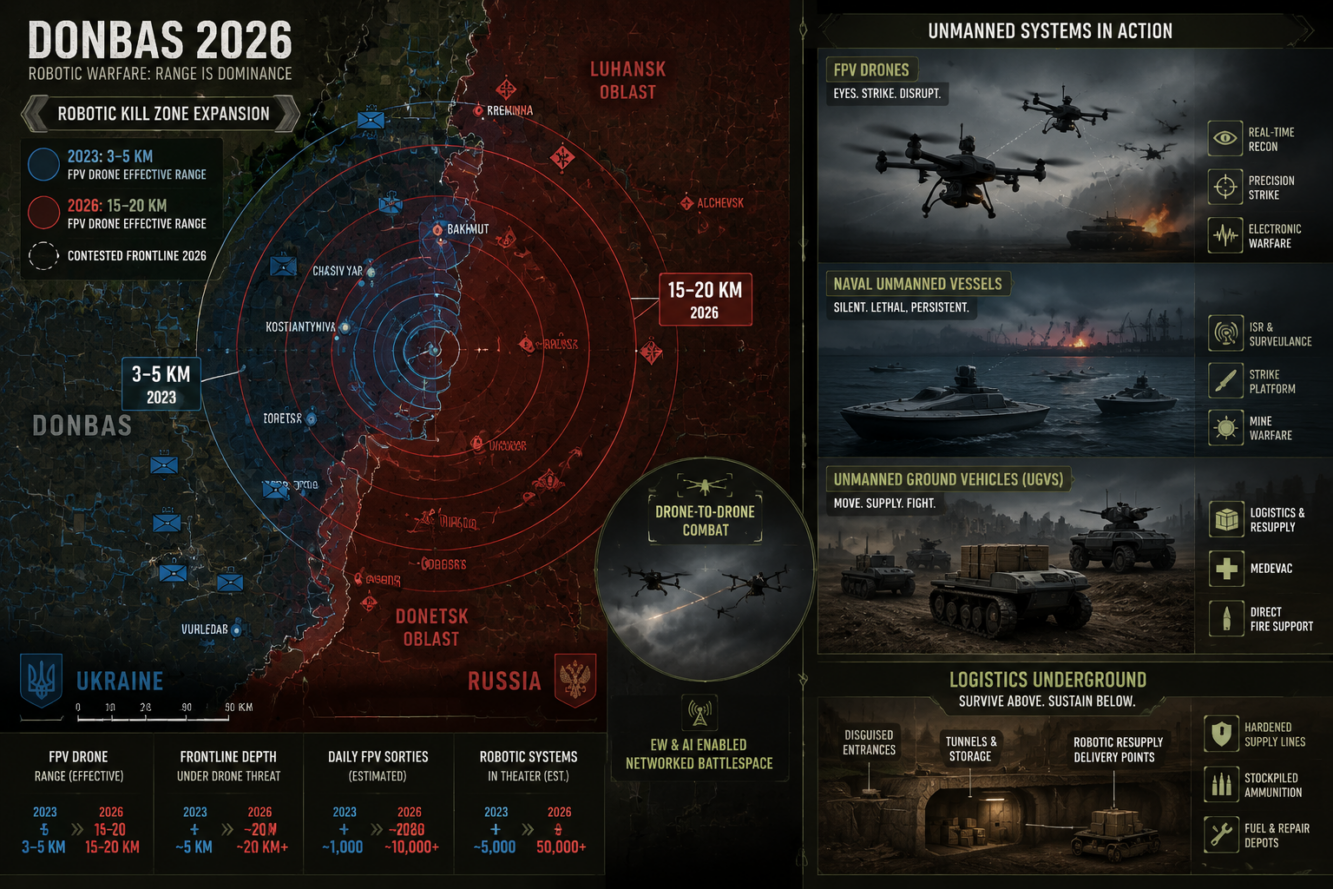
According to a Ukrainian battalion commander interviewed by Euromaidan Press, the kill zone has expanded many times beyond the 3–5 km range that defined combat in 2023–24. Getting within 5 km of the contact line is now described as a “lottery” for Russian forces [7]. Massed vehicle convoys and troop concentrations are destroyed before they can close with Ukrainian positions.
What changed most:
- Drone-laid remote mines now stop armored assaults outright — one documented operation destroyed two armored vehicles before they reached their objective [7]
- Logistics that once relied on vehicle convoys have moved underground and been distributed across the battle area
- Ukrainian forces use heavy drones and unmanned ground vehicles (UGVs) to deliver supplies where conventional transport cannot safely operate [7]
“Storm a treeline? Better to just take it apart with a Vampire.” — Ukrainian battalion commander, April 2026 [7]
What Drone Warfare Innovations Are Defining Ukraine-Russia Frontline Shifts in 2026?
Three specific innovations stand out in the current phase of the conflict: drone-to-drone combat, multi-domain robotic deployment, and drone-laid mining.
Jacob Parakilas of RAND Europe confirmed that Ukrainian and Russian drones are already engaged in direct aerial combat, and analysts consider it extremely likely that this will extend to land and maritime domains [1]. The Carnegie Endowment has documented this period as a “New Revolution in Military Affairs,” driven almost entirely by unmanned systems [3].
Key innovations on the Ukrainian side include:
| Innovation | Operational Impact |
|---|---|
| FPV drone strikes | Replaces artillery for close-range precision kills |
| Drone-laid remote mines | Stops armored assaults before contact [7] |
| Heavy cargo drones / UGVs | Frontline resupply without vehicle exposure [7] |
| Multi-domain robotic systems (UFORCE) | Air, land, and sea coverage in one platform [1] |
| Naval drone denial via Starlink cutoff | Collapsed Russia’s 2026 naval offensive [4] |
Common mistake: Analysts who focus only on FPV strike drones miss the equally decisive role of logistics drones and unmanned mining — the supply and denial functions are reshaping the battle as much as the strikes themselves.
Why Did Russia’s Naval Drone Campaign Collapse in 2026?
Russia’s planned 2026 naval unmanned vessel offensive failed before it began, and the reason is a single communications dependency.
Ukraine’s Defense Ministry advisor Serhii “Flash” Beskrestnov confirmed that SpaceX blocked Russian Starlink satellite access at Kyiv’s request in early 2026 [4]. Russia had built the naval drones but had no reliable way to control them. Domestic Russian communication systems proved technically unstable and insufficient for maritime drone operations near the Ukrainian coast [4].
Why this matters for the broader conflict:
- It exposes Russia’s defense-industrial base as dependent on Western technology even after years of sanctions
- Russia cannot quickly replace Starlink with a domestic equivalent — the technical gap is significant [4]
- The failure effectively removes a major threat to Ukrainian Black Sea operations and grain corridor security
This development directly connects to the broader Ukraine-Russia frontline shifts picture: Ukraine’s ability to influence Russian technology access through diplomatic channels (in this case, via SpaceX) is now a genuine force multiplier.
How Are NATO Supply Delays Affecting Ukrainian Frontline Momentum?
NATO supply delays are creating real gaps, but Ukrainian forces have adapted rather than stalled.
The Institute for the Study of War’s May 11, 2026 assessment notes continued Russian pressure in the Donbas, partly enabled by Ukrainian ammunition constraints tied to delayed Western deliveries [6]. Aviation Week has reported that Ukraine’s new offensive season is leaning heavily on domestic drone production to compensate for gaps in NATO-supplied conventional munitions [9].
The adaptation pattern looks like this:
- Delayed artillery shells → increased reliance on FPV drone strikes for fire support
- Reduced armored vehicle deliveries → UGVs and drone logistics fill the gap
- Slower air defense resupply → drone interception systems take on greater importance [5]
The Atlantic Council’s analysis of the “compute war” dimension argues that software, AI targeting, and electronic warfare capabilities — many of which Ukraine sources domestically or from allied tech firms — are becoming as important as physical hardware deliveries [5].
Choose this framing if you’re assessing NATO’s actual impact: hardware delays hurt, but Ukraine’s drone-industrial ecosystem has partially decoupled from NATO supply timelines for tactical operations.
What Do Frontline Commanders Say About How War Has Changed in 2026?
Ukrainian unit commanders are the clearest voice on operational reality, and their accounts from April–May 2026 are consistent.
The battalion commander profiled by Euromaidan Press described a battlefield where traditional assault tactics — storming a treeline, rushing a position — have been replaced by remote destruction [7]. The drone doesn’t just support the infantry; in many cases, it is the infantry.
Key operational shifts commanders describe:
- Units no longer drive supply vehicles to forward positions; drones carry ammunition and medical supplies
- Enemy troop concentrations are identified and struck by drone before any human soldier engages
- Electronic warfare and drone jamming have become as tactically important as the drones themselves
- Russia’s FPV campaign has also institutionalized targeting of civilian infrastructure, documented by ISW as deliberate policy [8]
Conclusion: What Should Readers Watch Next?
The Ukraine-Russia frontline shifts, drone warfare innovations, and NATO supply impacts as of May 13, 2026 point toward one clear trajectory: the conflict is becoming a competition in robotic systems, communications infrastructure, and industrial production speed — not just manpower and artillery.
Actionable next steps for analysts, policymakers, and informed readers:
- Track NATO supply timelines closely. Gaps in air defense and artillery ammunition remain the most acute vulnerability for Ukraine in the near term [6]
- Monitor Russia’s communications technology development. If Russia finds a Starlink alternative, its naval drone program could revive quickly [4]
- Watch the drone-to-drone combat domain. The first confirmed land-domain drone-versus-drone engagement will mark a major tactical threshold [1]
- Follow Ukrainian domestic drone production figures. Output rates now directly determine frontline capacity more than NATO shipment schedules [9]
- Assess the “compute war” dimension. AI targeting, electronic warfare, and satellite access are the new logistics [5]
The battlefield of May 2026 rewards speed, adaptability, and technological depth. Forces that can iterate drone systems faster than the enemy can jam or counter them hold the initiative — and right now, that edge belongs to Ukraine’s decentralized innovation ecosystem.
FAQ
Q: What is the “robotic kill zone” on the Ukraine-Russia frontline? A: It refers to the area near the contact line where drones dominate and make traditional troop movements extremely dangerous. By 2026, this zone extends well beyond 15 km from the front, compared to 3–5 km in 2023–24 [7].
Q: Why did Russia’s naval drone campaign fail in 2026? A: SpaceX blocked Russian access to Starlink satellite communications at Ukraine’s request. Russia had built the naval drones but had no reliable domestic system to control them at sea [4].
Q: Are drones replacing soldiers on the Ukrainian battlefield? A: For logistics, reconnaissance, and many strike missions, yes. Military analysts predict unmanned systems will outnumber human soldiers in future Ukrainian battles [1].
Q: How are NATO supply delays affecting Ukraine? A: Delays in artillery ammunition and air defense systems have pushed Ukraine to rely more heavily on domestic drone production and FPV strikes as substitutes for conventional firepower [9].
Q: What is drone-to-drone combat? A: It is direct engagement between opposing unmanned aerial vehicles in flight. Ukrainian and Russian drones are already fighting each other in the air, and analysts expect this to extend to land and sea domains [1].
Q: What is UFORCE? A: UFORCE is a Ukrainian-British military start-up that has deployed air, land, and sea drones in active combat scenarios. President Zelensky highlighted their systems publicly in 2026 [1].
Q: What is the “compute war” in Ukraine? A: A term used by the Atlantic Council to describe the growing importance of AI targeting, electronic warfare, and satellite communications — software and data infrastructure — as decisive factors alongside physical weapons [5].
Q: Can Russia develop a Starlink replacement for its naval drones? A: Not quickly. Russia’s domestic communication systems have proven technically unstable for maritime drone operations, and no viable alternative has emerged as of May 2026 [4].
References
[1] C9d35v126vyo – https://www.bbc.com/news/articles/c9d35v126vyo [3] Ukraine Russia War Changing Warfare Practice Military Strategy – https://carnegieendowment.org/research/2026/04/ukraine-russia-war-changing-warfare-practice-military-strategy [4] Russia Planned Major Naval Counteroffensive Against Ukraine Drones Are Built But They Cant Be Used – https://euromaidanpress.com/2026/05/09/russia-planned-major-naval-counteroffensive-against-ukraine-drones-are-built-but-they-cant-be-used/ [5] The Coming Compute War In Ukraine – https://www.atlanticcouncil.org/content-series/the-big-story/the-coming-compute-war-in-ukraine/ [6] Russian Offensive Campaign Assessment May 11 2026 – https://understandingwar.org/research/russia-ukraine/russian-offensive-campaign-assessment-may-11-2026/ [7] Storm A Treeline Better To Just Take It Apart With A Vampire Drone Battalion Commander On How War Changed In 2026 – https://euromaidanpress.com/2026/04/17/storm-a-treeline-better-to-just-take-it-apart-with-a-vampire-drone-battalion-commander-on-how-war-changed-in-2026/ [8] Russias Fpv Drone Campaign In Ukraine Institutionalizes Intentional Civilian Harm As A Tool Of War – https://understandingwar.org/research/russia-ukraine/russias-fpv-drone-campaign-in-ukraine-institutionalizes-intentional-civilian-harm-as-a-tool-of-war/ [9] Ukraine Leverages Drone Warfare New Offensive Season Begins – https://aviationweek.com/defense/missile-defense-weapons/ukraine-leverages-drone-warfare-new-offensive-season-begins