





















US Layoffs Surge to Great Recession Levels: What It Means for Workers and Economy
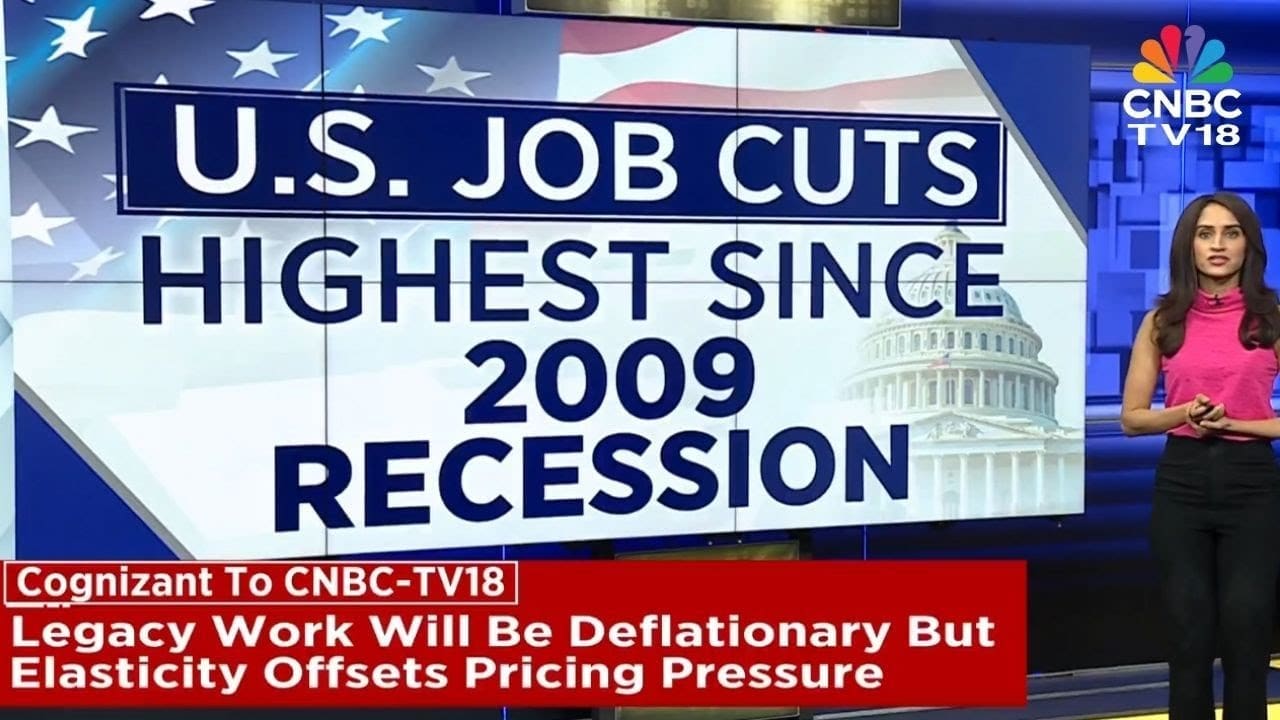
The American job market is experiencing a seismic shift that hasn’t been seen in nearly two decades. As workers across the nation opened their January 2026 paychecks—or worse, received termination notices—a troubling pattern emerged that economists are comparing to the darkest days of the 2008-2009 financial crisis. US layoffs surge to Great Recession levels: what it means for workers and economy is no longer just a headline; it’s a reality affecting hundreds of thousands of families navigating unprecedented economic turbulence.
With 108,435 job cuts announced in January 2026 alone, representing a staggering 118% increase compared to the same month in 2025, the employment landscape has fundamentally changed[2][3]. This marks the highest total for the start of a year since 2009, when the Great Recession was in full swing[3]. The acceleration is even more dramatic when compared to December 2025—layoffs have tripled in just one month[3].
Key Takeaways
📊 Record-Breaking Layoffs: January 2026 saw 108,435 job cuts, the highest start-of-year total since 2009, with a 118% year-over-year increase[2][3].
💼 Hiring Freeze Intensifies: Private sector hiring fell to just 22,000 new jobs in January, far below expectations, while job openings collapsed by 1 million over 12 months[2].
🏭 Three Hardest-Hit Sectors: Transportation (31,000+ cuts), Technology (22,000), and Healthcare (17,000) are bearing the brunt of layoffs[2].
🏢 Corporate Giants Leading Cuts: Amazon and UPS alone accounted for nearly half of all January layoffs, with 16,000 and 30,000 cuts respectively[3].
⚠️ Economic Uncertainty Driving Decisions: Contract losses, market conditions, and restructuring—not automation—are the primary drivers of workforce reductions[2].
Understanding the Scale: US Layoffs Surge to Great Recession Levels
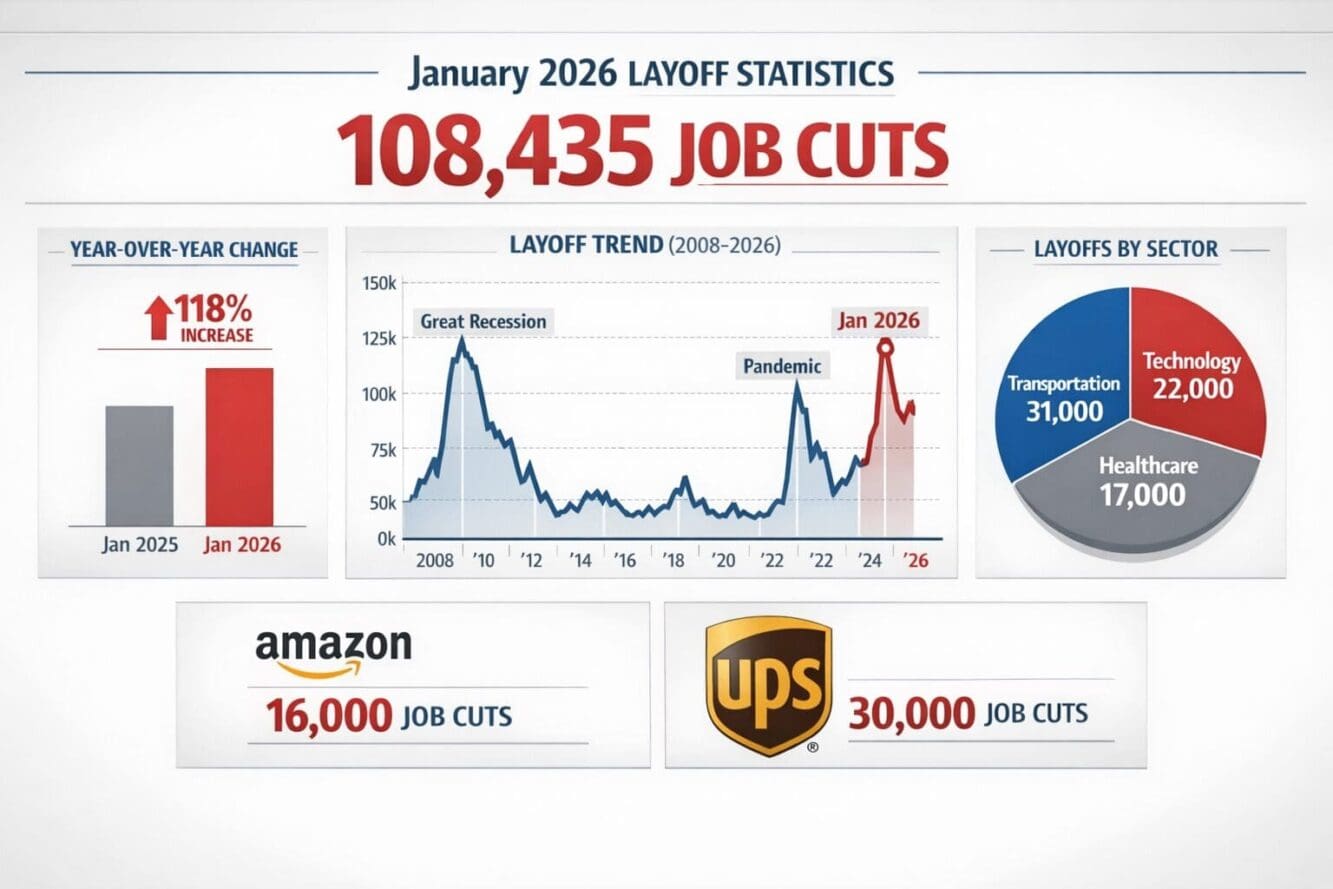
The numbers tell a sobering story. January’s layoff announcement didn’t just edge past previous months—it more than doubled compared to January 2025 and tripled from December 2025[3]. This acceleration suggests that companies aren’t making isolated adjustments but are responding to deeper structural concerns about the economy.
Historical Context Matters
To understand why these figures are alarming, consider that the last time January layoffs reached these levels was during the second year of the Great Recession in 2009[3]. That period saw:
- Massive banking failures
- Housing market collapse
- Global credit freeze
- Unemployment rates exceeding 10%
While the current economic environment differs from 2008-2009, the layoff trajectory is eerily similar. The full-year 2025 data provides additional context: US companies announced more than 1.2 million layoffs throughout 2025, the highest total since 2020 when the COVID-19 pandemic first struck[3].
The Hiring Freeze Compounds the Problem
What makes the current situation particularly challenging is that layoffs are occurring simultaneously with a dramatic slowdown in hiring. According to the Challenger report, hiring levels fell to their lowest point since the firm began tracking data in 2009[3].
The ADP employment report reinforced this trend, showing that private companies added only 22,000 jobs in January—significantly below the 45,000 analyst expectation[2]. ADP’s chief economist noted that “hiring is softening” and “continues a pattern that we’ve noticed for the past 3 years. Employers are cautious to hire in the current economy”[2].
Adding to the concern, job openings collapsed by 1 million over the past 12 months, falling from 7.5 million to 6.5 million according to government JOLTS reports[2]. This represents a fundamental shift in labor market dynamics, with fewer opportunities available for displaced workers.
Which Industries Are Hit Hardest by the Layoff Surge?
The pain of workforce reductions isn’t distributed evenly across the economy. Three sectors are experiencing particularly severe cuts:
🚚 Transportation Sector (31,000+ Cuts)
The transportation industry leads all sectors with more than 31,000 announced job cuts in January[2]. The primary driver is UPS, which announced plans to eliminate 30,000 additional jobs on top of the 48,000 already cut since the prior year[3]. This represents a massive restructuring in response to changing shipping volumes and operational efficiency initiatives.
💻 Technology Sector (~22,000 Cuts)
Technology companies, which were hiring aggressively just two years ago, announced approximately 22,000 cuts in January[2]. Major announcements included:
- Amazon: 16,000 job cuts concentrated in corporate and technology positions[3]
- Meta Reality Lab: 1,500–2,200 positions eliminated
- Oracle: 30,000 cuts reportedly pending
- Autodesk: Approximately 1,000 jobs
- Pinterest: 15% of total workforce
- Mastercard: 1,400 jobs[3]
The technology sector’s challenges reflect a correction from pandemic-era over-hiring and shifting business priorities.
🏥 Healthcare Sector (17,000 Cuts)
Perhaps most surprisingly, healthcare announced more than 17,000 layoffs in January—the highest level since the start of the COVID-19 pandemic in 2020[3]. This contradicts the conventional wisdom that healthcare remains recession-proof, suggesting deeper systemic challenges in the industry.
Other Notable Sectors
Additional significant layoffs were announced across:
- Financial Services: Citi announced 1,000 cuts with 20,000 total planned
- Retail: Home Depot eliminated 800 positions
- Manufacturing: Nike cut 775 jobs at distribution centers in the American South
- Media: The Washington Post reduced staff by 300[3]
What’s Driving the Layoffs? Economic Causes Behind the Surge
Understanding why companies are cutting jobs helps workers and policymakers respond appropriately. The data reveals that economic factors, not technological disruption, are the primary drivers:
Primary Causes of January 2026 Layoffs
| Cause | Number of Cuts | Percentage |
|---|---|---|
| Contract Losses | ~31,000 | 28.6% |
| Market/Economic Conditions | ~28,000 | 25.8% |
| Restructuring | ~20,000 | 18.4% |
| Business Closings | ~13,000 | 12.0% |
| AI/Automation | 7,624 | 7.0% |
| Other | ~8,811 | 8.2% |
Contract losses accounted for just under 31,000 cuts, while market and economic conditions drove 28,000 layoffs[2]. This suggests companies are responding to reduced demand, lost business opportunities, and economic uncertainty rather than simply replacing workers with technology.
The Limited (But Growing) Role of AI
While artificial intelligence dominates headlines, it was directly responsible for only 7,624 job cuts in January, representing just 7% of total cuts for the month[2]. However, this figure is growing, and some analysts believe companies may be using “AI-washing” as cover for economically motivated layoffs[1].
Policy Shifts and Global Economic Pressures
The timing of these layoffs—surging in early 2026—suggests companies are responding to:
- Monetary policy uncertainty: Interest rates remain elevated, increasing borrowing costs
- Global economic slowdown: Reduced international demand affecting export-oriented companies
- Regulatory changes: New compliance requirements adding operational costs
- Geopolitical tensions: Trade uncertainties affecting supply chains and market access
What US Layoffs Surge Means for American Workers and Families
Behind every statistic is a family facing difficult decisions. The 205% month-over-month increase in layoffs from December 2025 to January 2026 means hundreds of thousands of households are grappling with:
Immediate Financial Stress 💰
- Lost income: Average severance packages typically cover 1-3 months of salary
- Benefits disruption: Health insurance, retirement contributions, and other benefits end
- Emergency fund depletion: Families draw down savings to cover basic expenses
- Debt accumulation: Credit card balances and loans increase to bridge income gaps
Medium-Term Career Challenges
The combination of mass layoffs and hiring freezes creates a particularly difficult environment:
- Increased competition: Hundreds of qualified candidates competing for each opening
- Longer job searches: Average time to re-employment extending beyond historical norms
- Wage pressure: Desperate job seekers accepting positions below their previous compensation
- Skill obsolescence concerns: Extended unemployment periods creating resume gaps
Psychological and Social Impacts
The stress of job loss extends beyond finances:
- Mental health challenges: Anxiety and depression rates increase among unemployed workers
- Family strain: Relationships tested by financial pressure and uncertainty
- Community effects: Reduced consumer spending impacts local businesses
- Social isolation: Loss of workplace social connections and professional identity
Broader Economic Implications: What It Means for the Economy
When US layoffs surge to Great Recession levels, the ripple effects extend throughout the entire economy:
Consumer Spending Decline
Unemployed and worried workers reduce discretionary spending, creating a negative feedback loop:
- Layoffs reduce household income
- Families cut spending on non-essentials
- Retailers and service providers see reduced revenue
- Those businesses reduce staff or close
- More layoffs occur, repeating the cycle
Housing Market Pressure
Job insecurity affects housing in multiple ways:
- Reduced home purchases: Uncertain employment prospects delay homebuying decisions
- Increased foreclosures: Unemployed workers struggle to maintain mortgage payments
- Rental market stress: Even renters face difficulty meeting monthly obligations
- Geographic immobility: Workers unable to relocate for opportunities due to housing constraints
Tax Revenue and Government Services
Mass layoffs reduce tax collections at all levels:
- Federal income tax: Fewer employed workers paying taxes
- State and local revenue: Sales tax and property tax collections decline
- Unemployment insurance strain: State unemployment systems face increased claims
- Service reductions: Governments forced to cut services or raise taxes on remaining workers
Long-Term Economic Scarring
Research from previous recessions shows that prolonged unemployment creates lasting damage:
- Skill degradation: Extended joblessness reduces worker productivity
- Wage scarring: Workers who find jobs during recessions earn less throughout their careers
- Entrepreneurship decline: Economic uncertainty reduces business formation
- Innovation slowdown: Companies in survival mode reduce R&D investment
What Workers Can Do: Practical Steps for Navigating the Layoff Surge
While the macroeconomic trends are concerning, individual workers can take concrete actions to protect themselves:
✅ Immediate Actions
- Build emergency savings: Aim for 6-12 months of expenses if possible
- Update your resume: Keep professional documents current and ready
- Strengthen your network: Maintain relationships with colleagues and industry contacts
- Assess your skills: Identify gaps and pursue relevant training
- Review your finances: Understand your budget and identify areas to reduce spending
📚 Skill Development and Adaptation
The current environment rewards workers who can demonstrate:
- Digital literacy: Comfort with technology and digital tools
- Adaptability: Ability to learn new systems and processes quickly
- Cross-functional capabilities: Skills that transfer across industries
- Data analysis: Understanding of metrics and data-driven decision making
Consider exploring AI-related skills that complement rather than compete with automation.
🔍 Strategic Job Search Approaches
In a competitive market, effective job searching requires strategy:
- Target growing sectors: Research industries still hiring despite economic headwinds
- Consider geographic flexibility: Willingness to relocate expands opportunities
- Explore contract work: Temporary and project-based roles can provide income bridges
- Leverage multiple platforms: Use LinkedIn, industry-specific boards, and networking
- Customize applications: Tailor each resume and cover letter to specific positions
💼 Financial Protection Strategies
- Understand unemployment benefits: Know your state’s requirements and application process
- Review COBRA options: Evaluate health insurance continuation versus marketplace alternatives
- Negotiate severance: Don’t automatically accept initial severance offers
- Protect retirement accounts: Avoid early withdrawals that trigger penalties and taxes
- Explore side income: Freelancing, consulting, or gig work can supplement unemployment
Policy Responses and What Comes Next
The surge in layoffs to Great Recession levels demands coordinated responses from policymakers:
Potential Government Interventions
- Extended unemployment benefits: Longer benefit periods during economic downturns
- Retraining programs: Subsidized skill development for displaced workers
- Tax incentives: Credits for companies that maintain or expand workforce
- Infrastructure investment: Job creation through public works projects
- Small business support: Loans and grants to prevent additional closures
What Economists Are Watching
Key indicators that will signal whether the situation improves or deteriorates:
- Monthly job reports: Continued weakness would confirm recession
- Consumer confidence: Falling confidence predicts reduced spending
- Corporate earnings: Profit warnings may trigger additional layoff rounds
- Credit markets: Tightening credit access would compound problems
- Global economic data: International slowdowns affect US export industries
Conclusion: Preparing for Uncertainty While Maintaining Hope
The reality that US layoffs surge to Great Recession levels represents a significant economic challenge that will affect millions of American workers and families throughout 2026. With 108,435 job cuts in January alone, hiring at record lows, and job openings down by 1 million, the employment landscape has fundamentally shifted[2][3].
However, understanding the scope and causes of this crisis is the first step toward navigating it successfully. Unlike the 2008-2009 Great Recession, today’s economy has different strengths: stronger banking systems, more diverse industry bases, and technological capabilities that enable remote work and new business models.
Actionable Next Steps
For Workers:
- Assess your emergency preparedness today—don’t wait for a layoff notice
- Invest in skill development that increases your marketability
- Build and maintain professional networks actively
- Create a financial buffer through reduced spending and increased savings
For Employers:
- Consider alternatives to layoffs: reduced hours, temporary pay cuts, voluntary sabbaticals
- Provide robust outplacement services for affected workers
- Maintain transparent communication with remaining staff
- Invest in retention of critical talent
For Policymakers:
- Monitor employment data closely for signs of acceleration
- Prepare expanded unemployment and retraining programs
- Consider targeted interventions in hardest-hit sectors
- Balance fiscal responsibility with necessary economic support
The months ahead will test the resilience of American workers, families, and institutions. By staying informed, taking proactive steps, and supporting one another, communities can weather this economic storm and emerge stronger on the other side.
References
[1] Us Companies Face Backlash For Ai Washing As Cover For Layoffs – https://mlq.ai/news/us-companies-face-backlash-for-ai-washing-as-cover-for-layoffs/
[2] Watch – https://www.youtube.com/watch?v=QadL1JNe-GU
[3] Xgpp F06 – https://www.wsws.org/en/articles/2026/02/06/xgpp-f06.html
Some content and illustrations on GEORGIANBAYNEWS.COM are created with the assistance of AI tools.
GEORGIANBAYNEWS.COM shares video content from YouTube creators under fair use principles. We respect creators’ intellectual property and include direct links to their original videos, channels, and social media platforms whenever we feature their content. This practice supports creators by driving traffic to their platforms.