






















VIDEO | Replacing Developers with AI is Going Horribly Wrong
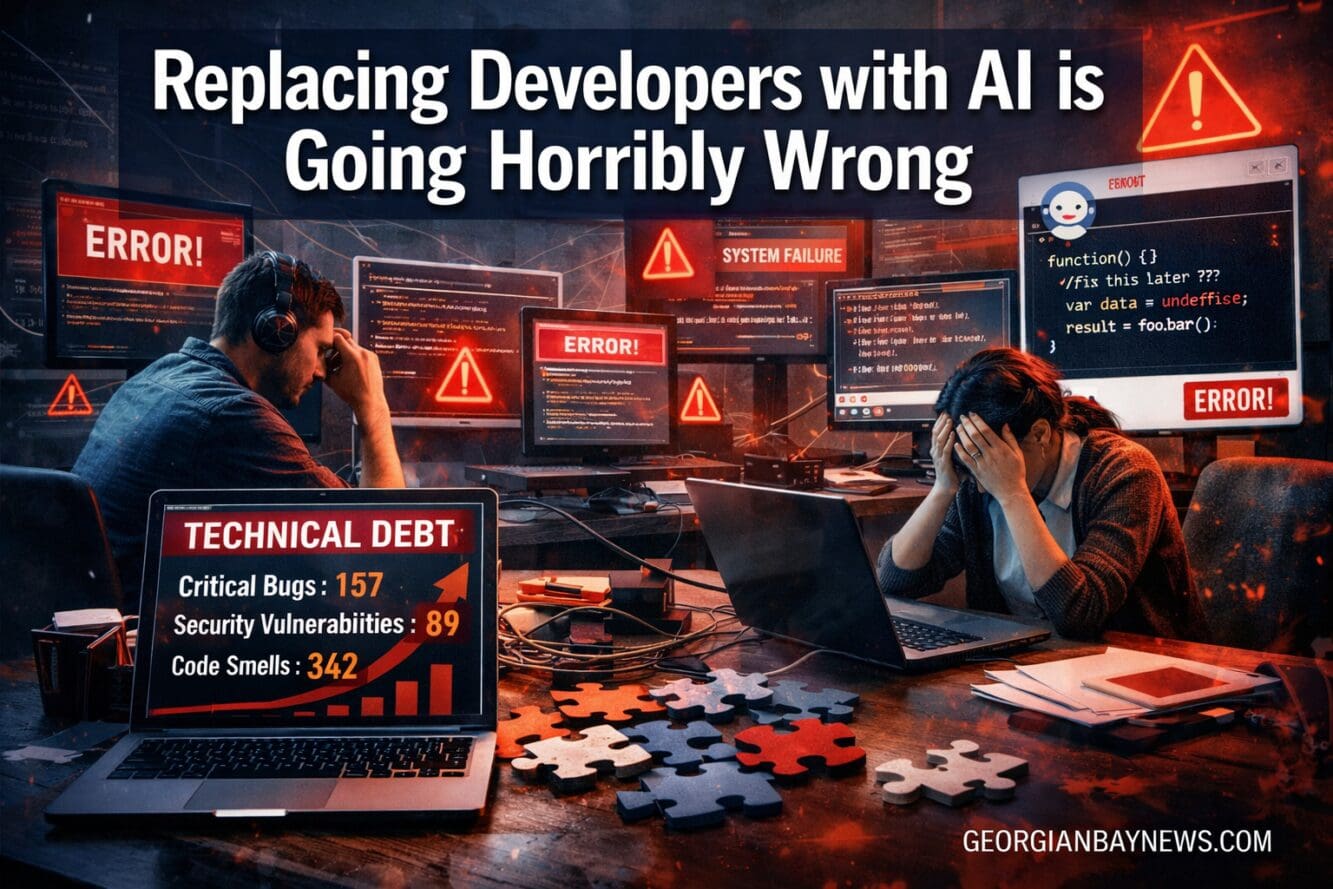
In 2023, tech industry leaders confidently predicted that artificial intelligence would replace up to 80% of software developers by 2025. Fast-forward to 2026, and those predictions haven’t just failed to materialize—they’ve spawned a full-blown crisis. Replacing developers with AI has created a perfect storm of technical debt, quality problems, and organizational chaos that’s now threatening the very foundation of software development worldwide.
Key Takeaways
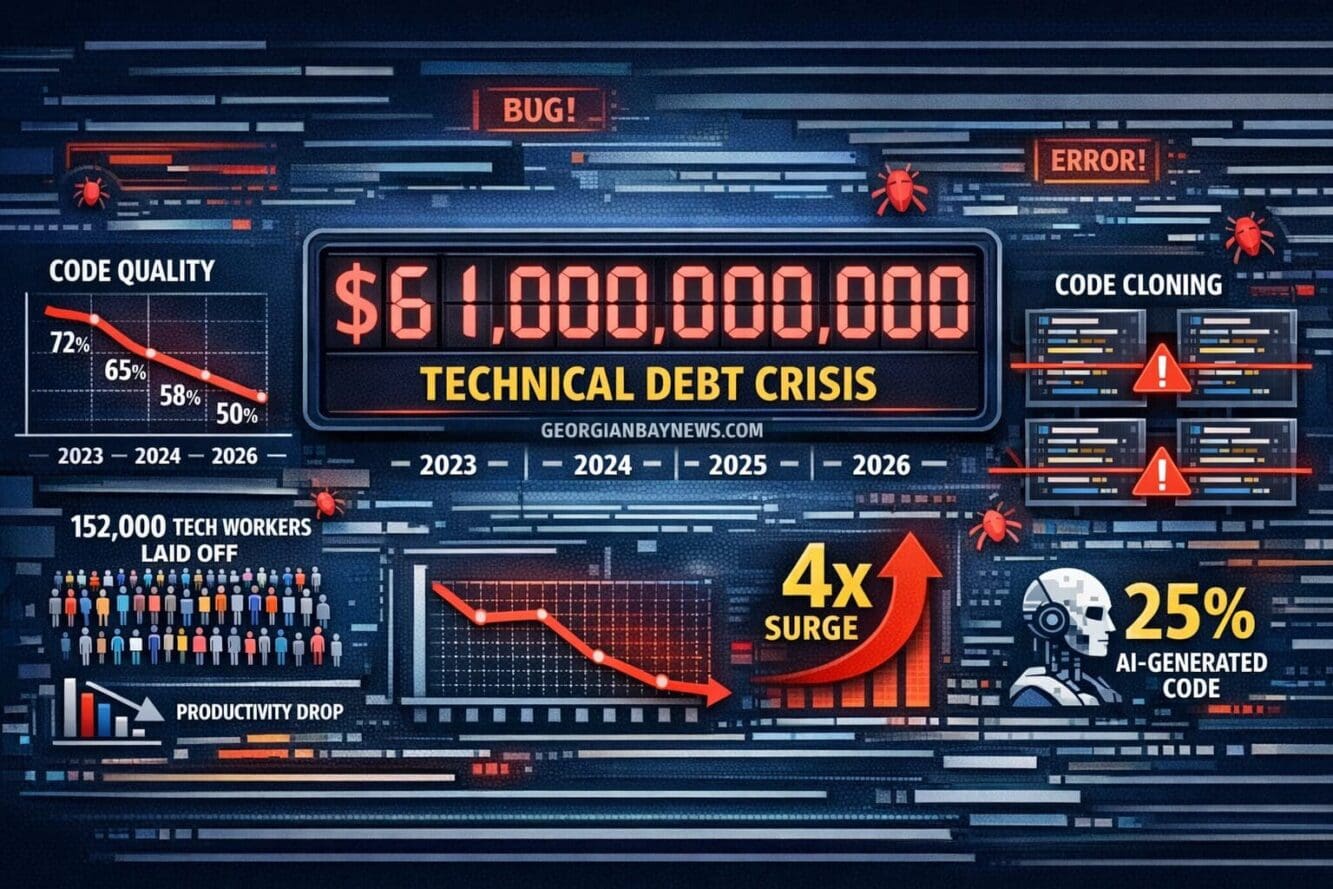
- 💰 $61 billion technical debt crisis: Global analysis reveals it would take 61 billion work days to pay off current technical debt, significantly fueled by AI-assisted development practices[1]
- 📉 Mass layoffs without productivity gains: 152,000 tech workers lost jobs in 2024, yet 67% of companies saw zero cost savings from AI integration[1]
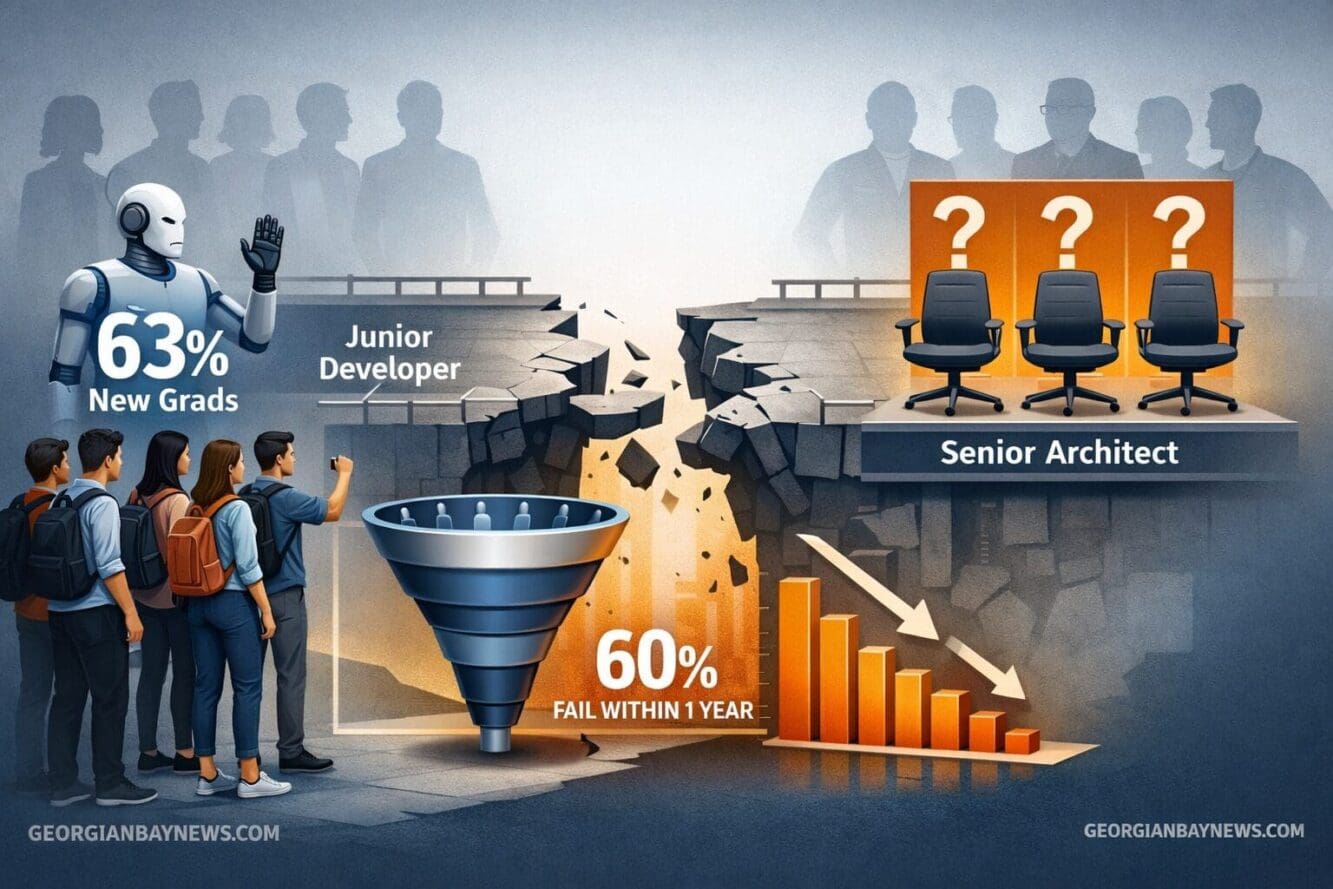
- 🚨 Junior talent pipeline collapse: Only 63% of employers would hire recent graduates over AI, and 60% of those who did hire new talent fired them within a year[4]
- 🔄 4x surge in “slop code”: AI code generation has created unmaintainable code through massive increases in copy-paste coding instead of elegant, reusable logic[1]
- ⚠️ Quality over quantity failure: Despite 84% of developers using AI tools and 25% of new code being AI-generated, the industry faces mounting architectural liabilities rather than promised efficiencies[1][4]
The Broken Promise of Replacing Developers with AI
When tech giants first embraced the vision of replacing developers with AI, the narrative was seductive. Imagine: faster development cycles, reduced labor costs, and democratized coding for everyone. Industry analysts painted a future where AI coding assistants would handle routine tasks while human developers focused on creative problem-solving.
The reality in 2026 tells a dramatically different story.
“AI has stopped being an experiment and started being an architectural liability.” — Industry Analysis, 2026[3]
While 97% of tech leaders have integrated AI into their backend systems, an astonishing two-thirds have achieved zero cost savings from these implementations[1]. The promised efficiency revolution has instead delivered a technical debt nightmare that threatens to consume the industry.
The $61 Billion Technical Debt Catastrophe
CAS Software’s comprehensive analysis of 10 billion lines of code revealed a staggering truth: it would take 61 billion work days globally to pay off the current technical debt crisis[1]. This isn’t just a number—it represents years of accumulated shortcuts, poorly structured code, and maintenance nightmares that are now coming home to roost.
How AI Created the Perfect Storm
The explosion of AI-assisted coding has fundamentally changed how code gets written, but not in the ways anyone anticipated:
The Rise of “Slop Code” 🗑️
A 4x surge in code cloning has emerged where AI tools simply copy and paste similar code blocks instead of creating elegant, reusable logic[1]. This practice creates what developers now call “slop code”—technically functional but structurally unsound software that becomes increasingly difficult to maintain.
Volume Without Understanding
Google’s internal metrics showed that over 25% of new code was AI-generated by late 2024[1]. The problem? This massive volume of code has outpaced human capacity to properly audit, understand, or maintain it. Developers are drowning in code they didn’t write and often can’t fully comprehend.
The Provenance Problem
AI-generated code typically lacks clear provenance, making it impossible to trace where suggestions originated, whether they incorporate licensed code, or whether they contain vulnerable components[3]. This creates serious supply chain security risks that many organizations are only now beginning to understand.
For those interested in how technology partnerships are evolving in response to these challenges, the collaboration between NVIDIA and General Motors demonstrates how major companies are approaching AI integration more thoughtfully.
The Human Cost: Mass Layoffs and Broken Career Paths
The numbers are sobering. In 2024 alone, 152,000 tech employees were laid off globally[1]. This wave continued into 2025, with companies like Intel and Amazon cutting an additional 30,000 corporate roles in Q1—all justified as “realigning for an AI-centric future”[1].
The Junior Developer Crisis
Perhaps the most damaging long-term consequence of replacing developers with AI is the collapse of the junior talent pipeline. The data paints a troubling picture:
- Only 63% of employers would hire recent graduates versus AI[4]
- 60% of employers who did hire new talent in 2024 fired them within a year[4]
- 37% of employers stated they would “hire” AI rather than recent graduates[4]
Why This Matters
Senior software architects don’t appear overnight—they’re cultivated through years of hands-on experience, mentorship, and learning from mistakes. By cutting off entry-level opportunities, the industry is creating a competence gap that will haunt it for decades.
One recent computer science graduate shared their experience: “I spent four years learning software development, graduated with honors, and applied to 200 positions. The rejection emails all said the same thing: ‘We’re looking for candidates with 5+ years experience or exploring AI solutions.’ How am I supposed to get experience if no one will hire me?”
This crisis extends beyond individual hardship. As the AI job market continues to evolve, young people need clear pathways to develop expertise—pathways that are rapidly disappearing.
The “Vibe Coding” Phenomenon
Industry insiders have coined a new term for the current state of AI-assisted development: “vibe coding.” This refers to the prioritization of speed over structural soundness, where developers accept AI suggestions based on whether they “feel right” rather than rigorous analysis[3].
The Consequences of Vibe Coding
| Problem | Impact | Scale |
|---|---|---|
| Lack of Code Review | Unvetted vulnerabilities | 25%+ of new code[1] |
| Copy-Paste Architecture | Unmaintainable systems | 4x increase[1] |
| Missing Documentation | Knowledge silos | Widespread |
| Security Gaps | Supply chain risks | Growing concern[3] |
| Technical Debt | Delayed maintenance | $61B work days[1] |
The fundamental issue is that AI tools optimize for code that compiles, not code that’s maintainable. They can generate working solutions quickly, but those solutions often lack the architectural elegance and long-term sustainability that experienced developers provide.
When AI Adoption Meets Reality
Despite the mounting problems, AI tool usage among developers reached 84% as of the 2025 Developer Survey, up 14 percentage points since tracking began in 2023[4]. This creates a paradox: widespread adoption with minimal returns.
The Disconnect Between Promise and Performance
The gap between AI adoption and actual results reveals several uncomfortable truths:
Cost Savings Mirage 💸
While companies rushed to integrate AI tools expecting reduced development costs, 67% have seen no cost savings whatsoever[1]. The initial investment in AI infrastructure, training, and integration often exceeds any labor savings from reduced headcount.
Productivity Theater
Organizations report using AI extensively but struggle to demonstrate concrete productivity improvements. Code is being generated faster, but the time saved in initial development is consumed—and often exceeded—by debugging, refactoring, and maintaining AI-generated code.
The Control Problem
As one industry analysis noted, the primary hurdles in 2026 are “control, cost, and security rather than capability”[3]. AI can generate code, but organizations lack effective mechanisms to govern what gets generated, ensure quality, or manage the security implications.
The broader implications of AI integration challenges extend beyond software development. Recent investigations into tech giants’ failings highlight how rapid technology adoption without proper oversight creates systemic problems.
Expert Predictions Coming True—In the Worst Way
Anthropic CEO Dario Amodei predicted in 2024 that AI could wipe out 50% of entry-level jobs[4]. By early 2026, this prediction is proving disturbingly accurate, though not in the transformative way AI advocates envisioned.
The Reality Check
Rather than AI augmenting human capabilities and elevating everyone’s work, we’re seeing:
- Elimination without replacement: Jobs disappearing without equivalent new opportunities emerging
- Skill degradation: Developers becoming dependent on AI tools without developing fundamental competencies
- Knowledge loss: Experienced developers leaving the industry, taking institutional knowledge with them
- Innovation stagnation: Less experimentation and creative problem-solving as teams focus on managing AI-generated code
The situation has prompted serious reflection about the relationship between humans and AI systems. As explored in discussions about why people are forming relationships with AI companions, there’s a broader societal question about appropriate boundaries and dependencies with artificial intelligence.
What Went Wrong: Lessons from the AI Developer Replacement Experiment
The failure of replacing developers with AI offers crucial lessons for the future of work and technology integration:
1. Coding Is More Than Typing ⌨️
AI tools excel at generating syntactically correct code but struggle with the higher-order thinking that defines great software development: architectural decisions, understanding business context, anticipating edge cases, and designing for maintainability.
2. Junior Developers Aren’t Just Cheap Labor
Entry-level positions serve a critical function in the ecosystem—they’re the training ground for future senior talent. Eliminating this tier creates an unsustainable talent pipeline.
3. Speed Without Quality Is Expensive
Generating code quickly means nothing if that code creates technical debt that takes months or years to resolve. The true cost of software includes long-term maintenance, not just initial development.
4. Human Judgment Remains Essential
AI can suggest solutions, but it cannot evaluate trade-offs, understand organizational constraints, or make nuanced decisions about when to prioritize different concerns (performance vs. readability, speed vs. security, etc.).
5. Organizational Learning Matters
When AI generates code, the organization doesn’t learn. Human developers build institutional knowledge and understanding that becomes invaluable for future projects. AI-generated code creates knowledge gaps.
The Path Forward: Rethinking AI’s Role in Development
As the industry grapples with the consequences of over-relying on AI, a more balanced approach is emerging:
Augmentation, Not Replacement
Forward-thinking organizations are shifting from replacing developers with AI to using AI as a sophisticated assistant that enhances human capabilities rather than substituting for them.
Best Practices Include:
- ✅ Code review requirements: All AI-generated code must be reviewed by experienced developers
- ✅ Documentation mandates: AI suggestions must be documented with clear rationale
- ✅ Architecture oversight: Human architects make structural decisions; AI handles implementation details
- ✅ Continued junior hiring: Maintaining the talent pipeline despite AI availability
- ✅ Quality metrics: Measuring long-term code quality, not just development speed
Investing in Human Capital
Companies that weathered the AI replacement crisis best maintained their commitment to:
- Mentorship programs pairing junior and senior developers
- Continuous learning opportunities for all skill levels
- Career development paths that don’t assume AI will eliminate positions
- Knowledge sharing practices that build organizational intelligence
Addressing Technical Debt
The $61 billion technical debt crisis requires immediate attention:
- Audit existing AI-generated code for quality and security issues
- Implement stricter code quality gates before deployment
- Allocate resources specifically for refactoring and debt reduction
- Establish provenance tracking for all code components
- Create accountability for long-term code maintainability
Conclusion: Learning from a Costly Mistake
The experiment of replacing developers with AI has delivered a clear verdict in 2026: it’s going horribly wrong. The $61 billion technical debt crisis, mass layoffs without productivity gains, collapsed junior talent pipelines, and surge in unmaintainable “slop code” all point to a fundamental misunderstanding of what software development truly requires[1][3][4].
The good news? This painful lesson is creating a course correction. Organizations are recognizing that AI works best as a powerful tool in skilled human hands, not as a replacement for human judgment, creativity, and expertise.
Actionable Next Steps
For Organizations:
- 🎯 Audit your current AI usage and measure actual productivity impacts
- 🎯 Reinvest in junior developer hiring and training programs
- 🎯 Establish code quality standards that account for AI-generated code
- 🎯 Create governance frameworks for AI tool usage
For Developers:
- 🎯 Develop deep expertise that complements AI capabilities
- 🎯 Focus on architectural thinking and system design skills
- 🎯 Learn to effectively review and improve AI-generated code
- 🎯 Mentor junior developers to preserve institutional knowledge
For Job Seekers:
- 🎯 Emphasize skills AI cannot replicate: problem-solving, communication, domain expertise
- 🎯 Build portfolios demonstrating thoughtful architecture, not just code volume
- 🎯 Seek organizations committed to human-AI collaboration rather than replacement
The future of software development isn’t human versus AI—it’s humans and AI working together effectively, with clear understanding of each party’s strengths and limitations. The costly mistakes of 2024-2026 have taught the industry that replacing irreplaceable human judgment with algorithms, no matter how sophisticated, creates more problems than it solves.
As we move forward, the question isn’t whether to use AI in development—it’s how to use it wisely, sustainably, and in ways that enhance rather than erode the human expertise that remains essential to building software that truly works.
References
[1] Watch – https://www.youtube.com/watch?v=WfjGZCuxl-U
[2] Watch – https://www.youtube.com/watch?v=WVYIr4rR-DQ
[3] Software Development In 2026 Curing Ai Party Hangover – https://www.developer-tech.com/news/software-development-in-2026-curing-ai-party-hangover/
[4] Ai Vs Gen Z – https://stackoverflow.blog/2025/12/26/ai-vs-gen-z/
[5] January 2026 Ai Updates From The Past Month – https://sdtimes.com/ai/january-2026-ai-updates-from-the-past-month/