





















Why Are People Afraid of AI? Understanding the Real Fears Behind the Technology
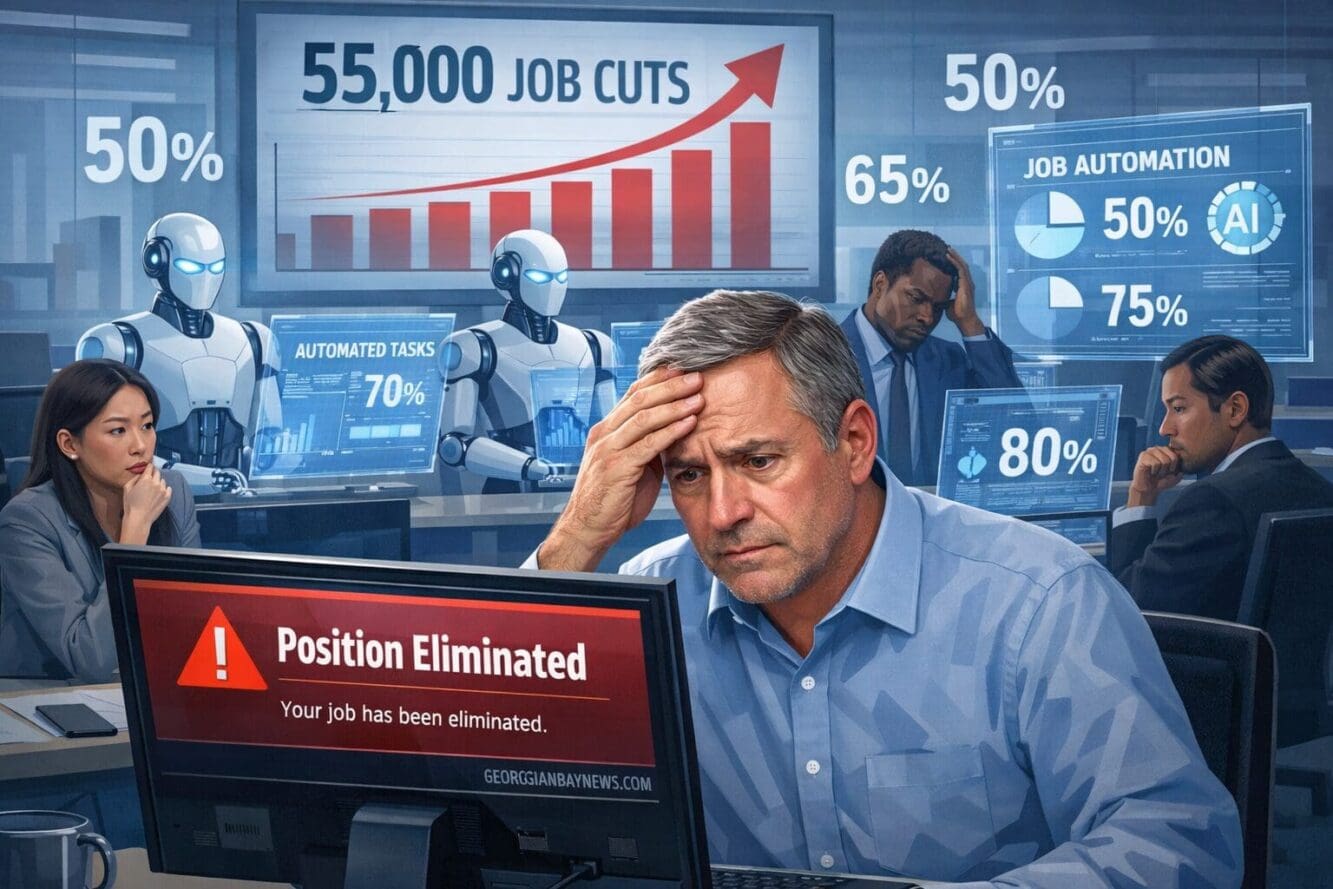
Imagine walking into your office on Monday morning to find an email explaining that your position—the one you’ve held for fifteen years—has been eliminated. Not because of budget cuts or company restructuring, but because an AI system can now do your job faster, cheaper, and without coffee breaks. This isn’t a dystopian movie plot. It’s the reality facing tens of thousands of workers in 2026.
The fear surrounding artificial intelligence has shifted from abstract concern to concrete anxiety.
As AI systems become more sophisticated and widespread, people across generations, professions, and continents are grappling with a fundamental question: What happens to us when machines can do what we do?
Key Takeaways
- Nearly 55,000 US workers lost jobs directly to AI in 2025, with major companies like Amazon, Workday, and Salesforce leading workforce reductions[2]
- 50-80% of Americans fear AI-driven job obsolescence by 2026, yet only 1-6% are actively adapting to the technology[1]
- AI confidence dropped 18% in 2025 even as usage increased 13%, revealing a critical gap between adoption and competence[2]
- 78-86% of employees now use unauthorized AI tools at work, indicating systemic trust failures in organizational AI strategies[2]
- Fear of Becoming Obsolete (FOBO) now dominates workplace anxiety more than immediate job loss concerns[2]
The Job Displacement Reality: From Theory to Lived Experience
For years, economists and tech experts debated whether AI would truly replace human workers or simply augment their capabilities. That debate is over. The data from 2025 has validated what many feared: AI-driven job displacement is real, measurable, and accelerating.
According to Challenger, Gray & Christmas, approximately 55,000 US job cuts were directly attributed to AI in 2025 alone[2]. These weren’t minor adjustments—they represented fundamental restructuring at some of the world’s largest companies:
- Workday reduced its workforce by 8.5%
- Amazon eliminated 14,000 corporate roles
- Salesforce cut 4,000 customer support positions
Sarah, a 42-year-old customer service manager from Seattle, experienced this firsthand. “I trained the AI system that replaced my team,” she recalls. “They told us it was to ‘enhance our capabilities.’ Six months later, twelve of us were gone, and the AI handled 90% of what we used to do.”
This pattern extends beyond customer service. Preparing for the AI job market has become essential for young people entering the workforce, as traditional entry-level positions disappear before careers even begin.
The Numbers Behind the Anxiety
| Impact Metric | 2025 Data | Source |
|---|---|---|
| AI-attributed job losses (US) | 55,000+ | Challenger, Gray & Christmas[2] |
| Americans fearing obsolescence | 50-80% | Reuters[1] |
| “AI mature” population actively adapting | 1-6% | Reuters[1] |
| Employees using unauthorized AI tools | 78-86% | Workforce surveys[2] |
The gap between fear and preparation is staggering. While half to four-fifths of Americans worry about AI-driven obsolescence, fewer than one in twenty are actively developing the skills to remain relevant[1].
The Confidence Paradox: Using AI While Fearing It
One of the most striking paradoxes of 2026 is that AI usage increased 13% in 2025 while confidence in using these tools dropped 18% over the same period[2]. This isn’t a contradiction—it’s a symptom of forced adoption without adequate support.
75% of employees report not feeling confident using AI in their day-to-day work, yet they’re increasingly required to do so[2]. This creates what researchers call “technostress”—the psychological strain of being expected to master tools you don’t understand while your job security depends on your performance.
Shadow AI: When Trust Breaks Down
Perhaps the most telling indicator of this confidence crisis is the rise of “Shadow AI.” Between 78-86% of employees now regularly use unapproved AI tools at work, with security professionals—the very people tasked with preventing such behavior—being the worst offenders at nearly 90%[2].
Why would employees bypass official channels? The answer reveals a fundamental organizational failure: official AI tools and training aren’t meeting their actual job demands. Workers are left to figure things out themselves, using whatever tools they can find, often without proper security protocols or institutional support.
This mirrors broader patterns where people are falling in love with AI companions in their personal lives while struggling to trust AI in professional contexts—a disconnect that highlights how personal agency versus forced adoption shapes our relationship with technology.
FOBO: Fear of Becoming Obsolete
The nature of AI-related anxiety has evolved. Workers are no longer primarily asking “Will I have a job next year?” Instead, they’re asking “Will I matter in five years?”
This shift from immediate job security to long-term relevance anxiety is what experts call FOBO: Fear of Becoming Obsolete[2]. According to Pew Research, 52% of workers fear their long-term workplace relevance rather than immediate job loss[2].
The Generational Divide
Age significantly impacts how people experience AI fear:
- Baby Boomers: Experienced a 35% decrease in AI confidence[2]
- Gen X: Dropped 25% in confidence[2]
- Millennials and Gen Z: Face anxiety about losing entry-level learning opportunities
For older workers, the fear is particularly acute. Decades of accumulated expertise can become irrelevant overnight, with no clear retraining path. As one 58-year-old accountant put it: “I spent thirty years mastering tax code. Now an AI can do in thirty seconds what took me thirty hours. What am I supposed to retrain as?”
Younger professionals face a different challenge: AI is eliminating the entry-level positions where they would traditionally learn their profession. How do you become an expert when the apprenticeship phase no longer exists?
The Deepfake Threat: When Reality Becomes Negotiable
Beyond job displacement, AI poses existential threats to truth itself. UC Berkeley AI experts identified that deepfakes will become routine, scalable, and cheap in 2026, fundamentally blurring the line between real and fake[3].
This isn’t about occasional viral hoaxes. We’re entering an era where:
- 🎥 Video evidence becomes unreliable in legal proceedings
- 📰 Journalism loses its verification foundation when any image or recording could be fabricated
- 🗳️ Democratic processes face manipulation through synthetic media campaigns
- 👤 Personal reputations can be destroyed by convincing fake content
The implications extend far beyond technology. When people can’t trust their own eyes and ears, social cohesion breaks down. The fear isn’t just about AI’s capabilities—it’s about living in a world where reality itself becomes negotiable.
The Workload Intensification Trap
AI was supposed to make work easier. Instead, for many employees, it’s made work more intense and demanding.
Here’s how the trap works: An AI tool saves an employee two hours on a weekly report. Rather than gaining two hours of relief, their manager assigns them three additional reports. The efficiency gains become justification for increased workload rather than improved work-life balance[2].
This pattern appears across industries:
✅ Expected outcome: AI handles routine tasks → workers focus on creative, strategic work
❌ Actual outcome: AI handles routine tasks → workers assigned more tasks → increased stress and burnout
The result? AI tools that were meant to reduce cognitive load instead create additional demands, contributing to widespread technostress and resentment toward the technology[2].
Organizational Failures: Treating Transformation as a Tech Project
A critical source of AI fear stems not from the technology itself, but from how organizations are implementing it. Companies are approaching AI transformation as technology projects rather than human restructuring initiatives[2].
This manifests in several ways:
🔴 Demanding adoption without adequate training
🔴 Treating efficiency gains as justification for workforce reduction
🔴 Providing no adaptation space or learning time
🔴 Measuring success by cost savings rather than human outcomes
Employees at organizations undergoing comprehensive AI-driven redesign showed 46% job security worry compared to 34% at less-advanced companies[2]. Proximity to actual AI deployment directly correlates with threat perception—and for good reason.
The Hype Versus Reality Gap
Not all AI fears are proportional to actual risks. While some predicted 90% workforce reductions, actual layoffs like TCS’s 12,000 employees represent roughly 2% of their workforce—significant, but far from apocalyptic[4].
Similarly, predictions of artificial general intelligence (AGI) by early 2025 proved premature. The technology is advancing rapidly, but we’re not facing the sci-fi scenario of sentient machines making humans obsolete overnight[4].
This gap between prediction and reality reveals hype inflation in AI discourse. The challenge is distinguishing legitimate concerns from exaggerated fears without dismissing real threats that are already materializing.
Finding the Path Forward: From Fear to Informed Action
Understanding why people fear AI is the first step toward addressing those fears constructively. The anxiety is rational—it’s based on real job losses, genuine skill obsolescence, and legitimate concerns about social stability.
Actionable Steps for Individuals
💡 Develop AI literacy: Understanding how AI works reduces fear and increases agency
💡 Focus on uniquely human skills: Creativity, emotional intelligence, complex problem-solving, and ethical judgment remain difficult to automate
💡 Embrace continuous learning: The half-life of skills is shrinking; adaptability matters more than any single expertise
💡 Build diverse skill sets: Cross-functional capabilities provide resilience when specific roles become automated
What Organizations Must Do
🏢 Invest in genuine reskilling programs, not token training sessions
🏢 Create transition pathways for displaced workers rather than simply eliminating positions
🏢 Measure success by human outcomes, not just efficiency metrics
🏢 Provide adaptation time when introducing new AI tools
🏢 Foster psychological safety so employees can express concerns without fear of being labeled “resistant to change”
Policy and Societal Responses
At a broader level, addressing AI fears requires systemic changes:
- 📋 Stronger worker protections and transition support
- 📋 Educational system reforms to prepare students for AI-augmented careers
- 📋 Regulatory frameworks for deepfakes and synthetic media
- 📋 Social safety nets redesigned for an era of technological displacement
The unprecedented challenges facing our youth require coordinated responses from educators, policymakers, and technology leaders.
Conclusion: Fear as a Catalyst for Necessary Change
The fear surrounding artificial intelligence in 2026 is neither irrational nor insurmountable. It reflects legitimate concerns about job security, skill obsolescence, social stability, and the erosion of truth in an age of deepfakes.
The 55,000 workers who lost jobs to AI in 2025 aren’t statistics—they’re people with mortgages, families, and identities built around careers that technology has rendered obsolete[2]. The 50-80% of Americans fearing AI-driven displacement aren’t technophobes—they’re rational actors observing clear trends[1].
But fear can be a catalyst. The same anxiety driving 78-86% of employees to adopt Shadow AI tools[2] demonstrates human adaptability and resourcefulness. The question isn’t whether we’ll adapt to AI—it’s whether we’ll do so in ways that preserve human dignity, expand opportunity, and strengthen rather than fracture our social fabric.
Your Next Steps
- Assess your AI literacy honestly—where are your knowledge gaps?
- Identify one AI tool relevant to your field and commit to mastering it this month
- Connect with others navigating similar transitions—shared learning reduces isolation
- Advocate for support systems in your workplace or community
- Stay informed about AI developments without succumbing to hype or panic
The future isn’t predetermined. The choices we make today—as individuals, organizations, and societies—will shape whether AI becomes a force for human flourishing or displacement. Understanding our fears is the essential first step toward ensuring the former.
References
[1] Watch – https://www.youtube.com/watch?v=VUWTJ1GU3pk
[2] Ai Fears 2026 – https://peoplemanagingpeople.com/workforce-management/ai-fears-2026/
[3] What Uc Berkeley Ai Experts Are Watching For In 2026 – https://news.berkeley.edu/2026/01/13/what-uc-berkeley-ai-experts-are-watching-for-in-2026/
[4] Is The Ai Bubble About To Burst Separating Hype From Reality In 2026 – https://codebasics.io/blog/is-the-ai-bubble-about-to-burst-separating-hype-from-reality-in-2026
Some content and illustrations on GEORGIANBAYNEWS.COM are created with the assistance of AI tools.
GEORGIANBAYNEWS.COM shares video content from YouTube creators under fair use principles. We respect creators’ intellectual property and include direct links to their original videos, channels, and social media platforms whenever we feature their content. This practice supports creators by driving traffic to their platforms.