






















Why is the Crypto Market Crashing Right Now? Understanding the 2026 Downturn 📉

Picture this: You wake up on a Saturday morning in late January 2026, grab your coffee, and check your crypto portfolio. Your heart sinks. Bitcoin has plummeted to $75,644—the lowest level since April 2025. If you’re among the millions who invested during the October 2025 peak, you’re now staring at losses exceeding 35%. The crypto market crashing isn’t just a headline—it’s a financial earthquake shaking portfolios worldwide.
The cryptocurrency landscape has transformed dramatically in recent months, leaving investors, tech enthusiasts, and financial analysts scrambling for answers. From Canadians watching their digital assets evaporate to American retirees who allocated retirement funds into Bitcoin, the current crash affects everyone from seasoned traders to curious newcomers. Understanding why this is happening requires looking beyond simple price movements to the fundamental identity crisis plaguing the entire crypto ecosystem.
Key Takeaways 🔑
- Bitcoin crashed 15% in a single day on January 29, 2026, falling from $96,000 to $80,000, with weekend lows touching $75,644[1]
- $800 million in liquidations swept through derivatives markets as forced selling accelerated the downturn[3]
- Bitcoin’s identity crisis has intensified—it’s behaving like a risk asset while being marketed as “digital gold,” creating unprecedented confusion[1]
- Institutional positions are underwater for the first time, with major holders like Strategy seeing their massive Bitcoin holdings fall below cost basis[3]
- Correlation with traditional markets reached all-time highs, with Bitcoin volatility tracking the VIX at 0.88—the strongest connection ever recorded[1]
What’s Happening with the Crypto Market Crashing in 2026?
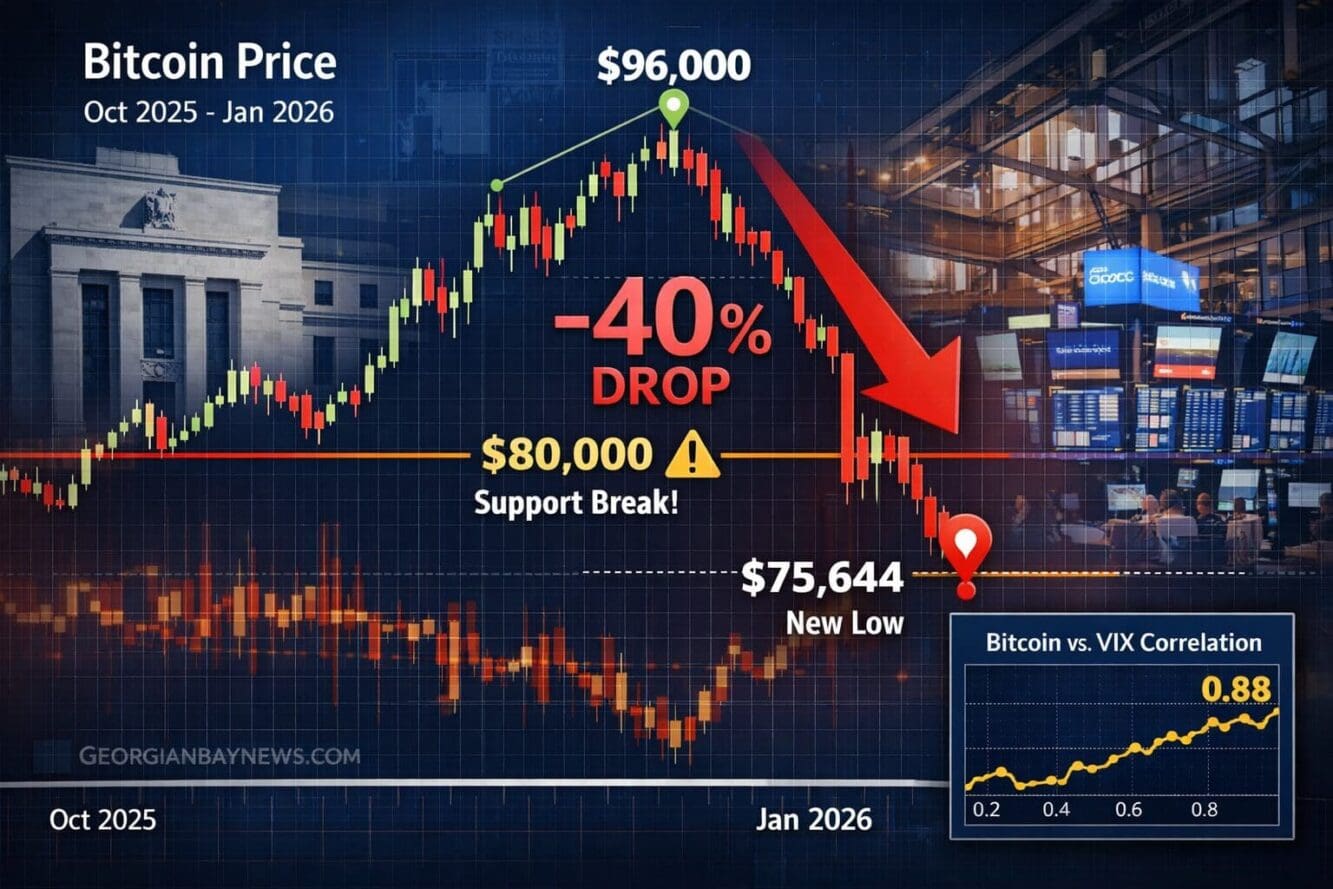
The numbers tell a sobering story. On January 29, 2026, Bitcoin experienced one of its most dramatic single-day collapses, plunging 15% from $96,000 to $80,000[1]. But that was just the beginning. By the following weekend, Bitcoin had crashed further to approximately $75,644, marking the lowest price point since April 2025[3].
This wasn’t an isolated incident affecting only Bitcoin. The entire cryptocurrency ecosystem felt the tremors:
- Ethereum dropped 12.30% in 24 hours
- Cardano fell 13.76%
- Bitcoin Cash declined 12.35%
- BNB slipped 9.20%[3]
Trading volumes exploded to $75 billion daily, a clear signal that panic selling and forced liquidations were driving the market[3]. When you see volume spike like that, it’s not organic selling—it’s margin calls, stop-losses triggering, and leveraged positions being forcibly closed.
The Weekend Liquidation Catastrophe
The weekend crash triggered a $800 million liquidation event across derivatives markets[3]. For those unfamiliar with crypto trading mechanics, liquidations occur when leveraged positions can’t maintain their margin requirements. Imagine borrowing money to buy more Bitcoin, betting the price will rise. When it falls instead, the exchange automatically sells your position to prevent further losses.
This creates a devastating cascade effect. As positions get liquidated, more selling pressure hits the market, pushing prices lower, which triggers more liquidations. It’s a vicious cycle that can wipe out months of gains in hours. Similar market dynamics have affected global markets as trade tensions escalate, creating uncertainty across all asset classes.
Why is the Crypto Market Crashing? The Identity Crisis Explained
Here’s where things get fascinating—and troubling. Bitcoin is experiencing what analysts call an identity crisis, and it’s tearing the market apart[1].
On January 29, something unprecedented happened. Bitcoin crashed despite two opposite market events occurring simultaneously:
- Equity markets crashed (which theoretically should support Bitcoin as a “safe haven” asset)
- The Federal Reserve signaled tighter monetary policy (which should hurt Bitcoin as a “risk asset”)
Bitcoin fell in both scenarios[1]. Think about that for a moment. If you’re a safe asset like gold, you should rise when stocks fall. If you’re a risk asset like tech stocks, you should fall when the Fed tightens. Bitcoin did the worst of both worlds—it fell regardless of the market conditions.
The Gold Comparison Falls Apart
The “digital gold” narrative has been a cornerstone of Bitcoin marketing for years. But 2026 data reveals this comparison is crumbling. The correlation between Bitcoin and gold turned negative at -0.27[1].
When gold rallied 3.5% on hawkish Fed news, Bitcoin crashed 15%[1]. The Bitcoin-to-gold ratio hit all-time lows of 16.68, completely contradicting Bitcoin’s positioning as a digital alternative to precious metals[1].
“Bitcoin’s correlation with gold has turned negative while its correlation with stock market volatility has reached all-time highs. It’s behaving exactly opposite to how a reserve asset should perform.”
Unprecedented Volatility Correlation
Perhaps the most damning evidence comes from volatility metrics. The correlation between Bitcoin volatility and the VIX stock volatility index reached 0.88 in January 2026—the highest reading ever recorded[1]. For context, this correlation was only 0.2 in 2020[1].
What does this mean in plain English? Bitcoin now moves in lockstep with stock market fear. When the stock market gets scared, Bitcoin gets terrified. This is the exact opposite behavior you’d expect from an independent store of value or hedge asset. Understanding how to be cautious with cryptocurrency services becomes even more critical during these volatile periods.
The Fundamental Disconnect: Usage vs. Price
Here’s a puzzle that should concern every crypto investor: Daily active Bitcoin addresses declined in January 2026 despite the price rally to $96,000[1]. Transaction volumes also fell even as institutional adoption supposedly accelerated[1].
Meanwhile, the Lightning Network grew 266% year-over-year[1]—a genuine sign of increasing utility and adoption. Yet the price still crashed.
This reveals an uncomfortable truth: price movements are driven by positioning and correlation rather than fundamentals[1]. The crypto market isn’t crashing because Bitcoin is failing as a technology. It’s crashing because traders and institutions are treating it as a highly leveraged bet on risk sentiment, not as a revolutionary payment system or store of value.
Real People, Real Losses
Consider Maria, a 62-year-old from Toronto who allocated 10% of her retirement savings into Bitcoin in October 2025 at $95,000. She’d heard about Bitcoin’s potential as an inflation hedge and digital gold. By late January 2026, her investment had lost over 35% of its value. She’s not alone—millions of retail investors, particularly seniors exploring cryptocurrency for the first time, have been caught in this downturn.
Or think about the tech workers in Silicon Valley who received Bitcoin bonuses in late 2025. Many held onto their coins, believing in the long-term vision. Now they’re underwater, watching their compensation evaporate in real-time. As young people prepare for the AI job market, understanding financial volatility in emerging technologies becomes crucial.
Institutional Stress: When the Big Players Hurt
The crypto market crashing has hit institutional investors particularly hard. Strategy, a publicly listed company holding the largest institutional Bitcoin position with over 700,000 BTC, saw its holdings fall below its average cost basis of $76,037 for the first time[3].
This represents a psychological and financial turning point. Strategy has been the poster child for corporate Bitcoin adoption, aggressively accumulating coins through debt financing and equity raises. Their stock price collapsed nearly 70% from its July 2025 high of $455 to $143[3].
When institutional investors who’ve been publicly bullish start showing losses, it creates a crisis of confidence that ripples through the entire market. Retail investors wonder: “If the professionals are losing money, what chance do I have?”
The Political and Economic Backdrop
The January 2026 crypto crash didn’t happen in a vacuum. The U.S. government experienced a partial shutdown due to missed congressional budget deadlines, creating broader market uncertainty[3]. Political instability tends to hurt risk assets first and hardest.
Additionally, global supply chain disruptions have continued, with tariffs crashing China’s supply chain and creating economic uncertainty worldwide. When the global economy faces headwinds, speculative assets like cryptocurrency typically suffer disproportionately.
Federal Reserve policy has also played a crucial role. Signals of tighter monetary policy mean higher interest rates, which make risk-free Treasury bonds more attractive relative to speculative, volatile assets like Bitcoin. Why take the risk of a 40% drawdown when you can earn 5% risk-free?
Support Levels and Technical Breakdown
For those who follow technical analysis, the crypto market crashing breached several critical support levels. Bitcoin lost the realized market value support level of $80,700 for the first time since October 2023[3].
The realized market value represents the aggregated cost basis for active BTC supply—essentially, the average price at which current Bitcoin holders acquired their coins. When price falls below this level, it means the average holder is now underwater. This psychological threshold often triggers additional selling as investors capitulate.
Key support zones analysts are watching include:
- Mid-$70,000 range (current testing ground)
- $74,500 (April 2025 low)[3]
- $65,000-$68,000 (major accumulation zone from early 2025)
Breaking below $74,500 would open the door to significantly lower prices and potentially shake out even more leveraged positions.
What Happens Next? Four Possible Paths Forward

Analysts project that Bitcoin will gradually shift from risk asset to reserve asset during 2026, with price consolidating between $80,000 and $110,000 until one identity becomes dominant[1].
The four potential paths forward include:
- Full Risk Asset Embrace: Bitcoin continues trading with high correlation to tech stocks and equity volatility, appealing primarily to speculators
- Digital Gold Emergence: Bitcoin decouples from traditional markets and establishes negative correlation with stocks, fulfilling the store-of-value narrative
- Reserve Asset Transition: Central banks and sovereign wealth funds begin meaningful accumulation, establishing Bitcoin as a legitimate reserve holding
- Payment Network Focus: Lightning Network adoption accelerates, with price driven by actual usage rather than speculation
Each path has different implications for price, volatility, and investor positioning. The current crypto market crashing may actually be the painful transition period between identities.
Protecting Yourself During the Crypto Market Crash
For investors navigating this turbulent period, several strategies can help manage risk:
🛡️ Risk Management Essentials:
- Never invest more than you can afford to lose completely
- Avoid leverage and margin trading during high volatility periods
- Dollar-cost average rather than trying to time the bottom
- Maintain emergency funds in stable, liquid assets
- Diversify across asset classes, not just within crypto
📊 Portfolio Positioning:
- Consider reducing exposure to altcoins, which typically fall harder than Bitcoin
- If holding long-term, focus on projects with genuine utility and adoption
- Set stop-losses if you can’t emotionally handle further drawdowns
- Review your original investment thesis—has it changed?
🧠 Emotional Discipline:
- Avoid checking prices constantly—it increases stress without adding value
- Don’t make decisions based on fear or FOMO
- Remember that volatility works both directions
- Consider tax-loss harvesting opportunities if you’re already in losses
The real estate market has shown that even traditional assets experience cycles of boom and bust. Crypto’s cycles are simply more compressed and extreme.
Learning from History: Previous Crypto Crashes
This isn’t cryptocurrency’s first rodeo with dramatic crashes. Bitcoin has experienced multiple 70%+ drawdowns throughout its history:
- 2011: 93% crash from $32 to $2
- 2013-2015: 87% crash from $1,150 to $150
- 2017-2018: 84% crash from $20,000 to $3,200
- 2021-2022: 77% crash from $69,000 to $15,500
Each time, Bitcoin eventually recovered and reached new all-time highs. However, past performance doesn’t guarantee future results, especially as Bitcoin’s market structure and participant base have evolved significantly.
The current 40% decline is painful but not unprecedented by historical crypto standards. What’s different this time is the level of institutional involvement and the identity confusion plaguing the asset class.
The Global Perspective: Impact on Different Communities
The crypto market crashing affects different communities in unique ways:
🇨🇦 Canadians: With a tech-savvy population and high crypto adoption rates, many Canadians have significant exposure. The crash comes at a challenging time as leadership transitions create political uncertainty.
🇺🇸 Americans: The largest crypto market globally, with millions of retail investors and most major exchanges based in the U.S. Political gridlock and regulatory uncertainty compound the market stress.
👴 Seniors: Many older investors who entered crypto seeking inflation protection or retirement income are experiencing their first major crypto winter, often without the risk tolerance for such volatility.
🌍 Developing Nations: Countries experiencing currency instability often see Bitcoin as a hedge against local inflation. The crash creates a dilemma—stick with volatile crypto or return to depreciating local currencies?
💼 Tech Communities: Early adopters and tech workers who’ve been in crypto for years are more accustomed to volatility but still feel the pain of seeing portfolios decline significantly.
Conclusion: Navigating Uncertainty with Clear Eyes
The crypto market crashing in 2026 represents more than just a price correction—it’s a fundamental reckoning with what cryptocurrency actually is and what role it plays in the global financial system. Bitcoin’s identity crisis between risk asset and reserve asset has created unprecedented volatility and confusion.
For investors, the path forward requires clear-eyed assessment of both the risks and opportunities. The $800 million in liquidations, the breach of critical support levels, and the correlation with traditional market volatility all signal genuine stress in the system[3]. Yet the underlying technology continues developing, with Lightning Network adoption growing 266% year-over-year[1].
Actionable Next Steps:
- Reassess your risk tolerance honestly—can you handle another 30-40% decline?
- Review your portfolio allocation—is your crypto exposure appropriate for your financial situation?
- Stay informed about regulatory developments and institutional adoption trends
- Consider your time horizon—are you investing for 6 months or 6 years?
- Avoid emotional decisions—create a plan and stick to it regardless of short-term volatility
- Educate yourself continuously about blockchain technology and market dynamics
- Maintain perspective—crypto remains a speculative, emerging asset class
The consolidation period between $80,000 and $110,000 predicted by analysts may last throughout 2026[1]. This could provide opportunities for patient, disciplined investors while shaking out overleveraged speculators.
Whether Bitcoin emerges as digital gold, remains a risk asset, transitions to a reserve asset, or focuses on payments will determine its trajectory for the next decade. The current pain may be the price of that transformation.
Remember: in volatile markets, survival is success. Those who manage risk appropriately and maintain emotional discipline will be positioned to capitalize when clarity eventually emerges. The crypto market may be crashing right now, but understanding why helps navigate the uncertainty with confidence rather than fear.
References
[1] Bitcoins Identity Crisis In 2026 4 Paths Forward And The Road To 150000 200674299 – https://www.investing.com/analysis/bitcoins-identity-crisis-in-2026-4-paths-forward-and-the-road-to-150000-200674299
[2] m.techflowpost – https://m.techflowpost.com/en-US/article/30251
[3] Bitcoin Crashes To 77000 Altcoins Plunge By Double Digits In Many Cases – https://www.trendingtopics.eu/bitcoin-crashes-to-77000-altcoins-plunge-by-double-digits-in-many-cases/
[4] Watch – https://www.youtube.com/watch?v=edJFS6vK1LQ
Some content and illustrations on GEORGIANBAYNEWS.COM are created with the assistance of AI tools.
GEORGIANBAYNEWS.COM shares video content from YouTube creators under fair use principles. We respect creators’ intellectual property and include direct links to their original videos, channels, and social media platforms whenever we feature their content. This practice supports creators by driving traffic to their platforms.