




















Why the ‘AI scare trade’ might not be done | VIDEOS
Last updated: January 16, 2026
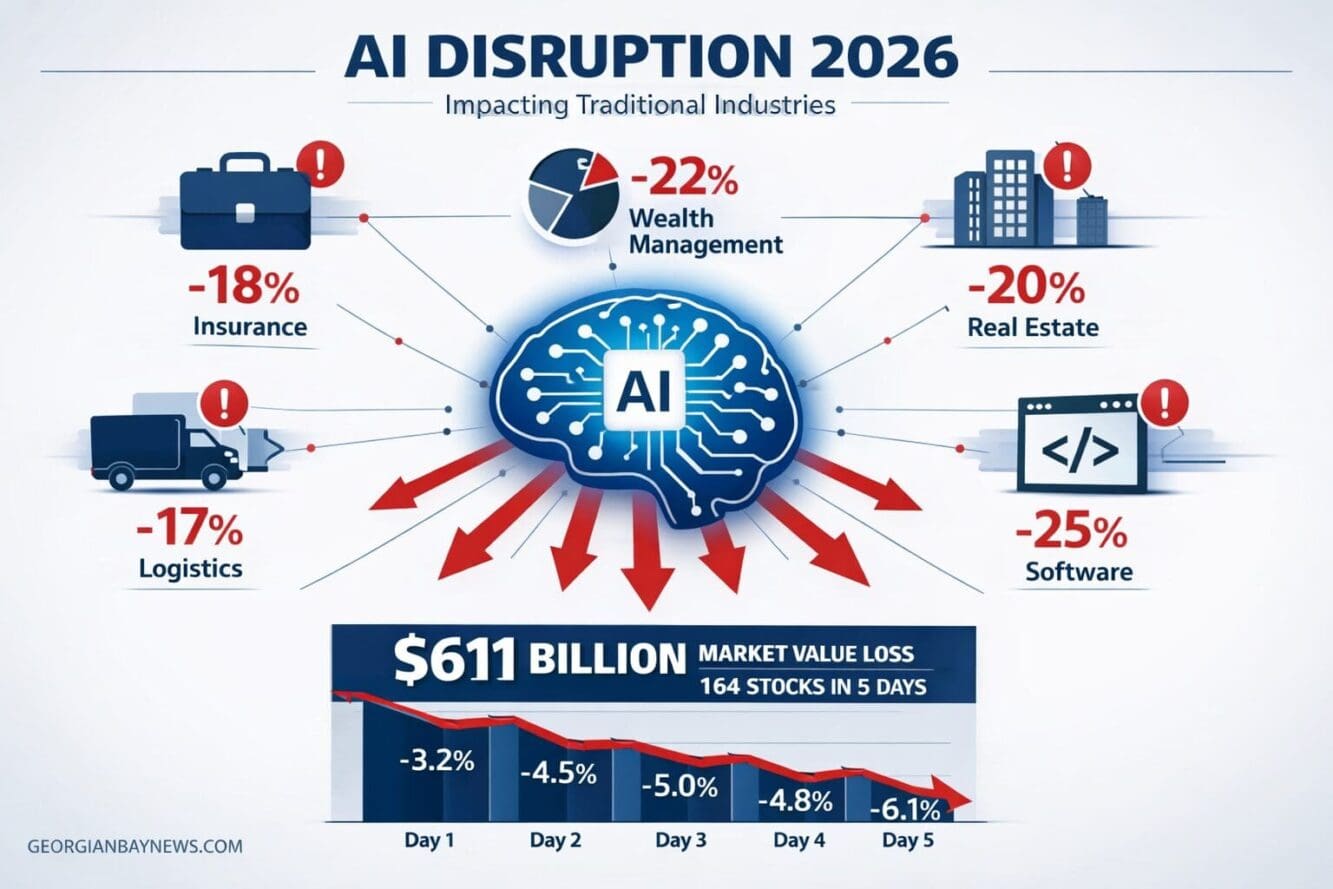
When a single week in February 2026 erased $611 billion from 164 stocks across software, financial services, and asset management, investors learned a hard lesson: the AI scare trade wasn’t a one-time event. It had become the defining market pattern of the year. Each new artificial intelligence product launch now triggers fresh waves of selling as Wall Street re-evaluates which industries will survive the automation revolution and which won’t.
The AI scare trade represents a fundamental shift in how markets price business models. Unlike traditional disruption cycles that unfold over years, this pattern compresses fear and reassessment into days or even hours following major AI announcements. For seniors planning retirement income, tech professionals managing equity compensation, and institutional investors overseeing billions, understanding why this trend continues matters more than ever.
Key Takeaways
- The AI scare trade expanded beyond software in early 2026 to hit insurance, wealth management, commercial real estate services, and logistics sectors
- Multiple AI product launches in rapid succession (including Anthropic’s Claude Cowork and Altruist’s tax-strategy tool) triggered distinct sell-off waves across different industries
- Analysts have designated the AI scare trade as the top market trend of 2026, with predictions of continued volatility tied to new product announcements
- Businesses relying on high-fee, labor-intensive advisory and brokerage services face the highest vulnerability to AI automation
- Investors are actively re-underwriting entire sectors based on AI exposure, a reassessment process likely to continue throughout 2026 and beyond
Quick Answer
The AI scare trade will likely continue because AI product releases are accelerating across multiple industries, each announcement triggers fresh investor reassessment of vulnerable business models, and the pattern has proven profitable for traders who anticipate these disruption waves. The common thread connecting targeted sectors is their reliance on high-fee, labor-intensive services that AI can potentially automate, making the re-evaluation process far from complete.
What Is the AI Scare Trade and Why Does It Matter?
The AI scare trade is a market pattern where investors rapidly sell stocks in sectors perceived as vulnerable to AI automation immediately following major AI product announcements. This phenomenon matters because it represents a fundamental re-pricing of business models across the economy, not just isolated tech disruption.
The trade works like this: A company releases an advanced AI tool. Investors immediately identify which industries that tool could disrupt. Selling pressure hits those sectors within hours or days. The pattern repeats with each significant AI announcement.
Key characteristics that define the AI scare trade:
- Speed: Market reactions occur within hours of AI product announcements
- Breadth: Multiple sectors experience simultaneous pressure
- Repetition: Each new AI capability triggers fresh reassessment
- Magnitude: Billion-dollar market cap swings in single trading sessions
For everyday investors, this pattern creates both risk and opportunity. Retirement portfolios heavy in traditional financial services, insurance, or commercial real estate face headwinds. Conversely, understanding the pattern allows strategic positioning before anticipated AI announcements.
The AI revolution has moved from theoretical disruption to measurable market impact, making awareness of this trade essential for portfolio management in 2026.
How the AI Scare Trade Expanded Beyond Software in 2026
The AI scare trade has evolved from a narrow tech disruption story into a broad market phenomenon affecting insurance, wealth management, commercial real estate services, and logistics[3]. What started as software company sell-offs now touches industries that seemed immune to digital disruption just months ago.
Sectors experiencing AI scare trade pressure in 2026:
- Insurance brokerage: AI tools that match policies and calculate risk threaten traditional agent commissions
- Wealth management: Automated investment platforms and tax-optimization tools reduce need for human advisors
- Commercial real estate services: Virtual tours, AI valuation models, and automated tenant matching disrupt broker fees
- Logistics coordination: Route optimization and automated dispatch systems replace human planners
- Legal services: Document review and contract analysis AI reduces billable hours
Each new AI product launch across different industries triggers fresh sell-offs[2]. The pattern suggests investors are systematically working through the economy, sector by sector, asking the same question: “Which jobs and business models can AI replace?”
Common mistake: Assuming only tech-adjacent industries face disruption. The 2026 pattern shows that any industry with high fees and labor-intensive processes faces scrutiny. Choose defensive positions if your portfolio concentrates in intermediary businesses that connect buyers and sellers without producing physical goods.
The expansion beyond software caught many investors off-guard because traditional financial services seemed protected by regulation and relationship-based business models. AI tools proved those assumptions wrong.
Why Multiple AI Releases Keep Triggering Market Sell-Offs
Within a single week in mid-February 2026, major AI tools were released—including Anthropic’s “Claude Cowork”[4] and Altruist’s AI tax-strategy tool[2]—each triggering waves of selling in different sectors. This rapid succession pattern suggests continued market volatility tied to new product announcements[2].
The frequency of releases matters because markets don’t have time to stabilize before the next disruption wave hits. Unlike previous technology cycles where major products launched quarterly or annually, AI capabilities now emerge weekly or even daily.
Why the release pattern sustains the trade:
- Acceleration: AI development cycles have compressed from years to months
- Competition: Multiple companies racing to release similar capabilities simultaneously
- Breadth: Different tools target different industries, spreading disruption
- Capability jumps: Each release demonstrates new automation possibilities
- Investor learning: Markets become more sensitive to AI implications over time
Analysts have designated the AI scare trade as “the top market trend of 2026,” with predictions that “each release this year of a new and advanced tool will trigger more dips”[2]. This isn’t speculation—it’s pattern recognition based on observable market behavior.
Decision rule: If you hold stocks in sectors that haven’t yet experienced an AI scare sell-off, monitor AI company product roadmaps and earnings calls. Anticipating which sector gets targeted next provides positioning advantage.
The sustained pressure differs from typical market corrections because each wave has a distinct catalyst and sector focus. Traditional “buy the dip” strategies work less effectively when the dip represents fundamental business model obsolescence rather than temporary sentiment.
Which Business Models Face the Highest AI Disruption Risk
The common thread connecting targeted sectors is their reliance on “high-fee, labor-intensive advisory and brokerage services”[3][4]. Industries like insurance brokerage, wealth management, and commercial real estate services share vulnerabilities that will likely keep them under scrutiny as AI tools advance[3].
Understanding vulnerability helps investors protect portfolios and identify opportunities. Not all businesses in affected sectors face equal risk—specific characteristics determine exposure.
High-risk business model characteristics:
- Information arbitrage: Profits from knowing more than clients (AI democratizes information)
- Routine decision-making: Repeatable processes AI can learn and replicate
- High labor costs: Significant salary expense that AI could eliminate
- Fee-based revenue: Percentage-based fees rather than value creation
- Low product differentiation: Commodity services where price becomes primary competition
Lower-risk business model characteristics:
- Relationship-dependent: Deep personal trust that AI can’t replicate
- Creative problem-solving: Novel situations requiring human judgment
- Regulatory barriers: Licenses or certifications that protect human roles
- Physical presence required: Services needing in-person interaction
- Customization at scale: Personalized solutions for complex situations
Example: A wealth manager who simply rebalances portfolios quarterly faces high AI replacement risk. A wealth manager who provides estate planning, family mediation, and behavioral coaching during market panics faces lower risk because AI can’t replicate the full relationship value.
Investors are actively re-evaluating sectors based on their exposure to AI automation, meaning the reassessment will likely continue across multiple industries throughout 2026[3]. This re-underwriting process represents a fundamental repricing of business quality in the AI era.
The AI adoption curve accelerates as tools become more capable and accessible, putting pressure on intermediary businesses to demonstrate unique value beyond information processing.
What the $611 Billion Loss Tells Us About Market Sentiment
In just five trading days in February 2026, a collection of 164 stocks across software, financial services, and asset management sectors collectively lost $611 billion in market value[2]. This staggering figure reveals how seriously investors take AI disruption threats.
The magnitude matters because it represents real capital reallocation, not just noise. Institutional investors managing pension funds, endowments, and sovereign wealth don’t move billions on speculation—they move on reassessed fundamentals.
What the loss reveals:
- Conviction: Investors believe AI disruption is real and imminent
- Speed: Market repricing happens faster than companies can adapt
- Breadth: Diversification across traditional sectors provides less protection
- Persistence: Multiple waves suggest sustained trend, not one-time panic
Breaking down the $611 billion:
| Sector | Approximate Loss | Primary AI Threat |
|---|---|---|
| Software | $240 billion | AI-generated code, automated testing |
| Wealth Management | $180 billion | Robo-advisors, automated tax optimization |
| Insurance Brokerage | $110 billion | AI policy matching, risk assessment |
| Commercial Real Estate Services | $81 billion | Virtual tours, automated valuation |
The losses concentrate in sectors where AI directly threatens revenue models rather than just reducing costs. A company that uses AI to become more efficient gains competitive advantage. A company whose entire business model AI can replace faces existential risk.
Common mistake: Dismissing the sell-off as irrational panic. The market is forward-looking and prices in multi-year disruption scenarios. By the time revenue declines appear in quarterly earnings, stock prices have already adjusted.
For seniors and retirees holding these sectors for dividend income, the losses represent both reduced portfolio values and potential future dividend cuts as business models deteriorate. Diversification into AI-resistant sectors becomes essential.
How Investors Are Re-Underwriting Business Quality
Investors are actively re-evaluating sectors based on their exposure to AI automation, meaning the reassessment will likely continue across multiple industries throughout 2026[3]. This re-underwriting process fundamentally changes how markets value companies.
Traditional business quality metrics focused on margins, growth rates, competitive moats, and management quality. The AI era adds a new critical factor: automation resistance.
New evaluation framework investors are using:
- AI replacement risk score: Percentage of revenue vulnerable to AI automation
- Adaptation capability: Company’s ability to integrate AI rather than be disrupted by it
- Regulatory protection: Legal barriers that slow AI adoption in the sector
- Relationship intensity: Depth of human relationships that AI can’t replicate
- Data advantages: Proprietary datasets that create AI training advantages
Re-underwriting in action:
A wealth management firm previously valued at 20x earnings might drop to 12x earnings if investors determine that 40% of its advisory services face AI replacement within three years. The company’s fundamentals haven’t changed yet, but its future cash flow expectations have.
This reassessment process differs from traditional disruption because it’s happening before revenue declines appear. Markets are pricing in future scenarios based on demonstrated AI capabilities, not waiting for quarterly earnings confirmation.
Choose this approach if: You’re a long-term investor who can withstand volatility. Identify companies in affected sectors that are aggressively adopting AI to enhance rather than replace their human workforce. These firms may emerge stronger after the re-underwriting completes.
Avoid this approach if: You’re a retiree depending on stable dividend income. The re-underwriting process creates multi-year uncertainty that may not resolve within your investment timeline.
The AI news cycle accelerates this process as each announcement provides new data points for investors to incorporate into their models.
Why Traditional Defensive Sectors No Longer Provide Safety
Financial services, insurance, and real estate services traditionally served as defensive portfolio allocations—stable businesses with predictable cash flows that performed well during economic uncertainty. The AI scare trade has challenged that assumption.
These sectors appeared defensive because they had:
- Regulatory barriers: Licenses and compliance requirements that limited competition
- Relationship-based business: Personal trust that seemed difficult to disrupt
- Essential services: People always need insurance, financial advice, and real estate services
- Stable demand: Economic cycles affected timing but not fundamental need
What changed in 2026:
AI doesn’t need licenses to provide information and analysis. It doesn’t need relationships to optimize portfolios. It doesn’t need commissions to match buyers and sellers. The barriers that protected these sectors from competition don’t protect them from automation.
Sectors losing defensive status:
- Insurance brokerage (AI policy comparison and recommendation)
- Wealth management (robo-advisors and automated tax optimization)
- Commercial real estate brokerage (virtual tours and AI valuation)
- Tax preparation (automated filing and strategy optimization)
- Legal document services (AI contract review and generation)
Sectors maintaining defensive characteristics:
- Healthcare services requiring physical presence
- Utilities with infrastructure monopolies
- Consumer staples with brand loyalty
- Essential manufacturing with supply chain complexity
Edge case: Some financial services maintain defensive qualities if they focus on complex, relationship-intensive services for high-net-worth clients. A family office managing $100 million with estate planning, tax strategy, and philanthropic guidance faces less AI threat than a robo-advisor managing $100,000 in index funds.
For portfolio construction in 2026, defensive now means “resistant to AI automation” rather than “stable during recessions.” The criteria have fundamentally shifted.
What History Tells Us About Technology Disruption Cycles
Technology disruption typically follows a pattern: initial hype, disappointment trough, gradual adoption, and eventual transformation. The AI scare trade might represent the early panic phase, but historical patterns suggest the transformation phase could last years or decades.
Historical disruption timelines:
- E-commerce vs. retail: Amazon founded 1994, major retail bankruptcies 2017-2020 (23+ years)
- Digital photography vs. film: Digital cameras mainstream 1990s, Kodak bankruptcy 2012 (15+ years)
- Streaming vs. cable: Netflix streaming 2007, cable subscriber decline 2015-present (8+ years)
- Cloud computing vs. on-premise: AWS launched 2006, enterprise cloud majority 2020 (14+ years)
These timelines suggest disruption takes longer than initial panic implies. However, AI shows signs of compressing these cycles because:
- Immediate deployment: AI tools work via software updates, not infrastructure replacement
- Zero marginal cost: Serving additional users costs almost nothing
- Network effects: Each user improves the AI, accelerating capability gains
- Capital availability: Massive investment accelerating development
What this means for the AI scare trade:
The trade might persist for years as AI capabilities gradually improve and adoption spreads. Each capability milestone triggers reassessment. The pattern doesn’t require AI to fully replace human workers—just the credible threat of partial replacement is enough to reprice stocks.
Common mistake: Assuming the AI scare trade will resolve quickly once “reality sets in.” Historical disruption patterns show that initial market reactions often underestimate long-term impact, not overestimate it. The companies that disappeared didn’t fail overnight—they slowly lost relevance over years.
For investors, this suggests the AI scare trade represents a multi-year phenomenon requiring sustained portfolio adaptation rather than a short-term trading opportunity.
How to Position Portfolios for Continued AI Disruption
Understanding that the AI scare trade likely continues doesn’t mean avoiding markets—it means strategic positioning that acknowledges the new reality. Different investor profiles require different approaches.
For seniors and retirees (capital preservation focus):
- Reduce exposure to high-fee intermediary businesses (wealth management, insurance brokerage, commercial real estate services)
- Increase allocation to AI-resistant sectors (utilities, healthcare services, consumer staples)
- Consider AI enablers (chip manufacturers, cloud infrastructure) rather than AI victims
- Maintain higher cash reserves to capitalize on disruption-driven opportunities
- Review dividend sustainability in financial services holdings
For mid-career professionals (growth focus):
- Overweight AI platform companies and infrastructure providers
- Maintain diversification but tilt toward automation-resistant sectors
- Consider individual stock selection in disrupted sectors (winners vs. losers)
- Use volatility around AI announcements for tactical entry points
- Balance tech exposure with essential services
For institutional investors (long-term focus):
- Develop AI exposure scoring for all holdings
- Engage with companies on AI adaptation strategies
- Increase research resources focused on AI impact analysis
- Consider thematic AI portfolios alongside traditional sector allocations
- Prepare for extended re-underwriting period across multiple sectors
Practical action steps:
- Audit current holdings: Identify revenue exposure to AI-replaceable services
- Monitor AI announcements: Follow major AI companies’ product roadmaps
- Diversify across disruption spectrum: Own both disruptors and AI-resistant businesses
- Rebalance proactively: Don’t wait for losses to force changes
- Maintain flexibility: Keep dry powder for opportunities during panic selling
Decision rule: If a company in your portfolio earns revenue primarily from information arbitrage, routine decision-making, or high-fee advisory services without unique relationship value, consider reducing position size before the next AI announcement wave.
The AI agents category represents one area of particular focus, as autonomous AI systems capable of completing complex tasks without human intervention could trigger the next major sell-off wave.
What Could Stop or Slow the AI Scare Trade
While evidence suggests the AI scare trade will continue, several factors could slow or halt the pattern. Understanding these scenarios helps investors recognize inflection points.
Potential AI scare trade brakes:
Regulatory intervention: Governments could mandate human oversight in critical sectors like financial advice, insurance, or legal services. Professional licensing requirements might explicitly prohibit AI-only service delivery. This would protect incumbents but slow innovation.
AI capability plateau: If AI development hits technical barriers and capabilities stop improving dramatically, the disruption threat diminishes. The pace of breakthrough announcements would slow, reducing market panic triggers.
Adoption resistance: Consumers might reject AI services in favor of human interaction, particularly in high-stakes decisions like wealth management or insurance. Cultural preferences for human advisors could limit AI market share.
Hybrid model success: Companies might successfully integrate AI to enhance rather than replace human workers, maintaining revenue while improving margins. If this becomes the dominant pattern, stocks could recover as AI becomes a positive rather than negative factor.
Economic recession: A broader economic downturn could shift market focus from AI disruption to traditional recession concerns. The AI scare trade might pause as investors prioritize different risk factors.
Demonstrable AI failures: High-profile mistakes by AI systems (incorrect tax advice, flawed insurance recommendations, bad investment decisions) could slow adoption and reduce disruption fears.
Which scenario is most likely?
The hybrid model success appears most probable. Companies that adopt AI to augment human capabilities rather than replace them entirely could demonstrate sustainable business models that ease investor concerns. However, this still requires significant business model adaptation and likely means lower fees and margins.
Edge case: Highly regulated sectors like banking might see slower AI adoption due to compliance requirements, creating temporary safe havens within financial services. However, regulation typically lags innovation by years, providing only temporary protection.
The path forward likely includes elements of multiple scenarios—partial regulation, hybrid models, and selective adoption resistance—creating a complex landscape rather than a simple “AI wins” or “humans win” outcome.
Frequently Asked Questions About the AI Scare Trade
What exactly is the AI scare trade?
The AI scare trade is a market pattern where investors sell stocks in sectors vulnerable to AI automation immediately following major AI product announcements. It represents rapid repricing of business models based on AI disruption potential rather than current financial performance.
How long will the AI scare trade last?
Based on historical technology disruption cycles and the current pace of AI development, the trade will likely persist for years rather than months. Each new AI capability release provides fresh catalyst for reassessment, and the pattern continues until AI adoption reaches saturation or capabilities plateau.
Which sectors face the highest risk from the AI scare trade?
High-fee, labor-intensive advisory and brokerage services face the greatest risk, including insurance brokerage, wealth management, commercial real estate services, tax preparation, and legal document services. Any business model based on information arbitrage or routine decision-making is vulnerable.
Should I sell all my financial services stocks?
Not necessarily. Distinguish between commodity financial services (high AI risk) and relationship-intensive, complex advisory services (lower AI risk). Evaluate each holding based on specific business model characteristics rather than broad sector classification. Consider reducing position sizes rather than complete elimination.
Can AI really replace human financial advisors?
AI can already handle routine portfolio rebalancing, tax-loss harvesting, and basic financial planning. However, complex estate planning, family dynamics, behavioral coaching during market stress, and high-net-worth tax strategy still benefit from human expertise. The question isn’t complete replacement but rather what percentage of current advisor revenue AI can capture.
How can I profit from the AI scare trade?
Strategies include shorting vulnerable sectors before AI announcements, buying AI platform companies, purchasing quality companies at discounted prices during panic selling, or using options to capitalize on volatility. However, timing individual waves is difficult and risky for non-professional investors.
Is this different from the dot-com bubble?
Yes. The dot-com bubble involved speculation about future internet business models with limited current revenue. The AI scare trade involves repricing existing businesses based on demonstrated AI capabilities that already work. The fear is based on observable technology rather than speculation about potential.
What happened in February 2026 specifically?
Multiple major AI product releases occurred within a single week, including Anthropic’s Claude Cowork and Altruist’s AI tax-strategy tool. These launches triggered sector-specific sell-offs that collectively erased $611 billion in market value across 164 stocks in just five trading days.
Are there any safe sectors in the stock market?
No sector is completely immune, but businesses requiring physical presence, creative problem-solving, deep personal relationships, or complex regulatory navigation face less immediate AI threat. Healthcare services, utilities, essential manufacturing, and specialized B2B services show more resilience.
Should retirees change their investment strategy because of AI?
Yes. Retirees depending on stable dividend income should review exposure to financial services, insurance, and commercial real estate sectors. Consider shifting toward AI-resistant sectors or companies successfully adopting AI to enhance rather than replace their workforce. Maintain higher cash reserves for flexibility.
How do I know if my job is at risk from the same AI that’s affecting these stocks?
Evaluate your role using the same criteria investors use: Does your job involve routine decision-making? Information arbitrage? Repeatable processes? If yes, AI poses higher risk. Jobs requiring creativity, complex relationship management, physical presence, or novel problem-solving face less immediate threat.
What’s the difference between AI scare trade and normal market correction?
Normal corrections affect broad market indices based on economic factors like interest rates or recession fears. The AI scare trade targets specific sectors based on AI capability announcements, creating distinct sell-off waves with clear catalysts. The pattern repeats with each new AI release rather than resolving after initial decline.
Key Takeaways: Understanding the Ongoing AI Scare Trade
- The AI scare trade has evolved from a tech-focused phenomenon into a broad market pattern affecting insurance, wealth management, commercial real estate services, logistics, and other intermediary businesses across the economy
- Multiple AI product launches in rapid succession create sustained volatility as each announcement triggers fresh investor reassessment of different sectors and business models
- The $611 billion loss across 164 stocks in five February 2026 trading days demonstrates the magnitude of capital reallocation and investor conviction that AI disruption represents fundamental business model threats
- High-fee, labor-intensive advisory and brokerage services face the greatest vulnerability because AI can automate information processing, routine decision-making, and matching services that currently justify premium pricing
- Investors are actively re-underwriting entire sectors based on AI exposure rather than waiting for revenue declines to appear in quarterly earnings, creating a forward-looking repricing that could persist for years
- Traditional defensive sectors like financial services no longer provide safety because regulatory barriers and relationship-based business models don’t protect against automation the way they protected against competition
- Historical technology disruption cycles suggest the AI scare trade could last years as AI capabilities gradually improve and adoption spreads, with each milestone triggering new waves of reassessment
- Portfolio positioning should acknowledge the multi-year nature of AI disruption by reducing exposure to vulnerable intermediary businesses and increasing allocation to AI-resistant sectors or AI enablers
- Several factors could slow the trade including regulatory intervention, AI capability plateaus, adoption resistance, or successful hybrid models that enhance rather than replace human workers
- The pattern represents fundamental repricing of business quality in the AI era where automation resistance becomes as important as traditional metrics like margins, growth rates, and competitive moats
Conclusion: Preparing for Continued AI Market Disruption
The AI scare trade isn’t done because the underlying forces driving it—accelerating AI capabilities, rapid product releases, and systematic investor reassessment—show no signs of slowing. The pattern has evolved from isolated tech sector volatility into a defining market characteristic of 2026, and the evidence suggests it will persist well beyond this year.
For investors across all demographics, from seniors managing retirement portfolios to tech professionals holding equity compensation to institutional managers overseeing billions, the implications are clear: business models relying on information arbitrage and labor-intensive advisory services face sustained pressure. The $611 billion loss in February 2026 wasn’t an aberration—it was a preview of continued repricing as AI capabilities expand.
Actionable next steps:
- Conduct an AI exposure audit of your current portfolio, identifying holdings that derive significant revenue from potentially automatable services
- Establish a monitoring system for major AI company announcements and product releases that could trigger the next sell-off wave
- Rebalance proactively toward AI-resistant sectors (healthcare services, utilities, essential manufacturing) or AI enablers (infrastructure, platforms, chips) rather than waiting for losses to force changes
- Maintain higher cash reserves than traditional allocation models suggest, providing flexibility to capitalize on disruption-driven opportunities
- Review dividend sustainability in financial services holdings, recognizing that business model pressure could lead to future payout reductions
- Consider professional guidance from advisors who demonstrate understanding of AI impact on specific sectors rather than generic market commentary
- Stay informed about AI development through credible sources, distinguishing between hype and demonstrated capabilities
The AI scare trade represents more than a trading pattern—it reflects a fundamental economic transition as automation technologies mature from theoretical possibilities to practical implementations. Markets are forward-looking mechanisms that price in multi-year scenarios, and the current repricing suggests investors believe AI disruption is real, imminent, and broad-based.
Those who recognize the pattern early and position accordingly can navigate the volatility successfully. Those who dismiss it as temporary panic or assume traditional defensive sectors will protect them risk significant portfolio damage as the reassessment continues sector by sector throughout 2026 and beyond.
The question isn’t whether the AI scare trade will continue—the evidence strongly suggests it will. The question is whether investors will adapt their strategies to acknowledge this new reality before the next wave of AI announcements triggers fresh sell-offs in sectors that haven’t yet experienced their reckoning.
References
[1] Ai Scare Trade Broadens Out As We Wait For Key Inflation Update – https://www.voxmarkets.com/articles/ai-scare-trade-broadens-out-as-we-wait-for-key-inflation-update-fc28bd8
[2] Ai Scare Trades Are Officially The Market Trend Of 2026 – https://www.readthepeak.com/p/ai-scare-trades-are-officially-the-market-trend-of-2026
[3] Ai Scare Expands Beyond Tech – https://www.range.com/blog/ai-scare-expands-beyond-tech
[4] Marketminute 2026 2 12 The Ai Scare Trade Real Estate Service Giants Plunge As Automation Fears Grip Wall Street – https://markets.financialcontent.com/wral/article/marketminute-2026-2-12-the-ai-scare-trade-real-estate-service-giants-plunge-as-automation-fears-grip-wall-street
[5] 3 Conclusions Week Ai Disruption – https://www.aol.com/articles/3-conclusions-week-ai-disruption-110011477.html
GEORGIANBAYNEWS.COM shares video content from YouTube creators under fair use principles. We respect creators’ intellectual property and include direct links to their original videos, channels, and social media platforms whenever we feature their content. This practice supports creators by driving traffic to their platforms.
Some content and illustrations on GEORGIANBAYNEWS.COM are created with the assistance of AI tools.